
What if your brand’s most influential reviews are being written in private chat windows where your social listening tools can’t reach them? While traditional monitoring focuses on public feeds and search results, the reality is that customers now turn to LLMs for recommendations and direct comparisons. I’ve seen how difficult it is to manage a reputation when you’re blind to what AI models are saying. This guide focuses on using ai to measure brand sentiment so you can regain control over your digital narrative in the generative era.
I recognize that traditional social listening tools often fail to capture the nuances of AI chat responses. It is a common challenge to reconcile inconsistent brand mentions between models like Claude and ChatGPT or to turn qualitative vibes into actionable data. I am sharing a direct methodology for auditing these mentions and categorizing sentiment accurately. I will provide a clear, process-oriented workflow for auditing AI brand mentions and distinguishing between positive, negative, and neutral sentiment. You will learn how to turn these qualitative responses into a structured tracking system that monitors your reputation automatically over time.
Key Takeaways
- Understand the shift from traditional search results to AI-driven synthesis and why it requires a new approach to reputation management.
- Discover how training data and real-time web information shape the specific tone and factual accuracy LLMs use when describing your brand.
- Learn a repeatable process for using ai to measure brand sentiment through standardized audit prompts across the top five most relevant AI models.
- Identify the four dimensions of AI sentiment to help you distinguish between positive recommendations and negative factual errors.
- Transition from manual checks to automated LLM tracker software to maintain a consistent brand voice across all major generative platforms.
What is AI Brand Sentiment and Why Does it Matter in 2026?
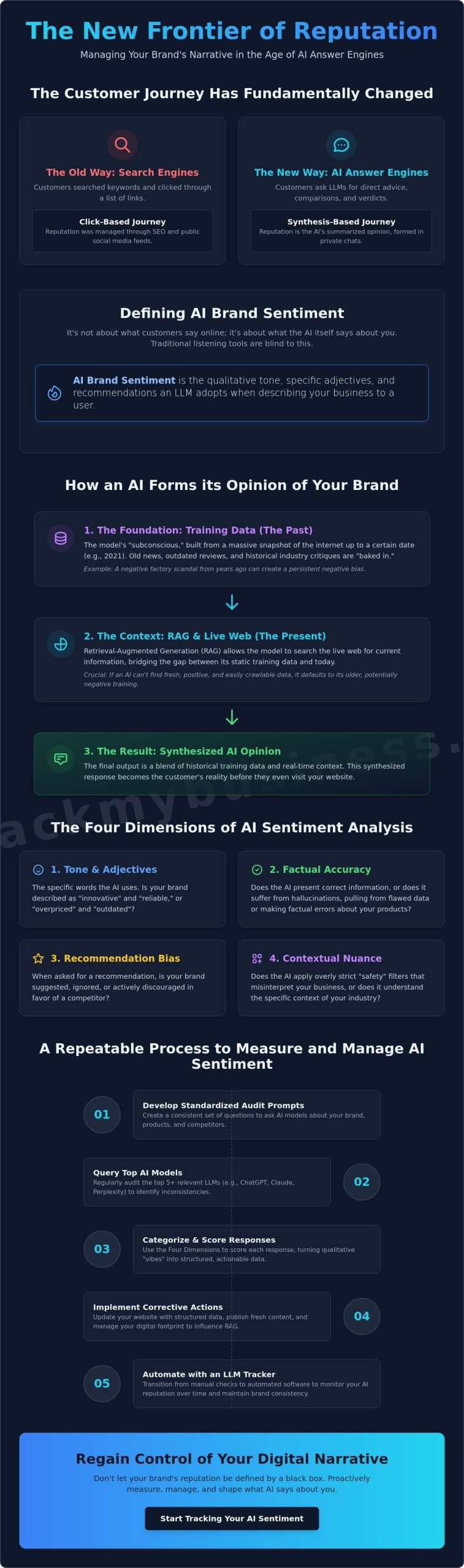
I have observed a fundamental shift in how consumers interact with information. For decades, brand reputation was managed through search engine results and social media feeds. Today, the landscape has changed. AI brand sentiment is the qualitative tone an LLM adopts when describing your business to a user. It is no longer about which link appears first on a page. It is about the specific words, adjectives, and recommendations an AI generates when a customer asks for advice. I believe that using ai to measure brand sentiment is now a survival skill for marketing teams because LLMs have become the primary “Answer Engines” for the modern web.
The year 2026 marks a definitive tipping point. With the sentiment analysis market projected to reach up to $6.44 billion this year, businesses are moving beyond simple data collection. We are seeing a transition from a “click-based” journey to a “synthesis-based” journey. When a user asks an AI to compare two products, they aren’t looking for a list of websites. They want a verdict. If an LLM characterizes your brand as “unreliable” or “overpriced” based on outdated training data, that becomes the customer’s reality before they ever visit your site.
AI Analysis vs. AI Sentiment
I find that many professionals confuse these two concepts. Traditionally, companies used sentiment analysis as a tool to read through thousands of customer reviews or tweets to find patterns. That was the “old way” of measuring sentiment. The new frontier is measuring what the AI says itself. Traditional social listening tools are currently blind to LLM mentions because these conversations happen in private, generative sessions. I recognize this as a major visibility gap. To solve this, the process of using ai to measure brand sentiment involves probing the models directly to see what they “know” about you.
The Impact on the Customer Journey
The path to purchase is no longer linear. “Which brand should I buy?” prompts are rapidly replacing specific keyword searches. This creates a significant risk if your brand suffers from negative bias in training data or if an LLM is pulling from hallucinated sources. I’ve seen industries like finance and healthcare struggle with this as models apply stricter “safety” filters that can inadvertently flag legitimate businesses. I define AI Brand Sentiment as the ‘reputation of your brand within an AI’s latent space’. Managing this requires specialized LLM tracker software to ensure your brand’s personality remains consistent across every major model.
How LLMs Form Opinions About Your Business
I have found that understanding how an LLM “thinks” is the first step in managing your reputation. These models are not simple databases; they are complex neural networks that have been fed massive amounts of historical data. This training data acts as the model’s subconscious. If your brand was associated with poor quality or customer service issues in 2021, that sentiment is often baked into the model’s foundation. I often tell clients that unlearning this negative bias is much harder than building a new reputation from scratch. Using ai to measure brand sentiment helps you identify these deep-seated perceptions before they derail a customer’s decision.
The Training Data Layer
In industries like garment manufacturing, historical mentions in trade journals and high-authority publications carry immense weight. According to the 2026 AI Index Report, public trust in AI responses is highly dependent on the perceived authority of the underlying sources. If an LLM was trained on a decade of industry critiques, it might project a “personality” onto your brand that feels outdated. I have seen brands struggle because an AI still associates them with a factory scandal from years ago. This historical layer sets the baseline for every interaction a user has with the AI regarding your business.
Real-Time Context and RAG
Modern models like ChatGPT and Perplexity use Retrieval-Augmented Generation (RAG) to bridge the gap between their training and the present day. This allows them to browse the web to find your latest news and updates. I recommend ensuring your latest production management updates and sustainability reports are easily crawlable and structured for AI consumption. If the AI cannot find fresh, positive data, it defaults to its older, potentially negative training. I have observed that maintaining a clean digital footprint is now just as important as traditional SEO.
LLMs have a distinct hierarchy of trust. I have noticed they frequently prioritize third-party review sites and independent journalism over a brand’s own marketing copy. They are designed to provide what feels like an objective synthesis. However, this objectivity can fail when an AI “hallucinates” sentiment. If your brand fits a certain industry stereotype, the AI might invent negative traits even if your specific products are high-quality. This is why monitoring these mentions is vital for corrective action. By using ai to measure brand sentiment, I can see exactly where these hallucinations begin and address the source data directly to protect a brand’s integrity.
Step-by-Step: Using AI to Measure Brand Sentiment
I’ve found that manual prompting is a significant bottleneck for growing businesses. If you’re checking models one by one, you’re only seeing a snapshot in time. I prefer a systematic approach to using ai to measure brand sentiment that relies on a consistent workflow. To begin, I identify the top five LLMs most relevant to the target audience. In 2026, this typically includes ChatGPT, Claude, Gemini, Perplexity, and Llama. By running the same queries across these platforms, I can pinpoint exactly where a brand’s narrative is strongest or most vulnerable.
Crafting the Audit Prompts
I develop three specific types of prompts to gather comprehensive data. Direct prompts like “What is the reputation of [Brand]?” provide a high-level overview of the model’s training data. Comparative prompts are essential for understanding market positioning; for example, I might ask, “Should I choose [Brand] or [Competitor] for garment manufacturing?” Finally, instructional prompts like “Summarize customer complaints about [Brand] based on available data” reveal the specific negative data points the AI is retrieving. This multi-layered approach ensures I’m not just seeing a “vibe,” but a detailed map of the brand’s digital standing.
Quantifying Qualitative Data
Turning AI responses into data requires a structured scoring system. I assign numerical values to outputs: positive responses get a +1, neutral a 0, and negative a -1. I also track mention frequency alongside sentiment quality to understand how often the brand is being recommended versus just described. Research on Public Perception of AI suggests that users often treat these AI summaries as objective truths. This makes the accuracy of your tracking even more critical. Consistency across models is the primary indicator of a stable brand reputation.
I’ve observed that managing this manually is impossible at scale. This is where specialized LLM tracker software becomes necessary. These tools automate the query process and aggregate the scores into a single dashboard. By comparing the variance across providers, I can find specific reputation gaps. For instance, if ChatGPT is positive but Claude is negative, I know there’s a specific data source influencing Claude that needs addressing. This process-oriented method moves brand management from guesswork to a proactive science. By using ai to measure brand sentiment, I can stay ahead of shifts in the latent space before they impact the bottom line.
The Four Dimensions of AI Sentiment Analysis
I have developed a four-dimension framework to help businesses categorize the results they get when using ai to measure brand sentiment. It is not enough to look for a simple “good” or “bad” score. You must understand the specific role your brand plays in the AI’s generated response. I categorize these outputs into positive, negative, neutral, and mixed dimensions to provide a clearer path for reputation management. By distinguishing between these categories, I can move beyond basic monitoring and toward a proactive strategy.
- Positive Sentiment: This occurs when an AI recommends your brand as a top-tier choice. It often uses superlatives and cites your strengths as definitive market advantages.
- Negative Sentiment: I focus heavily on identifying “red flag” characterizations. This includes factual errors where the AI might claim you don’t offer a service that you actually do.
- Neutral/Informational: This is the danger of being “just another option.” If the AI lists you in a group of ten competitors without highlighting a unique benefit, your brand is effectively invisible in the decision-making process.
- Mixed/Conflicted: I see this when the AI highlights strengths but warns of specific weaknesses, such as “high quality but long lead times.”
Identifying Red Flags in AI Responses
In the apparel and decoration industry, I frequently see negative tropes regarding sustainability or supply chain ethics. I have also found instances where an LLM confuses a brand with a competitor due to similar naming conventions. These hallucinations are dangerous because they feel authoritative to the user. I identify these specific errors by running comparative prompts and then work to update the brand’s digital footprint with structured data that the AI can easily verify. Correcting the record requires a steady stream of high-authority mentions to override the model’s older training data.
Moving from Neutral to Recommended
Shifting from a neutral mention to a recommendation requires Answer Engine Optimization (AEO). I believe that providing more transparent operational data is the most direct way to improve AI trust. When you provide clear information about your production management and shipping policies, LLMs are more likely to cite you as a reliable partner. Using TrackMyBusiness helps you ensure your internal data and latest updates are visible to RAG-enabled models. This process helps move your brand from being a generic entry in a list to a recommended solution. I recommend that you audit your current AI mentions to see which dimension your brand currently occupies in the latent space.
Proactive Reputation Management with ChatGPT Mention Tracking
I have shown how LLMs form opinions and how to audit them. Now, I want to address the limitations of manual work. Manual prompting is too slow for a 2026 market where the sentiment analytics industry has reached a valuation of up to $6.44 billion. I recognize that a single person cannot keep up with the millions of tokens processed by these models daily. Relying on occasional checks leaves your brand vulnerable to hallucinations that can spread through AI search results. I believe that using ai to measure brand sentiment requires a transition from reactive searching to proactive, automated monitoring.
I am introducing a more direct approach through ChatGPT mention tracking. This methodology allows for real-time monitoring of how generative models represent your business to users. I’ve observed that sentiment shifts often occur within an LLM’s latent space before they ever manifest as a viral complaint on social media. By detecting these shifts early, you can adjust your structured data and public-facing content before the negative sentiment becomes a permanent part of the next model training cycle. My process focuses on catching these nuances at the source.
The Power of Automated LLM Tracking
I monitor multiple models simultaneously to catch inconsistencies. I set up specific alerts for “Negative Sentiment Spikes” in AI responses so I can react immediately to factual errors. This is especially important given the fragmented regulatory environment of 2026, where data governance is a board-level concern. Historical tracking is also vital. I use it to see how brand perception evolves across different model versions. This long-term view is essential for measuring the success of reputation management campaigns and ensuring your LLM tracker software provides a consistent narrative across ChatGPT, Claude, and Gemini.
Closing the Loop: From Sentiment to Strategy
I believe the ultimate goal of using ai to measure brand sentiment is to inform your actual business operations. If an AI consistently characterizes your brand as having “unreliable support,” I use that data to improve internal customer service workflows. Integrating this sentiment data with your “Tracker” software provides a 360-degree view of your business health. When your internal workflow management is transparent and efficient, the data that AI models crawl becomes more positive. I invite you to explore our ChatGPT mention tracking solutions at TrackMyBusiness to start managing your brand’s future in the generative era.
Take Control of Your Brand Narrative in the Generative Era
I have detailed how LLMs synthesize data to form brand opinions and provided a structured 4D framework for analyzing those responses. Moving from manual audits to automated monitoring is the only way to maintain a consistent reputation as AI search becomes the standard. By using ai to measure brand sentiment, I can help you bridge the gap between what your brand is and what the models say it is. I recognize that the transition to Answer Engine Optimization requires a clear, process-oriented methodology to be effective. My approach focuses on using specialized ChatGPT mention tracking and comprehensive LLM tracker software to provide a transparent view of your digital standing. I believe that integrating these insights into your broader business management strategy is the next logical step for any growth-focused company. Start tracking your brand mentions in ChatGPT today with TrackMyBusiness. I am confident that with the right data, you can turn every AI interaction into a competitive advantage.
Frequently Asked Questions
What is the difference between traditional sentiment analysis and AI brand sentiment?
Traditional sentiment analysis uses AI tools to read and categorize what humans say in reviews or on social media. I define AI brand sentiment as measuring the actual output generated by the AI itself. It is a shift from observing the audience to observing the narrator. This process requires probing a neural network’s latent space rather than just scanning a database of public comments.
Can I really influence what ChatGPT says about my business?
You can influence AI responses by providing clear, structured data for models to crawl and synthesize. I recommend focusing on high-authority industry journals and verified third-party reviews to build a better baseline. Since LLMs prioritize these authoritative sources during their retrieval process, updating your public digital footprint helps shift the tone of their responses over time.
How often should I audit my brand’s sentiment across different LLMs?
I suggest a monthly audit for established businesses to maintain a baseline of their reputation. However, if you are in a fast-moving industry or undergoing a PR crisis, weekly checks are much more effective. Using ai to measure brand sentiment consistently allows you to spot negative shifts before they become a permanent part of a model’s next training cycle.
What should I do if an AI model is hallucinating negative facts about my brand?
Factual hallucinations are best countered with a proactive data strategy. I first identify the specific error and then update the brand’s official documentation and structured schema on its website. By ensuring that RAG-enabled models find the correct data across multiple high-authority domains, you can force the AI to update its synthesis and correct the record.
Is there a free tool for measuring AI brand sentiment?
There is no single free dashboard that handles this at scale across all models. You can manually prompt individual models like ChatGPT or Claude for free, but this is a time-consuming and inconsistent process. For a reliable workflow, I recommend professional LLM tracker software that automates the collection and scoring of these mentions across every major provider.
How does LLM tracker software work without access to private user chats?
Professional tools don’t need access to private user conversations to be effective. They use API-driven probing to ask the models thousands of standardized questions in a controlled environment. This process maps out the model’s latent space to see how it describes your brand. I use this method to get a representative sample of what any user would see in their own sessions.
Why does Claude give a different answer about my brand than ChatGPT?
Each model is built on a unique training dataset and uses different retrieval methods. ChatGPT might prioritize certain news sources while Claude emphasizes specific safety and ethical guidelines. I’ve found that these variations often reveal reputation gaps that only exist within one model’s specific data ecosystem, which helps me pinpoint exactly where a brand’s narrative is failing.
Does Answer Engine Optimization (AEO) actually help with brand sentiment?
Answer Engine Optimization is a critical part of a modern reputation strategy. It focuses on making your content scannable for AI synthesis rather than just human eyes. By providing direct, clear answers to common industry questions, you increase the likelihood that an AI will cite your brand as an authoritative source. Using ai to measure brand sentiment helps you verify if your AEO efforts are actually working.
