
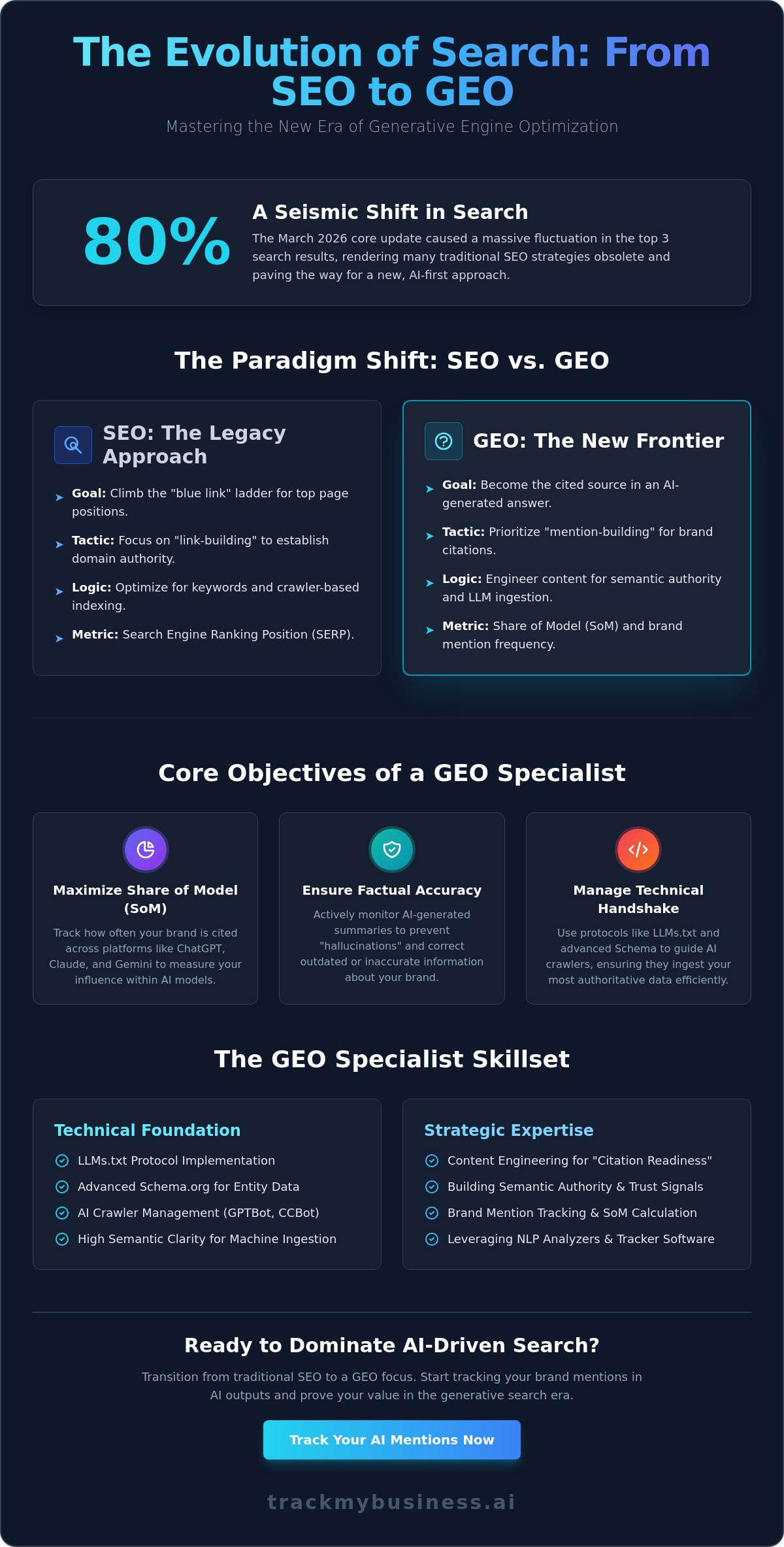
The March 2026 core update caused nearly 80% of top-three search results to shift, leaving many traditional SEO strategies in the rearview mirror. I recognize that it’s frustrating to watch your rankings fluctuate while trying to figure out exactly how LLMs decide which brands to cite in AI Overviews. You aren’t alone in feeling the pressure to measure the ROI of AI mentions when the old playbooks no longer apply. To stay competitive in a market where salaries for these roles now reach up to $190,000, you need a specific set of skills for a generative engine optimization specialist that goes beyond simple keyword placement.
I’ve put together this guide to help you master the technical and strategic protocols required to dominate AI-driven search results. You’ll learn how to transform your content from merely “publishable” to “citable” and how to leverage new tools like the Google Search Console AI performance reports released on June 3, 2026. This article provides a clear roadmap for understanding agentic search, implementing technical protocols like LLMs.txt, and proving your value to clients through advanced ChatGPT mention tracking. By the end, you’ll have the technical foundation needed to navigate the latest regulatory shifts and secure your place at the forefront of the generative search era.
Key Takeaways
- Learn how to pivot from traditional search ranking to a citation-first strategy that targets LLM responses directly.
- Master new technical protocols like LLMs.txt and advanced Schema.org to ensure your entity data is indexed correctly by AI agents.
- I’ll outline the essential skills for a generative engine optimization specialist, including how to engineer content for “Citation Readiness” and semantic authority.
- Discover how to measure success by tracking brand mentions within LLM outputs and calculating your Share of Model across different platforms.
- Explore the 2026 tech stack to understand how tracker software and NLP analyzers help you transition from a traditional SEO role to a GEO focus.
What is a Generative Engine Optimization (GEO) Specialist?
I define a GEO specialist as a professional who optimizes digital assets specifically to be cited by Large Language Models (LLMs). While traditional SEO focuses on climbing the “blue link” ladder, GEO is about becoming the primary source for an AI’s generated answer. To understand the foundation of this field, it helps to look at What is Generative Engine Optimization? as a starting point. In 2026, the primary metric isn’t just a position on a page. It’s whether an engine like ChatGPT or Claude explicitly mentions your brand when a user asks a question.
The core difference lies in the underlying logic. Traditional search engines use crawlers to index keywords and evaluate backlink profiles. Generative engines use transformer architectures to predict the most helpful and authoritative response. This shift means that “mention-building” has replaced “link-building” as the gold standard for visibility. I see the GEO specialist as a translator. They ensure that a brand’s data is structured so clearly that it becomes the “preferred source” for an AI training set or a real-time retrieval-augmented generation (RAG) process.
The Evolution from SEO to GEO
User behavior has changed. People don’t want a list of sites; they want a direct answer. This has moved the goalposts from simple keyword matching to semantic entity recognition. I’ve observed that technical SEO is no longer the final goal. It’s now the baseline infrastructure. To succeed, you must develop the specific skills for a generative engine optimization specialist that allow you to manage how LLMs interpret your brand’s unique value proposition. We’ve moved from “finding a site” to “getting an answer,” and your content must be ready to provide that answer.
Core Objectives of the GEO Role
The day-to-day focus for a specialist revolves around three specific pillars. First, you must maximize your “Share of Model” (SoM). This involves tracking how often your brand is cited across platforms like ChatGPT, Claude, and Gemini. Second, you are responsible for ensuring factual accuracy. You’ll need to monitor AI-generated brand summaries to prevent “hallucinations” or outdated information about your services. Finally, you manage the technical “handshake” between your website and AI crawlers. This includes using protocols like LLMs.txt to guide bots toward your most relevant data. Mastering these skills for a generative engine optimization specialist ensures that your brand isn’t just indexed, but actively recommended by AI.
Technical GEO Skills: The New Infrastructure
I’ve found that technical GEO is where most traditional SEOs hit a wall. It isn’t just about making a site fast; it’s about making it legible to a non-human agent. While Core Web Vitals remain a factor for user experience, the priority for a specialist in 2026 is ensuring that AI crawlers can ingest and process your data with zero friction. Acquiring the technical skills for a generative engine optimization specialist requires moving beyond the basics of site speed and into the mechanics of machine ingestion. Google’s May 2026 core update, which finished on June 2, 2026, highlighted this shift by rewarding sites with high semantic clarity and structured relationships.
I recommend studying the technical skills for GEO to understand how to bridge the gap between human content and machine-readable data. The goal is to create an environment where an AI search agent doesn’t have to guess your brand’s intent. This means your technical stack must prioritize crawlability for bots like GPTBot and CCBot while maintaining the authority signals that Google’s June 3, 2026, AI performance reports now track. Monitoring these technical changes is more effective when you use LLM tracker software to see which specific data points are being pulled into generative responses.
Managing AI Crawler Permissions
I manage bot traffic by using a combination of robots.txt and the newer LLMs.txt protocol. While robots.txt is excellent for blocking, LLMs.txt is designed to guide. You can use it to point AI agents toward your most authoritative training data or provide a summary of your site’s purpose. I suggest configuring your robots.txt to give high-priority access to GPTBot and CCBot for your core research pages while restricting them from low-value utility pages. An LLMs.txt file acts as a machine-readable directory that provides explicit instructions and context to generative AI agents regarding your site’s most authoritative content. This ensures that when an LLM scrapes your site, it prioritizes the facts you want it to learn.
Advanced Structured Data and Entities
Basic JSON-LD is no longer enough to secure a citation. I’ve moved toward complex entity relationship mapping to define how a brand connects to broader industry concepts. This involves using Knowledge Graph identifiers from sources like Wikidata or DBpedia to anchor your brand identity. By explicitly linking your “Organization” schema to recognized entities, you help LLMs build a more accurate internal model of who you are. Consistency is vital here. I ensure that every digital touchpoint, from social profiles to press releases, uses the same machine-readable identifiers. This prevents the model from fragmenting your brand into separate, unrelated entities during the training process.
Content Engineering and Semantic Authority
I’ve seen that a solid technical foundation is only half the battle. Once you’ve ensured that bots can crawl your site, the content itself must be “Citation Ready.” I use the CR Framework to engineer content that is highly extractable for Large Language Models. This involves moving away from traditional narrative fluff and focusing on factual density. AI models are trained to prioritize high-value tokens, which means that every sentence must serve a specific purpose. If a paragraph contains 100 words but only one verifiable fact, it’s inefficient for an LLM to process. Developing this level of precision is one of the most critical skills for a generative engine optimization specialist in 2026.
I focus on building topical authority through deep-dive semantic clusters. Instead of targeting a single keyword, I map out an entire entity and its relationships to other concepts. This approach aligns with how Google’s May 2026 core update rewards sites that demonstrate clear expertise. By creating a network of related, high-density pages, you signal to the AI that your brand is the definitive source for that specific topic. I’ve found that using tracker software to monitor which parts of these clusters are being cited helps me refine the content in real-time.
Writing for LLM Citations
I prioritize clear, declarative statements. Instead of saying, “We believe our software might help you track mentions,” I write, “Our tracker software identifies brand mentions across ChatGPT, Claude, and Gemini.” This directness makes it easier for an AI to extract a “fact” and attribute it to your brand. I also rely heavily on tables and lists. These structured formats are gold for LLMs because they provide high-density data in a machine-readable layout. I use N-gram analysis to study the linguistic patterns common in AI responses. By mirroring these patterns, I can increase the likelihood that the model will select my content as its primary source.
Building Semantic Trust
Trust is the primary currency in the generative era. E-E-A-T (Experience, Expertise, Authoritativeness, and Trustworthiness) is no longer just a guideline; it’s a visibility signal for AI Overviews. I work to secure brand mentions within the high-authority datasets that are used for fine-tuning models. This ensures the brand is part of the model’s “internal knowledge” rather than just something it finds during a live search. A GEO specialist verifies the factual density of a page by calculating the ratio of unique, verifiable data points to the total word count to ensure the content provides maximum information value to the crawler. This rigorous approach prevents your content from being dismissed as commodity “aggregator” material.
Measurement and Analytics: Tracking AI Mentions
I’ve observed that the metrics of success have fundamentally changed. In the past, we obsessed over blue link positions, but today, visibility is measured by your presence within a model’s generated response. This shift from rank tracking to mention tracking is one of the most vital skills for a generative engine optimization specialist. You must be able to calculate your “Share of Model” (SoM) across different platforms to understand your true market presence. While Google Search Console introduced AI performance reports on June 3, 2026, these tools primarily focus on Google’s own ecosystem. To track performance in closed environments, I recommend using specialized ChatGPT mention tracking to see how your brand is being presented to users.
I believe that attribution modeling is the next great challenge for our industry. When a user asks an AI for a recommendation and then visits your site directly, traditional analytics often mislabels that traffic. I solve this by correlating mention spikes with direct and branded search volume. It’s a more complex process than checking a keyword rank, but it’s the only way to prove the ROI of your GEO strategy. By mastering these measurement techniques, you can provide clients with a clear picture of how AI citations drive their bottom line.
Setting Up an LLM Tracking Workflow
I implement a rigorous workflow to ensure no citation goes unnoticed. First, I identify the core brand queries and industry-specific prompts that are most likely to trigger a generative answer. Second, I use tracker software to monitor brand citations in these AI responses across multiple models. Third, I analyze the sentiment and accuracy of the descriptions. If an LLM is misrepresenting your product features, you need to know immediately so you can adjust your content engineering. Finally, I correlate these mentions with direct traffic to build a reliable attribution model. This systematic approach ensures you aren’t just guessing about your AI visibility.
KPIs for the GEO Specialist
I focus on three specific KPIs to measure my impact. First is “Citations per 100 prompts,” which serves as the new benchmark for brand visibility. If your brand appears in 40 out of 100 relevant industry queries, your SoM is 40%. Second is the “Accuracy Rate.” I check if the AI is hallucinating or providing outdated information about your offerings. Finally, I track “Source Diversity.” This shows me which specific pages the LLMs are citing most frequently, helping me understand which content structures are most effective. Mastering these analytics is what separates a modern specialist from someone still stuck in a traditional SEO mindset.
How to Become a GEO Specialist in 2026
I believe the transition from a traditional SEO background to a GEO focus is a natural progression for those who prioritize data over guesswork. You don’t need to discard your existing knowledge. Instead, you should leverage your understanding of crawlability and authority to meet the needs of agentic search. Building the necessary skills for a generative engine optimization specialist starts with mastering a new tech stack. In 2026, this includes advanced schema builders for entity mapping, NLP analyzers to check for factual density, and specialized tracker software to monitor citations. I’ve found that those who adapt early are the ones securing the $130,000 to $190,000 salaries currently seen in the market.
I’ve observed that the best way to prove your value is by building a “GEO Portfolio.” Clients and employers want to see documented instances where your optimizations directly led to a brand being cited in an AI Overview or a ChatGPT response. You can achieve this by running controlled experiments on specific semantic clusters and recording the results. This evidence is more persuasive than any certification because it shows you can navigate the “black box” of LLM logic. It’s a proactive way to demonstrate that you can move the needle in a rapidly shifting field.
Recommended Learning Path
I suggest a three-pronged approach to your education. First, gain foundational knowledge in LLM architecture. You don’t need to be a data scientist, but you must understand how transformer models predict the next token and how retrieval-augmented generation (RAG) works. Second, pursue advanced technical SEO certifications that focus heavily on structured data and entity relationships. Finally, get hands-on experience using ChatGPT mention tracking to audit brand presence. This practical application allows you to see exactly how your technical and content changes influence real-world AI outputs. I’ve found that this direct feedback loop is the fastest way to refine your strategy.
The Future of the GEO Profession
I don’t believe GEO will entirely replace SEO. We are entering a hybrid reality where both will coexist. While traditional search still drives volume, generative responses drive high-intent conversions. This is particularly true in sectors dealing with physical products, where there is an increasing demand for “AI-Ready” data management. Businesses need specialists who can ensure their product specifications are machine-readable and consistently cited across different models. The most successful specialists in this field will be those who master the art of measurement. If you can’t prove the citation happened, you can’t prove the value of your work. Developing the skills for a generative engine optimization specialist is ultimately about becoming a master of attribution in an AI-first world.
Secure Your Place in the Generative Search Era
I’ve outlined how the transition from traditional search to generative engine optimization requires a fundamental shift in both mindset and methodology. You now understand that technical protocols like LLMs.txt and advanced entity mapping form the backbone of this new infrastructure. By focusing on factual density and citation readiness, you can ensure your brand remains a preferred source for AI agents. Mastering these specific skills for a generative engine optimization specialist allows you to move beyond basic keywords and into the strategic management of brand citations.
I believe that the most successful professionals will be those who prioritize transparent measurement and attribution. You don’t have to guess whether your optimizations are working. I recommend using a specialized tool to audit your current visibility and track your progress across different models. You can start tracking your brand mentions in ChatGPT with TrackMyBusiness to gain immediate insights into your Share of Model. My process-oriented methodology for ChatGPT mention tracking provides the clarity you need to prove your value to stakeholders. The search landscape is changing fast, but with the right technical foundation and tracker software, you’re well-positioned to lead the way.
Frequently Asked Questions
What is the difference between SEO and GEO?
I view SEO as the practice of ranking blue links in traditional search results, whereas GEO focuses on becoming the primary source cited in generative AI responses. SEO uses link equity and keyword placement to drive traffic. GEO prioritizes semantic relevance and factual density to ensure an LLM selects your content for its generated answers. It’s a shift from “ranking” to “being cited.”
Do I need to know how to code to be a GEO specialist?
You don’t need to be a full-stack software engineer, but you must be comfortable with machine-readable data structures. I’ve found that understanding JSON-LD and the syntax for LLMs.txt is essential for success. These technical foundations are among the most important skills for a generative engine optimization specialist because they facilitate a clean handshake between your site and AI crawlers.
How do I track if ChatGPT is mentioning my business?
I recommend using specialized tracker software to monitor brand citations within generative outputs. Traditional rank trackers can’t see inside the closed environments of models like ChatGPT or Claude. By using ChatGPT mention tracking, you can measure your Share of Model and see exactly how the AI describes your services to users in real-time.
What is the most important technical file for GEO?
The LLMs.txt file is the most critical technical asset for a specialist in 2026. It acts as a machine-readable directory that provides explicit instructions to AI bots about which content is most authoritative. While robots.txt is still used for blocking, LLMs.txt is the primary tool I use to guide generative engines toward high-value training data.
Can traditional SEO tools track generative search performance?
Traditional SEO tools are designed to track positions on a search engine results page and cannot analyze the text inside a generative response. To measure success today, you need LLM tracker software that can ingest model outputs and identify brand mentions. I’ve observed that relying on old tools leads to a significant gap in your performance data.
Why is schema more important for GEO than for regular search?
Schema is vital because it defines the relationships between different entities in a way that AI models can easily ingest. It helps an engine understand that your brand is an authority in a specific niche. I use advanced entity mapping to ensure that my brand identity remains consistent across the entire knowledge graph, which is one of the core skills for a generative engine optimization specialist.
How much does a GEO specialist earn in 2026?
Market data published on June 8, 2026, indicates that a GEO specialist can expect a baseline salary between $130,000 and $190,000. These figures reflect the high demand for experts who can navigate the complexities of AI-driven search. I’ve seen that professionals with a proven track record of influencing LLM citations often command the highest compensation in the current market.
Is GEO only for big brands, or can small businesses benefit?
Small businesses can benefit significantly by dominating niche semantic clusters where competition is lower. You don’t need a massive budget to become the “preferred source” for a specific, localized, or highly specialized query. I’ve found that small brands often move faster to implement new protocols like LLMs.txt, giving them a temporary edge over slower enterprise competitors.
