
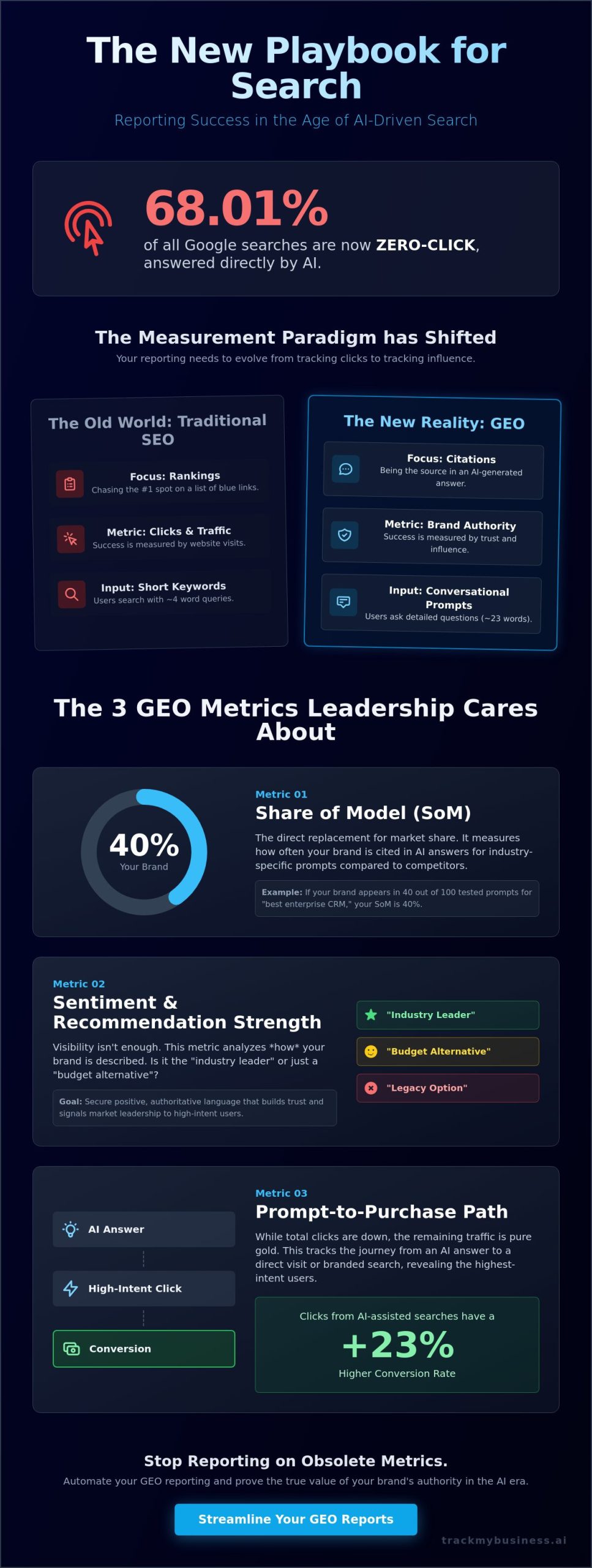
In early 2026, research shows that 68.01% of all Google searches ended without a single click to a non-Google website. I understand the pressure you feel when traditional organic traffic numbers dip, even as your brand’s presence in AI Overviews expands. When you’re presenting geo results to leadership, you can’t rely on the old top 10 rankings to prove your value. Executives want to know if the brand’s being cited as a trusted authority, not just how many clicks the blog received.
I’ve developed a process to help you bridge this communication gap. You’ll learn how to translate technical LLM visibility data into high-impact executive reports that clearly demonstrate your share of model. I’ll walk you through a reporting framework that focuses on brand authority and provides a clear roadmap for your future GEO investments. By the end of this guide, you’ll have the tools to show leadership exactly how your optimization efforts are capturing the highest-intent users in an AI-driven market.
Key Takeaways
- Learn why traditional organic rankings are no longer a reliable indicator of success and how to pivot toward tracking AI citations.
- Discover how to calculate Share of Model to show leadership exactly how often your brand appears compared to competitors in LLM answers.
- Gain a clear framework for presenting geo results to leadership that reframes zero-click searches as high-intent brand impressions.
- Understand the methodology for testing industry prompts across major LLMs to build a consistent and trustworthy reporting baseline.
- Explore how LLM tracker software can automate your data collection process and provide a single source of truth for your GEO performance.
The Shift in Search Reporting: Why Traditional SEO Metrics Fail in 2026
I have observed that leadership often views declining organic traffic as a failure unless the new GEO context is provided early. This is a common hurdle I encounter when reviewing quarterly performance. In 2026, the data confirms that 68.01% of all Google searches end without a single click to an external website. This is not a sign of poor content; it is a reflection of how AI Overviews now satisfy user intent directly on the search results page. When you are presenting geo results to leadership, you must explain that the traditional “click” is no longer the only metric of success.
The user journey has migrated into an invisible funnel. Instead of browsing multiple websites, users now make complex decisions within the AI interface itself. LLMs like ChatGPT and Claude aggregate information from various sources to provide a single, authoritative answer. If your brand is the source of that information, you’ve won the impression, even if you didn’t get the visit. Shifting the narrative from “Rankings” to “Citations” is the first step in proving the value of your work in this new environment.
The Death of the Keyword-to-Click Pipeline
Traditional search was built on short, four-word queries that led to a predictable list of blue links. Today, conversational AI queries average 23 words in length, reflecting a much deeper level of user intent. Being in “Position 1” on a Google search page is now less valuable than being the primary source cited in a Perplexity or ChatGPT response. The attribution gap in 2026 is the space between AI discovery and final conversion. This gap makes it difficult to track the exact moment a user decides to buy, but it doesn’t diminish the influence of the AI’s recommendation.
From Traffic Volume to Brand Authority
In this new era, a mention in a trusted LLM response is the modern equivalent of a high-authority backlink. AI engines decide what to cite based on the consistency and credibility of the data they find. This process mirrors the foundational principles of local search, where proximity and reputation dictate visibility. However, the stakes are higher now because of the risk of AI hallucinations. If the models are citing incorrect data about your brand, it can damage your reputation instantly. I recommend that when presenting geo results to leadership, you emphasize the importance of monitoring brand accuracy across these models to ensure your authority remains intact.
Defining Success: 4 GEO Metrics Your Leadership Actually Cares About
I’ve found that the biggest mistake marketers make is showing leadership raw data without a narrative. When you are presenting geo results to leadership, you need to speak the language of market share and brand authority. Since 68% of searches don’t result in a click, we have to measure what happens inside the AI’s response. I focus on four specific metrics that translate technical visibility into business value. These KPIs provide a clear picture of how your brand performs when the “blue links” disappear.
Metric 1: Share of Model (SoM)
Share of Model is the most direct replacement for traditional organic market share. To calculate this, I aggregate a set of industry-specific prompts and measure how often the brand is mentioned across major LLMs like ChatGPT, Gemini, and Claude. If your brand appears in 40 out of 100 prompts for “best enterprise CRM,” your SoM is 40%. This metric is vital because it proves your category dominance within the AI’s training data. It shows leadership that even without a click, your brand is the primary option being considered by the model.
Metric 2: Sentiment and Recommendation Strength
Visibility alone isn’t enough. I’ve seen brands mentioned in AI responses only as a “budget alternative” or a “legacy option.” We must move beyond “is it there?” to “is it good?” Analyzing the adjectives an AI uses provides a leading indicator of future market share. If the model consistently labels your brand as the “expert” or “industry leader,” that builds a level of trust that traditional display ads cannot match. I recommend utilizing LLM tracker software to monitor these sentiment shifts in real time.
Metric 3: Prompt-to-Purchase Path
While total clicks may be down, the quality of the remaining traffic is higher. Research from 2026 shows that clicks originating from searches with AI Overviews convert 23% better than standard organic clicks. This indicates high user intent. I track how users move from an AI “answer” to a branded search or a direct visit to the site. This path proves that the AI isn’t just answering a question; it’s driving a commercial action that eventually leads to the checkout page.
Metric 4: Competitive Displacement
Finally, I look at competitive displacement. This measures how often your brand replaces a competitor in a “Top 5” recommendation list. In the winner-take-all environment of AI responses, being the third recommendation instead of the sixth is the difference between being invisible and being a market leader. This metric allows you to show leadership exactly which competitors you are outmaneuvering in the generative space. It turns a technical SEO report into a strategic competitive briefing.
How to Compile and Visualize Your GEO Performance: A Step-by-Step Guide
Moving from abstract metrics to a concrete report requires a repeatable methodology. I use a five-step process to ensure that when I am presenting geo results to leadership, the data is both defensible and easy to understand. This framework bridges the gap between technical AI citations and the business-level outcomes that stakeholders demand. It transforms raw data into a strategic narrative that proves your optimization efforts are moving the needle.
- Step 1: Prompt Aggregation. I begin by selecting the “Top 50” industry prompts that reflect our core business. I test these across three or four major LLMs, such as ChatGPT and Gemini, to establish a baseline of visibility.
- Step 2: Continuous Tracking. Mentions in AI models are dynamic. I use Tracker software to monitor these citations over time, ensuring we capture shifts as models update their training data or real-time search capabilities.
- Step 3: Sentiment Categorization. I tag every mention as “Brand Positive,” “Neutral,” or “Competitor Favored.” This adds a layer of qualitative analysis that raw numbers often miss.
- Step 4: Competitor Gap Analysis. I create a “Competitor Gap Chart.” This visual highlights specific prompts where our competitors are cited but we are absent, creating a clear “to-do” list for our content team.
- Step 5: Dashboard Synthesis. Finally, I compile these findings into a “Share of Voice” dashboard. This becomes the centerpiece of the monthly leadership deck.
Visualizing the Data for the C-Suite
I’ve found that “Citation Maps” are incredibly effective for executive presentations. These maps show how an AI connects your brand to key industry topics, visually representing your authority within the model’s knowledge base. I also include side-by-side screenshots of AI answers. For a non-technical stakeholder, seeing your brand listed as the top recommendation in a ChatGPT window is far more persuasive than a spreadsheet of numbers. I always prioritize trend lines over single snapshots. A snapshot tells them where we are, but a trend line proves that our GEO strategy is actually working over the long term.
The “Mention-to-Action” Correlation
To prove the ROI of these efforts, I overlay our GEO mention spikes with branded search volume in Google Search Console. When an AI model begins citing our brand more frequently, we typically see a corresponding rise in direct and branded traffic. This “Halo Effect” proves that AI visibility drives real-world interest. You can learn how our Tracker software integrates data for better reporting to help automate this correlation. By showing that presenting geo results to leadership isn’t just about “AI presence” but about driving the next step in the buyer journey, you secure the budget for future investment.
Addressing the “Zero-Click” Objection: Proving the Value of AI Mentions
I have found that framing GEO as a “Digital Defensive Strategy” is highly effective for risk-averse leaders. When you are presenting geo results to leadership, the first hurdle is always the decline in raw traffic. I use the “Storefront” analogy to overcome this objection. Think of an AI answer in ChatGPT as a high-end window display on a busy street. Even if the user doesn’t enter the store immediately, the display builds intent and brand recognition. In 2026, we must count these “AI Impressions” as high-intent touchpoints because they pre-validate your brand before the user ever visits your site.
The cost of absence is a powerful motivator for executives. I often show leadership exactly what happens when a competitor is the only source cited for a “Best [Product]” query. If we are missing from that conversation, we aren’t just losing a click; we are losing the entire mental model the user is building about the industry. By being present in the AI’s response, you occupy the space where decisions are made. This visibility is a critical asset that protects your market position from aggressive competitors who are already optimizing for generative engines.
The Defensive Value of GEO
Protecting brand equity is a primary goal of my GEO process. I focus on ensuring the AI doesn’t hallucinate negative or outdated facts about the business. Monitoring these models allows us to correct the narrative before it scales. There is also a significant “first-mover” advantage in this space. I’ve observed that it’s much harder to unseat a brand the AI already trusts than it is to get cited first. For example, I recently worked with a garment manufacturer that used targeted data structuring to dominate the “Sustainable Fabric” narrative across three major LLMs. By providing the most consistent data, they became the default expert for the model, making it nearly impossible for competitors to break into that specific AI summary.
Connecting Mentions to Sales Conversations
I recommend using GEO data to arm your sales teams with “what the AI is saying” about your industry. If ChatGPT is recommending your product for its “durability” or “ease of use,” that becomes a powerful piece of social proof for marketing collateral. It moves the conversation from “we say we are the best” to “the most advanced AI models recommend us as the best.” I define GEO ROI as the reduction in customer acquisition cost through pre-validated trust. When a lead arrives at your site after seeing your brand cited by an AI, they are already further down the funnel. To ensure you stay ahead of these trends, you should monitor your brand’s AI mentions with specialized tracking tools.
Automating the Narrative: Streamlining GEO Reports with TrackMyBusiness
I’ve learned that manual prompting is not a scalable reporting strategy. If you’re spending hours every week manually asking ChatGPT and Claude about your brand, you’re losing time that should be spent on strategy. When I’m presenting geo results to leadership, I need a system that updates automatically. This is where TrackMyBusiness “Tracker” software becomes essential. It provides a single source of truth for LLM visibility, allowing you to move from “I think we are mentioned” to “here is the data-backed report.”
The real power of this approach lies in modular reporting. By integrating your ChatGPT mention tracking with order management and inventory data, you can show a direct line between AI visibility and product demand. If an AI model starts citing your brand for a specific garment style, you can prepare your inventory before the trend peaks. This level of insight reduces reporting time and keeps leadership informed in real-time through automated alerts for new brand citations. It transforms your report from a static document into a proactive business intelligence tool.
The Power of Professional LLM Tracking
For businesses in the garment and decoration industry, monitoring niche mentions is critical. You need to know if the AI is recommending your specific embroidery services or sustainable fabric choices over a competitor’s. A general search tool won’t catch these nuances. You can explore our LLM tracker software for real-time visibility to see exactly how your brand is being categorized. This data ensures your reports are grounded in reality, not guesswork. I’ve found that when I show leadership the exact prompts where we are winning, it builds immediate confidence in our GEO investment.
Next Steps for Your Leadership Presentation
To help you get started, I recommend using a “GEO Executive Summary” one-pager. This template focuses on the core metrics we’ve discussed: Share of Model, sentiment, and competitive displacement. Your first step should be setting up a “Brand Mention” alert in our tracker software. This ensures you never walk into a meeting surprised by what an AI is saying about your company. You can then use these alerts to build your “Trend Line” of mentions, proving that your strategy is working month-over-month. If you’re ready to automate your reporting and prove your ROI, schedule a demo of TrackMyBusiness to start tracking your AI mentions today. By presenting geo results to leadership with this level of precision, you move the conversation from “why is traffic down?” to “how can we capture more of this AI-driven market?”
Securing Your Brand’s Future in the Generative Era
The transition from traditional SEO to GEO is a necessary evolution for any brand that wants to remain visible in 2026. I’ve shown you how to move past the anxiety of declining clicks by focusing on brand authority and Share of Model. By adopting a citation-first mindset, you turn the “zero-click” challenge into a strategic advantage. I’ve found that presenting geo results to leadership becomes a much smoother process when you have a clear framework for measuring influence instead of just traffic.
I recommend moving away from manual checks and adopting a more systematic approach to your reporting. Our specialized LLM tracking modules provide the transparent, process-oriented data you need to justify your budget. You can integrate these insights with your existing business data using our modular Tracker software to create a truly comprehensive view of your market impact. These tools ensure you’re not just reacting to changes, but actively shaping how AI models perceive your brand.
Start tracking your brand mentions in ChatGPT and beyond with TrackMyBusiness. You have the methodology and the tools to prove your value. It’s time to lead your organization into the next era of search with confidence.
Frequently Asked Questions
What is the most important metric to show leadership for GEO?
I recommend focusing on Share of Model as your primary KPI. It represents the frequency your brand appears in AI responses relative to your competitors. When you are presenting geo results to leadership, this metric provides a direct comparison of market influence. It clearly shows who the AI considers the industry leader for specific categories. This data helps executives see exactly where you stand in the eyes of the most influential AI engines today.
How do I explain “Share of Model” to a non-technical CEO?
You should describe Share of Model as “AI market share.” Tell your CEO that it measures how often the most popular AI assistants recommend your company when a customer asks for help in your category. It’s essentially digital shelf space in the world’s most used search tools. This framing shifts the conversation from technical data to competitive positioning. It makes the value of GEO optimization immediately clear to anyone focused on bottom-line growth.
Can we actually influence what ChatGPT says about our brand?
Yes, you can influence AI responses by providing structured, high-authority data that models can easily parse. LLMs prioritize sources that show consistent expertise and clear formatting across multiple reputable platforms. By optimizing your technical infrastructure and content quality, you increase the likelihood that ChatGPT or Claude will cite you as a primary source. I focus on creating a citation network of consistent information that makes it easy for the AI to trust us.
How often should I report on GEO results to leadership?
I suggest a monthly cadence for your GEO reporting. While model training doesn’t happen daily, the real-time search capabilities of LLMs mean visibility can shift quickly. Regular reporting allows you to catch brand hallucinations or competitive moves early. This consistent schedule helps in presenting geo results to leadership as a standard part of your strategic growth plan. It keeps the team agile and ready to respond to any major shifts in AI behavior.
What is a “good” citation rate in Perplexity or Gemini?
A “good” citation rate is entirely dependent on your specific industry’s competitive landscape. I focus on outperforming the top three competitors rather than hitting a generic percentage. If the market leader is cited in 30% of category prompts, your goal is to exceed that number. Success is defined by your relative dominance within the model’s recommendation engine. I find that a citation rate that grows month-over-month is the best indicator of a successful GEO strategy.
Does GEO help with traditional Google rankings as well?
GEO and traditional SEO often reinforce one another. The same signals of authority and trustworthiness that help you rank in blue links are used by AI models to select their citations. Improving your brand’s credibility for AI engines frequently leads to better visibility in standard search results. It’s a holistic approach to modern digital presence. You don’t have to choose between the two because they both rely on the same foundation of high-quality, expert content.
How do we track conversions from an AI mention if there is no click?
You can track these “invisible” conversions by monitoring branded search volume in your search console. When an AI mentions your brand, users often perform a direct search for your company name shortly after. By overlaying these branded search spikes with your AI mention data, you can prove a clear correlation between the two. This helps bridge the attribution gap. I also look for increases in direct traffic to specific product pages mentioned in the AI summaries.
What tools are available for tracking brand mentions in LLMs?
Professional LLM tracker software is the most effective way to monitor these results at scale. These tools automate the process of querying different models and categorizing the sentiment of the responses. Using dedicated tracker software ensures you have a reliable, data-backed report for your executive meetings. It removes the need for manual, anecdotal evidence. This automation allows you to spend more time on strategic improvements and less time on the tedious task of manual data collection.
