
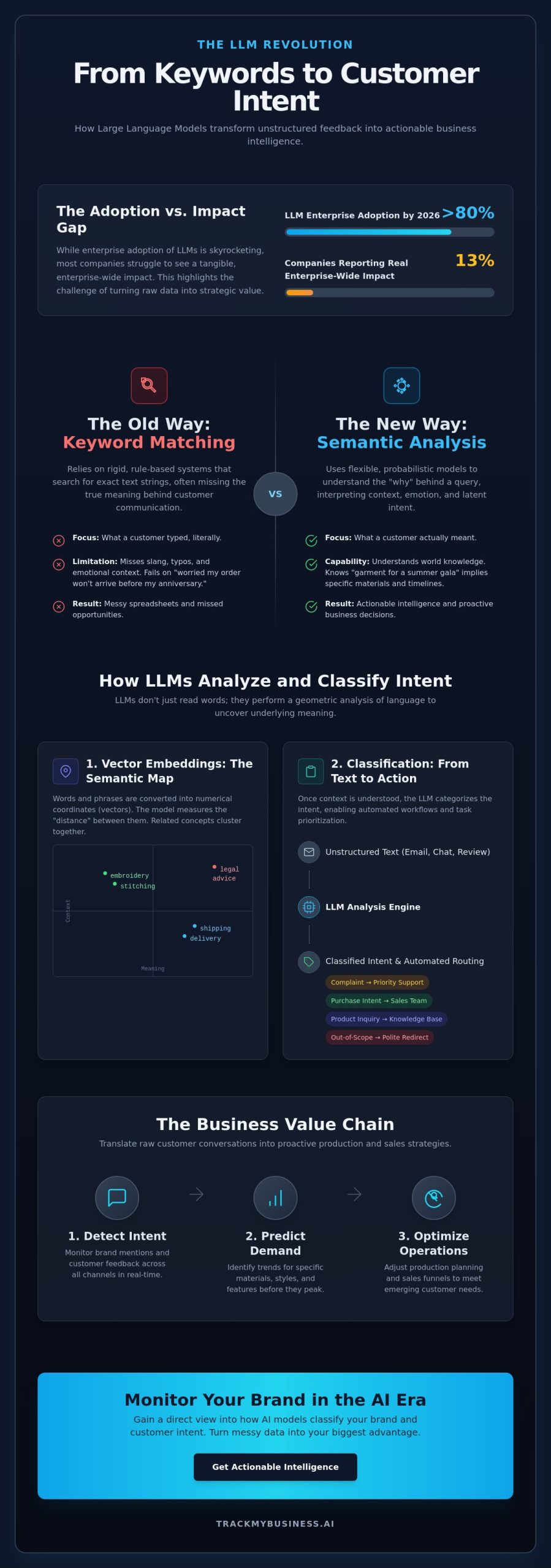
Did you know that while enterprise adoption of Large Language Models is expected to exceed 80% by 2026, only 13% of companies report seeing a real, enterprise-wide impact from the technology? I’ve observed many businesses struggle because they’re overwhelmed by unstructured feedback and feel blind to how customers discuss their brand inside tools like ChatGPT. It’s a common challenge to have mountains of data but no clear way to predict demand for specific product lines. Understanding customer intent through llms is the proactive step needed to turn this messy information into actionable intelligence.
I’ll show you how these models transform raw text into a clear framework for categorizing what your customers actually want. You’ll discover practical methods to track your brand mentions within AI models and learn how to use semantic data to improve your production planning. My goal is to provide a transparent look at the methodology behind intent analysis. By the end of this guide, you’ll have a direct process for monitoring your presence in the AI era and using those insights to drive better business decisions.
Key Takeaways
- Learn how the shift from exact keyword matching to semantic analysis allows you to capture what customers actually mean, even when they use slang or typos.
- I’ll explain how vector embeddings and classification techniques enable understanding customer intent through llms by mapping human language into mathematical coordinates.
- Discover how to bridge the gap between social intent and production by predicting demand for specific materials and styles before they trend.
- I’ll detail the methodology for using LLM tracker software to monitor brand mentions and reputation within models like ChatGPT.
- Transition from rigid, rule-based legacy systems to flexible, probabilistic frameworks that automate complex tasks like extracting intent from customer emails.
What is Customer Intent in the LLM Era?
I’ve spent a lot of time looking at how businesses process feedback. Most rely on keyword filters. If a customer types “shipping delay,” the system flags it. But what if they say, “I’m worried my order won’t arrive before my anniversary”? Traditional systems often miss the emotional urgency and the specific context. Understanding customer intent through llms allows us to move past literal strings of text. We can finally look at the “why” behind the query. This shift is rooted in the technical field of intent recognition, where models analyze patterns to predict what a user is trying to achieve.
LLMs bring a level of world knowledge that previous software lacked. They understand that a “garment for a summer gala” implies specific materials, price points, and delivery timelines. They don’t just see words; they see coordinates in a semantic space. This allows for a more nuanced interpretation of buyer psychology. I’ve found that this process-oriented approach reveals insights that were previously buried in messy spreadsheets. It’s about moving from what a customer typed to what they actually meant.
From Keywords to Semantic Meaning
Traditional search filters often fail because they can’t handle complex buyer motivations. A customer might describe a problem without using a single product keyword. LLMs use surrounding context to identify “latent intent.” For example, someone asking about the durability of a specific fabric isn’t just asking for specs. They’re likely in the consideration phase, weighing a high-ticket purchase. I see this as a way to differentiate between casual browsing and a firm intent to buy based on the depth of the inquiry.
The Business Value of Intent Detection
Automating the categorization of these intents reduces friction in your sales funnel. Instead of a human manually reading every email, an LLM can route queries based on urgency and category. If a customer’s intent is identified as a complaint regarding a late shipment, it goes to priority support. If the intent is a product inquiry, it goes to sales. Customer intent is the bridge between raw data and operational response. By identifying these patterns early, you can adjust your production planning to meet specific demand before it becomes a bottleneck. Understanding customer intent through llms ensures your team focuses on the highest-value tasks first.
How LLMs Analyze and Classify Intent
I’ll walk you through the technical process of how these models actually process language. Unlike traditional software that searches for exact word matches, Large Language Models treat words as points in a multi-dimensional space. This mathematical approach is the secret to uncovering customer intent across thousands of unstructured feedback points. By converting a sentence into a list of numbers, or a vector, the AI can measure how “close” one idea is to another. Understanding customer intent through llms is essentially a geometry problem where the model calculates the distance between a user’s question and your business goals.
I’ve found that the most effective systems use a “Chain of Thought” process. Instead of jumping to a conclusion, the model is prompted to explain its reasoning step by step. This is particularly helpful when a customer inquiry is vague or contains conflicting information. If a query falls outside your expertise, such as a customer asking for legal advice on a retail site, I recommend setting up an out-of-scope (OOS) category. This ensures the model politely redirects the user rather than hallucinating a response. If you want to see how these models categorize your own brand, using tracker software provides a direct view into the AI’s internal classification.
The Role of Vector Embeddings
Vector embeddings allow the AI to understand that “embroidery” and “stitching” are related even if they don’t share the same letters. In a high-dimensional semantic space, these terms sit near each other. This enables more accurate customer clustering. Instead of simple labels like “complainant,” you can build multi-layered intent profiles. For example, a customer might be classified as “high-intent buyer” and “material-sensitive” simultaneously based on their specific word choices.
Training vs. Prompting for Intent
You don’t always need to train a model from scratch. I often use zero-shot classification, where the AI categorizes text without seeing previous examples, for general tasks. For industry-specific needs, few-shot prompting provides the model with three to five examples of your business categories. This guides the LLM to follow your specific schema. To maintain high accuracy, I suggest a human-in-the-loop verification process. This involves a team member reviewing a small percentage of classifications to ensure the model’s logic remains aligned with your operational standards. Understanding customer intent through llms is a continuous process of refinement rather than a one-time setup.
Traditional Analytics vs. LLM-Powered Intent
I’ve observed many companies relying on legacy analytics that function like a blunt instrument. These systems are rule-based and rigid. They depend on specific strings of text. If a customer makes a typo or uses slang, the logic often fails. Understanding customer intent through llms solves this by adopting a probabilistic approach. The AI doesn’t just look for a literal match; it calculates the likelihood of a specific meaning. This allows for a level of flexibility that traditional systems can’t match.
Traditional analytics excel at telling you “what happened.” You might see a 15% increase in negative feedback across your social channels. However, you’re often left guessing about the root cause. LLM systems focus on “why it happened.” Processing thousands of unstructured reviews in seconds is a task that would otherwise require a massive human team for manual tagging. This scalability is a fundamental shift for business intelligence. It moves the needle from simple data collection to actual understanding.
Breaking the Rule-Based Barrier
Legacy systems are limited by their reliance on exact matches. Standard logic fails when dealing with sarcasm or cultural nuances. If a customer writes, “Oh, wonderful, another shipping delay,” a standard keyword filter sees the word “wonderful” and classifies it as positive. An LLM reads the context and correctly identifies the frustration. By implementing these models, I’ve seen organizations reduce their “unclassified” data bucket from 25% down to almost zero. Understanding customer intent through llms ensures that every piece of feedback is categorized correctly, regardless of how it’s phrased.
Real-Time Intent Processing
I find that monthly reports are usually too late to be useful. Waiting for a static PDF means the window for a proactive response has closed. LLMs enable real-time intent streams that allow you to see shifts in buyer psychology as they occur. Using this technology lets you address a growing concern before it turns into a PR crisis or a loss in sales. While legacy analytics provide a static snapshot of the past, LLM-driven insights offer a dynamic, living map of the current customer experience. Your team can finally be proactive rather than reactive.
Practical Applications in Manufacturing and Retail
I’ve seen how theory turns into profit when we apply these models to real-world supply chains. In manufacturing and retail, the ability to predict demand before it shows up in a sales ledger is a massive advantage. Understanding customer intent through llms allows you to identify “emerging” product mentions in social media threads or customer emails. This isn’t just about counting keywords; it’s about identifying the sentiment and urgency behind them. If customers are suddenly asking about “breathable linen” in February, your procurement team can act months before the summer rush.
Connecting this feedback directly to your production workflow reduces the guesswork that leads to overstock. I recommend using these models to scan for specific features or material preferences that aren’t yet categorized in your inventory system. By the time a trend hits the mainstream, you’ve already adjusted your orders. This proactive approach is the direct result of turning unstructured text into structured business intelligence. If you want to see how these trends are impacting your brand’s reputation in real-time, I suggest using LLM tracker software to monitor mentions across various models.
Intent-Driven Production Planning
I find that scanning customer inquiries for specific features, such as “sustainable fabrics” or “recycled hardware,” provides a clearer picture of market shifts than past sales data alone. You can align your procurement with these semantic trends before they ever reach a formal sales report. This methodology helps in reducing waste by identifying when intent for a specific product line is declining. If the semantic “noise” around a certain style drops off, I suggest scaling back production even if your current sales look steady.
Streamlining the Order-to-Dispatch Workflow
One of the most immediate benefits is extracting SKU and quantity intent from unstructured client communications. Instead of a staff member manually reading every email to find out what a client wants, the LLM identifies the specific items and amounts requested. This process significantly reduces manual data entry in your ERP systems. It’s a functional way to handle high-volume communications without increasing headcount. Understanding customer intent through llms is the most efficient way to bridge the gap between what people say and what they eventually buy.
Tracking Mentions and Intent with TrackMyBusiness
I’ve spent the previous sections discussing the mechanics of how AI understands humans. Now, I want to address the final piece of the puzzle: how you can understand what the AI is saying about you. By 2026, the way customers discover products has fundamentally changed. They aren’t just using search engines; they’re asking LLMs for curated advice. Understanding customer intent through llms is only half the battle if you don’t know how those same models are presenting your brand to potential buyers. Traditional SEO tools simply can’t look inside a private ChatGPT session to see if your product is being recommended or ignored.
I use TrackMyBusiness to solve this visibility problem. My approach focuses on ChatGPT mention tracking to provide a clear view of your brand’s reputation within these models. This goes beyond simple counting. We analyze the context of every mention to see if the AI views your brand as a solution to a specific customer problem. If the model consistently links your brand to “durable outdoor gear,” that’s a strong indicator of how the market perceives your value proposition. It’s a direct way to see the results of your brand positioning in a space that was previously a black box.
The New Frontier: Brand Visibility in AI
I find it helpful to look at how LLMs categorize your brand relative to your closest competitors. AI models use their internal semantic mapping to group brands together based on shared attributes. If you’re being grouped with discount retailers when you’re trying to position yourself as a luxury brand, you have a data problem that needs addressing. We track “intent-to-recommend” patterns to see which specific prompts trigger a mention of your business. This methodology allows me to identify exactly where your brand equity stands and how it influences the AI’s decision-making process.
Operationalizing AI Insights
The data we gather through LLM tracker software isn’t just a vanity metric. It’s a functional tool for production planning. When TrackMyBusiness identifies a surge in brand mentions or a shift in how AI models recommend your products, I can alert the production team to prepare for a spike in demand. This bridges the gap between digital sentiment and physical inventory. It’s a proactive way to manage your supply chain by closing the loop between AI data and operational response. See how TrackMyBusiness helps you track brand mentions and intent to stay ahead of these shifts and ensure your production stays aligned with market reality.
Mastering the New Language of Business Intelligence
I’ve detailed how the shift from rigid keyword filters to semantic analysis changes the way we interpret human desire. Understanding customer intent through llms isn’t just a technical upgrade; it’s a fundamental change in how we align production with reality. We’ve looked at how vector embeddings and real-time intent streams allow you to move from reactive reporting to proactive planning. By closing the gap between what customers say in AI prompts and how your factory floor responds, you create a more resilient supply chain.
I recommend taking the next step by securing real-time brand visibility within AI ecosystems. My methodology relies on specialized LLM tracker software to ensure you aren’t operating in a vacuum. This system offers seamless integration with Tracker software for production management, allowing you to turn digital sentiment into physical results. It’s time to stop guessing and start monitoring. Start tracking your brand mentions and intent with TrackMyBusiness today to lead your industry in the AI era.
Frequently Asked Questions
How does an LLM differ from a standard search engine in understanding intent?
An LLM analyzes the context and relationship between words rather than just matching literal characters. While a standard search engine looks for specific terms, understanding customer intent through llms involves calculating the probability of a specific meaning. I see this as the difference between looking for the word “blue” and understanding that a user wants a “navy aesthetic.” This allows for much higher nuance in processing complex queries.
Can LLMs identify intent in languages other than English?
Yes, most modern Large Language Models are trained on massive multilingual datasets. They can identify intent across dozens of languages by mapping concepts to a universal semantic space. I’ve found that this is useful for international retailers who need to categorize feedback from global markets without hiring a massive team of translators. The model understands the underlying intent regardless of the specific language used by the customer.
Is it possible to track how my brand is mentioned inside ChatGPT?
It’s possible to monitor these mentions using specialized LLM tracker software. Traditional SEO tools can’t access the data inside a model’s generated response, but our software allows you to see how your brand is categorized and recommended. This provides a direct look at your reputation within the AI ecosystem. I believe this visibility is essential for any brand that wants to stay relevant in the 2026 market.
How accurate is LLM intent classification for specialized industries like garment manufacturing?
Accuracy is generally very high when you use few-shot prompting or industry-specific schemas. I’ve observed that LLMs are excellent at distinguishing between technical terms like “gsm weight” and “fabric hand.” While general models are good, the precision increases when you guide the model with examples from your specific niche. Understanding customer intent through llms is often more accurate than manual human tagging because the AI doesn’t experience fatigue.
Do I need a data science team to implement LLM-based intent tracking?
You don’t need a dedicated data science team to start monitoring these insights. I recommend using established tracker software that handles the complex vector math and model hosting for you. These tools are designed for business intelligence professionals who need actionable data without writing code. My process focuses on making this technology accessible so you can focus on operational responses rather than technical infrastructure.
What is the difference between sentiment analysis and intent detection?
Sentiment analysis measures how a customer feels, while intent detection identifies what they want to do. For example, a customer might be “unhappy” in their sentiment because they want to “cancel an order” as their intent. I find that intent is much more actionable for business operations. Knowing someone is frustrated is helpful, but knowing they intend to return a product allows you to trigger a specific workflow immediately.
How does understanding intent help with inventory management?
Understanding intent allows you to see demand signals before they show up in your sales reports. If I notice a sudden surge in customers asking about a specific material or style, I can adjust procurement orders early. This proactive approach helps reduce overstock and prevents stockouts on trending items. It’s a functional way to use semantic data to keep your physical inventory aligned with real-time market desires and upcoming trends.
Can LLMs process voice-to-text data for intent analysis?
Yes, once voice data is transcribed into text, it can be processed just like any other feedback source. I’ve seen this used effectively in customer service centers to categorize calls based on the caller’s specific goals. The LLM can analyze the transcript to identify whether the caller wants to troubleshoot a problem or inquire about a new product. This allows for automated routing and more precise post-call analytics for your team.
