
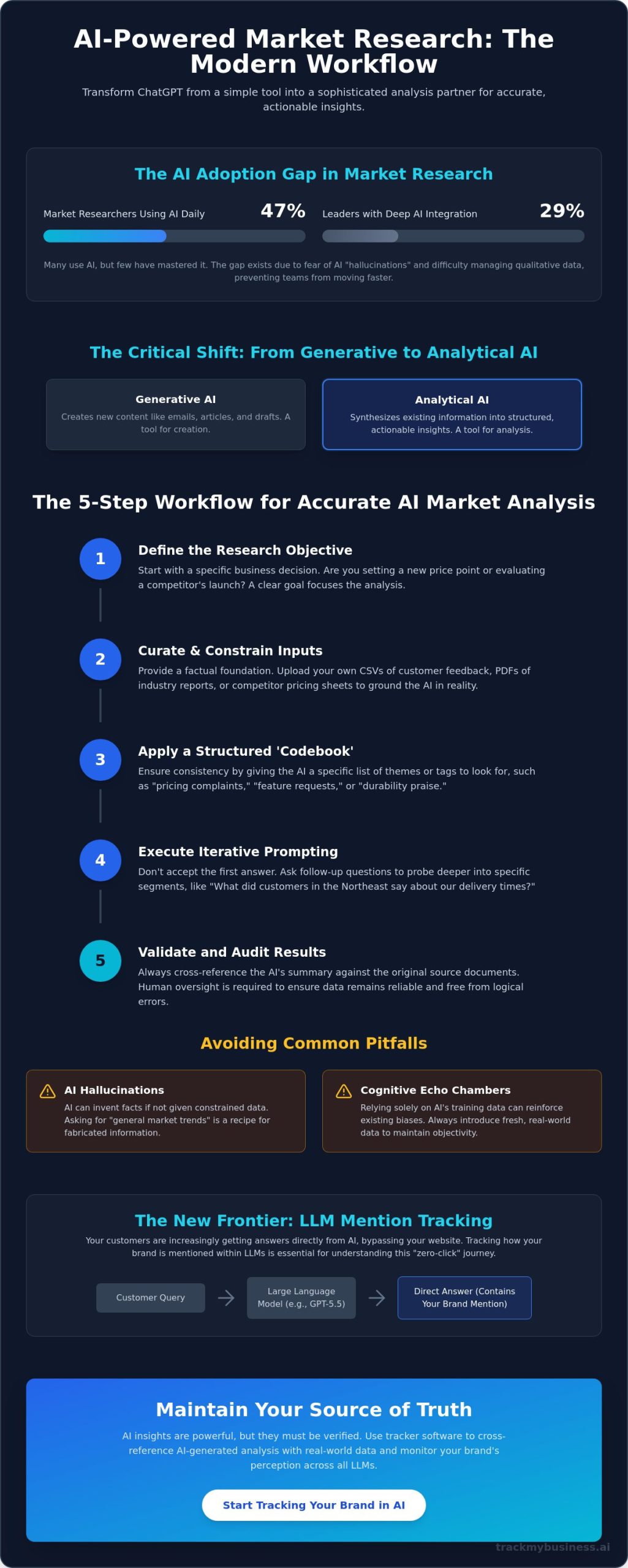
Did you know that 47% of market researchers now use AI in their daily work, yet only 29% of leaders feel they’ve deeply integrated chatgpt for market research into their core workflows? It’s a gap I see often. You want to move faster, but the fear of hallucinated facts or the sheer volume of messy qualitative data often gets in the way. It’s frustrating to feel like you’re falling behind because you can’t see how your brand is being recommended by the very models your customers use every day.
I understand these hurdles, and I’ve developed a process to help you overcome them. This guide will show you how to transform ChatGPT into a sophisticated assistant that maintains data integrity while accelerating your analysis. You’ll learn a structured workflow for synthesis and faster competitor research. I’ll also explain how to use tracker software to monitor your brand mentions across LLMs like GPT-5.5. We will start by refining your data inputs and then move into professional-grade methods for tracking brand perception in real time.
Key Takeaways
- Discover how the shift from generative to analytical AI allows you to use chatgpt for market research to process and structure complex data sets.
- Master a 5-step workflow that prioritizes constrained inputs like your own CSVs and PDFs to ensure your results remain accurate.
- Learn to identify and mitigate common risks such as AI hallucinations and cognitive echo chambers that can distort your market findings.
- Understand why tracking brand mentions within LLMs is essential for capturing the customer’s “zero-click” search journey.
- Explore how to use tracker software to verify AI-generated insights against real-world data and maintain a reliable source of truth.
What is ChatGPT for Market Research in 2026?
I define chatgpt for market research as the strategic use of a Large Language Model (LLM) to process, structure, and analyze vast amounts of market data. We’ve moved past the era where AI was just a tool for drafting emails. In 2026, the focus has shifted from generative AI, which creates new content, to analytical AI, which synthesizes existing information into actionable insights. I’ve found that this transition is vital for professionals who need to turn messy qualitative feedback into clear executive summaries without losing the nuance of the original source.
Effective research in 2026 requires a human-in-the-loop approach. While models like GPT-5.5 are incredibly powerful, they don’t replace the need for professional oversight. I use ChatGPT primarily for desk research; the synthesis of existing reports, transcripts, and data. It’s less effective for primary research, such as conducting live focus groups or original data collection. Instead, I treat it as a high-speed analytical layer that sits on top of the data I’ve already gathered. This ensures that the “ground truth” remains rooted in real customer behavior rather than AI-generated predictions.
The Core Capabilities of LLMs in Analysis
The practical application of chatgpt for market research involves three main areas of data processing. I rely on these functions to handle the heavy lifting of qualitative analysis:
- Summarizing transcripts: I can upload hours of customer interview recordings and receive a structured summary of the key pain points in seconds.
- Pattern identification: By feeding the model hundreds of product reviews, I can quickly see recurring themes that might take a human researcher days to categorize.
- Generating research instruments: I use the model to draft initial survey questions or interview guides, which I then refine based on my specific project goals.
Why Traditional Search is Different from AI Research
It’s a mistake to treat ChatGPT like a standard search engine. Traditional search engines are designed to find documents and links. ChatGPT is designed to synthesize concepts. When I use a search engine, I’m looking for a specific source. When I use AI, I’m looking for a relationship between ideas. However, I always keep data freshness in mind. Even with the advanced capabilities of GPT-5.5, there’s a knowledge cutoff or a delay in how real-time data is indexed. I don’t rely on it for breaking news or current market prices. Instead, I use it to build structured research workflows where I provide the most recent data as an input, ensuring the output is both relevant and accurate.
The 5-Step Workflow for AI-Powered Market Analysis
I’ve found that the most effective way to use chatgpt for market research is to treat the AI as a junior analyst who needs extremely clear instructions. You shouldn’t simply log in and ask what the “market looks like.” Instead, I follow a disciplined 5-step workflow to ensure the output is both accurate and actionable for my business decisions.
- Step 1: Define the research objective. I start by identifying the specific decision this data will support. For instance, am I deciding on a new price point or evaluating a competitor’s recent product launch?
- Step 2: Curate and constrain inputs. I never rely on the model’s internal training data alone. I upload my own CSVs of customer feedback or PDFs of industry reports to provide a factual foundation.
- Step 3: Apply a structured ‘Codebook’. To keep the analysis consistent, I provide the AI with a list of specific themes or tags to look for, such as “pricing complaints” or “durability praise.”
- Step 4: Execute iterative prompting. I don’t accept the first summary. I ask follow-up questions to dig into specific segments, such as “What did customers in South Australia specifically say about our shipping times?”
- Step 5: Validate and audit. I always cross-reference the AI’s summary against the original documents. According to Harvard Business School research on LLMs, while these models are excellent at synthesizing preferences, they require human oversight to ensure the data remains reliable and free from logical errors.
Constraining Your Inputs for Accuracy
I’ve learned that asking for “general market trends” is a recipe for hallucinations. If you want high-quality results, you must provide the context. I often upload competitor pricing sheets or production reports from my apparel partners to give the AI something concrete to analyze. Grounding is the practice of forcing the AI to use only your provided text to generate its response. By doing this, I ensure the model doesn’t fill in gaps with outdated information from its training set. If you want to verify these findings against live mentions, using tracker software can bridge the gap between AI synthesis and real-world data.
Drafting Research Instruments with AI
I also use chatgpt for market research to build the tools I need for primary data collection. When I’m working with apparel manufacturing stakeholders, I use the model to draft persona-based interview scripts that speak their technical language. It’s helpful for creating unbiased survey questions for the garment industry, as I can ask the AI to “rewrite these questions to remove leading language.” This process allows me to refine technical terms and ensure my surveys are clear for diverse audiences, from factory managers to retail floor staff.
Avoiding Common Pitfalls: Hallucinations and Data Bias
I’ve seen many researchers treat AI as a truth machine, which is a dangerous mistake. When you use chatgpt for market research, you must understand that LLMs are probabilistic. They predict the next most likely word based on patterns rather than a database of facts. If the model lacks specific information in its training set or the documents you’ve uploaded, it may “hallucinate” facts. These fabrications often sound incredibly convincing. This creates a traceability gap where insights appear valid but have no root in reality. I make it a rule to never accept a data point that I can’t trace back to a specific sentence in my source files.
Another risk I frequently encounter is the echo chamber effect. AI models are designed to be helpful, which often means they’ll mirror the tone and assumptions of your prompts. If I write a prompt that assumes a specific customer pain point exists, the AI will likely find evidence to support it while ignoring data that contradicts it. This reinforces my existing biases instead of challenging them. To combat this, I specifically ask the model to identify “disconfirming evidence” or “outlier opinions” within the data sets I provide.
The Validation Checklist
I follow a strict verification process for every report I generate. AI is a starting point, not a final product. I use this checklist to ensure my findings are robust:
- Cross-reference stats: I verify any percentage or market size figure against primary government databases or verified industry reports from 2026.
- Test logical consistency: I run the same analysis through multiple prompt iterations. If the AI provides wildly different themes each time, my prompt is likely too vague.
- Audit citations: I manually check every URL or source the AI mentions. It’s common for models to “invent” plausible-sounding study titles or link to non-existent pages.
Privacy and Security in AI Research
I prioritize data security when handling sensitive market intelligence. With the EU AI Act’s high-risk obligations coming into force on August 2, 2026, and the Colorado AI Act active as of June 30, 2026, compliance is no longer optional. I recommend using the Business tier, which costs $20 per user per month, because it offers team workspaces and ensures your data isn’t used to train future models. I always anonymize customer names and specific PII before uploading any qualitative transcripts. For quick synthesis tasks that don’t involve sensitive IP, I use “Temporary Chats” to ensure the history isn’t stored. Protecting your brand’s proprietary data is the most critical part of using chatgpt for market research effectively.
LLM Mention Tracking: The New Frontier of Competitive Intelligence
I’ve noticed a significant shift in how customers find businesses in 2026. They are no longer just clicking through lists of search results; they are asking AI models for direct, personalized recommendations. This makes tracking what ChatGPT says about your brand a critical part of chatgpt for market research. If a potential client asks for the “best sustainable apparel manufacturer” and your brand isn’t mentioned, you’ve lost that lead before they even visited your website. I call this the “Zero-Click” journey, and monitoring it is the only way to understand your true visibility in an AI-first market.
I use chatgpt for market research to analyze a concept I call “Share of Model.” By prompting the AI with various industry-specific queries, I can see how often my brand appears compared to my top three competitors. It’s not just about the frequency of mentions, though. I also pay close attention to the “Persona” the AI assigns to my business. Does it describe us as a premium industry leader or a budget-friendly alternative? Understanding this sentiment allows me to adjust my broader marketing strategy to better align with how the AI perceives my brand’s value proposition.
How to Track Brand Mentions in AI
I recommend using specific, layered prompts to uncover these competitive insights. I often start by asking, “Which products do you recommend for [specific niche]?” and then I follow up with “Why did you choose those over other options?” This helps me see the underlying reasoning the AI uses to justify its recommendations. I look for gaps where competitors are highlighted for features we also offer but the AI hasn’t recognized yet. If you want to automate this process and get consistent data across different models, you can use our ChatGPT mention tracking software to stay ahead of the curve.
Responding to AI Misinformation
One of the biggest challenges I face is dealing with outdated or incorrect information. If an LLM tells a user that your services are no longer available or quotes pricing from three years ago, it directly hurts your bottom line. LLM mention tracking is the 2026 equivalent of SEO rank tracking. While you can’t “delete” an AI’s training data, you can influence future model iterations by updating your digital footprint. I do this by ensuring our most recent data is published on high-authority sites that AI models crawl, such as industry journals and official press releases. This proactive step helps ensure that the next version of the model has a more accurate view of my business.
Integrating AI Insights with TrackMyBusiness Solutions
Research is only the first step in a larger strategic process. I’ve observed many teams spend hours using chatgpt for market research only to let those insights sit idle in a digital folder. To truly benefit from AI, you must close the loop between analysis and operational execution. At TrackMyBusiness, we provide the functional infrastructure to turn those synthesized patterns into daily tasks. Our Tracker Software acts as the necessary “Ground Truth” for your business operations. While ChatGPT might suggest that customer interest in a specific sustainable fabric is rising, Tracker shows you if your current inventory levels and manufacturing schedules can actually support a new product line.
I’ve found that moving from a prompt to a production order requires a clear, process-oriented structure. Limitations in AI, like the hallucinations I mentioned earlier, are less dangerous when you have a direct connection to your real-world data. We focus on helping you acknowledge these limitations openly before you take a proactive next step in your business strategy. This methodology ensures that your decision-making remains rooted in what is actually happening on your shop floor rather than just what an LLM predicts might happen.
The Power of LLM Mention Tracking
One of our primary services is ChatGPT mention tracking. We help you move beyond guessing how AI models perceive your brand’s position in the market. By using our specialized tracker software, you can see the specific language and sentiment that flagship models like GPT-5.5 assign to your business. This is a direct connection to your customer’s new search journey. If the AI identifies a gap in your offerings that your competitors are currently filling, we help you turn that insight into an actionable marketing or production strategy. We provide custom LLM solutions for the garment and decoration industry, ensuring that the tracking data you receive is relevant to the technical nuances of apparel manufacturing.
Operationalising Research with Tracker
I believe that maintaining a single source of truth is the only way to scale effectively in 2026. When you identify a new market opportunity through your research, you can use our Tracker software to manage the resulting production workflows. It integrates your customer data, inventory, and vendor communications into one central dashboard. This prevents the fragmentation that occurs when research teams and production teams operate in silos. You can Learn more about our LLM tracker software and workflow tools to see how we bridge the gap between high-level AI analysis and the practical realities of your business. By combining LLM tracker software with your internal data, you ensure that your research leads to measurable growth.
Take Control of Your Brand’s AI Presence
I’ve shown you how to move beyond basic prompts and build a rigorous workflow that keeps your data grounded. By now, you understand that using chatgpt for market research is a balance of high-speed synthesis and careful human oversight. You’ve also learned that monitoring your brand’s share of model is the only way to ensure you aren’t invisible in the new zero-click search environment. It’s a shift from simply finding information to actively managing how AI models perceive and recommend your business to your target audience.
I’m here to help you bridge the gap between AI analysis and your daily operations. I specialize in garment and decoration industry workflows, providing the cloud-based Tracker software you need for full operational transparency. We also offer specialized mention tracking for LLMs so you can see exactly how models describe your business to potential customers. Start tracking your brand mentions in ChatGPT today with TrackMyBusiness. It’s time to stop guessing and start using data to drive your next production cycle. You have the tools to stay ahead; now it’s time to use them.
Frequently Asked Questions
Is ChatGPT reliable enough for professional market research?
I find it highly reliable for synthesizing data and structuring qualitative feedback, but it shouldn’t be your only source of truth. It excels at processing large volumes of text that you provide. However, you must still verify any specific market statistics against primary sources to ensure professional rigor. Using chatgpt for market research works best when you treat the AI as an analytical assistant rather than a primary data collector.
How do I stop ChatGPT from hallucinating data in my reports?
The most effective way to prevent hallucinations is through a process called grounding. I force the AI to use only the documents I upload, such as CSVs or PDFs, by giving it a direct instruction to ignore its internal training data. I also implement a structured codebook for analysis. This methodology ensures that every insight the AI generates can be traced back to a specific data point in your original files.
Can I use ChatGPT to track what people are saying about my brand?
You can’t use the standard ChatGPT interface for real-time social listening, but you can use it to analyze the sentiment of data you’ve already collected. To see how the AI itself recommends your business to others, I recommend using specialized ChatGPT mention tracking. This allows you to monitor your “Share of Model” and understand how the LLM describes your brand’s persona to potential customers during their search journey.
What is the best way to upload my own data for ChatGPT to analyze?
I recommend uploading cleaned CSV files for quantitative data or structured PDFs for qualitative transcripts. Before you upload, ensure you’ve anonymized any sensitive customer information. For those managing complex apparel production, I suggest using Tracker Software to maintain a clean source of truth. Having your data organized in a dedicated system makes the subsequent AI analysis much more accurate and easier to execute.
Does ChatGPT have access to real-time market data in 2026?
Flagship models like GPT-5.5 have limited browsing capabilities, but they still operate with a knowledge cutoff or indexing delay. I’ve found that relying on the model’s internal search often leads to outdated pricing or trends. I always supplement my research by uploading the most recent industry reports. This ensures that my chatgpt for market research projects are based on the latest 2026 market shifts rather than historical patterns.
How does LLM mention tracking differ from traditional social listening?
Traditional social listening monitors public conversations on social media, while LLM mention tracking monitors how an AI model synthesizes your brand for a user. It’s a shift from tracking “Share of Voice” to tracking “Share of Model.” This is essential because many customers now use AI to get direct product recommendations. I use this data to see if the AI’s reasoning for recommending a competitor reveals a gap in my own marketing.
Is it safe to put my company’s financial data into ChatGPT for research?
It’s only safe if you are using an Enterprise or Business tier account that explicitly states your data won’t be used for model training. With the EU AI Act’s obligations starting August 2, 2026, and the Colorado AI Act active as of June 30, 2026, data privacy is a legal necessity. I always check the specific terms of service for my workspace before uploading proprietary financial figures or sensitive intellectual property.
What are the best prompts for competitor analysis in the garment industry?
I get the best results by using persona-based prompts that focus on specific technical attributes. For example, I might ask the AI to “Analyze these three competitor pricing sheets from the perspective of a high-volume garment buyer.” This identifies specific gaps in our decoration services or lead times. I avoid general questions and instead ask the AI to compare specific data points I’ve provided in my uploaded documents.
