
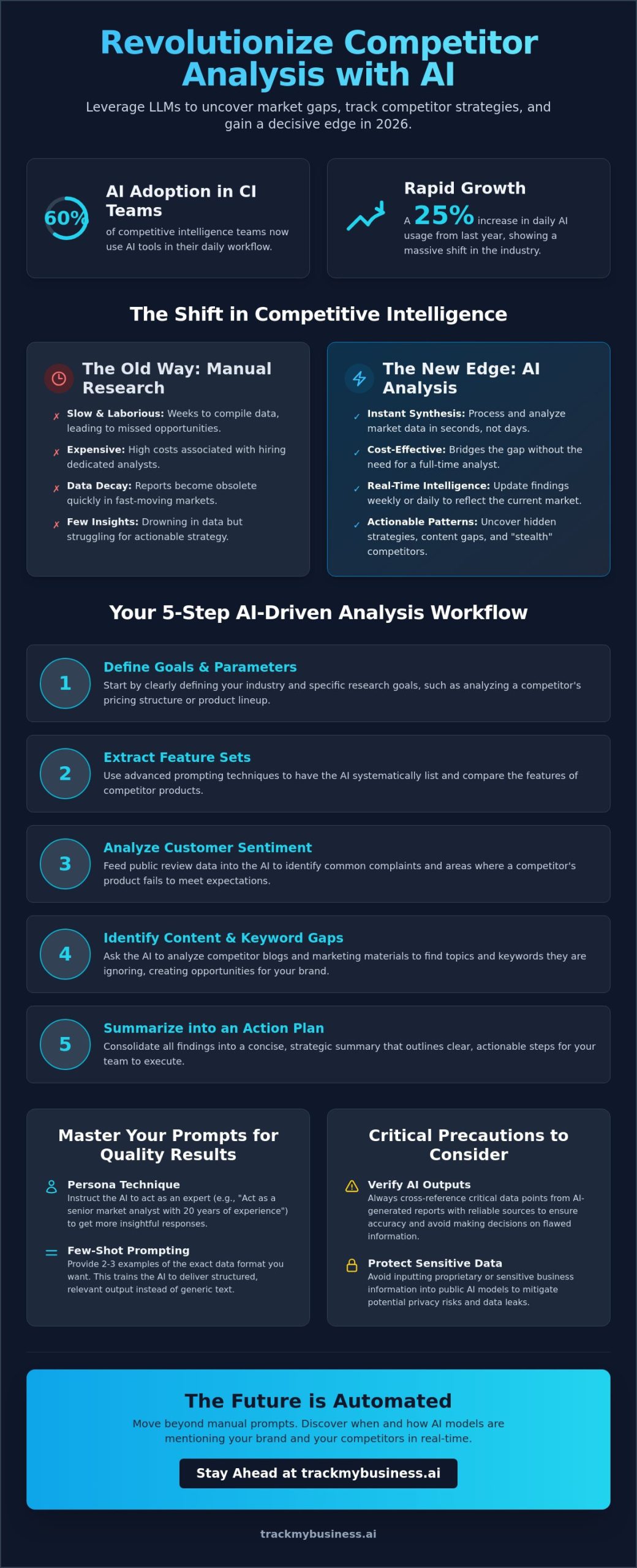
Did you know that 60% of competitive intelligence teams now use AI tools daily to keep up with the market? It’s a 25% increase from last year according to Crayon’s 2025 State of Competitive Intelligence report. I’ve seen firsthand how manual research can drain your schedule, leaving you with hours of data but very few actionable insights. Performing competitor analysis using chatgpt isn’t just about saving time; it’s about seeing the patterns that manual spreadsheets often miss.
I understand the frustration of feeling like you’re always one step behind, especially when you’re unsure if your AI prompts are even returning accurate business data. In this guide, I’ll show you how to leverage GPT-5.5 to uncover competitor strategies and identify specific market gaps that your brand can fill. We’ll walk through a repeatable process for AI-driven research and explore how to use tracker software to monitor if your competitors are being mentioned in AI conversations, ensuring you stay ahead in 2026.
Key Takeaways
- Learn why speed is the new competitive advantage and how LLMs synthesize market data instantly to streamline your research.
- Master a repeatable process for competitor analysis using chatgpt to extract competitor feature sets and pricing through advanced prompting.
- Identify specific content gaps and keywords your competitors are ignoring to refine your own digital strategy.
- Understand the methodology for verifying AI outputs and protecting sensitive business data from potential privacy risks.
- Move beyond manual prompts by utilizing ChatGPT mention tracking to see exactly when AI models cite your brand or competitors.
The Evolution of Competitor Analysis in the AI Era
I’ve found that the traditional way of researching rivals is fundamentally changing. In the past, we relied on manual audits that took weeks to compile and even longer to analyze. Now, speed is the primary advantage. Using competitor analysis tools and processes powered by AI allows me to process data in seconds rather than days. This shift isn’t just about efficiency; it’s about staying relevant in a market where trends vanish as quickly as they appear.
LLMs like GPT-5.5 have changed how I synthesize market data. Instead of reading every blog post a competitor publishes, I can ask an AI to summarize their content strategy over the last quarter. This shifts the focus from simple data collection to dynamic, real-time intelligence. Performing competitor analysis using chatgpt has become my preferred method for handling this volume of information. In 2026, staying competitive means looking at how AI perceives the market. If an AI doesn’t mention your brand when a user asks for a solution, you’re invisible to a massive segment of the audience that has moved away from traditional search engines.
Defining Your Competitors in 2026
Identifying who you’re actually up against has become more complex than it used to be. I categorize competitors into direct and indirect groups, but AI now helps me find “stealth” competitors that I might have otherwise missed. These are often companies with different business models that solve the same problem for your audience. For example, a software tool might lose market share to a specialized AI agent rather than a similar SaaS product. I use AI to map out these non-traditional threats so I can adjust my positioning before they take over the niche.
The Problem with Manual Research
I often see small businesses struggle with the high cost of manual data collection. Hiring a full-time analyst is expensive; for many, it’s just not feasible. Beyond the cost, there’s the issue of data decay. A report from six months ago is likely obsolete by the time you act on it because markets move so fast now. Performing competitor analysis using chatgpt helps bridge this gap effectively. It allows me to turn raw, fragmented data into an actionable strategy without the manual grind. I can update my findings weekly or even daily, ensuring my strategy reflects the current state of the market rather than a snapshot from last year.
A Step-by-Step Guide to Competitor Analysis Using ChatGPT
I’ve developed a specific workflow for competitor analysis using chatgpt that minimizes guesswork. It’s a five-step process that moves from high-level goals to a concrete action plan. I start by defining the industry parameters and specific goals, such as identifying a rival’s pricing structure. Then, I use advanced prompts to extract feature sets. For the third step, I feed public review data into the AI to analyze customer sentiment. This helps me see where a competitor’s product fails to meet expectations. Next, I identify content gaps where my own brand can provide better answers. Finally, I summarize everything into a strategic action plan that my team can actually use.
Mastering the Prompt Engineering Process
I’ve learned that the quality of your research depends entirely on how you talk to the AI. I always start with the Persona technique by telling the model to act as a senior market analyst with twenty years of experience. To get better results for specific sectors like the garment industry, I use Few-Shot prompting. This means I provide the AI with two or three examples of the exact data format I want before asking it to analyze a new competitor. It prevents the model from giving me fluffy, generic responses that don’t help my business. If you want to see how these insights reflect your actual market position, using tracker software can help you see which brands are currently winning the AI conversation.
Analyzing Competitor Workflows
I don’t just look at what competitors sell; I look at how they operate. I use AI to analyze public shipping data and press releases to estimate their production lead times. This helps me understand if they’re prioritizing speed or cost. I also prompt the AI to identify which software modules a competitor likely uses for inventory or procurement based on their job listings and technical documentation. Knowing if a rival is investing heavily in automated procurement gives me a clear signal about their future scaling plans. This methodology ensures my competitor analysis using chatgpt covers the operational “how” as much as the marketing “what”. It’s a proactive way to find weaknesses in their supply chain or order management styles that I can exploit.
Identifying Content Gaps and Strategy Blind Spots
I’ve found that identifying what your competitors aren’t saying is just as important as knowing what they are. When I perform competitor analysis using chatgpt, I start by feeding the AI summaries of the top five ranking pages for my target keywords. I ask the model to highlight specific sub-topics or questions that these pages fail to answer. This process reveals the strategy blind spots that my competitors have overlooked, allowing me to create content that is more comprehensive and helpful to my audience. It’s a direct way to find the “missing pieces” in a niche’s information landscape.
In the garment industry, I take this a step further by using AI to analyze public review data. I look for specific patterns in customer frustration, such as recurring complaints about eco-friendly fabric durability or inconsistent sizing in mid-range activewear. These unmet needs represent a massive opportunity for a new product launch. By mapping the customer journey, I can see exactly where a rival’s experience breaks down. If their social media presence is strong but their post-purchase communication is weak, I know I can win by prioritizing better order tracking and customer support systems.
Using AI to Spot Market Trends
I use AI to look ahead by prompting it to identify emerging apparel trends for 2026. I’ve noticed that businesses that ignore new production technologies, like automated 3D knitting or bio-based textiles, often fall behind. I ask ChatGPT to scan industry news and report on which competitors are adapting to these shifts. This helps me find the “white space” in the market. It ensures my next product launch addresses a future demand rather than a past trend. This proactive approach is essential when 89% of businesses report that their competitive landscape has become more intense.
Benchmarking Your Brand Perception
I also use AI to understand how the market perceives my brand compared to my main rival. I’ll ask ChatGPT to describe both companies based on public sentiment and available web data. This exercise often highlights an “authority gap” where a competitor is viewed as the expert in a specific niche even if my product is technically superior. Once I identify this gap, I can craft a unique value proposition that directly fills it. This methodology ensures that my competitor analysis using chatgpt results in a strategy that isn’t just a copy of what others are doing, but a proactive plan to stand out and claim authority where others have failed.
Avoiding Pitfalls: Accuracy and Data Privacy
I rely on AI to speed up my research, but I never treat its output as absolute truth. Hallucinations remain a reality even with flagship models like GPT-5.5. If the AI provides a specific market share percentage for a rival in the SA market, I always verify it against primary sources. I’ve found that setting up a human-in-the-loop system is the only way to ensure final strategic decisions are based on reality. I recommend using real-time browsing features for any data that changes frequently, as static training data can quickly become obsolete in our fast-moving local economy.
Data privacy is another area where I’m extremely cautious. I follow Australian privacy principles and never upload non-public business data or proprietary product designs into ChatGPT. Instead, I focus my competitor analysis using chatgpt on publicly stated facts and web-based information. This keeps my research compliant and secure. If you want to track public sentiment and market movements without risking your internal data, you can use tracker software to monitor how your brand is mentioned across various LLM conversations.
Verifying Competitor Claims
I cross-reference any AI-generated insight with primary sources like LinkedIn profiles or local business registries. I often use ChatGPT to draft specific fact-check queries that I run through search engines to find original documentation. Red flags in AI reports include overly round numbers or citations for sources that don’t exist. If an AI claims a competitor has a high satisfaction rate without a clear source, I know it’s time to dig deeper manually. This verification step ensures that my competitor analysis using chatgpt remains a reliable foundation for my business strategy.
Maintaining Ethical Analysis Standards
I always maintain a clear line between competitive intelligence and industrial espionage. Competitive intelligence involves analyzing public information to make better decisions. Espionage involves acquiring trade secrets through deceptive means. I ensure my AI analysis remains ethical by only using public-facing data, such as website copy, press releases, and customer reviews. This approach keeps my business compliant with local standards and data protection expectations. It’s about being proactive and efficient without crossing legal or moral boundaries in the SA business community.
Automating Your Strategy with ChatGPT Mention Tracking
I’ve realized that manual competitor analysis using chatgpt is a great starting point, but it’s ultimately just a snapshot in time. If I only run my prompts once a month, I’m missing the daily shifts in how AI perceives my market. Continuous monitoring is the only way to keep a strategy from going stale. This is why I’ve moved toward ChatGPT mention tracking. It allows me to know exactly when my brand, or a competitor, is cited by an LLM during a user’s research phase. It’s a proactive way to stay visible in the new search landscape.
Using LLM tracker software changes the game. It automates the research phase by scanning for brand citations across the major models. This isn’t just about vanity; it’s about lead generation. If a user asks ChatGPT for the best eco-friendly activewear brands for 2026 and my competitor is the only one listed, I’ve lost a lead before I even knew they were looking. Turning these AI mentions into a brand authority engine requires seeing the data in real-time so you can adjust your content and PR efforts accordingly.
The Power of LLM Tracker Software
I use specialized software to monitor how ChatGPT, Claude, and Gemini recommend products in my specific niche. This process helps me track my “share of model” (SOM), a metric that shows how often my brand is chosen over others in AI outputs. I set up alerts so that if a rival gains traction, I can respond immediately. My current workflow includes:
- Real-time alerts for rival brand growth within LLM responses.
- Comparison of brand authority across multiple different AI models.
- Identification of the specific questions that trigger competitor mentions.
Integrating this into my tracker software operations means I’m not just reacting to the past. I’m actively managing how AI models describe my business to the world.
Scaling Your Competitive Intelligence
I’ve found that moving from a one-time audit to a 24/7 intelligence dashboard reduces my research time by about 90%. I no longer have to manually prompt the AI every morning to see if anything has changed. The automation does the heavy lifting for me. This allows me to close the loop on our business operations. For example, if tracking data reveals that competitors are being praised for their production transparency, I can immediately update our own public documentation. It ensures our production and order management strengths are reflected in the data LLMs use to recommend brands. This is the final step in making competitor analysis using chatgpt a truly scalable and profitable part of my business strategy.
Mastering Your Market Position in 2026
I’ve shown you how LLMs transform research from static, outdated reports into a dynamic source of real-time intelligence. By identifying content gaps and analyzing customer sentiment, you can build a strategy that addresses unmet needs your rivals are ignoring. Integrating competitor analysis using chatgpt into your regular workflow ensures you’re always acting on the most current data available. However, manual research is only half the battle in a market that moves this quickly.
To truly stay ahead, you need a system that monitors the landscape while you focus on growth. I recommend moving to an automated solution to save time and increase accuracy. You can start tracking your AI mentions and streamline your business with TrackMyBusiness today. Our specialized LLM tracker software for the garment industry offers an all-in-one “Tracker” modular system for production and orders. This provides cloud-based transparency across all your business operations, helping you maintain your authority in AI conversations. It’s time to turn these insights into a permanent competitive advantage.
Frequently Asked Questions
Can ChatGPT accurately identify my local competitors?
I’ve found it can identify local rivals if you provide specific geographic parameters, such as postcodes or city names within SA, and use models with live browsing. I recommend asking for businesses within a specific radius and cross-referencing the results with local directories. While it handles prominent local brands well, it might miss very new or small businesses that don’t have a strong digital footprint yet.
How do I prompt ChatGPT to perform a SWOT analysis?
I start by assigning the AI a persona, such as a senior business strategist, and then provide it with specific competitor data points. You should ask the model to categorize information into strengths, weaknesses, opportunities, and threats based on recent market news or product reviews. This is a core part of competitor analysis using chatgpt, helping you turn raw data into a structured strategic framework.
Is it legal to use AI for competitor analysis?
Yes, it’s legal as long as you only process publicly available information and comply with the Australian Privacy Act. I make sure to avoid processing personal data without a legal basis, focusing instead on business-level facts, pricing, and public reviews. Staying within these ethical and legal boundaries ensures your research remains compliant with local standards.
How often should I run a competitor analysis using AI?
I recommend moving away from quarterly reports toward a continuous monitoring approach. While many businesses only update their analysis every few months, the local market moves too fast for that. Using AI allows you to check for shifts in competitor messaging or pricing weekly. For the best results, I use automated tools to track changes in real time.
What are the limitations of using the free version of ChatGPT for business research?
The free version currently uses GPT-5.5 Instant and has a limit of approximately 10 messages every 5 hours. It also includes ads and uses your data for training by default, which might be a concern for sensitive research. I’ve noticed that for deep competitor analysis using chatgpt, the message limits and lack of advanced sessions can hinder comprehensive data gathering.
How can I tell if my brand is being mentioned in ChatGPT conversations?
You can’t see private user chats, but you can use tracker software to monitor how LLMs recommend your brand in generated outputs. I utilize specialized LLM tracker software to see when my company or a competitor appears in response to relevant industry queries. This helps me understand our current market authority without having to manually test thousands of different prompts myself.
What is share of model (SOM) and why does it matter for my business?
Share of model is the percentage of time an AI model recommends your brand compared to your competitors for specific keywords. It’s a critical metric because more users are using AI for product discovery in 2026. I track this to see if our brand authority is growing or if a rival is becoming the preferred recommendation for the AI.
Can ChatGPT help me find competitor pricing if it is not listed publicly?
No, ChatGPT cannot access private, non-public pricing data or internal company documents. I use it to synthesize publicly available pricing from websites, press releases, or user reviews instead. If a competitor uses a hidden pricing model, I ask the AI to analyze public discussions where customers might have shared the quotes they received to get an accurate estimate.
