
Did you know that over 70% of consumers now use AI-powered chatbots like ChatGPT for product research before they ever reach a checkout page? Despite this massive shift in behavior, I see many businesses in Saudi Arabia still struggling with tracking sales from chatgpt mentions, which leaves their digital ROI in a state of total uncertainty. It’s difficult to justify the cost of the GPT-5.5 model, currently priced at 18.75 ﷼ per million input tokens, when you can’t prove those recommendations are actually driving growth in your local market.
I agree that the inability to attribute revenue to AI conversations is a major hurdle for any modern marketing team. This guide will show you how to bridge that gap by building and operationalizing a high-performance, AI-integrated sales funnel. I will provide a clear map from the initial ChatGPT mention to the final transaction, using specialized tracker software to automate lead qualification and keep your inventory perfectly synchronized. You’ll learn exactly how to use LLM tracker software to turn generic AI outputs into a streamlined path to purchase that reflects your brand authority.
Key Takeaways
- I show you how to pivot from traditional SEO to LLM Optimization (LLMO) by treating AI conversations as a dynamic feedback loop.
- I provide a five-step prompt framework designed to move users through a logical path directly toward a commitment.
- I explain why connecting your AI funnel to production workflows is essential to prevent inventory issues during sudden demand spikes.
- I demonstrate the specific methodology for tracking sales from chatgpt mentions to identify revenue coming from the dark social layer of AI.
- I discuss how to scale your sales machine using specialized LLM tracker software that provides a unified view of mentions and performance.
The Evolution of AI Sales: Building a Sales Funnel from ChatGPT in 2026
I define the 2026 AI sales funnel as a dynamic feedback loop rather than a static sequence of landing pages. In my experience, the shift from Search Engine Optimization (SEO) to LLM Optimization (LLMO) has fundamentally changed how we reach customers in the Saudi market. Instead of fighting for a blue link, I focus on how an AI model perceives and recommends a brand. This is where tracking sales from chatgpt mentions becomes the most critical metric for growth. It is the only way to prove that your presence in an AI’s training data is actually translating into Riyals at the checkout.
Brand authority in ChatGPT has become the digital equivalent of word-of-mouth. When a user asks for the best local service, the AI’s response is built on the vast datasets it has ingested. I view this as a “Circular Funnel.” By using tracker software to see exactly what the AI says about your business, I can refine your brand’s digital footprint. This creates a cycle where better data leads to better mentions, which then leads to more conversions. It is a continuous process of improvement and validation that requires constant monitoring.
Why Traditional Funnels Are Failing
Traditional funnels rely on static email sequences and interruptive ads that many modern consumers simply ignore. I’ve noticed that users in Saudi Arabia increasingly use LLMs to bypass cluttered search results and sponsored content. This creates a problem of “AI noise” where generic outputs can drown out your specific value. If you aren’t actively tracking sales from chatgpt mentions, you are essentially flying blind while your competitors are being recommended by the very tools your customers trust for objective advice. The old way of pushing a user through a rigid path is over; the new way is being present where the conversation is already happening.
The Context Window Advantage
The massive context windows available in 2026 allow me to upload entire business histories and product catalogs into an AI environment. This turns a standard chat interface into a Conversational commerce powerhouse. I use these custom GPTs as 24/7 sales representatives that never lose track of a lead. They maintain my specific first-person brand voice and provide functional, direct assistance to every query. By operationalizing this through our LLM tracker software, I can ensure that every interaction is a step toward a measurable transaction rather than just a helpful chat. This methodology allows us to acknowledge the limitations of generic AI while proposing a proactive, brand-aligned next step for the customer.
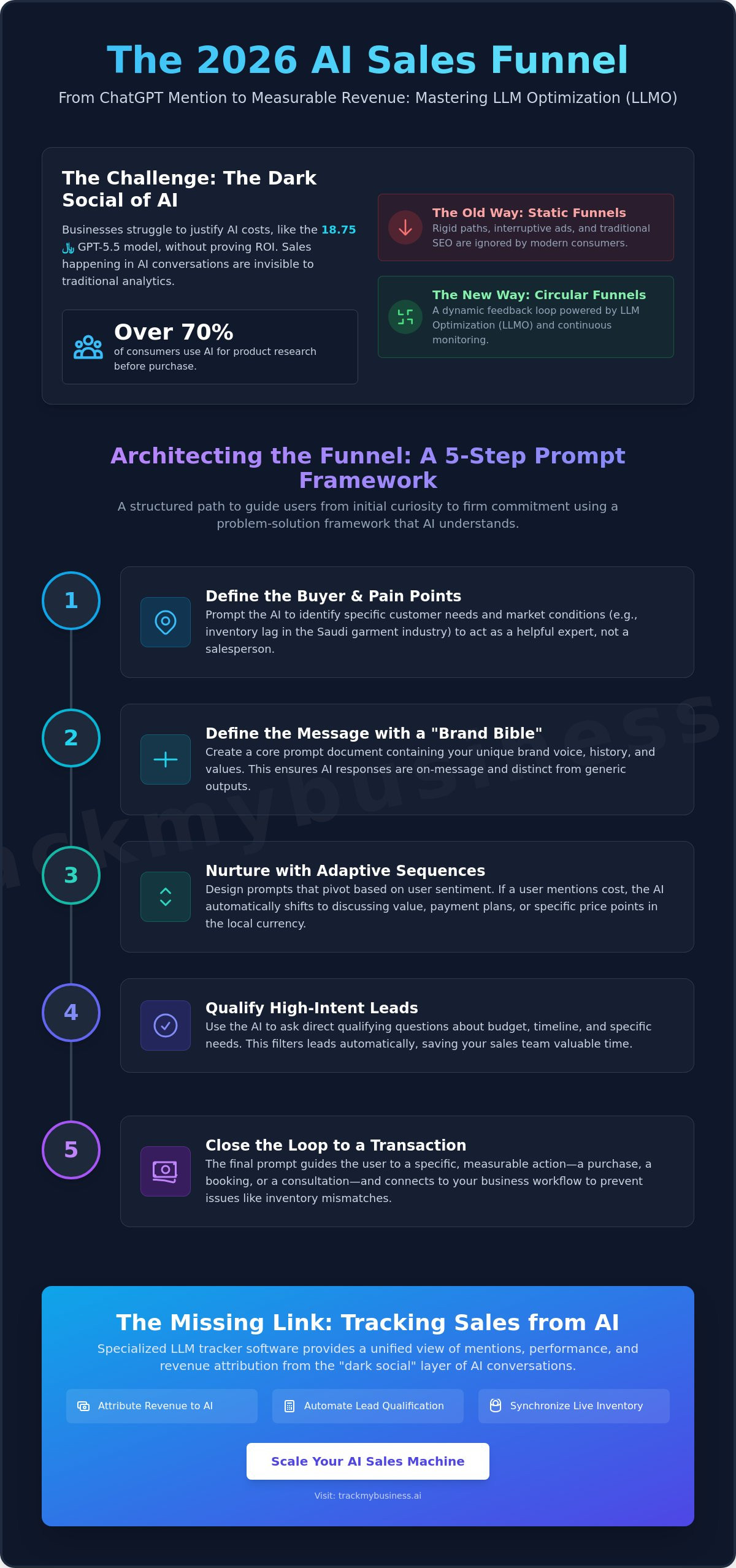
Architecting the Funnel: A 5-Step Prompt Framework
I build my AI sales funnels using a hierarchy of prompts that move a user from initial curiosity to a firm commitment. This process relies on a problem-solution structure because that’s how LLMs process logic most efficiently. In 2026, I’ve found that functional, direct language outperforms marketing fluff every time. When I focus on tracking sales from chatgpt mentions, I need the AI to act as a precise filter for high-intent leads. If the prompt doesn’t guide the user toward a specific outcome, the tracking data becomes useless. I start by training the model to recognize that transforming marketing with AI requires more than just conversation; it requires a structured path to conversion.
Steps 1 & 2: Defining the Buyer and the Message
I begin by prompting ChatGPT to identify specific buyer pain points. In the Saudi garment industry, for example, a major issue is often inventory lag or seasonal stock availability. I don’t want the AI to sound like a pushy salesperson. I prompt it to act as a helpful expert that understands local market conditions. To prevent generic, bot-like responses, I create a “Brand Bible” prompt. This document contains my brand’s unique voice and specific history. It ensures the AI stays on message while acknowledging the limitations of its current data before proposing a proactive next step for the user.
Steps 3-5: Nurture, Qualify, and Close
Steps three through five involve creating adaptive nurture sequences. I design these prompts to change based on user sentiment. If a user expresses concern about costs, the AI should pivot to discussing value or specific price points in Saudi Riyal. I use the AI to qualify leads by asking direct questions about budget and timeline. For instance, I might have the AI ask, “Are you looking for premium fabrics for a collection launching before the next Eid season?” This filters out casual browsers. Finally, I automate the close by directing the qualified user to a specific product page or a demo link. This is where tracking sales from chatgpt mentions becomes tangible. If you want to see how this looks in practice, our tracker software provides real-time visibility into these specific conversion points.
To help you get started, I use this master prompt template for lead qualification in the garment sector: “You are an expert procurement assistant for a Saudi textile firm. A user is inquiring about summer fabrics. First, identify if they are a retail or wholesale buyer. Second, ask if they require shipping to Riyadh or Jeddah within the next 14 days. If they confirm a budget over 5,000 ﷼, provide the direct link to our digital catalog and flag this as a high-priority lead.”
Operationalising AI: Connecting ChatGPT to Your Business Workflow
I believe a sales funnel is only as strong as its weakest operational link. If your ChatGPT interactions are disconnected from your production management, you’re setting yourself up for failure. I’ve seen businesses generate massive interest through AI recommendations only to realize they can’t fulfill the orders. This is why tracking sales from chatgpt mentions must be integrated with your core business systems. Without this connection, you risk “AI-driven demand spikes” that can overwhelm a manual system and lead to lost revenue. I use Tracker Software to serve as the engine that bridges the gap between a conversation and a completed sale.
Transparency across orders, suppliers, and procurement is the only way to maintain professional diligence when an AI funnel succeeds. I acknowledge that setting up these integrations takes time, but the proactive next step is always to automate the data flow. If your procurement team isn’t seeing the same data as your marketing team, you’ll face stockouts right when your brand authority is peaking. I focus on building a methodology where every mention is a signal for the entire supply chain, not just a metric for the marketing department.
From Chatbot to Checkout
I focus on integrating ChatGPT leads directly into apparel erp software. This isn’t just about capturing a name; it’s about synchronizing real-time inventory levels with the product recommendations the AI provides. If a user in Riyadh asks for a specific cotton blend, the AI should know exactly how many meters are left in the warehouse. By reducing the friction between an AI suggestion and a warehouse dispatch, I ensure that the promise made in the chat is kept at the loading dock. This level of synchronization is what separates a gimmick from a scalable business model.
Managing Growth Without Chaos
Scaling an AI funnel requires moving away from static spreadsheets. I’ve found that manual tracking becomes impossible when order volume triples overnight due to a viral AI mention. I use modular systems that allow a business to scale without losing focus on the immediate task. In the Saudi market, where procurement cycles can be complex, having a clear view of your supply chain is mandatory for survival. Tracking sales from chatgpt mentions gives me the data I need to predict these spikes before they happen. It allows for a proactive next step in resource allocation rather than a reactive scramble during a crisis.
The Missing Link: Tracking Sales from ChatGPT Mentions
I have found that visibility metrics are often misleading. While some industry tools provide a visibility score from 0 to 100, they fail to tell you if a customer actually completed a purchase. I treat LLMs as the “Dark Social” of the 2026 sales landscape. These are private, encrypted conversations where traditional tracking pixels cannot reach. Without a specific methodology for tracking sales from chatgpt mentions, your marketing budget is essentially a black hole. I acknowledge that this attribution gap is a significant limitation, but the proactive next step is to implement a dedicated data layer. I use LLM tracker software to bridge this gap and justify every Riyal spent on generative engine optimization.
Closing the attribution loop is the only way to prove ROI to stakeholders in Saudi Arabia. I focus on the immediate task of connecting the mention to the transaction. If an AI model recommends your brand to a procurement manager in Dammam, you need to know exactly which prompt led to that recommendation. I use a process-oriented approach to capture this data, ensuring that my methodology is transparent and repeatable. By establishing this link, I can move from guessing about brand awareness to measuring hard revenue growth.
Why Traditional Analytics Fail AI Funnels
Traditional tools like Google Analytics 4 cannot track what happens inside a private ChatGPT session. This creates a massive blind spot for any brand trying to scale. I solve this by using unique referral codes and dedicated landing pages designed specifically for AI-driven traffic. When a user follows a link provided by an LLM, they land on a page that validates the AI’s suggestion. This allows me to identify if my funnel is successfully influencing the AI’s real-time training data or if the mentions are coming from older, cached datasets. It is a functional way to reclaim the data that traditional search engines have lost.
Monitoring Brand Sentiment in the LLM Ecosystem
I don’t just track the volume of mentions; I analyze the sentiment behind them. I set up automated alerts for brand mentions across ChatGPT, Claude, and Gemini to see how the brand is being positioned. I look for whether the AI is providing positive, neutral, or negative recommendations. If the AI is hallucinating incorrect pricing or outdated service information, I use that data to refine my funnel prompts immediately. This ensures that the AI is always working as a high-context sales rep rather than a source of misinformation. If you want to secure your brand’s reputation, you can start tracking sales from chatgpt mentions with our specialized software to get the full picture of your AI performance.
Scaling Your AI Sales Machine with TrackMyBusiness
I have detailed the journey from creating an AI sales funnel to operationalizing the fulfillment process. Now, I want to emphasize the importance of scaling this machine. In my experience, tracking sales from chatgpt mentions is the only way to move from speculative AI experimentation to true channel ownership. I believe that a unified system for tracking and backend operations is the most efficient way to manage this new revenue stream. For businesses operating in Saudi Arabia, this means having a system that handles the specific complexities of local procurement and supplier management. I acknowledge that the transition to AI-driven sales can feel complex, but the proactive next step is to consolidate your data into a single, functional source of truth.
I focus on the methodology of professional diligence. When I track a mention, I’m not just looking for a name; I’m looking for a repeatable path to a transaction. By using our tracker software, I can see exactly where the funnel is succeeding and where it needs refinement. This process-oriented approach ensures that we aren’t just reacting to the market, but actively shaping how AI models perceive and recommend your brand. It’s a steady rhythm of gathering information, analyzing the results, and taking the next logical step toward growth.
Future-Proofing for the AI Decade
I consider staying ahead of LLM mention tracking to be the ultimate competitive advantage for the coming years. If you don’t have a system for tracking sales from chatgpt mentions, you are effectively invisible in the fastest-growing research channel for modern consumers. I recommend adopting cloud-based modular systems for long-term scalability. These systems allow you to move from manual lead outreach to an automated, tracked ecosystem that grows with your business. I’ve seen how this transition prevents the chaos of demand spikes and ensures that your brand authority remains consistent across all AI platforms. It’s about building a foundation that lasts.
Getting Started with TrackMyBusiness
I believe the best way to understand the value of this system is to see it applied to your specific business needs. You can request a demo of the Tracker ERP and the LLM tracking module to see how they integrate with your current garment industry workflow. I focus on making this integration as direct and helpful as possible, ensuring that your team can begin using the software without unnecessary delays. This is the functional next step for any brand ready to take control of its AI visibility. I invite you to start tracking your AI mentions and sales today to ensure your business remains at the forefront of the Saudi market’s technological evolution.
Owning Your Brand’s Future in the AI Marketplace
I have outlined how to transform ChatGPT from a simple chatbot into a high-performance sales engine. By shifting your focus from traditional SEO to LLM Optimization and integrating your prompts directly with your production management, you can finally close the attribution loop. I’ve found that the most successful brands in Saudi Arabia are those that treat AI mentions as a measurable revenue stream rather than just a visibility metric. Tracking sales from chatgpt mentions provides the precise data you need to justify your marketing spend and scale your operations without the risk of inventory chaos.
I acknowledge that moving away from legacy systems can feel daunting, but the proactive next step is to adopt a unified system designed for this new era. Our unified cloud-based Tracker system is specifically built to handle apparel and garment industry workflows while offering the advanced LLM tracker software required for exact sales attribution. I am ready to help you move from experimentation to total channel ownership. See how TrackMyBusiness can track your brand mentions in ChatGPT and start securing your ROI today. Your growth in the AI decade starts with the right data.
Frequently Asked Questions
Can ChatGPT actually build a functional sales funnel for a physical product business?
Yes, I use a structured hierarchy of prompts to move users from initial research to a direct checkout link. While the AI doesn’t handle the physical manufacturing, it acts as a high-context sales representative that qualifies leads in real-time. It’s essential to connect this conversational funnel to your backend systems to ensure that the demand the AI generates is actually met by your available stock in Saudi Arabia.
How do I know if ChatGPT is recommending my brand to potential customers?
I recommend using programmatic monitoring tools rather than manual checks. Specialized LLM tracker software scans for your brand across thousands of potential queries to see if you appear as a primary recommendation. This provides a clear view of your visibility that manual searching simply cannot match. Without these tools, you’ll miss the majority of mentions occurring in private chat sessions every day.
What is the best way to integrate AI-generated leads into my existing ERP?
I suggest using a direct API integration between your chat interface and your Tracker Software. This allows lead data, such as specific material preferences or budget requirements, to flow directly into your procurement workflow. This synchronization prevents demand spikes from overwhelming your team by giving your production staff real-time visibility into incoming interest from the local market. It turns a chat into a functional work order.
Does tracking sales from ChatGPT mentions require coding knowledge in 2026?
No, it doesn’t. While the OpenAI API for the GPT-5.5 model costs approximately 18.75 ﷼ per million input tokens, you don’t need to write code to access the data. Modern tracker software handles the technical heavy lifting for you. I provide a functional dashboard where you can view your visibility and conversion data without ever touching a line of script or managing complex API integrations yourself.
How often should I update the prompts in my AI sales funnel?
I find that a monthly update cycle works best for most brands to remain relevant. You must ensure your prompts align with seasonal shifts in Saudi Arabia, such as inventory changes before major holidays. Since models like GPT-5.4 mini are updated with new data frequently, your instructions need to stay current. I acknowledge that this takes effort, but the proactive next step is maintaining a relevant and accurate “Brand Bible.”
What are the risks of relying entirely on AI for customer acquisition?
The biggest risk is the model hallucinating incorrect information, such as stating a business is closed or quoting wrong prices in ﷼. This can lead to lost revenue and customer frustration. I believe tracking sales from chatgpt mentions is the best way to mitigate this risk. It allows you to identify inaccuracies immediately and adjust your optimization strategy before it impacts your brand authority or bottom line.
How can I track ROI from my ChatGPT-driven marketing efforts?
I use unique referral codes and dedicated landing pages to bridge the attribution gap between the chat and the sale. By monitoring which codes are used at checkout, I can attribute specific Riyal amounts to individual AI interactions. This methodology allows you to compare your software costs against actual sales. It provides the hard data needed to justify your investment in tracking sales from chatgpt mentions and broader AI strategies.
Can I use ChatGPT to manage my inventory and order fulfillment as well?
No, you shouldn’t. ChatGPT is a language model that is excellent for conversation but lacks the logic for physical logistics and inventory tracking. I propose using the AI for the initial customer engagement and lead qualification only. You should then hand off those leads to your Tracker Software to manage the actual fulfillment, supplier procurement, and real-time stock levels across your Saudi warehouses.
