
In 2026, if you aren’t tracking how your brand appears in Large Language Model responses, you’re essentially invisible to a massive segment of your market. I’ve noticed that many teams still rely on outdated methods that ignore the AI shift, leaving them blind to what ChatGPT tells their potential customers. It’s exhausting to deal with manual tracking that’s prone to error, and it’s even harder to know which rivals actually count when the digital landscape changes every week. To maintain your edge, you must systematically add competitors to a unified strategy that covers both traditional search and AI visibility.
I understand the frustration of data silos where competitor info stays separate from your daily operations. In this guide, I’ll walk you through the exact steps to identify and monitor your rivals across all modern channels. You’ll learn how to use tracker software to automate alerts for LLM mentions and create a streamlined process for competitor entry. By the end, you’ll have a clear view of your market share and the tools needed to protect your brand’s reputation in an AI-driven world.
Key Takeaways
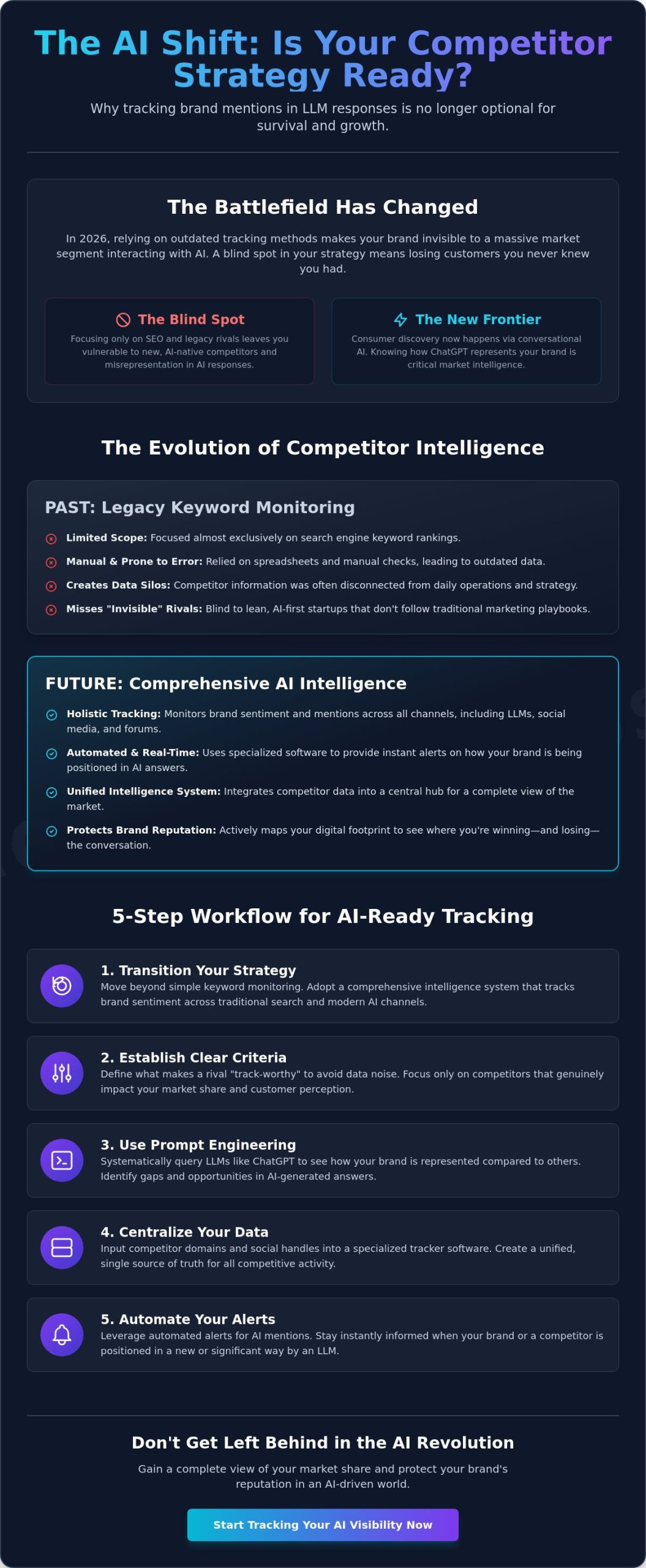
- Transition your strategy from simple keyword monitoring to a comprehensive intelligence system that tracks brand sentiment across traditional and AI channels.
- Establish clear criteria for “track-worthy” rivals to ensure you only add competitors that impact your market share, preventing unnecessary data noise.
- Utilize prompt engineering techniques to identify how LLMs and ChatGPT represent your brand compared to others in your industry.
- Follow a functional workflow to input domains and social handles into specialized tracker software for a unified view of competitor activity.
- Leverage automated alerts for AI mentions to stay informed about how your competitors are being positioned in generated answers.
Why You Must Add Competitors to Your Strategic Tracking System
I view competitor tracking as a dynamic, multi-channel intelligence process rather than a static spreadsheet. In 2026, it’s no longer sufficient to just look at search engine rankings. You need to understand how your brand is perceived across social platforms, industry forums, and the Large Language Model (LLM) ecosystem. When you decide to add competitors to your tracking strategy, you aren’t just watching their prices; you’re mapping their entire digital footprint to see where they are winning the conversation. This comprehensive competitor analysis helps you identify specific gaps in your own product line by showing you what features or services customers are praising in your rivals’ mentions.
Competitive benchmarking serves a vital role in 2026 business growth. It provides the context needed to set realistic performance targets and ensures your team isn’t working in a vacuum. I use benchmarking to:
- Compare brand sentiment scores across different LLM platforms.
- Identify which competitors are gaining “Share of Voice” in AI-generated recommendations.
- Detect when a rival’s product update triggers a shift in market interest.
The shift from traditional keyword tracking to brand sentiment and AI mention tracking is the defining change of this year. While SEO still matters, a significant portion of consumer discovery now happens through conversational AI. If a user asks ChatGPT for the best solution in your niche, you need to know if your brand is being recommended or if the AI is hallucinating incorrect data about your services. By using specialized LLM tracker software, I can see exactly how often my brand is mentioned alongside rivals in generated text. This provides a much more accurate picture of market presence than old-school search volume metrics.
The Risk of Incomplete Competitor Profiles
Focusing solely on legacy competitors is a dangerous strategy. I’ve seen many businesses lose market share because they ignored “invisible” rivals, like lean AI-first startups that don’t follow traditional marketing playbooks. When your profile is incomplete, your ROI data becomes skewed. You might think your marketing spend is performing well because you’re beating an old rival, while a new player is actually capturing the majority of new leads through AI search visibility. You must add competitors who are digital-native to get a true sense of the market.
Moving Beyond Simple Keyword Monitoring
Traditional SEO tools are often blind to how brands are portrayed in AI-generated answers. I believe your tracking system must be modular and adaptable to keep up with how quickly LLMs like ChatGPT and Claude update their training data. Modern tracking isn’t about counting how many times a keyword appears on a page; it’s about monitoring the context of those mentions. If an AI model consistently links a competitor to a specific problem-solving capability that you also offer, you have a visibility gap that needs immediate attention.
Identifying the Right Rivals: Who to Add to Your List
I’ve learned that adding every single business in your niche leads to a cluttered dashboard that obscures real insights. To avoid data bloat, I establish clear criteria for “track-worthy” rivals before I begin the data entry process. It’s helpful to first conduct a competitive analysis to understand the baseline of your market. This foundational research ensures you’re focusing on businesses that actually impact your bottom line rather than just chasing every new startup that appears on your radar. By being selective, you keep your reports focused and your strategy manageable.
I use specialized market research tools to find “hidden” competitors that might not show up in a standard search. For example, in the garment industry, many emerging boutique brands gain massive traction through social media engagement and niche hashtags long before they rank on the first page of Google. I look for disruptors who are mentioned frequently in community forums or social comments. These players often move faster than established giants. Tracking these agile rivals early allows you to pivot your own strategy before they capture a significant portion of your market share.
Categorizing Your Competitor List
I divide my list into three distinct categories to keep the data organized. Direct competitors are those selling the same products to the same audience. I monitor them for price shifts and feature updates. Indirect competitors solve the same problem with different products; they’re the ones who might steal your customers’ attention. Finally, I include aspirational competitors. These are the industry leaders I want to emulate. Even if they’re currently much larger, tracking their moves helps me understand the future direction of the market. This structure makes it much easier when I’m ready to add competitors to my automated tracker software.
Qualifying Competitors for AI Tracking
In 2026, you must qualify rivals based on their presence in Large Language Models. I check if a competitor is frequently cited by ChatGPT or Claude when users ask for recommendations in my sector. If an AI model regularly points users toward a specific rival, that brand must be at the top of your list. I evaluate their digital footprint by looking at how often they’re mentioned in the training data or recent web-scraped outputs used by these models. I prioritize rivals based on their “AI Visibility Score.” This score reflects how likely an LLM is to recommend them over you. When I choose to add competitors to my system, I focus on those with the highest scores to ensure I’m monitoring the brands that pose the greatest threat in the AI-driven search landscape.
The New Frontier: Adding Competitors for LLM and ChatGPT Mention Tracking
I’ve found that traditional SEO tools are completely blind to how Large Language Models (LLM) recommend brands. In 2026, a significant portion of your traffic comes from users asking AI for advice rather than clicking through a list of blue links. If you don’t add competitors to your AI tracking strategy, you’re missing the exact moment a potential customer asks ChatGPT for a solution and receives your rival’s name instead. This process isn’t just about keywords; it’s about being present in the generated response. I use specific prompt engineering techniques to see how models like ChatGPT, Gemini, and Claude categorize my business compared to others. By asking the AI to compare the top providers in my niche, I can see exactly where I stand in its training data.
LLM mention tracking differs fundamentally from traditional web scraping. While scraping looks at static text on a website, mention tracking monitors the dynamic, probabilistic output of an AI. This is vital because AI models can sometimes provide outdated information or incorrect claims about your business hours, a phenomenon known as an AI hallucination. I rely on specialized LLM tracker software to monitor these responses in real-time. It’s not enough to know what a competitor says about themselves on their blog. You need to know what the AI says about them when a user is ready to make a purchase.
I monitor several key platforms to ensure my data is comprehensive:
- ChatGPT: The primary model for general consumer queries and brand discovery.
- Gemini: Essential for tracking how Google integrates AI responses into its search ecosystem.
- Industry-Specific Models: Specialized LLMs that cater to niche technical or professional fields.
Setting Up AI Mention Alerts
I configure my system to send immediate alerts whenever a rival is recommended over my brand in a specific category. This isn’t just a count of mentions. I track the context to see if the sentiment is positive, negative, or neutral. If I see a competitor consistently praised for a specific feature in LLM responses, I know I need to refine my own brand positioning. This allows me to address gaps in how the AI perceives my value proposition. Using ChatGPT mention tracking helps me stay ahead of these subtle shifts in AI recommendations.
Analyzing Competitor LLM Dominance
I measure my “AI Share of Voice” by analyzing how often rivals appear in “Top 10” lists generated by various models. When you add competitors to your tracking list, you can benchmark your visibility against theirs across multiple platforms. This data helps me identify which specific features the AI values most in a competitor’s profile. I can then adjust my content strategy to better align with the model’s training data. It’s a proactive way to ensure that when a user asks for the best in the business, my name is the one the AI provides.
Step-by-Step: How to Add and Manage Competitors in Your Software
To begin the implementation phase, I first log into the tracker software and navigate to the Market Intelligence module. This is the central hub where all external data points converge. When you are ready to add competitors, it’s best to have your categorized list from the previous steps prepared. I’ve found that a structured approach here prevents the system from becoming a disorganized data dump. I start by entering the primary domain for each rival, which serves as the anchor for all subsequent data gathering. I also include their associated social media handles; this is crucial for capturing the sentiment and engagement metrics that traditional SEO tools often miss.
I then tag each entry by its specific market category, such as Wholesale or Direct-to-Consumer. This tagging allows me to filter reports later and see how different segments of the market are performing relative to my own growth. Once the profiles are created, I set the frequency for automated data refreshes. For high-priority rivals, I prefer daily scans to catch sudden market shifts. For aspirational competitors, weekly updates are usually sufficient. I also assign specific team members to monitor high-priority accounts. This ensures that someone is always accountable for reviewing the reports and flagging significant changes in rival activity. If you want to streamline this entire process, you can use our specialized tracker software to automate these manual steps.
Integrating URLs and Social Handles
I don’t just track the root domain. I often add specific product pages for head-to-head comparisons. This is especially useful when a rival launches a direct alternative to one of my top-selling items. I’ve noticed that managing the noise from high-volume social competitors requires careful filtering. I set the system to only flag mentions that meet a certain engagement threshold, which keeps my dashboard focused on meaningful interactions rather than every minor comment. This precision is what makes a tracking strategy truly effective.
Setting Up Custom Tracking Parameters
Defining which KPIs to track for each added competitor is essential for a clear view of the market. I might track pricing on one rival and AI visibility on another. I also set Threshold Alerts for sudden spikes in activity. For instance, if a rival is suddenly mentioned 40% more often in LLM responses over a 24-hour period, I want an immediate notification. For teams managing dozens of rivals, I recommend using the bulk-upload feature via CSV to add competitors in seconds rather than manual entry. This saves hours of administrative work and gets your monitoring system live much faster.
Optimizing Your Workflow with TrackMyBusiness AI
I believe that the true power of intelligence lies in how quickly you can turn data into a decision. Our Tracker Software is built to bridge the gap between market observation and operational response. When you add competitors to our system, you’re doing more than just populating a list; you’re creating a live feed that informs your entire production cycle. I’ve designed this process to be functional and direct, ensuring that the information you gather doesn’t sit idle in a spreadsheet. Instead, it flows into a centralized dashboard where you can see every market move in real-time.
The unique value of our ChatGPT mention tracking service becomes clear when you consider the 2026 digital environment. While other tools might show you a rival’s backlink profile, I focus on how AI models are actually describing their brand to your potential customers. This specialized LLM tracker software provides a level of transparency that was previously impossible to achieve. For businesses navigating the Saudi Arabian market, I utilize local expertise to ensure regional rivals are tracked with the same rigor as international players. This localized focus is essential for capturing the nuances of regional brand sentiment and AI recommendations.
I find that a modular system is the only way to manage growth effectively. As your business expands, you can easily add competitors without overwhelming your team with irrelevant data. The average power user of AI tools in 2026 often pays between $60 and $110 per month across various fragmented subscriptions. I propose a more streamlined approach where all your LLM and traditional tracking data lives in one place. This consolidated view allows you to maintain a steady rhythm in your market analysis and ensures your strategy remains proactive rather than reactive.
From Mention to Action: The Tracker Advantage
I’ve seen firsthand how a competitor’s misfortune can become your biggest win. If our software flags a sudden spike in negative mentions regarding a rival’s product availability, I can immediately adjust my own inventory and procurement strategies to fill that gap. Turning a competitor’s stock-out mention into a sales opportunity requires speed and precision. By integrating rival data with your internal production schedules, you can pivot your focus to the products that the market is currently demanding but struggling to find elsewhere.
Getting Started with Professional Competitor Tracking
I invite you to request a demo of the Tracker system to see how these integrations work in a live environment. We offer various “bolt-on” options tailored to specific industry needs, allowing the software to adapt as you add competitors to your tracking list. I’m committed to providing a process-oriented solution that simplifies the complexities of modern market intelligence. You don’t have to manage data silos anymore. Optimize your competitive edge with TrackMyBusiness and take control of your brand’s AI visibility today.
Future-Proof Your Market Intelligence
I’ve outlined how the landscape of competitive tracking has shifted toward AI visibility and integrated operational data. By now, you understand that a modern strategy requires moving beyond simple keyword lists to include deep analysis of how LLMs recommend your rivals. I believe the most effective way to manage this complexity is to add competitors to a unified, cloud-based system that provides total transparency. This approach is particularly vital for Saudi Arabian businesses in the garment and decoration industry, where local market shifts happen rapidly and require immediate responses.
I focus on providing functional tools that turn these mentions into actionable insights for your production and sales teams. Our system ensures you never miss a critical update in how ChatGPT or Gemini portrays your brand compared to others. If you’re ready to move from manual tracking to an automated, process-oriented workflow, I invite you to take the next step. You can Request a Demo of Tracker’s Competitor Intelligence Module today to see our integrated LLM tracking in action. I look forward to helping you secure your competitive edge in this evolving market.
Frequently Asked Questions
How many competitors should I realistically track in my system?
I recommend tracking 5 to 10 core rivals to avoid data bloat and maintain a focused strategy. This range allows you to gather deep insights into their specific moves without being overwhelmed by excessive noise. While you might identify dozens of players in your sector, focusing on your top direct and aspirational rivals ensures your reports remain actionable for your production and sales teams.
Can I add competitors that don’t have a traditional website?
Yes, you can track rivals who primarily operate through social media platforms or niche marketplaces. I’ve found that many emerging boutique brands in the garment industry use Instagram or TikTok as their main storefront. You can add competitors to our tracker software by using their social handles or marketplace profile URLs to monitor their engagement and brand sentiment effectively.
How often should I update my competitor list?
I suggest reviewing your list once per quarter to account for new market entrants and shifting trends. The digital landscape moves quickly, especially with AI-first startups emerging frequently in 2026. If you notice a shift in LLM recommendations during your weekly scans, it’s a clear signal that you should update your profiles to include these rising players immediately.
What is the difference between an SEO competitor and a business competitor?
An SEO competitor is a website that ranks for your target keywords but may not sell the same products, while a business competitor directly vies for your customers’ budget. I track both because an SEO rival can steal your visibility in search results. A business rival impacts your actual sales and market share, so monitoring both provides a complete picture of your competitive environment.
Will adding competitors slow down my software performance?
No, adding rivals will not impact the performance of our cloud-based tracker software. I’ve designed the system to handle large volumes of data processing on our servers, which keeps your dashboard fast and responsive. You can add competitors as your business grows without worrying about technical lag or slowdowns in your daily workflow.
How do I track competitors in the Saudi Arabian market specifically?
I use localized tracking parameters that focus on regional social platforms and Arabic-language LLM outputs. This ensures you capture mentions in the specific dialects and platforms used by Saudi consumers. Our software allows you to filter data by region, giving you a clear view of your standing in the local garment and decoration sector relative to regional rivals.
Is it possible to track what ChatGPT says about my rivals?
Yes, our specialized LLM tracker software is built specifically to monitor how models like ChatGPT and Gemini describe your competitors. I track these responses to see if rivals are being recommended for specific features or if the AI is providing incorrect information. This helps you identify if a competitor is gaining an unfair advantage in generated answers and allows you to adjust your positioning.
Do I need a separate tool for social media and LLM tracking?
No, I’ve integrated both social media and LLM mention tracking into a single, unified dashboard. Using separate tools often leads to data silos and missed connections between different marketing channels. Our tracker software brings all this information together, giving you a comprehensive view of your market presence without the need for multiple, fragmented subscriptions.
