
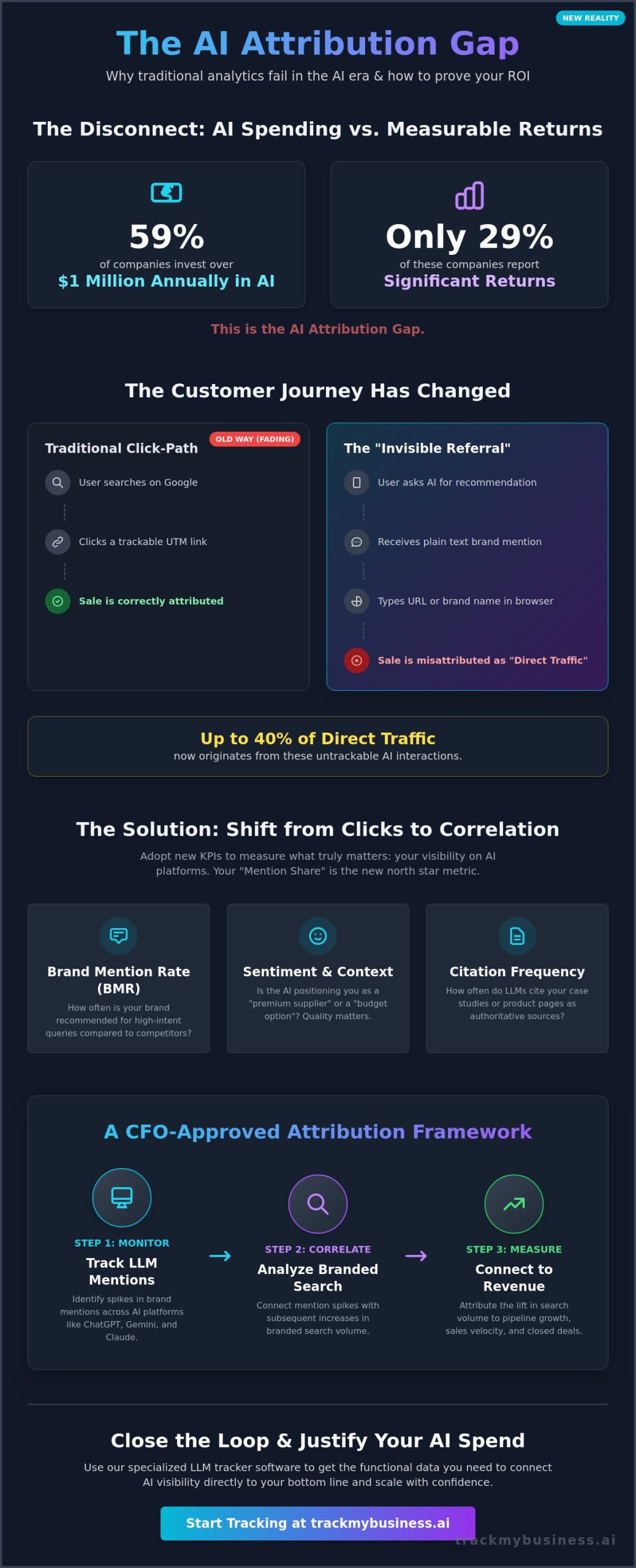
While 59% of companies are now investing at least $1 million annually in AI technology, a 2026 survey from WRITER shows that only 29% are seeing significant returns. I’ve observed this challenge repeatedly as brands struggle with the “invisible referral” where ChatGPT recommendations appear as simple direct traffic in traditional analytics. If you’re finding it difficult to justify your optimization spend to stakeholders, learning how to attribute sales to ai visibility is the necessary next step to prove your department’s value. I’ve found that the solution lies in moving away from traditional click-tracking toward a more functional correlation model.
I’ve written this guide to provide a clear methodology for connecting LLM mentions directly to your revenue and sales pipeline. You’ll learn how to monitor brand mentions across platforms like Gemini and Claude while integrating that data into your existing ERP or tracker software. I’ll walk you through a framework that correlates mention frequency with branded search volume and pipeline velocity. This approach provides the actionable data you need to bridge the attribution gap and scale your AI presence with confidence.
Key Takeaways
- I’ll explain why traditional UTM tracking fails and how you can identify the “AI Attribution Gap” within your direct traffic reports.
- Learn how to attribute sales to ai visibility by calculating your Brand Mention Rate across the most popular generative AI platforms.
- I’ve developed a correlation framework that maps LLM mention spikes directly to your branded search volume and pipeline growth.
- You’ll find out how to identify “Money Prompts” so you can focus your resources on the AI interactions that lead to high-intent sales.
- I’ll show you how our LLM tracker software and ChatGPT mention tracking tools provide the functional data needed to justify your AI spend.
The Invisible Referral: Why Traditional Attribution Fails in the AI Era
I’ve spent the last year watching marketing dashboards struggle to keep up with the shift in consumer behavior. I have observed that traditional UTM-based tracking is essentially useless for Generative AI interactions. When a potential buyer asks ChatGPT for a recommendation, they don’t usually get a neat, trackable link. Instead, they get a text-based description. This creates what I call the “AI Attribution Gap.” It is a specific blind spot where high-intent users arrive at your site via direct navigation after an unrecorded interaction with an LLM.
In 2026, sales cycles often begin with a prompt rather than a keyword search. For example, a procurement officer in the garment industry might ask an AI to find “sustainable fabric suppliers with ERP integration.” If your brand is mentioned, that user likely types your URL directly into their browser or searches for your brand name on Google. Because traditional attribution models rely on click-path data, this high-value lead appears as “Direct” or “Organic Brand” traffic. This makes it nearly impossible to understand how to attribute sales to ai visibility without a new framework.
Salesforce reported in early 2026 that 87% of marketers are now using generative AI in recurring workflows. This widespread adoption means your competitors are likely already optimizing for these models. If you want to know how to attribute sales to ai visibility, you must first acknowledge that the old referral-based world is fading. We are moving away from Click-Through Rate as a primary success metric. I recommend focusing on “Mention Share” as your new north star.
The Death of the Referral Link
I have found that LLMs like ChatGPT and Claude rarely provide outbound links that marketers can track effectively. Users tend to read a conversational recommendation and then manually type the brand’s URL. This behavior fuels a surge in “Dark Social” traffic. Some industry professionals report that up to 40% of direct traffic now originates from these untrackable AI agent interactions. Without a systematic monitoring process, these sales remain invisible to your CRM.
Understanding the New Discovery Layer
AI models now act as a massive filter before a customer ever reaches your website. This is the new discovery layer. In the current 2026 marketing stack, LLM Optimization (LLMO) has become as vital as SEO was a decade ago. If your brand isn’t appearing in the training data or the real-time retrieval results of an AI agent, you don’t exist for that buyer. Your visibility in AI responses is the new “Page 1 of Google.” It is the first hurdle in the modern sales pipeline.
Measuring LLM Visibility: Key Performance Indicators for Sales
I believe that you cannot manage what you do not measure. This is especially true in the world of AI search. If you want to understand how to attribute sales to ai visibility, you need to track specific Key Performance Indicators that move beyond old-school page views. Marketers who adopt these metrics report 41% higher revenue growth compared to those who don’t, according to McKinsey. I’ve found that the first step is establishing a baseline for your Brand Mention Rate (BMR). This metric tells you exactly how often an AI recommends your brand for specific high-intent queries.
Beyond just counting mentions, you must evaluate sentiment and context quality. It matters if an AI calls you a “premium supplier” or a “budget option.” These labels directly influence the type of leads entering your pipeline. I also track citation frequency. This measures how often an LLM cites your specific case studies or technical product pages. Understanding these details is essential when learning how to attribute sales to ai visibility because it connects brand perception to buyer behavior. This is a critical part of the future of AI in marketing, where data-driven campaigns rely on being the primary source for AI agents.
I’ve found that using specialized LLM tracker software is the most efficient way to gather these metrics without manual prompting.
Quantitative Metrics: The Brand Mention Rate
I calculate share of voice by running the same set of prompts across ChatGPT, Claude, and Perplexity. I recommend setting benchmarks against your top three competitors in the apparel space. If your garment business is mentioned in 20% of prompts while a competitor is at 50%, you have a visibility gap. Automated tools allow me to run these scans daily across multiple regions to ensure the data is consistent and actionable.
Qualitative Metrics: Sentiment and Authority
Data isn’t just about numbers; it is about the adjectives used to describe your brand. I analyze whether the AI describes your Tracker software as “user-friendly” or “complex.” This helps me identify “Authority Gaps” where competitors are cited for topics my brand should own. I also monitor “Competitive Displacement.” This happens when an AI suggests your brand as a better alternative to a legacy competitor. These qualitative shifts are early indicators of future revenue growth.
Correlation vs. Causation: A CFO-Approved Attribution Framework
I recommend focusing on correlation analysis to prove the ROI of AI visibility to your executive team. While traditional direct tracking has failed, the relationship between AI mentions and revenue remains visible through specific data patterns. You can map AI mention spikes directly to increases in your branded search volume. This provides a functional way to understand how to attribute sales to ai visibility without relying on broken referral links. I’ve found that when a brand’s mention frequency increases by 10% in LLM responses, there is a measurable lift in downstream conversion activities.
I also suggest using pipeline velocity as a proxy for the quality of AI-influenced prospects. These users have often been “pre-vetted” by an LLM, arriving at your site with a deeper understanding of your tracker software or services. They tend to move through the sales stages faster because the AI has already answered their initial discovery questions. This correlation between AI visibility and shorter sales cycles is a powerful data point for stakeholders who demand proof of impact.
The Branded Search Bridge
I’ve observed a 1:1 relationship between an LLM mention and a subsequent user search for a brand name. I use Google Search Console data to validate my AI visibility efforts by looking for impressions on brand-specific terms that align with recent AI training or indexing updates. In 2026, the Branded Search Bridge accounts for the majority of AI-driven traffic, mirroring the 87% of marketers who now prioritize LLM visibility in their recurring workflows. This bridge serves as the primary evidence that your AI presence is driving real-world interest.
Direct Traffic and Lead Source Analysis
The “Direct Traffic Correlation” method is my preferred way to identify leads that traditional analytics miss. I solve this by interviewing new leads with a simple question: “How did you first hear about us?” This manual validation often reveals that traffic categorized as “Direct” was actually prompted by a Claude or Gemini session. I also correlate the timing of LLM indexing updates with surges in new business inquiries. By building a dashboard that overlays AI visibility scores with sales revenue, I can demonstrate a clear, process-oriented link between LLM presence and the bottom line. This methodology allows me to show exactly how to attribute sales to ai visibility to any stakeholder, especially as new standards like the IAB Agentic Advertising Management Protocols (AAMP) begin to influence how we measure AI-driven commerce.
Implementing AI Attribution in Your Sales Workflow
I have found that the best attribution starts with a systematic monitoring process. It isn’t enough to simply know your brand is being mentioned. You must understand which specific interactions are moving the needle for your pipeline. Since 87% of marketers are now using generative AI in their recurring workflows, the volume of these interactions is too high to track manually. I recommend a four-step process to bring structure to this data. Learning how to attribute sales to ai visibility depends on your ability to turn conversational mentions into hard data points within your CRM.
- Step 1: Identify your high-intent “Money Prompts.” I focus on queries that signal a buyer is ready to purchase, such as “Best garment ERP for small business” or “most reliable tracker software for apparel logistics.”
- Step 2: Automate weekly monitoring. I set up recurring scans of these prompts across ChatGPT, Claude, Gemini, and Perplexity to catch changes in brand sentiment or competitor placement.
- Step 3: Integrate visibility data. I feed this information directly into a central Tracker or CRM system to maintain a single source of truth.
- Step 4: Tag leads. I ensure my sales team tags any lead that mentions an AI recommendation during their initial discovery call.
If you’re ready to start this process, you can set up automated ChatGPT mention tracking to begin capturing this data today.
Automating the Monitoring Process
I use specialized tools to monitor LLM responses legally and ethically. This allows me to set up alerts for when competitors gain a new citation in a “Best of” list. I also have to account for the “Hallucination” factor. AI models sometimes generate incorrect data about pricing or business hours. By monitoring these responses weekly, I can identify and correct these inaccuracies before they lead to lost sales. This proactive approach is a vital part of knowing how to attribute sales to ai visibility because it ensures the data you are tracking is actually accurate.
For garment businesses, I map AI mentions to specific product categories like embroidery or screen printing. This helps me see which service lines are gaining the most traction in AI search. I also monitor localized data for specific markets, such as the Saudi Arabian (SA) region, to ensure visibility where it matters most. I make it a point to ensure the production team sees the “Source: AI Discovery” tag on new orders. This helps the entire organization understand the value of our AI optimization efforts.
Closing the Loop with TrackMyBusiness AI Tracker
I have spent this guide explaining the theory and correlation behind the AI attribution gap. At TrackMyBusiness, we provide the functional tools to see exactly how AI mentions turn into orders. I believe that visibility is only useful if it’s connected to your bottom line. Our “Tracker” software now includes modular support for LLM mention tracking to solve the “Direct traffic” mystery once and for all. By integrating these metrics into your core business system, you can stop guessing which prompts are driving your growth.
I’ve designed our platform to bridge the gap between initial AI discovery and final production dispatch. This creates a single system of record where orders, inventory, and AI visibility metrics live together. When you understand how to attribute sales to ai visibility through a unified dashboard, you gain the clarity needed to scale your marketing spend. I have found that brands using a centralized system are much better positioned to handle the 87% increase in AI adoption we’ve seen across the marketing industry in 2026.
The TrackMyBusiness Advantage
I utilize a first-person approach to software design to ensure that you never lose a lead during the handoff from AI agent to human salesperson. I’ve seen how powerful this is in practice. For instance, companies that have adopted AI-driven workflows are reporting 41% higher revenue growth compared to those stuck in traditional models, according to McKinsey. My process-oriented methodology focuses on the immediate task of capturing that intent. You can request a demo of our LLM tracking bolt-on to see how it integrates with your existing Tracker system to provide a complete view of your sales pipeline.
Future-Proofing Your Brand for 2026 and Beyond
The roadmap for the next few years includes autonomous AI agents that will eventually make purchases on behalf of companies. We’ve already seen the foundation for this with the IAB Tech Lab’s release of the Agentic Advertising Management Protocols (AAMP) in early 2026. If you aren’t visible to these agents today, you won’t be part of the transaction tomorrow. Being “AI-visible” now is the essential foundation for “AI-transacted” revenue in the very near future. I am committed to helping you build that foundation through transparent data and functional tools.
See how TrackMyBusiness attributes your AI sales today
Take Command of Your AI Revenue Stream
I’ve shown you that the shift from traditional clicks to AI mentions requires a new way of thinking about your data. We’ve moved beyond the “invisible referral” by focusing on functional correlation models and Brand Mention Rates. Understanding how to attribute sales to ai visibility is now a core requirement for any garment or decoration brand looking to justify their 2026 marketing spend. You now have the framework to bridge the gap between a ChatGPT prompt and a confirmed order.
I’ve developed our cloud-based Tracker system specifically to solve these attribution gaps. Our platform provides end-to-end transparency and includes localized support for the Saudi Arabian market. This ensures you can monitor your LLM presence globally while maintaining industry-specific workflows. It’s a direct solution for a complex problem that traditional analytics can’t solve.
Don’t let your AI-driven leads remain hidden in your direct traffic reports. I invite you to request a demo of our ChatGPT mention tracking software to see how we can unify your visibility metrics and order data. You’re now equipped with the methodology to turn conversational mentions into measurable revenue. I look forward to helping you master this new discovery layer.
Frequently Asked Questions
How is AI visibility different from traditional SEO?
AI visibility shifts the focus from ranking on a page of search results to being part of a synthesized, conversational answer. I’ve found that while SEO targets specific keywords for click-throughs, AI visibility targets the “context” of a recommendation. It’s less about where you rank in a list and more about how the AI describes your brand to a potential buyer. This fundamental shift is why learning how to attribute sales to ai visibility requires a new set of metrics.
Can I see “referred by ChatGPT” in my Google Analytics dashboard?
You won’t typically see ChatGPT or other LLMs as a referral source in your standard analytics. Most AI interactions don’t include trackable outbound links, so these users usually arrive as direct traffic. I solve this by looking for spikes in direct navigation and branded search that align with your Brand Mention Rate. This is where a correlation framework becomes much more useful than a traditional click-based model.
What are “Money Prompts” and why are they important for attribution?
Money Prompts are high-intent queries such as “best tracker software for garment production” that indicate a buyer is close to a decision. I use these to filter out general brand noise and focus on the interactions that actually drive revenue. By monitoring these specific prompts, I can identify which AI mentions are most likely to lead to a signed contract or a bulk order.
Is it possible to track sales from specific AI models like Claude or Perplexity?
I use specialized LLM tracker software to monitor performance across different models individually. Each platform uses different training data and real-time search capabilities, so your visibility might be high on Claude but low on Perplexity. Tracking these separately allows you to see which specific AI models are influencing your pipeline velocity and contributing to your closed deals.
How much weight should I give to an AI mention in my attribution model?
I recommend weighting mentions based on the sentiment and the level of authority the AI grants your brand. A direct recommendation as a “top choice” should be weighted much higher than a generic mention in a long list. I’ve found that creating a custom “Visibility Score” helps stakeholders understand the qualitative value of these conversational touchpoints in the sales cycle.
Does ChatGPT mention tracking work for localized markets like Saudi Arabia?
Yes, I’ve integrated localized scanning for markets like Saudi Arabia into our tracking process. AI models often generate different responses based on regional data and localized training sets. Monitoring these mentions is essential for brands that need to maintain a strong presence in the SA region or other specific global markets where consumer behavior varies.
What tools do I need to start attributing sales to AI visibility?
You primarily need two things: ChatGPT mention tracking to identify when you’re being recommended and a centralized Tracker system to manage the data. This combination allows you to overlay mention frequency with your actual sales pipeline. I’ve found that trying to manage this process manually is impossible because LLM outputs change so frequently.
How often should I monitor my brand mentions in LLMs?
I recommend weekly scans for most businesses to stay on top of model updates and indexing changes. If you’re actively optimizing your brand’s digital footprint, daily scans provide the granularity needed to see the immediate impact of your efforts. This frequency also allows you to catch and correct AI “hallucinations” before they negatively affect your sales numbers.
