
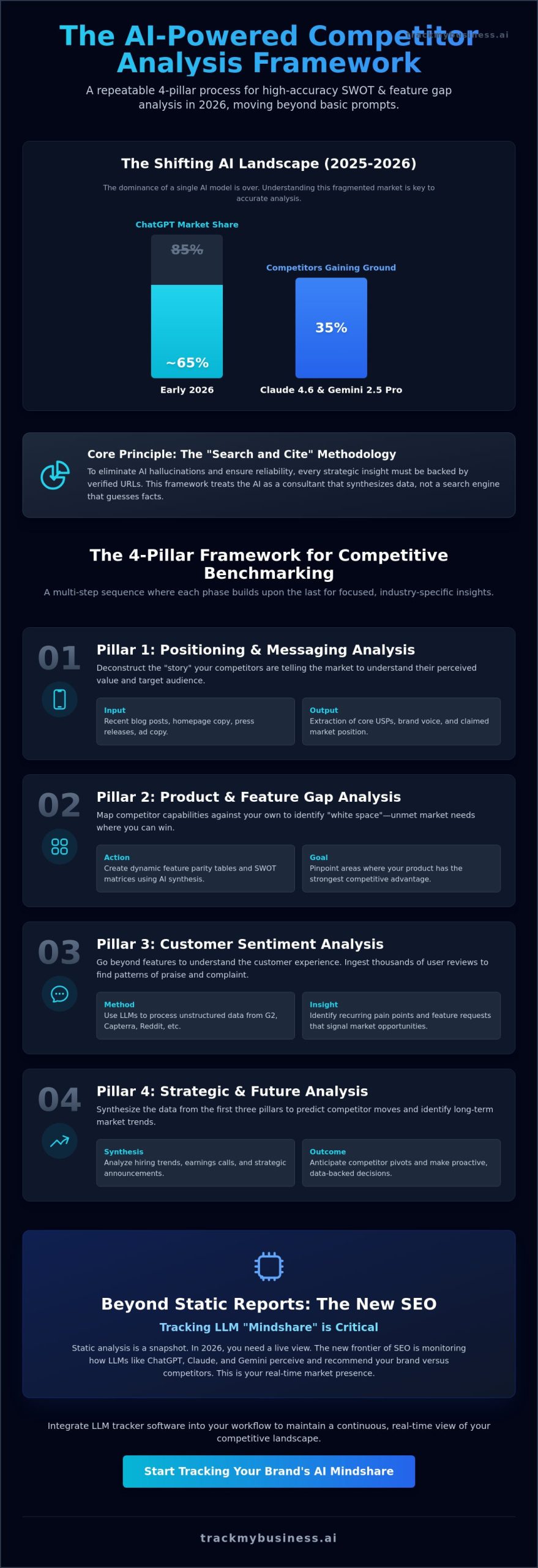
Did you know that ChatGPT’s market share dropped from over 85% in early 2025 to approximately 65% by early 2026? As models like Claude 4.6 and Gemini 2.5 Pro gain ground, relying on basic prompts for market research is no longer enough. I know how frustrating it is to spend hours on manual research only to find that your AI-generated data is outdated or completely hallucinated. You need a consistent process that your entire team can follow without questioning the reliability of the results.
In this guide, I will show you how to build a repeatable chatgpt competitor analysis framework that delivers high-accuracy SWOT and feature gap analyses. You will learn how to deconstruct competitor strategies using GPT-5.5 while avoiding the common pitfalls of AI-driven research. I will also explain how to use LLM tracker software to see exactly how these models perceive your brand compared to the competition. This allows you to track your market presence in real-time and make data-backed decisions faster.
Key Takeaways
- Learn how to implement a structured chatgpt competitor analysis framework that uses a specific sequence of prompts to replace slow, manual research methods.
- Discover the “Search and Cite” methodology to eliminate AI hallucinations and ensure every strategic insight is backed by verified URLs.
- Master the creation of dynamic SWOT matrices and feature parity tables that highlight exactly where your brand outperforms the competition.
- Understand why tracking LLM mindshare is the new SEO and how to monitor how models like ChatGPT recommend your brand to potential customers.
- Find out how to integrate LLM tracker software into your workflow to maintain a real-time view of your competitive landscape throughout 2026.
The Shift to AI-First Market Intelligence: Defining the ChatGPT Competitor Analysis Framework
I define a chatgpt competitor analysis framework as a structured sequence of prompts designed to extract deep strategic insights rather than surface-level data. In 2026, the speed of market shifts makes traditional methods obsolete. I’ve found that the best frameworks treat ChatGPT as a consultant rather than a simple search engine. You aren’t just looking for facts; you’re looking for synthesis. While tools like GPT-5.5 can summarize a webpage, their real power lies in their ability to act as a strategist that identifies patterns your team might miss.
A solid Competitor analysis framework traditionally involves identifying rivals and evaluating their strategies to determine strengths and weaknesses. However, the 2026 version moves from simple data gathering to high-level strategic synthesis using LLMs. Instead of spending 20 hours reading PDF reports, I use GPT-5.5 to cross-reference competitor pricing models against market sentiment. For example, with ChatGPT’s market share sitting at roughly 65% while Claude 4.6 and Gemini 2.5 Pro gain ground, understanding how these models perceive your brand is a critical survival skill.
Why Static Spreadsheets are Failing Your Strategy
Manual spreadsheets are snapshots of a past that no longer exists. They are static, while the digital economy is fluid. If a competitor pivots their pricing or launches a new feature in May 2026, a static document won’t catch it until your next quarterly update. I’ve seen many teams miss critical shifts because they relied on manual data entry that quickly became outdated. AI changes the game by processing unstructured data from thousands of customer reviews and news cycles in seconds. It identifies a competitor’s pivot the moment it happens, allowing you to react before they capture your market share.
Core Components of a 2026 AI Framework
A functional framework relies on three core pillars. First, you need high-quality data input. I never ask the AI to guess; I feed it specific source material like earnings calls or product documentation. Second, you must set the context. If you’re managing garment production software, you need to define that industry’s specific pain points for the model. Third, you must use iterative prompting. I start with a broad overview and then move into granular feature teardowns. This is how a chatgpt competitor analysis framework creates a tactical map of the market. It’s a structured conversation that builds on itself to reveal where your competitors are vulnerable and where you can win.
Building Your 4-Pillar ChatGPT Framework for Competitive Benchmarking
I don’t believe in the “one-prompt” solution often touted on social media. Relying on a single output usually leads to generic advice and increased hallucinations. Instead, a robust chatgpt competitor analysis framework requires a multi-step sequence where each phase builds on the previous one. This structured approach ensures the AI remains focused on your specific industry context. While academic models like the Porter’s Five Forces framework help us understand industry structure, this AI-driven method allows us to execute that analysis at the speed of the 2026 market. I break this process down into four essential pillars to ensure no strategic stone is left unturned.
Pillar 1 & 2: Positioning and Product Gaps
I begin by using Pillar 1 to tear down competitor messaging. I feed the LLM recent blog posts or homepage copy to extract their core USPs. This reveals the “story” they’re telling the market. Once the positioning is clear, I move to Pillar 2: the feature gap analysis. This is where I map their capabilities against my own. For instance, if I’m analyzing Tracker Software, I’ll prompt the model to contrast its modular inventory management with the heavy, legacy ERP systems common in the industry. This comparison helps me identify “white space,” which refers to market needs that competitors are currently ignoring or under-serving. It’s a direct way to find where your product has the strongest competitive advantage.
Pillar 3 & 4: Sentiment and Future Predictions
Pillar 3 shifts the focus to the customer. I use ChatGPT to ingest and summarize thousands of user reviews in seconds, identifying the specific frustrations that lead customers to switch providers. This provides a raw look at a competitor’s weaknesses that their marketing team would never admit. Finally, Pillar 4 involves Strategic Prediction. I often prompt the AI to play “Devil’s Advocate” by asking it to find flaws in my own business model from a competitor’s perspective. What-If Modeling is a tool for predicting competitor price shifts or product launches based on historical patterns and current market trends. For example, as major AI players have converged on a $20 per month price point for premium tiers, I can model how a competitor might attempt to undercut that standard. To stay ahead of these shifts, I recommend using LLM tracker software to monitor how these models perceive and recommend your brand in real-time.
Solving the ‘Hallucination’ Problem: Verifying AI-Generated Insights
I’ve found that one of the biggest hurdles in any chatgpt competitor analysis framework is the model’s tendency to be confidently wrong. Even with the release of GPT-5.5 in April 2026, AI can still fabricate data points that look entirely plausible. For example, some users have reported ChatGPT inventing detailed pricing structures for competitors that don’t even disclose their rates publicly. To build a framework you can actually trust, you must treat every AI-generated claim as a hypothesis that requires verification. I use a “Search and Cite” method where I explicitly instruct the model to provide a direct URL for every factual claim it makes. If the AI can’t link to a source, I don’t include that data in my strategic planning.
To professionally manage these inaccuracies, I align my verification process with the NIST AI Risk Management Framework. This involves distinguishing between “public data” and “inferred strategy.” I trust the AI to summarize a 2026 financial report, but I remain skeptical when it “infers” a competitor’s internal roadmap. I often run a “Double-Check” prompt in a separate session or use a different model like Claude 4.6 to critique the original findings. This cross-model triangulation highlights discrepancies that a single session might hide.
The Verification Workflow
I follow a three-step process to ensure my data is accurate. First, I use the “Deep Research” modes available in GPT-5.5 to browse the live web for the most current May 2026 information. Second, I manually cross-reference high-stakes claims with official press releases or SEC filings. Third, I triangulate the data across multiple LLMs. If Gemini 2.5 Pro and ChatGPT provide different versions of a competitor’s feature set, I know that specific area requires a human eyes-on approach.
When to Use Human Oversight
Human expertise is non-negotiable when identifying “too good to be true” statistics. In the garment sector, for instance, an AI might misunderstand technical jargon related to modular inventory or SKU management. I suggest setting strict guardrails in your custom GPT instructions to prevent the model from engaging in creative writing or speculation. You should always be the final filter for technical accuracy. While the AI accelerates the gathering process, your industry knowledge is what turns that raw data into a reliable chatgpt competitor analysis framework. I’ve seen that the most successful teams use AI to do the heavy lifting but rely on their own expertise to make the final call.
Executing Strategic Analysis: From SWOT to Feature Mapping
Once I have verified the data using the methods I described in the previous section, the next step in the chatgpt competitor analysis framework is turning that raw information into a tactical roadmap. I don’t settle for the generic charts that most AI tools produce. Instead, I focus on creating a dynamic SWOT matrix that suggests specific counter-moves. This is where the framework shifts from passive observation to active strategy. I use the model to synthesize competitor weaknesses into opportunities for my own team to exploit, ensuring that every insight leads to a concrete business action.
I also prioritize creating a “Feature Parity” table to visualize the competitive landscape. For example, when I analyze Tracker Software, I use the AI to contrast its modular inventory features against the rigid structures of legacy ERPs. This helps me identify exactly where my software wins and where I need to close a gap. I’ve found that using LLMs to analyze competitor pricing models is equally vital. As of May 2026, major players like OpenAI, Anthropic, and Google have converged on a $20 per month price point for premium consumer tiers. I use this context to prompt the AI to find “Customer Churn Signals” in community forums. If users are complaining about a competitor’s recent price hike or a sunsetted feature, I know exactly where to aim my next marketing campaign.
The Dynamic SWOT Prompting Strategy
I avoid surface-level descriptions by prompting for an “Actionable SWOT.” I don’t want the AI to just tell me “Competitor X is cheap.” I want it to explain that “Competitor X is undercutting our mid-market garment clients by 15% through a new modular pricing tier.” This level of detail allows me to prepare my sales team with specific talking points. I also use the framework to analyze the threat of new AI entrants in my specific niche. By tracking how these newcomers use GPT-5.5 to automate their own workflows, I can stay ahead of their growth. To see how these shifts affect your brand’s reputation, you should use LLM tracker software to monitor real-time changes in market perception.
Mapping the Feature Battlefield
I find it helpful to create a visual comparison of cloud-based versus on-premise solutions. I use ChatGPT to identify which features competitors are quietly sunsetting, which often indicates a shift in their long-term strategy. I then prompt the model to predict which integrations, such as e-commerce bolt-ons, my rivals will likely launch next based on their recent hiring patterns or patent filings. This predictive mapping ensures that my product roadmap isn’t just reactive but proactive. By the time a competitor launches a new tool, my team is already prepared with a superior alternative or a targeted response.
Beyond Static Prompts: Monitoring Competitor Mentions in LLMs with TrackMyBusiness
In the previous sections, I walked you through the manual steps of building a chatgpt competitor analysis framework. However, the 2026 reality is that your customers are no longer just searching; they’re asking. When a potential lead asks an LLM for the “best apparel management software,” they receive a curated recommendation based on the model’s training data and real-time web access. I’ve observed that traditional SEO tracking is no longer sufficient to capture these interactions. You need a way to track your “mindshare” within these models to understand how often you’re recommended compared to your rivals.
This is where LLM tracker software becomes an essential part of your toolkit. If you aren’t monitoring these mentions, you’re essentially flying blind in the new search economy. I use TrackMyBusiness to see exactly how ChatGPT, Claude, and Gemini describe my brand’s strengths and weaknesses. This data allows me to adjust my marketing messaging to influence how these models categorize my business. It’s a proactive step that goes beyond simple analysis and moves into active reputation management within the AI ecosystem. Integrating this data into your chatgpt competitor analysis framework ensures that your strategy remains grounded in how the market actually discovers your product.
The Rise of LLM Optimization (LLMO)
In 2026, being mentioned in a recommendation prompt is the new Page 1 of Google. I’ve found that these models often have a perception of a brand that differs from its own marketing materials. If ChatGPT perceives a competitor as the leader in user-friendly interfaces, it will consistently steer users in that direction. LLM Mindshare is the percentage of AI recommendations a brand receives. By monitoring this metric, you can see if your strategic pivots are actually helping you close the gap or if your competitors are pulling ahead in the eyes of the AI. This is a functional shift from tracking keywords to tracking brand authority within a neural network.
Automating Your Intelligence with Tracker
I use Tracker Software from TrackMyBusiness to bridge the gap between internal production data and external market intelligence. This software allows me to set up specific alerts for when a competitor is mentioned in a “best of” AI list or when their feature set is cited as a superior alternative. Integrating this real-time ChatGPT mention tracking into your workflow ensures that your SWOT analysis is always current. Instead of waiting for a monthly report, you get immediate feedback on how market shifts are affecting your brand’s standing. It turns a static strategy into a living process that adapts as fast as the models themselves. You can start tracking your ChatGPT mentions and competitor moves today at TrackMyBusiness.ai to ensure your brand stays at the forefront of AI recommendations.
Mastering the Future of Competitive Intelligence
I’ve outlined how a structured chatgpt competitor analysis framework transforms raw AI outputs into a tactical advantage. By moving beyond simple prompts and adopting a multi-pillar approach, you can identify market gaps and verify insights with precision. The shift toward LLM-based brand discovery means that static research is no longer enough to maintain your lead. You must understand how your business appears in the recommendations that drive modern purchasing decisions in 2026.
I invite you to book a demo of the Tracker Software to see how we track AI mentions. Our cloud-based modular system is specialized for garment and physical product businesses, offering first-to-market ChatGPT mention tracking technology. This tool is designed to bridge the gap between your internal production data and your external market presence. It allows you to respond to competitor moves as they happen rather than weeks after the fact. I’m confident that implementing these steps will give your team a clearer view of the evolving landscape. Start building your framework today and take control of how AI perceives your brand.
Frequently Asked Questions
Can ChatGPT accurately analyze my competitors’ pricing?
ChatGPT can analyze public pricing tiers effectively, but it often struggles with custom or unlisted enterprise costs. I’ve found that it’s most accurate when comparing the standard $20 per month premium tiers that became the industry norm by early 2026. You should always verify these numbers against official websites, as AI has been known to invent pricing structures for companies that don’t disclose them publicly.
How do I prevent ChatGPT from hallucinating competitor data?
I prevent hallucinations by using the “Search and Cite” method in every prompt. I explicitly instruct the model to provide a direct URL for every factual claim it makes about a rival’s features or market moves. If the AI cannot provide a source, I don’t include that information in my strategy. This process ensures that my data is grounded in reality rather than creative speculation.
Is it legal to use ChatGPT for competitor analysis?
It is generally legal to use AI to analyze publicly available competitor data, but you must stay informed about new regulations. For instance, the EU AI Act has specific transparency obligations that take effect on December 2, 2026. In the US, the “Protecting Consumers From Deceptive AI Act” was introduced in April 2026 to standardize how AI-generated content is identified. I suggest checking local state laws, like the California Transparency in Frontier AI Act, to ensure your methodology remains compliant.
What is the best prompt for a competitor SWOT analysis?
The best prompt for a chatgpt competitor analysis framework is one that asks for an “Actionable SWOT” with specific counter-moves. I tell the model to act as a senior strategic consultant and focus on “so-what” insights. Instead of a generic list, I ask it to identify how a competitor’s weakness in modular inventory can be exploited by our own product’s strengths. This turns a static chart into a tactical plan for my team.
How often should I update my ChatGPT competitor framework?
I recommend updating your analysis at least once a month or immediately following major model releases. The launch of GPT-5.5 on April 23, 2026, for example, significantly improved the depth of strategic synthesis available. Regular updates are necessary because competitor strategies and AI perceptions shift rapidly in the digital economy. Keeping your framework current prevents you from making decisions based on outdated market “snapshots.”
Can ChatGPT track real-time news about my competitors in 2026?
Yes, GPT-5.5 and other 2026 models can browse the live web to extract current news and press releases. I use “Deep Research” modes to find the latest updates on competitor product launches or regulatory filings. This capability allows me to see how rivals are responding to new laws, such as the Colorado AI Act that takes effect on June 30, 2026. It provides a level of speed that manual research simply can’t match.
What is LLM mention tracking and why does it matter for my business?
LLM mention tracking is the process of monitoring how often and in what context AI models recommend your brand to users. It matters because customers are increasingly asking AI for software suggestions instead of using traditional search engines. I use this to track my brand’s “mindshare” and see if ChatGPT perceives us as a leader in our niche. If you aren’t tracking these mentions, you’re missing a massive part of the modern customer journey.
How does TrackMyBusiness differ from standard SEO tools?
Standard SEO tools focus on keyword rankings and search engine results pages, while TrackMyBusiness monitors the internal logic of AI models. It uses a specialized chatgpt competitor analysis framework to track how your brand is perceived and recommended within LLM conversations. Our software bridges the gap between production data and market sentiment. It provides real-time alerts when your competitors are mentioned in “best of” lists generated by AI.
