
What if your brand’s biggest competitor is currently the default recommendation for every Microsoft 365 user in your industry? I recognize the frustration of seeing AI provide answers without knowing if your company is even part of the conversation. You likely feel that traditional SEO tools are leaving you blind to what is happening inside the Windows ecosystem. I have observed that many teams struggle with the “black box” of GPT-5.5, fearing that they are losing ground because they cannot see their own citations.
I understand that traditional analytics cannot currently peer into every private chat session, which creates a significant gap in your data. However, I have developed a process to help you regain control. I will show you how to implement microsoft copilot brand mention tracking to monitor and influence how your business is perceived. You will learn how to use LLM tracker software to build a dashboard of mentions, analyze sentiment trends, and increase your citation frequency in M365. I will walk you through the methodology to ensure your brand remains a top recommendation in this new era of AI visibility.
Key Takeaways
- Understand why the transition from traditional search rankings to being cited in AI responses is the essential shift for brand visibility in 2026.
- Learn how to leverage Retrieval-Augmented Generation (RAG) and the Bing Index to ensure your brand data is accessible to Copilot’s retrieval systems.
- Discover why manual monitoring fails due to personalized answers and how to implement microsoft copilot brand mention tracking using automated software for consistent data.
- Identify a framework for finding high-authority source sites that Microsoft trusts, allowing you to optimize your citation footprint effectively.
- Explore how our LLM tracker software bridges the gap between AI recommendations and your operational inventory to ensure you can fulfill the demand Copilot generates.
Why Microsoft Copilot is the New Front Line for Brand Visibility in 2026
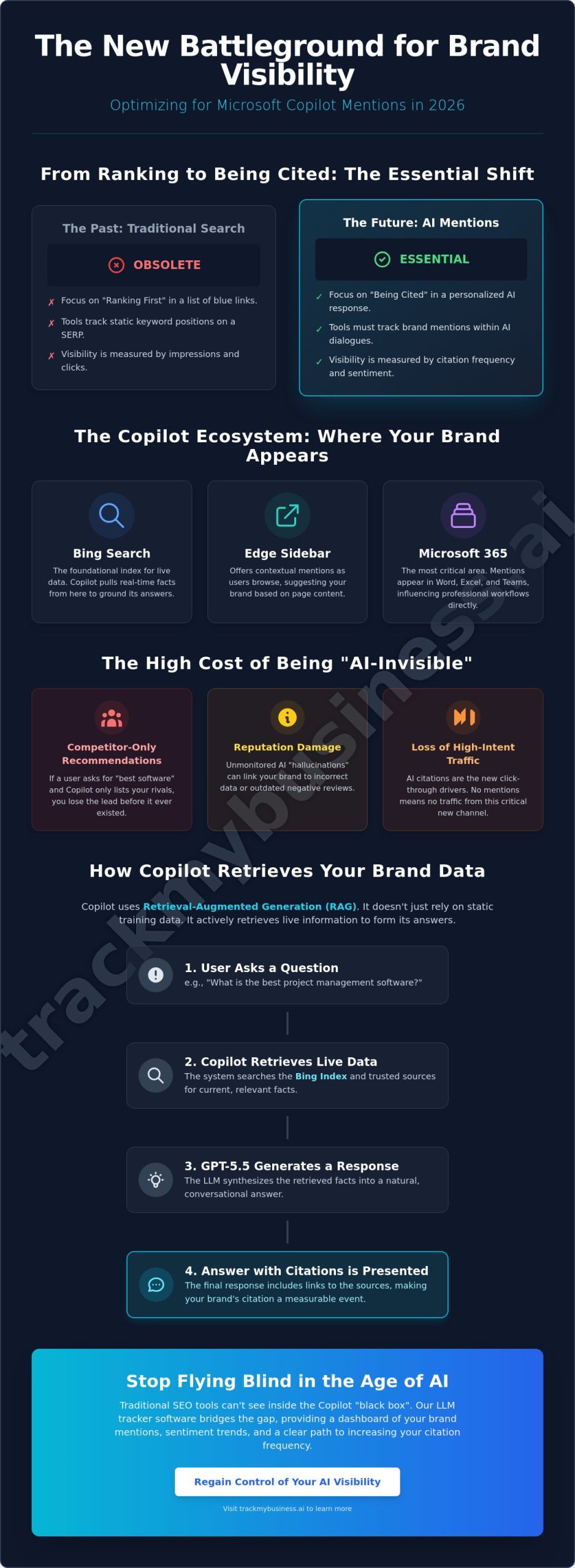
I define microsoft copilot brand mention tracking as the systematic process of identifying when and how an AI model recommends your business to users. In 2026, the digital landscape has moved beyond a simple list of blue links. Microsoft Copilot now acts as a sophisticated digital intermediary that synthesizes information from across the entire web to answer specific user queries. I have observed that the primary goal for modern brands has shifted from “ranking first” to “being cited.” If the AI does not mention your brand as a source or a recommendation, you effectively do not exist in that user’s decision-making journey.
I understand that traditional SERP tracking cannot capture the conversational nature of these interactions. Most SEO tools look for a static position on a results page, but Copilot generates unique, personalized responses. I see this as a significant visibility gap for most marketing teams. Since Copilot is deeply integrated into Windows 11, the Edge browser, and the Microsoft 365 suite, it reaches users during their most productive moments. It’s no longer enough to track keywords. You must track the actual mentions within the AI’s dialogue to understand your true market share.
The Ecosystem: Where Your Brand Appears
- Bing Search: This remains the foundational index for live data. Copilot pulls information from here to ground its answers in real-time facts.
- Edge Sidebar: As users browse the web, the sidebar offers contextual mentions, often suggesting alternatives or complementary brands based on the current page content.
- Microsoft 365: This is the most critical area for enterprise brands. Copilot mentions brands within Word documents, Excel spreadsheets, and Teams chats, influencing professional workflows directly.
The Consequences of Being “AI-Invisible”
I have noticed that being invisible to AI leads to several direct business risks. First, there is the threat of competitor-only recommendations. If a procurement officer asks for the “best project management software,” and Copilot only lists your rivals, you lose that lead before it ever reaches your website. Second, unmonitored “hallucinations” can link your brand to incorrect data or outdated reviews, which damages your reputation. Finally, you lose high-intent traffic. Citations in Copilot are the new click-through drivers. Without active microsoft copilot brand mention tracking, you cannot measure or improve your presence in these critical AI-driven conversations.
The Mechanics of Mention: How Copilot Retrieves Your Brand Data
I start by examining the relationship between the Bing Index and the GPT-5.5 model that powers Copilot. Copilot isn’t just a static database; it uses a process called Retrieval-Augmented Generation (RAG). I think of the Bing Index as the “live brain” and the LLM as the “voice.” When a user asks a question, the system searches the index for relevant facts and then uses the LLM to package those facts into a natural response. This means your website’s technical structure is more important than ever. If your data isn’t easily digestible for the RAG process, the AI will simply look elsewhere to find answers about your industry.
I prioritize optimizing for LLM brand visibility because Copilot relies on a hierarchy of trust. It cross-references your own site against high-authority platforms like G2, Capterra, and specialized industry news sites. If these external sources consistently mention your brand in a specific category, Copilot adopts that framing as truth. This is why microsoft copilot brand mention tracking is essential. You need to identify which external sources are driving your citations so you can focus your PR and review efforts where they have the most impact on the AI’s retrieval logic.
Live Citations vs. Training Data
I distinguish between the model’s “frozen” knowledge and what it finds during a live search. Training data gives the model its general language skills, but real-time indexing provides the specific, current facts about your products. When you look at the Copilot UI, you see “Citation Lists” at the bottom of the response. These links are the direct result of the RAG process. Tracking these mentions in real-time allows you to see if your latest product launch or press release is actually being picked up. If your brand only appears in the training data but not the live citations, your visibility will quickly vanish as information becomes outdated.
Sentiment and Contextual Framing
I also look at how the AI frames your brand. It’s not just about being mentioned; it’s about the adjectives the AI chooses. Does it call your product “expensive” or “value-driven”? I track sentiment drift across thousands of unique prompts to identify patterns in how the model perceives your market position. We’ve moved from “Share of Voice” to “Share of Recommendations,” where the AI’s opinion determines your lead flow. To manage this at scale, I suggest using dedicated LLM tracker software to automate the data collection and sentiment analysis across the entire Windows ecosystem.
The Limitations of Manual Monitoring and the Rise of Automated Trackers
I often see businesses attempting to conduct microsoft copilot brand mention tracking by hand. They open a browser, type a few prompts, and assume they have a clear picture of their visibility. I have found that this approach is fundamentally flawed. You cannot manually replicate the thousands of ways a potential customer might ask for a solution. Copilot’s responses are dynamic. They shift based on the specific phrasing of a prompt. If you only test five variations, you are missing the other ninety-five where your competitor might be the primary recommendation.
I recognize that tracking hundreds of “Buyer Intent” prompts daily is the only way to gain a statistically significant view of your market share. Manual checking doesn’t scale. It leaves massive blind spots in your data, especially for long-tail queries. I have observed that competitors often win the recommendation engine in these niche areas because they are ignored during manual audits. I utilize specialized LLM tracker software to ensure that no mention goes unrecorded across the entire Windows ecosystem.
The Problem with Personalized Results
Copilot is designed to be a personal assistant. It learns from your previous interactions, your location, and your account data. This creates a “bubble” effect. When I search for my own brand, I might see a positive result because the AI knows I’m associated with it. This doesn’t reflect what a neutral prospect sees. I have discovered that even using an incognito window doesn’t fully strip away the underlying biases of the model’s retrieval logic. To solve this, I recommend using localized tracker software that can query the system from a clean state. This provides a baseline of truth that manual searching cannot provide.
From Data Points to Actionable Insights
I believe that a simple “yes” or “no” regarding a brand mention is insufficient. You need to understand the “why” and “how” behind the answer. My methodology involves analyzing which third-party sources are actually powering the citation. If a specific niche forum or a particular review site is the reason Copilot recommends you, you need to know that. I use professional microsoft copilot brand mention tracking to categorize these mentions by their impact on the sales pipeline. This allows me to prioritize the prompts that actually drive revenue. I focus on the methodology behind the information gathering to ensure you are not just chasing vanity metrics in a chat interface.
Strategic Framework: How to Optimize for Copilot Mentions
I have developed a specific framework to move from passive monitoring to active optimization. I start by auditing your current citation footprint across the entire Bing ecosystem. I have observed that many brands focus exclusively on their own website while ignoring the external sites that Copilot uses to verify facts. I use microsoft copilot brand mention tracking to map out these relationships. I look for where your brand is mentioned alongside competitors and identify the gaps in your authority. I then focus on correcting factual inaccuracies in real-time. If the AI cites outdated pricing or discontinued features, I prioritize updating those specific source sites to feed the RAG process cleaner data.
I believe that your visibility data must be actionable. I integrate mention data directly with your operational systems to ensure that your supply can meet the demand generated by AI recommendations. If you’re ready to automate this process, I suggest you start using our LLM tracker software today to gain a competitive edge. I focus on this direct connection between visibility and operations to ensure your business is prepared for the traffic that microsoft copilot brand mention tracking reveals. I don’t just track data; I use it to drive procurement and inventory decisions.
Winning the Sources Copilot Trusts
I identify the specific domains that Copilot cites when discussing your industry niche. I’ve found that “Source Domination” is an effective strategy for brands in the garment and decoration industry. I focus on securing mentions in high-authority trade publications and review platforms that the model already trusts. I use PR and external reviews to provide the “social proof” that the AI needs to recommend your brand with confidence. I don’t wait for mentions to happen. I actively target the sources that the model’s retrieval logic favors to ensure your brand is the primary recommendation.
Technical Optimization for 2026
I prioritize technical site structure to improve LLM readability. I use JSON-LD and Schema markup to define your brand as a distinct entity rather than just a collection of keywords. I’ve found that entity-based content consistently outperforms traditional SEO content in Copilot answers. I also implement Model Context Protocol (MCP) servers to help AI agents access your data more efficiently. I ensure that your product information is structured so that Copilot can pull live specifications without hesitation. This technical foundation ensures your “Tracker” product data is always accessible to the next generation of AI agents.
Bridging Operations and AI: The TrackMyBusiness LLM Tracker
I have built LLM tracking into our core philosophy because I believe that visibility is useless without the operational capacity to fulfill it. Most tools treat AI mentions as a simple marketing metric, but I see them as a direct signal for your supply chain. If my microsoft copilot brand mention tracking reveals that a specific product is being recommended to thousands of users in the Microsoft 365 ecosystem, I need to know if that item is actually in stock. I have integrated these insights to bridge the gap between what the AI says and what your business can actually deliver. This prevents the frustration of driving high-intent traffic to out-of-stock pages.
I utilize a transparent methodology for gathering this data. My process involves querying the GPT-5.5 models through secure APIs to see exactly how your brand is being framed in real-time. I don’t rely on guesswork or cached results. I provide a direct look into the citations that appear in Word, Teams, and Edge. For my clients in Saudi Arabia and across the globe, this provides a localized understanding of how AI search trends are shifting. I focus on the functional data that allows you to stay ahead of competitors who are still relying on traditional, static SEO reports.
More Than a Marketing Metric
I use mention data to inform my procurement and production cycles. When I see a surge in Copilot citations for a specific category, I treat it as an early warning system for a coming trend. I have found that AI recommendations often precede traditional search volume spikes by several weeks. By identifying these shifts early, I can adjust my inventory levels before the demand peaks. I use our own tracker software to manage this flow, giving me a first-person advantage in the market. I don’t just sell these tools; I rely on them to ensure my business remains agile and responsive to AI-driven demand.
Getting Started with Copilot Tracking
I have designed the setup process to be as direct as possible. You can establish your first brand mention monitor in minutes by identifying your core brand entities and competitors. Once active, the system begins scanning the ecosystem to provide a clear dashboard of your visibility. I recommend integrating your tracker software with these AI insights to see the full picture of your business health. This proactive approach ensures you are never surprised by what the AI is telling your customers. If you are ready to see how your brand performs, you should request a demo of our LLM Tracker to begin your journey toward total AI visibility.
Secure Your Brand’s Position in the New AI Economy
I’ve outlined how the shift from search rankings to AI citations is redefining visibility for every business. You now have a framework to optimize your technical structure and influence the sources that Copilot trusts. I realize that manual monitoring is no longer a viable strategy for brands that want to scale. By adopting a professional approach to microsoft copilot brand mention tracking, you can move from guessing to knowing exactly how your brand is perceived. I’ve found that the most successful businesses are those that connect these AI insights directly to their operational workflows.
I offer a modular Tracker system that provides end-to-end transparency for your operations. My specialized expertise in physical product visibility ensures that your data is handled with precision. With SA-based support and a global cloud infrastructure, I provide the reliability you need to compete in a global market. Start tracking your brand mentions in Microsoft Copilot today and ensure your business is the one the AI chooses to recommend. I’m ready to help you navigate this transition with a clear, process-oriented methodology.
Frequently Asked Questions
Does Microsoft Copilot use the same data as ChatGPT?
No, Copilot utilizes a unique data retrieval pool despite both systems using GPT-based models. While ChatGPT relies heavily on its training set and specific plugins, Copilot integrates live data from the Bing Index and the Microsoft 365 Graph. I have found that this results in different citation patterns. Copilot is designed to prioritize the Microsoft ecosystem, which means your visibility there depends on how well Bing indexes your site.
How often does Copilot update its citations of my brand?
Citations update in real-time as the Bing Index crawls new information. I have observed that a new press release or a high-authority review can appear in Copilot answers within hours of being indexed. Because of this speed, I recommend microsoft copilot brand mention tracking to capture these rapid changes. If you don’t monitor your mentions daily, you might miss a sudden shift in how the AI describes your products.
Can I pay Microsoft to be a “Preferred Recommendation” in Copilot?
There’s currently no direct “pay-to-play” model for organic conversational citations in Copilot. While Microsoft offers traditional search ads, the AI’s recommendations are driven by its retrieval-augmented generation process. I focus on earning these mentions through authority and structured data. I’ve discovered that the best way to become a preferred recommendation is to dominate the source sites that the AI already trusts for your specific niche.
What is the difference between SEO and AEO (Answer Engine Optimization)?
SEO focuses on ranking a website in a list of blue links, while AEO focuses on providing the specific answer that an AI cites. I treat AEO as a methodology for data delivery. It’s about making your brand’s facts retrievable for an LLM rather than just clickable for a human. I use microsoft copilot brand mention tracking to measure how effectively my AEO strategies are influencing the AI’s final responses.
How does Copilot handle brand mentions in private Microsoft 365 chats?
Microsoft 365 Copilot maintains strict enterprise data boundaries. It doesn’t share private internal chat data with the public model or with other organizations. I cannot track what is said about your brand inside another company’s private Teams chat. My tracking methodology focuses on the public-facing version of Copilot and the data it pulls from the open web to recommend brands to the general public.
What should I do if Copilot is giving incorrect information about my products?
You must find the source of the error and correct it at the root. I use specialized LLM tracker software to identify which specific website or article provided the incorrect data to the AI. Once you update that source and Bing re-indexes the page, the AI’s response usually corrects itself. I’ve found that trying to “prompt engineer” the AI directly is less effective than fixing the underlying data.
Is brand mention tracking available for Saudi Arabian businesses?
Yes, I provide localized tracking services specifically for businesses in Saudi Arabia and the GCC region. I utilize a global infrastructure that allows me to see how Copilot responds to prompts within the Kingdom. This is essential for local brands that want to ensure they are appearing in Arabic or English queries. I help Saudi businesses stay ahead of global AI trends by monitoring their local visibility in real-time.
How do I track if Copilot is recommending my competitors over me?
I use specialized LLM tracker software to run head-to-head comparisons across your industry’s most important buyer-intent prompts. This process allows me to calculate your “Share of Recommendations” compared to your rivals. I analyze the sentiment and context of these mentions to see why the AI prefers one brand over another. This data provides the proactive next step for adjusting your content strategy to win back the AI’s trust.
