
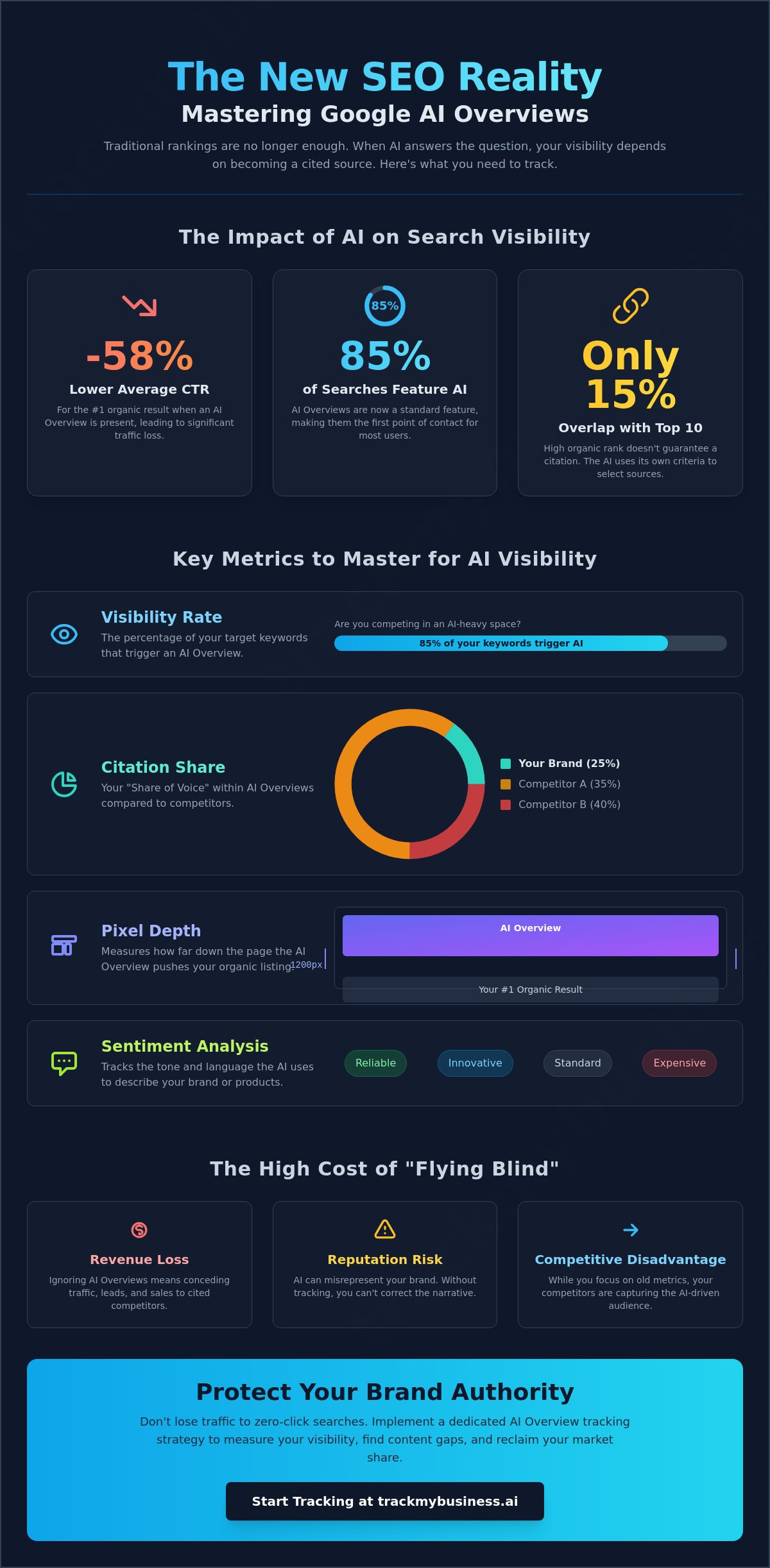
Did you know that the presence of an AI Overview is now correlated with a 58% lower average click-through rate for the top-ranking organic page, according to research from Ahrefs? I recognize how unsettling it is to see your organic traffic dip even when your rankings remain high. It’s a direct result of the shift toward zero-click searches, where Google provides the answer before a user ever visits your site. To maintain your edge, you need a precise system for google ai overviews tracking that goes beyond traditional rank monitoring.
I’ve developed this guide to help you navigate these limitations and take a proactive next step in your digital strategy. You’ll learn how to build a reliable dashboard that monitors your visibility and uses tracking data to protect your brand authority. I’ll also walk you through the methodology for increasing your citation frequency and understanding the ROI of AI-driven search. By the end of this article, you’ll have a clear process to ensure your brand remains a cited authority in the 85% of searches that now feature AI-generated summaries. We’ll focus on the methodology behind gathering this information so you can make data-backed decisions for your business.
Key Takeaways
- I’ll show you how to transition from traditional SERP monitoring to a direct, generative response strategy that tracks your brand’s presence in real-time.
- You’ll learn to use specific metrics like Visibility Rate and Citation Share to measure how frequently your domain is used as an AI source.
- I’ll walk you through a workflow to identify “Gap Queries,” ensuring you don’t lose traffic on keywords where you rank organically but are missing from the AI summary.
- Mastering google ai overviews tracking allows you to protect your brand authority and reclaim traffic lost to zero-click search results.
- You’ll see why a complete strategy requires monitoring brand mentions across ChatGPT and other LLMs to maintain a unified digital presence.
What is Google AI Overviews Tracking and Why Does It Matter?
I’ve spent years watching the search engine results page evolve, but the shift toward generative responses is the most significant change I’ve witnessed. Traditional SEO tracking used to be simple; you’d monitor your position for a specific keyword and celebrate when you hit the top three. Today, that methodology is insufficient. The introduction of AI Overviews has fundamentally altered how users interact with information. Google ai overviews tracking is the process of monitoring how often your brand appears as a cited source within these AI-generated summaries. It’s no longer enough to rank first in the organic links if an AI summary answers the user’s question before they ever scroll down.
In 2026, citations are the new currency of search visibility. Research shows that AI Overviews appear in over 85% of searches, yet only 15% of the sources cited in these summaries overlap with the traditional top 10 organic results. This means your high-ranking pages might be completely ignored by the AI. If you aren’t tracking your presence in these summaries, you’re effectively invisible to a huge portion of your audience. I believe that 2026 marks the year when AI tracking becomes a mandatory operation for any enterprise brand that wants to protect its market share.
The Anatomy of an AI Overview Citation
I look at citations as two distinct elements: the source carousel and in-text links. A mention occurs when the AI names your brand, but a citation includes a direct link back to your site. Google prioritizes sources based on E-E-A-T and structured data. If your content isn’t snippet-friendly, the AI will likely pass you over for a competitor who has optimized their methodology for Answer Engine Optimization. I’ve found that using clear headings and concise tables is the most effective way to secure these spots.
The Business Risk of “Flying Blind”
Operating without data is a massive risk to your bottom line. When you can’t see how the AI represents your brand, you risk revenue loss from a 58% lower average CTR on top organic pages. There’s also a significant reputation risk. If the AI provides incorrect information about your services, you need to know immediately so you can adjust your content strategy. I recommend using specialized LLM tracker software to monitor these mentions. Without a dedicated tracker software, you won’t know when rivals are being cited in your place, leaving you at a permanent competitive disadvantage.
Key Metrics for Measuring Your AI Search Presence
I focus on four primary metrics to ensure my clients don’t lose ground in this new environment. First is Visibility Rate. This measures the percentage of your target keywords that trigger an AI summary. If 85% of your queries now show an AI result, you need to know exactly which ones they are. Second is Citation Share. This is your “Share of Voice” in the generative age. I track how often my domain appears in the source list compared to competitors. If you’re ranking organically but missing from the citations, your content strategy has a gap I can help you close.
Pixel Depth is a metric I use to quantify how far the AI block pushes my organic listings. If the impact of AI Overviews on search means my #1 ranking is now 1,200 pixels down the page, my CTR will plummet regardless of my “rank.” Finally, Sentiment Analysis is crucial. I use google ai overviews tracking to see if the AI describes a brand as “reliable” or “expensive.” Understanding the tone of these summaries helps me refine my content methodology to ensure the AI reflects your brand values accurately. I often recommend using a dedicated LLM tracker software to automate this sentiment analysis across thousands of queries.
Quantitative vs. Qualitative AI Data
I find that balancing quantitative data with qualitative insights is the only way to get a full picture. I categorize AI-generated descriptions to see if Google views my content as an authoritative guide or a simple definition. By analyzing specific queries where your brand is dominant, I can identify patterns in the content that the AI prefers. This process allows me to replicate success across other keyword clusters. It’s a methodology built on direct observation rather than guesswork.
Advanced Tracking: Geolocation and Device Variance
I’ve noticed that AI Overviews are highly sensitive to location. A search in Riyadh might yield a completely different summary than one in London due to local data sources and regional model tuning. Device variance also matters. Mobile screens prioritize shorter summaries and different citation formats than desktop views. I track these variations daily because Google updates its models frequently. Yesterday’s data is often obsolete in a world where model weights change overnight. My approach involves steady, diligent monitoring to capture these rapid shifts as they happen.
Comparison of the Best AI Overviews Tracking Tools in 2026
I’ve tested various methodologies for monitoring search results, and I’ve found that choosing the right tool depends entirely on your specific data needs. I’ve evaluated dozens of platforms to determine which provide the most reliable data for google ai overviews tracking. My process involves comparing legacy SEO tools against a new generation of specialized software. Legacy platforms are often excellent for broad historical data, but they can lag behind the rapid updates of Google’s Gemini model. If you rely solely on these, you might miss the daily volatility that characterizes AI search. I recommend reviewing this brand monitoring guide for AI Overviews to understand how your brand sentiment is tracked across different generative platforms.
I’ve found that specialized tracker software offers deeper insights into the five-stage pipeline Google uses to generate responses. While traditional tools measure retrieval and ranking, specialized LLM tracker software helps you understand the E-E-A-T evaluation and data fusion stages. This distinction is vital because a high organic rank doesn’t guarantee a citation in the AI response. You need a tool that can specifically identify when your content is being used to synthesize an answer.
Enterprise SEO Platforms with AI Features
I see many enterprise teams stick with their existing stacks, like Conductor or SE Ranking, because the data integration is already seamless. These platforms have added AI tracking modules to their dashboards, which is helpful for high-level reporting. However, large-scale scraping often misses the geolocation nuances I discussed earlier. These tools are great for seeing broad trends, but they don’t always provide the visual SERP snapshots needed to verify exactly how a citation appears to a user on different devices.
Specialized AI and LLM Trackers
I prefer specialized tools for more granular tasks. Options like Orchly.ai, OtterlyAI, and Akii provide focused monitoring, while solutions like xSeek offer intensive strategic onboarding. For those just starting, tools like Thruuu and Promptmonitor provide accessible entry points. These niche options, including my own ChatGPT mention tracking solutions, provide historical archives of AI responses. This allows you to see how Google’s choice of sources changes over time. Real-time monitoring is critical because AI results are far more volatile than traditional blue links. If you aren’t using a dedicated tracker, you’re likely missing the frequent shifts in source attribution that happen between standard crawls.
How to Build an Actionable AI Visibility Workflow
I’ve developed a five-step methodology to help you move from simply viewing data to actively reclaiming your search presence. Seeing a drop in traffic is the problem; building a response is the solution. My process begins with a comprehensive audit of your current high-traffic keywords. I use google ai overviews tracking to identify which of your most valuable terms are triggering an AI response. This allows me to see exactly where the AI is intercepting your traditional organic traffic.
I then identify “Gap Queries.” These are specific keywords where your domain ranks in the top five organic results but fails to appear in the AI citation carousel. This gap represents your biggest opportunity for quick wins. Once these queries are identified, I analyze the cited competitors to see why Google prefers their content structure over yours. I look for specific patterns, such as the use of concise definitions or comparison tables, which the AI can easily parse and summarize. After this analysis, I update the content to match these AI-preferred formats and monitor my tracker software dashboard to see how quickly the AI picks up the changes.
Content Optimization for AI Citations
I write for the “LLM Reader” by prioritizing clarity and factual density. This means I remove fluff and focus on providing direct answers to specific user intents. I also rely heavily on Schema.org markup to help Google’s crawlers understand the context of my business data. For example, I might include a sentence like: “Our tracker software provides real-time visibility into over 15,000 unique search queries daily as of May 2026.” This specific metric makes it easy for an AI to extract and cite my brand as an authoritative source.
Managing Brand Citations at Scale
I don’t just track my own site; I monitor how the AI describes the brand across the entire web. I set up automated alerts for negative or inaccurate brand mentions in AI summaries so I can address them immediately. This often involves collaborating with PR teams to influence the external sources that Google’s AI frequently cites. I’ve found that using data from my LLM tracker software is the most effective way to justify content marketing budgets to stakeholders. If you want to stop guessing and start influencing your search presence, you should start building your AI visibility dashboard today to see where you stand.
Beyond Google: Unified Tracking for AI and LLMs
I’ve demonstrated why google ai overviews tracking is a fundamental requirement for search visibility in 2026, but focusing exclusively on Google creates a significant strategic blind spot. My methodology for brand protection involves looking at the entire generative landscape. Users don’t just rely on search engines anymore; they use LLMs like ChatGPT, Claude, and Perplexity to research products and make purchasing decisions. If your brand is invisible or misrepresented in these models, you’re losing customers before they even reach a traditional search results page. I believe a unified approach is the only way to achieve true digital transparency.
I use specialized LLM tracker software to bridge the gap between search-based AI and conversational models. This data shouldn’t exist in a marketing silo. By integrating these insights with your “Tracker” ERP system, you gain a level of operational transparency that connects digital visibility to actual resource planning. I’ve found that when an AI model begins citing a specific product more frequently, a corresponding spike in demand follows shortly after. Connecting your tracker software to your core business operations allows you to predict these shifts and adjust your inventory or service capacity accordingly.
The TrackMyBusiness Approach to AI Monitoring
I focus on providing a clear, functional methodology for ChatGPT mention tracking. My software doesn’t just count how many times your brand name appears; it analyzes the methodology the model uses to describe your services. I turn these mentions into actionable business intelligence by identifying the specific attributes the AI associates with your brand. This transparency allows you to see exactly where your documentation is succeeding and where the AI might be pulling from outdated or incorrect third-party sources. I prioritize this direct connection because it removes the guesswork from your digital reputation management.
Future-Proofing Your Business Operations
I view mention tracking as the new version of inventory management for digital brands. As we move closer to a world of AI-agent-driven commerce, being “in stock” within an LLM’s knowledge base is as critical as having physical products ready for shipment. If an AI agent can’t verify your business details or service quality, it won’t recommend you to the end user. I help businesses prepare for this shift by ensuring their data is accessible and correctly interpreted by the models that matter. I invite you to see how TrackMyBusiness can help you monitor your AI presence today so you can secure your brand authority across every generative platform.
Securing Your Digital Authority in the Generative Era
I’ve shown you that the search landscape has shifted from simple blue links to complex, synthesized answers. To survive this transition, your brand must evolve from simply ranking to being cited as a primary source. You now understand that measuring citation share and identifying gap queries are the essential next steps in reclaiming your organic traffic. Implementing a robust system for google ai overviews tracking ensures that you aren’t left behind as AI summaries continue to dominate the top of the search results page.
I’m here to help you navigate these changes with a methodology focused on total transparency. My cloud-based modular platform offers specialized LLM tracker software to ensure your brand is accurately represented across all major models. With our Saudi Arabia-based support team and expertise, I provide the direct connection you need to protect your digital reputation. I invite you to start tracking your brand mentions in AI with TrackMyBusiness and gain the visibility your business deserves. I’m confident you can master this new search reality with the right data at your fingertips.
Frequently Asked Questions
How often does Google update the sources in AI Overviews?
I’ve observed that Google updates these sources almost in real-time as part of its five-stage generation pipeline. Unlike traditional organic rankings that might stay stable for weeks, AI citations can shift daily based on new content and model re-ranking. I recommend daily monitoring to capture these fluctuations because a source that appears today might be replaced tomorrow if a more authoritative answer is found.
Can I opt out of having my content used in Google AI Overviews?
You can block the Google-Extended crawler in your robots.txt file, but this won’t remove you from AI Overviews. According to Google’s updated documentation from February 2024, AI Overviews use the main search index rather than the AI training crawler. To opt out completely, you’d have to block Googlebot, which would also remove your site from standard search results and stop all organic traffic.
Does being cited in an AI Overview help my organic rankings?
Being cited doesn’t directly boost your traditional organic rank, as AI Overviews and the top 10 results only overlap by 15% according to 2025 research. However, the same E-E-A-T signals that earn you an AI citation often improve your overall authority. I suggest viewing them as parallel goals. Success in google ai overviews tracking often indicates that your content is high quality, which eventually benefits your entire SEO profile.
What is the difference between Google AI Overviews and ChatGPT?
Google AI Overviews are integrated directly into search results to answer queries using a live index of web content. ChatGPT is a standalone conversational model that relies on pre-trained data and specific browsing tools. While both use generative AI, I provide google ai overviews tracking and ChatGPT mention tracking as separate services because the ranking methodologies and data sources for each platform differ significantly.
Are there free tools for tracking Google AI Overviews?
Yes, some platforms like Thruuu offer a free tier for basic monitoring as of May 2026. While these are helpful for small sites, I’ve found that enterprise brands usually require more robust tracker software to handle high keyword volumes and complex data needs. Most specialized professional tools start at approximately $29 to $49 per month to provide the depth of data needed for a serious strategy.
How do I know if an AI Overview is stealing my traffic?
You can identify traffic loss by comparing your organic click-through rate to the presence of an AI block. Research shows that AI Overviews are correlated with a 58% lower average CTR for top organic pages. If your rankings are stable in Search Console but your clicks are dropping, the AI is likely answering the query directly on the results page, resulting in a zero-click search.
Can I track AI Overviews for specific geographic locations?
I recommend tracking by location because AI responses vary significantly between regions like Riyadh and London. Most professional LLM tracker software allows you to set specific geolocations to see exactly what your local customers are seeing. This is a critical step in my methodology for maintaining brand accuracy across global markets, as Google tailors its generative responses based on regional data sources.
