
With traditional search volume dropping by 25% this year as AI chatbots take over, your old SEO dashboard is likely missing a massive piece of the puzzle. I know the pressure you’re under when leadership asks for the ROI on AI, especially since traditional tools don’t show what ChatGPT is actually telling your customers. Establishing the right ai visibility kpis for marketing teams is no longer optional if you want to stay relevant in 2026.
I understand how frustrating it is to manually prompt different LLMs just to see if your brand gets a mention. It is a time-consuming process that often leads to inconsistent data and missed opportunities. My goal is to help you master the metrics that matter in the age of LLMs with our comprehensive checklist for tracking and reporting AI visibility. I will walk you through the specific KPIs that actually move the needle, the tools that automate this data collection, and how to present these findings to your board with confidence.
Key Takeaways
- Learn the five essential pillars of ai visibility kpis for marketing teams, including Brand Mention Rate and Share of Model, to measure your presence across generative engines.
- Understand why traditional search rankings no longer guarantee brand discovery and how to pivot your strategy to capture conversational mentions.
- Discover the limitations of manual LLM testing and how automated LLM tracker software eliminates biased data caused by inconsistent prompting.
- Follow a step-by-step guide to auditing your current AI footprint and selecting the primary engines that align with your specific target audience.
- Identify how to integrate your operational data with specialized ChatGPT mention tracking to create board-ready reports on your brand’s performance.
Why Traditional SEO Metrics Fail in the Age of AI Visibility
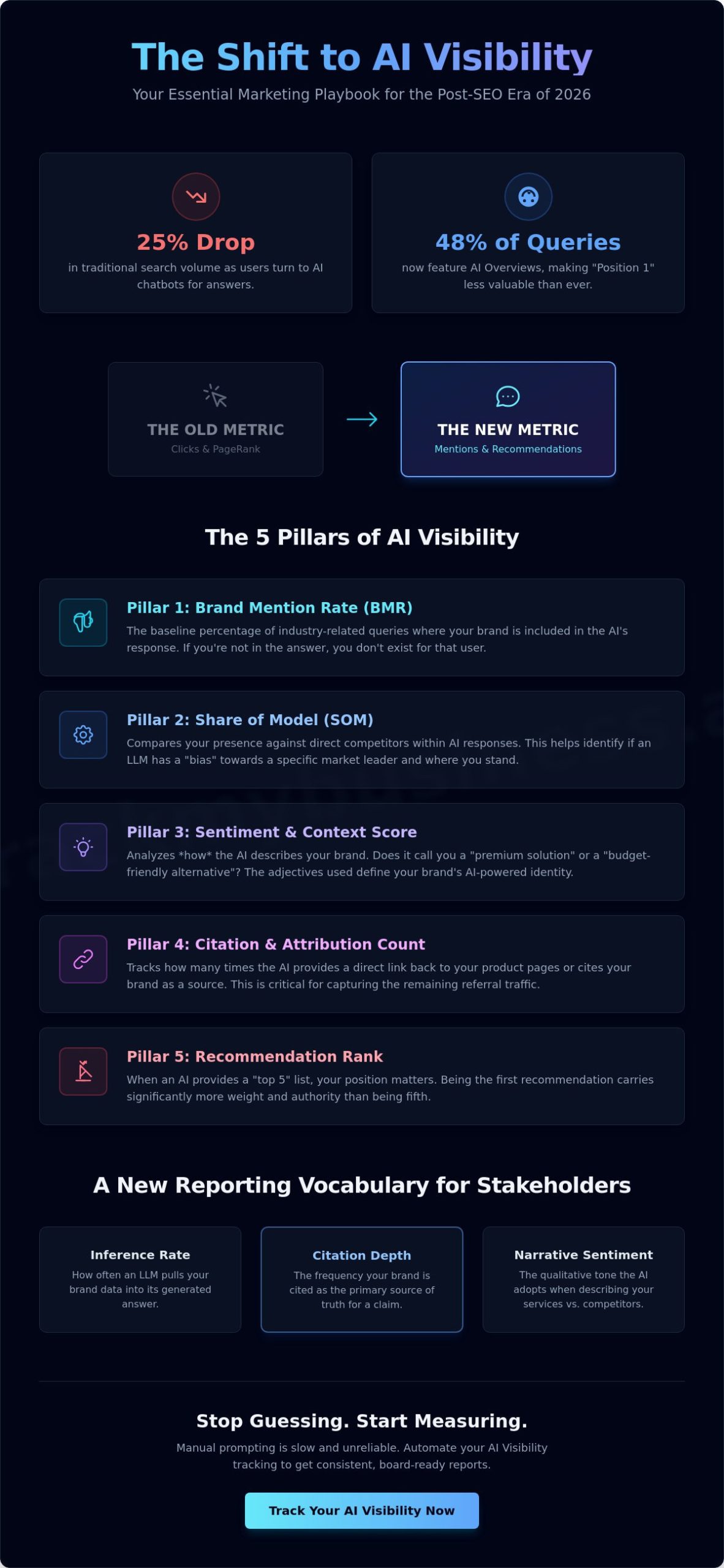
For years, we relied on a simple formula: rank high, get clicks, and convert users. But as of June 2026, that formula is fundamentally broken. With AI Overviews now appearing on 48% of search queries, I have seen even “Position 1” results lose their value because the user never leaves the search page. This shift requires a new approach to ai visibility kpis for marketing teams. Traditional metrics tell us where we sit in a list, but they don’t tell us if we are part of the conversation.
I define AI Visibility as the frequency and quality of your brand mentions within generative responses. Unlike Google’s index, platforms like ChatGPT or Claude operate as a non-deterministic “black box.” Because these models prioritize personalization and context over static keywords, traditional rank tracking has become obsolete. This is why we are seeing the rise of Generative Engine Optimization (GEO). It is a distinct discipline focused on how models ingest and surface your brand data during the inference process.
The difference between clicks and mentions
In the past, a “zero-click” search was a missed opportunity. Today, it is the standard baseline. Gartner predicted that traditional search volume would drop by 25% by 2026, and we are seeing that shift play out in real time. When an LLM recommends your product, you don’t always get referral traffic. Instead, you get a high-intent “Brand Impression” directly inside the chat window. If your team only tracks clicks, you are missing the moment your customer makes a buying decision. We must prioritize being the source of the answer rather than just a link on a page.
Why 2026 requires a new reporting vocabulary
To report effectively to your board, you need a vocabulary that reflects how Artificial intelligence in marketing actually functions. We are moving away from PageRank and toward “Trust Signals” that prioritize entity clarity and structured data. When building your ai visibility kpis for marketing teams, you should include these specific metrics:
- Inference Rate: How often an LLM pulls your brand data into its generated answer.
- Citation Depth: The frequency with which your brand is cited as the primary source of truth for a specific claim.
- Narrative Sentiment: The qualitative tone the AI adopts when describing your services compared to competitors.
For 2026 stakeholders, AI Visibility is defined as the measurable probability that an LLM will recommend your brand as the definitive solution to a user’s prompt. It is no longer about being found; it is about being chosen by the algorithm.
The Essential AI Visibility Checklist: 5 Pillars for Marketing Teams
I have observed that teams often struggle to move from conceptual AI discussions to actionable reporting. To effectively measure marketing metrics in the age of AI, you need a framework that captures both your volume of presence and the value of your positioning. These ai visibility kpis for marketing teams provide a structured way to evaluate how generative engines perceive and recommend your brand. I recommend focusing on these five pillars to build a report that resonates with stakeholders.
- Pillar 1: Brand Mention Rate (BMR). This is the baseline percentage of industry-related queries where your brand is included in the response. If you aren’t in the answer, you don’t exist for that user.
- Pillar 2: Share of Model (SOM). This metric compares your presence against your direct competitors. It helps identify if an LLM has a “bias” toward a specific market leader.
- Pillar 3: Sentiment and Context Score. I look at how the AI describes your brand. Does it call you a “premium solution” or a “budget-friendly alternative”? The adjectives used here define your digital identity.
- Pillar 4: Citation and Attribution Count. We track how many times the AI provides a link back to your product pages. This is critical for driving the traffic that remains in the synthetic search era.
- Pillar 5: Recommendation Rank. When an AI provides a “top 5” list, your position matters. Being the first recommendation carries significantly more weight than being fifth.
I suggest using a dedicated tracker software to keep these records consistent and unbiased. Without automation, your data will likely suffer from the non-deterministic nature of these models.
Technical Checklist: Tracking the Brand Mention Rate
To establish a reliable BMR, you must follow a rigorous methodology. I start by defining a set of 50 core “category” prompts that reflect your primary business goals. You should run these exact prompts across ChatGPT, Gemini, and Claude on a weekly basis. By calculating the percentage of responses that contain your brand name, you create a baseline for your ai visibility kpis for marketing teams that is grounded in data rather than anecdotes.
Qualitative Checklist: Sentiment and Positioning
Monitoring the quality of mentions is just as important as the quantity. I recommend categorizing every AI mention as Positive, Neutral, or Negative to see the broader trend. You should also identify the “Key Adjectives” the AI repeatedly associates with your brand. Finally, monitor whether the AI correctly identifies your primary service, such as “garment production management,” to ensure your messaging isn’t being garbled by the model’s training data.
Tooling Comparison: Manual Tracking vs. Automated LLM Software
I often see marketing managers spending hours “self-chatting” with LLMs to see if their brand pops up. While this feels productive, it is a deeply flawed methodology. Manual testing is plagued by personalization bias, where the AI tailors its response to your specific account history or location. To get accurate ai visibility kpis for marketing teams, you need a neutral environment that simulates how a first-time user interacts with the model. Without this, your data is just a collection of anecdotes rather than actionable intelligence.
The core challenge lies in the probabilistic nature of these models. A single prompt might mention you once, but the next ten might ignore you entirely. Research on Measuring Visibility in AI Search highlights that we need repeated, automated measurements to assess true performance. I have found that relying on manual spreadsheets is not only slow but also fails to capture the “Mention Velocity” required for modern reporting. You cannot prove ROI to leadership if your data points are based on a handful of random queries.
Why traditional SEO tools fall short for LLMs
I understand why many teams try to use familiar platforms like Ahrefs or Semrush. These tools are excellent for tracking citations on the live web, but they cannot see inside a private ChatGPT session. LLMs do not “crawl” the web in real time like Google does; they rely on training data and specific inference protocols. This creates a knowledge cutoff lag. If you only use traditional SEO tools, you’ll miss the conversational mentions that happen behind the chat interface.
The benefits of purpose-built AI tracking software
Dedicated LLM tracker software solves the “Black Box” problem by running thousands of prompts across multiple engines simultaneously. This approach removes personalization bias and provides a statistically significant “Share of Model” score. Automated tracking turns a forty-hour manual audit into a five-minute dashboard review. By automating this, you ensure your ai visibility kpis for marketing teams are based on objective data that your board can actually trust.
Implementation Guide: Setting Up Your AI Visibility Reporting
I have developed a five-step framework to help you move from theory to execution. Setting up a reporting workflow for ai visibility kpis for marketing teams requires a shift in how we think about data collection. It is not just about checking a box; it is about building a continuous feedback loop between what your brand publishes and what the AI models ingest. I recommend following this process to ensure your data is both accurate and actionable.
- Step 1: Audit your current “AI Footprint”. Establish a baseline by running a comprehensive sweep of your brand mentions across the major LLMs. You cannot measure growth without knowing your starting point.
- Step 2: Select your “Primary LLM Engines”. Focus your efforts where your audience lives. For example, I suggest prioritizing ChatGPT for B2B queries, while Gemini is essential for teams focused on Google ecosystem integration.
- Step 3: Integrate AI KPIs into your existing marketing dashboard. I suggest placing these metrics alongside your traditional SEO and PPC data. This provides a holistic view of your digital presence rather than keeping AI in a silo.
- Step 4: Set quarterly growth targets for Brand Mention Rate. If your initial audit shows a 12% mention rate, aim for a 5% increase over the next three months through targeted content updates.
- Step 5: Refine your content strategy based on AI sentiment gaps. If the AI mischaracterizes your services, you must update your site’s structured data and entity clarity to fix the model’s perception.
Defining your prompt library
The quality of your data depends entirely on your prompts. I recommend building a library of “Neutral” prompts that do not lead the AI. For example, instead of asking why your brand is great, ask “What are the top solutions for garment production management?”. You should test both “Head” terms, like “best garment ERP,” and “Long-tail” queries, such as “how to manage embroidery inventory,” to see how the model handles different levels of user intent. This variety is essential for a complete picture of your ai visibility kpis for marketing teams.
Presenting AI metrics to leadership
When it comes time for the board meeting, I focus on translating “Mention Rate” into “Potential Market Reach.” I create a “Competitive AI Map” to show leadership exactly where we are losing share of voice to competitors. This visual representation makes it clear that being invisible in an LLM response is a direct threat to long-term brand equity. To make this process seamless and professional, you can use automated tracker software to generate these reports without the manual headache.
How TrackMyBusiness Automates Your AI Visibility Tracking
I believe that manual data collection is the enemy of scale. That is why we developed a specialized ChatGPT mention tracking module within our platform. It bridges the gap between your daily operations and the AI engines that recommend your brand. By using our LLM tracker software, you can finally move away from anecdotal evidence and start reporting on ai visibility kpis for marketing teams with absolute precision. We designed Tracker Software to be a proactive tool that alerts you the moment your brand sentiment shifts in an LLM response. This ensures you can react to narrative changes before they impact your bottom line.
Our system integrates your operational data with AI visibility insights. This means you can see how changes in your production efficiency or inventory levels eventually influence how AI models describe your reliability. It is a single system that handles both production management and AI marketing tracking. This unified approach ensures that your real-world strengths are translated accurately into the digital narrative controlled by AI agents. I have seen this integration save teams dozens of hours each month by removing the need for cross-platform data reconciliation.
The Tracker Advantage for Physical Product Businesses
I recognize that garment and decoration businesses have unique needs that generic tools often overlook. Your AI visibility depends on the model’s ability to understand your specific niche, such as “high-volume embroidery” or “on-demand garment production.” We help ensure your inventory and order management strengths are reflected in AI answers by providing the data clarity these models require. We also offer custom bolt-ons for e-commerce platforms and third-party AI integrations to keep your visibility consistent across every touchpoint. This level of specificity is what allows a mid-sized business to compete with global giants in generative results.
Getting started with LLM tracker software
I have streamlined the onboarding process so you can set up your first tracking campaign in about 15 minutes. Once you are live, you gain access to a cloud-based dashboard that provides End-to-End transparency into your brand’s performance. You can monitor your ai visibility kpis for marketing teams from any device, ensuring you are always prepared for the next board meeting or strategy session. I invite you to start tracking your AI mentions with TrackMyBusiness today to secure your brand’s place in the generative future.
Securing Your Brand’s Future in the Generative Era
I have outlined why traditional metrics fail and how to implement the five pillars of AI visibility. The shift toward Generative Engine Optimization requires a disciplined approach to data collection that replaces manual guesswork with objective facts. By identifying your baseline and tracking your Brand Mention Rate, you ensure your marketing strategy aligns with how customers actually find information today. Establishing clear ai visibility kpis for marketing teams is the only way to prove your brand’s relevance to leadership.
I suggest moving away from biased “self-chatting” and adopting a system built for professional transparency. Our specialized ChatGPT mention tracking module provides the cloud-based End-to-End transparency you need to report results with confidence. This modular system is specifically designed to handle the nuances of the garment and decoration industries, ensuring your operational strengths are never lost in translation. You now have the framework to lead your team through this transition. Automate your AI visibility reporting with TrackMyBusiness and take control of your brand’s narrative. I am confident that with these metrics in place, you will secure your authority in every major LLM response.
Frequently Asked Questions
What is the most important AI visibility KPI for a marketing team?
I consider the Brand Mention Rate (BMR) the most critical metric. It measures how often your brand appears in responses to category-specific prompts. Without a presence in the initial response, you lose the opportunity to influence the user’s decision. I track this across multiple models to ensure a broad understanding of our digital footprint. This data provides the baseline for all other performance evaluations.
How often should we report on AI visibility metrics?
I recommend reporting on these metrics monthly for leadership, though internal teams should monitor them weekly. AI responses can shift rapidly due to model updates or new training data. Weekly checks help you identify sudden drops in sentiment or visibility before they become long-term issues. Monthly reports allow you to see broader trends and the impact of your Generative Engine Optimization efforts.
Can traditional SEO tools like SEMrush track ChatGPT mentions?
Traditional SEO tools cannot track mentions inside private ChatGPT sessions because they are designed to crawl the public web. While some tools now offer AI visibility add-ons, they often rely on static snapshots rather than real-time conversational data. I find that specialized LLM tracker software is necessary to capture the probabilistic nature of chat-based responses accurately. This ensures your data reflects actual user experiences.
What is a “good” Brand Mention Rate in 2026?
A good rate varies by industry, but I generally see market leaders aiming for a 20% to 30% mention rate in core category prompts. If your brand is mentioned in fewer than 10% of relevant queries, you are effectively invisible to users relying on AI assistants. I use this benchmark for our ai visibility kpis for marketing teams. It helps us track progress objectively.
Does AI visibility directly impact my website traffic?
AI visibility impacts traffic through citations and links provided in the response. While many users get their answers directly from the chat interface, a high-quality mention often includes a link to your source material. I treat these citations as high-intent referral traffic. Even without a click, the brand impression within the LLM builds the authority needed for future direct searches and conversions.
How do I improve my brands sentiment score in LLM responses?
I improve sentiment by refining the structured data on our website and earning mentions on trusted third-party platforms. LLMs aggregate information from various sources to form a narrative. If you ensure your technical documentation and press mentions use consistent, positive language, the models will likely adopt that same tone. I also focus on fixing factual errors in AI responses through direct feedback loops to the model providers.
Is GEO (Generative Engine Optimization) the same as SEO?
No, GEO is a distinct discipline from traditional SEO. While SEO focuses on ranking factors like backlinks and keyword density for search engines, GEO prioritizes entity clarity and citation authority for AI models. I treat GEO as the process of making our brand data as digestible as possible for an LLM inference engine. Both are necessary for a complete digital strategy in the 2026 landscape.
How does personalization affect our AI visibility reports?
Personalization can significantly skew your reports if you rely on manual testing. LLMs often tailor answers based on your account history or location, which creates a biased view of your brand’s reach. I use automated ai visibility kpis for marketing teams tracking to bypass this bias. This methodology ensures we are seeing what a neutral, first-time user would see rather than an echo chamber created by our own data.
