
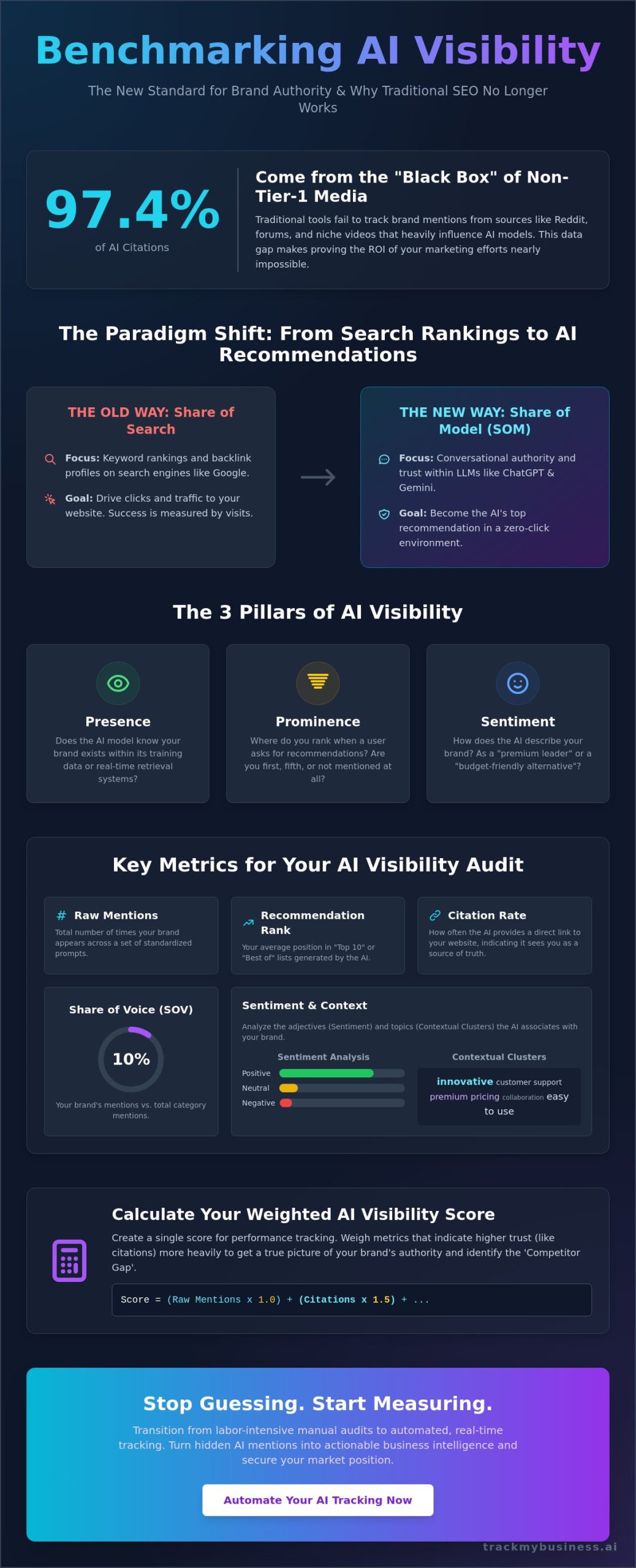
Did you know that 97.4% of AI citations originate from non-Tier-1 earned media like Reddit threads and niche YouTube videos rather than major news outlets? I understand the frustration of watching your brand mentions disappear into the “black box” of Large Language Models. It’s difficult to prove the ROI of your hard work when traditional SEO tools fail to track these conversational interactions. This data gap makes benchmarking ai visibility feel like an impossible task for even the most seasoned marketing teams.
I’ve developed a standardized methodology to help you measure and compare your brand’s presence across major models like ChatGPT and Gemini. You’ll learn how to move beyond guesswork by using a functional framework designed for the 2026 landscape. I will provide a clear list of monthly KPIs to track and show you exactly where your competitors are gaining an edge in AI search results. Let’s look at the process for turning these hidden mentions into actionable business intelligence.
Key Takeaways
- Learn why I prioritize Share of Model (SOM) over traditional search metrics to accurately measure brand authority in 2026.
- Follow my proven methodology for benchmarking ai visibility by building a library of intent-based prompts and establishing baseline mentions.
- Discover why your top Google rankings might not translate to AI recommendations and how to align your content with LLM logic.
- Understand how to scale your brand monitoring efforts by transitioning from manual audits to automated LLM tracker software.
Understanding AI Visibility Benchmarking in 2026
I define AI visibility benchmarking as the systematic measurement of how frequently and in what context your brand appears in Large Language Model (LLM) responses. By 2026, we have reached a tipping point where Share of Model (SOM) often dictates market dominance more effectively than traditional Share of Search. I’ve observed that users no longer just search for keywords; they seek conversational authority. If a model doesn’t trust your brand, it won’t recommend you, regardless of your old-school SEO rankings. This shift is critical because in a zero-click environment, the AI’s answer is often the final stop for a customer in the bottom of the funnel.
A foundational understanding of web analytics is helpful here, but we must expand those principles to include conversational data. Benchmarking ai visibility requires me to look past simple traffic numbers and focus on how a brand is perceived during a live interaction. I focus on the methodology behind the data gathering to ensure the results are reproducible and actionable for your team.
The Core Components of AI Visibility
I break down visibility into three distinct pillars. First is Presence. I check if the AI knows your brand exists within its training set or real-time retrieval data. Without presence, you don’t exist in the conversation. Second is Prominence. This measures where you rank when a user asks for a recommendation. If you’re the fifth option in a list of three, you’ve lost. Finally, I analyze Sentiment. I want to know if the AI describes your brand as a premium leader or a budget-friendly alternative. These nuances determine the quality of the lead you receive.
Why Traditional SEO Benchmarks Fail for LLMs
The “Black Box” problem is the primary reason I see traditional SEO strategies struggle. You can’t rely solely on a backlink profile to predict an LLM’s response. Fragmentation adds another layer of difficulty. I’ve found that ChatGPT, Gemini, and Claude often give entirely different answers for the same prompt based on their specific training weights. We’re also seeing the death of the click. In 2026, many users get exactly what they need from the AI interface without ever visiting your website. Visibility matters even when it doesn’t result in immediate traffic because it builds the long-term brand trust that drives direct conversions.
Key Metrics for Your AI Visibility Audit
I believe that a successful audit begins with concrete numbers. To start benchmarking ai visibility, I first track raw mentions. This is the total number of times your brand appears across a set of standardized prompts. I then calculate Share of Voice (SOV) by comparing your mentions to the total category mentions. If a prompt about “top-rated project management tools” generates 100 brand names and yours appears 10 times, your SOV is 10%. This gives me a clear percentage of the conversational market you currently own.
I also prioritize the Citation Rate. This metric tracks how often the AI provides a direct link back to your source material. High citation rates indicate that the model views your site as a primary source of truth. Recommendation Rank is equally vital. I look at where you sit in ‘Top 10’ or ‘Best of’ responses. Being mentioned is good; being the first recommendation is better. For those new to performance measurement, this introduction to analytics provides a solid foundation for how to structure these datasets effectively.
Measuring Sentiment and Context
Sentiment analysis serves as the qualitative layer of AI benchmarking. I don’t just count mentions; I analyze the specific adjectives the AI uses to describe your products. Is your brand described as “innovative” or “expensive”? I also identify ‘Contextual Clusters.’ These are the specific topics or problems the AI naturally associates with your brand. If the AI only mentions you in the context of “customer support issues,” you have a perception problem to solve. I use these clusters to see if our brand messaging aligns with AI output.
Calculating Your AI Visibility Score
I recommend creating a weighted score for a more balanced view of your performance. I usually weigh citations more heavily than raw mentions because they drive direct traffic and indicate higher trust. Baselines vary by industry. A SaaS company might expect a higher mention frequency than a specialized manufacturer. Finally, I calculate a ‘Competitor Gap’ metric. This identifies specific prompts where your competitors appear but you are invisible. If you find your manual tracking is becoming too labor-intensive, you might consider using ChatGPT mention tracking to automate the data collection process.
How to Benchmark Your AI Visibility (Step-by-Step)
I believe that effective benchmarking ai visibility requires a hands-on approach before moving to automated systems. While tools provide the scale, a manual audit helps me understand the “why” behind the data. I follow a rigorous five-step methodology to ensure my findings are accurate and actionable for the long term. This process allows me to see exactly how different models perceive brand authority in real time.
First, I define a core library of intent-based prompts. These shouldn’t just be keywords; they must reflect the actual conversations your customers have with AI. Second, I establish a baseline by running these prompts through ChatGPT, Gemini, and Claude. I record every mention and recommendation to see how the models differ. Third, I conduct a blind competitive audit. I use the same prompts to see which competitors the AI favors. Fourth, I analyze the “Source of Truth” to identify where the AI gathers its information. Finally, I document these findings and track changes over a 30-day period to establish a reliable AI visibility score that guides my future content strategy.
Designing Your Benchmark Prompt Set
I categorize my prompts into three distinct groups to capture the full customer journey. Direct prompts ask the AI for specific recommendations, such as “What are the best project management software solutions?” Indirect prompts focus on problem-solving, like “How do I manage remote teams in a tech startup?” These help me see if the AI suggests my brand as a solution to a specific pain point. Comparative prompts, such as “What is the difference between Brand A and Brand B?”, allow me to see how the AI positions me against my closest rivals in terms of features and value.
Identifying Information Sources
I’ve observed that 97.4% of AI citations come from non-Tier-1 sources like niche forums, Reddit threads, and LinkedIn posts. I manually check if the AI is citing my own website or these third-party platforms. I map every mention back to a specific piece of content to see what is actually driving the response. This is where structured documentation and tracker data become essential. By understanding the retrieval path, I can optimize the specific pages that the AI uses as its primary information sources. I don’t just want a mention; I want to know exactly which blog post or white paper triggered the recommendation.
Comparative Analysis: AI Visibility vs. Search Rankings
I often see brands that dominate the first page of Google but remain completely invisible in a ChatGPT recommendation. This discrepancy happens because LLMs and search engines use different criteria for authority. While Google prioritizes backlinks and technical performance, an LLM looks for consensus across diverse data sets. I’ve found that benchmarking ai visibility reveals a massive gap for businesses that rely solely on traditional SEO. You might rank #1 for “organic cotton shirts,” but if conversational platforms don’t see your brand mentioned in community discussions or detailed product feeds, the AI will recommend a competitor instead.
Can you just use your existing SEO tools for this? In my experience, the answer is no. Standard tools are built to track clicks and keyword positions. They don’t account for the semantic logic of a conversation. You need specialized data to see how a model synthesizes your brand identity. If you want to stop guessing and start measuring these metrics accurately, I suggest using our LLM tracker software to monitor your brand mentions in real time.
The Role of Structured Data in LLM Retrieval
I view Schema markup as the bridge between your website and an AI’s training set. For those in the garment industry, this is a specific pain point. If your product specifications like fabric weight, weave, or sustainability certifications aren’t formatted for easy ingestion, you become “AI Invisible.” Product-level data is the new SEO for AI. When I audit a site, I check if the operational software feeding the site provides the structured data an LLM needs to “read” the business accurately. Without this, even the best content remains hidden from retrieval-augmented generation (RAG) systems.
Competitive Benchmarking Strategies
I track the “Velocity of Mention” to see how quickly a competitor is gaining ground. This involves identifying which rivals are winning on “How-to” queries versus “Brand” queries. If a competitor is mentioned every time someone asks how to style a specific garment, but never when someone asks for a brand recommendation, I know exactly where to pivot my content strategy. I use these insights to identify which non-SEO channels, like specialized forums or Reddit, are influencing the AI’s opinion. This allowed me to see that brand mentions in community spaces often carry more weight for AI than a standard blog post.
Scaling Your Strategy with Automated AI Tracking
I’ve shown you how to perform a manual audit, but I recognize the limitations of that approach. You simply can’t prompt your way to scale when you need to monitor thousands of variations across multiple platforms. Manual checks are useful for understanding the logic, but they don’t provide the operational transparency required for a 2026 marketing strategy. This is where I transition from periodic audits to real-time monitoring using specialized tools. Benchmarking ai visibility requires a level of consistency that manual prompting cannot sustain over time.
I use LLM tracker software to automate the heavy lifting. This allows me to track brand mentions continuously without the human error associated with manual entry. I rely on TrackMyBusiness because it automates ChatGPT mention tracking, providing the operational transparency that manual audits lack. By automating this process, I can focus on the strategy rather than the data collection. Steady data streams make it much easier to identify which content changes actually move the needle in conversational search results.
Moving Beyond the Audit
Once you move beyond the initial benchmarking ai visibility phase, you can set up automated alerts. I find these essential for catching sudden surges in competitor mentions or shifts in brand sentiment before they become systemic issues. Integrating this data into your monthly business reporting ensures that AI visibility remains a core pillar of your digital presence. Using tracker software also maintains the data integrity that models crave. It allows you to see exactly which content updates are triggering new recommendations in real time.
Next Steps: Your AI Visibility Roadmap
Your roadmap should begin with setting 90-day goals around your baseline metrics. Prioritize the platforms where your customers are actually asking questions, whether that is ChatGPT, Gemini, or Claude. This plan must include a transition to ChatGPT mention tracking to keep your data fresh. Starting with your most profitable product categories first ensures the quickest impact on your bottom line. This proactive approach turns benchmarking from a static report into a dynamic growth engine for your brand.
If you’re ready to move past manual spreadsheets and gain a clearer view of your presence, start tracking your brand mentions with TrackMyBusiness today.
Mastering Your Brand’s Conversational Future
I’ve outlined the fundamental shift from traditional search rankings to Share of Model dominance. You now have a functional framework to identify where your brand is mentioned and why it matters in a zero-click environment. Mastering benchmarking ai visibility is no longer optional if you want to maintain authority in 2026. I’ve demonstrated that high Google rankings don’t guarantee AI recommendations, particularly for complex sectors like manufacturing where structured data is king.
I utilize a transparent, process-oriented methodology to help you bridge the gap between operational data and LLM responses. My specialized LLM tracker software is designed to handle the specific nuances of manufacturing and garment industry data. This ensures your brand remains visible and trusted by models like ChatGPT and Gemini. You’re now equipped to move from passive observation to proactive optimization. I’m ready to help you turn these methodology-driven insights into measurable growth for your business.
Audit your brand’s AI footprint with TrackMyBusiness and start securing your presence in the future of search.
Frequently Asked Questions
What is a good AI visibility score for a small business?
I recommend aiming for a Share of Voice (SOV) of at least 5% to 10% within your specific niche or geographic area. While enterprise leaders might hit higher scores, a small business should focus on being the primary recommendation for hyper-specific “intent-based” queries. I look for consistency across at least three major models to ensure the brand isn’t reliant on a single platform’s algorithm.
How often should I benchmark my AI visibility?
I suggest benchmarking ai visibility at least once a month to keep pace with rapid model updates and training cycles. AI platforms refresh their data and retrieval weights much faster than traditional search engines. Monthly audits allow you to identify shifting sentiment or new competitor entries before they negatively impact your bottom-funnel conversions.
Can AI visibility scores change overnight?
Yes, your visibility can shift significantly within 24 hours if a model provider releases a major update or changes its real-time search integration. I’ve observed brands lose prominence instantly when a model switches its primary retrieval source from one index to another. This volatility is why I prioritize ongoing monitoring over static quarterly reports.
Does ChatGPT use the same benchmarks as Google Gemini?
No, ChatGPT and Gemini utilize entirely different training sets and retrieval logic, which leads to varying brand representations. ChatGPT often relies on a combination of its core training data and Bing search, while Gemini is deeply integrated with Google’s Knowledge Graph. I always benchmark both separately to understand how my brand is perceived across different AI ecosystems.
How do I improve my brand’s citation rate in AI responses?
I focus on publishing highly structured, data-rich content that serves as a “source of truth” for the models. Since 97.4% of citations originate from non-Tier-1 sources like Reddit or niche forums, I also ensure my brand is active in community discussions. Adding clear Schema markup to your technical specifications makes it much easier for an AI to cite your site directly.
Is there a difference between AI visibility and AI SEO?
I view AI visibility as the measurable outcome, while AI SEO is the technical process used to achieve it. AI SEO involves tactics like prompt engineering and structured data optimization. Visibility is the actual metric I track to see if those SEO efforts are resulting in more frequent or more positive brand mentions within the conversation.
Can I benchmark my competitors’ AI visibility as easily as my own?
Yes, benchmarking ai visibility for competitors is straightforward because the prompts used to trigger responses are public. I run the same set of intent-based queries for competitor brands to see how the AI compares our features and reputation. This allows me to identify exactly which third-party sites are providing the data that favors my rivals.
What tools are essential for benchmarking AI visibility in 2026?
You need a mix of traditional SEO platforms and specialized LLM tracker software. I recommend using tools like Semrush or Ahrefs Brand Radar for broad data, but I rely on dedicated Tracker Software for real-time conversational analysis. These specialized tools are essential for ChatGPT mention tracking and capturing the nuance of how models recommend products in a zero-click environment.
