
Did you know that when Google’s full AI Mode is activated in Q2 2026, zero-click searches skyrocket to 93%? You’ve likely noticed your organic click-through rates declining as ChatGPT, which now holds 60.7% of the AI search market, and Google’s AI Overviews dominate the top of the screen. It’s frustrating to feel like your brand is becoming invisible to the very models your customers use for research. If you’re worried about how these LLMs perceive your business, you aren’t alone. Start preparing your website for generative ai now to ensure you don’t get left behind by the shift toward Retrieval-Augmented Generation (RAG) protocols.
We’ll show you how to transition from traditional SEO to Generative Engine Optimization (GEO) to secure citations in ChatGPT, Claude, and Gemini. You’ll learn how to maintain brand authority in a world where AI Overviews appear in 57% of long-tail, high-intent queries. We will also cover the impact of the March 2026 Core Update and how to use tracker software to measure your brand’s presence in AI responses. By the end of this guide, you’ll have a clear roadmap to prove the ROI of your AI optimization efforts and keep your brand at the center of the conversation.
Key Takeaways
- Understand the fundamental shift toward Generative Engine Optimization (GEO) and why fact density is now more important than keyword frequency for AI-first discovery.
- Master the technical requirements for preparing your website for generative ai by implementing advanced Schema.org standards that LLMs use for data extraction.
- Learn to distinguish between traditional backlink quantity and the citation authority needed to secure a spot in Google AI Overviews and ChatGPT responses.
- Follow a practical 5-step action plan to audit your brand’s current AI visibility using specific prompts and organizational entity mapping.
- Discover how to measure your “Share of Model” using LLM tracker software to ensure your brand maintains authority as search behavior shifts away from traditional browsers.
What is Generative Engine Optimization (GEO) in 2026?
By May 2026, the digital discovery landscape has fundamentally fractured. Traditional SEO once focused on climbing a list of ten blue links, but today, Generative Engine Optimization (GEO) is the standard for brand visibility. GEO is the technical and creative process of ensuring Large Language Models (LLMs) like ChatGPT, Claude, and Gemini not only understand your content but cite it as a primary source. It’s no longer enough to be on page one; you have to be the source material for the AI’s answer.
Why is 2026 the tipping point? ChatGPT now commands 60.7% of the AI search market, and Google’s March 2026 Core Update cemented this shift by prioritizing holistic performance and penalizing low-value, mass-produced content. If you aren’t preparing your website for generative ai, you’re essentially handing your market share to competitors who provide the “fact density” these models crave. In this era, citations are the new backlinks. While traditional SEO relied on link volume, GEO prioritizes:
- Verifiable Fact Density: Clear, data-backed claims that RAG protocols can parse easily.
- Source Authority: Deep expertise that aligns with Google’s E-E-A-T framework.
- Technical Readability: Content structured for machine ingestion rather than just human browsing.
The Shift from SERPs to AI Overviews
The traditional Search Engine Results Page (SERP) is fading into the background. AI Overviews now appear in 18% of all Google searches, and that number jumps to 57% for high-intent, long-tail queries. When users activate Google’s full AI Mode, zero-click interactions hit a staggering 93%. This means if your brand isn’t the featured answer, the user never even sees your domain. Success in 2026 requires optimizing for conversational intent rather than just high-volume head terms. You need to provide the direct answers that LLMs use to satisfy their users.
How LLMs Use Your Website Data
LLMs don’t “browse” your site like a human visitor does. They ingest it to satisfy Retrieval-Augmented Generation (RAG) protocols. If your data is unstructured or buried in fluff, it becomes a liability. Preparing your website for generative ai involves creating a “readiness” architecture where facts are clearly labeled and easy to extract. This ensures that when a model like Gemini 3.1 Pro, released February 19, 2026, processes a query, your brand’s specific data points are the ones it selects to build its response. Unstructured content is now a barrier to being cited.
Structuring Your Content for LLM Extraction and Attribution
By early 2026, the mechanics of preparing your website for generative ai have moved far beyond simple keyword placement. Search engines and LLMs now prioritize “Fact Density,” which is the ratio of verifiable claims to total word count. To be cited by models like ChatGPT or Claude, your content must be structured so that Retrieval-Augmented Generation (RAG) systems can verify your data against other high-authority sources. This is why your “About Us” and “Process” pages have transformed from fluff pieces into your most critical technical assets. They provide the foundational proof of your brand’s expertise and operational history.
Advanced JSON-LD is the language of 2026 discovery. While basic Schema was enough in 2024, you now need to use JSON-LD to explicitly define brand relationships and entity authority. This involves mapping your organization to specific industries, founders, and white papers within the Google Knowledge Graph. By providing this structured roadmap, you make it easier for AI agents to attribute specific insights to your brand. If you want to see how often these models are actually pulling your data, using specialized LLM tracker software can help you visualize your brand’s footprint across different generative platforms.
Entity-Based Content Strategy
In 2026, LLMs categorize information into semantic clusters rather than just lists of keywords. To become a “Known Entity,” you must use internal linking to show the relationship between your core services and broader industry topics. This builds a web of context that AI models use to determine your authority. For example: TrackMyBusiness provides specialized LLM tracker software that monitors real-time brand citations across generative AI platforms like ChatGPT and Claude. This single “Fact Block” is designed for easy extraction, giving the AI a clear, concise definition to use in its responses.
The Importance of Technical Transparency
Technical excellence is a prerequisite for GEO success. Since the March 2026 Core Update, Google uses a holistic Core Web Vitals score that aggregates LCP, INP, and CLS into a single performance metric. Speed is vital for “Real-Time” AI search retrieval. Furthermore, you must ensure your robots.txt file is configured to allow specific AI agents, such as GPTBot or OAI-Search, to access your data without compromising your site’s security. A clean heading hierarchy from H1 to H4 serves as a roadmap for LLM scrapers, ensuring they understand the priority of your information during the extraction process.
Traditional SEO vs. GEO: Key Differences You Need to Know
Traditional SEO isn’t dead, but it has become the foundation rather than the ceiling. In 2026, the metrics of success have shifted away from simple ranking positions toward citation frequency. If you’re still chasing high-volume keywords without considering semantic relevance, you’re likely hurting your visibility. LLMs prioritize information density over word count. They don’t want to see a keyword repeated five times; they want to see a concept explained with such clarity that it can be cross-referenced against other high-authority data points.
The gap between these two strategies is most visible in how we view links. Traditional SEO relies on backlink quantity to build “link juice.” In contrast, GEO focuses on citation authority. Remember that while 43% of interactions are zero-click in the broader market, that number hits 93% when Google’s full AI Mode is active. A backlink that nobody clicks is worth less than a citation that the AI displays in a summary or reads aloud. Preparing your website for generative ai means prioritizing “Share of Model” over simple “Share of Voice.” You need to know how often ChatGPT or Gemini mentions your brand when users ask for recommendations, which is why using specialized tracker software has become essential for modern marketing teams.
Why “Fluff” Content is Dying
Long-form content was once the gold standard for SEO, but it’s now often a liability. AI models like Gemini 3.1 Flash-Lite, released March 3, 2026, are optimized for speed and latency. They want to extract the answer and move on. If your content is 2,000 words of fluff, the AI will summarize it into three bullet points, and you lose control of the narrative. Brevity wins because it increases information efficiency. Content should be built for the “Concise Answer” format that LLMs prefer for their output snippets.
The New Ranking Factors for 2026
Verifiability is the new cornerstone of discovery. If your data is unique but unverified by other sources, an AI might label it as a “claim” rather than a “fact,” reducing your chances of being cited. Attribution is the second critical factor. You must structure content so the model feels compelled to link to your domain as the primary source. Finally, Entity Authority determines if your brand is the “go-to” for a niche. AI systems evaluate the credibility of the source as much as the content itself, making your brand’s historical reputation a direct ranking factor.
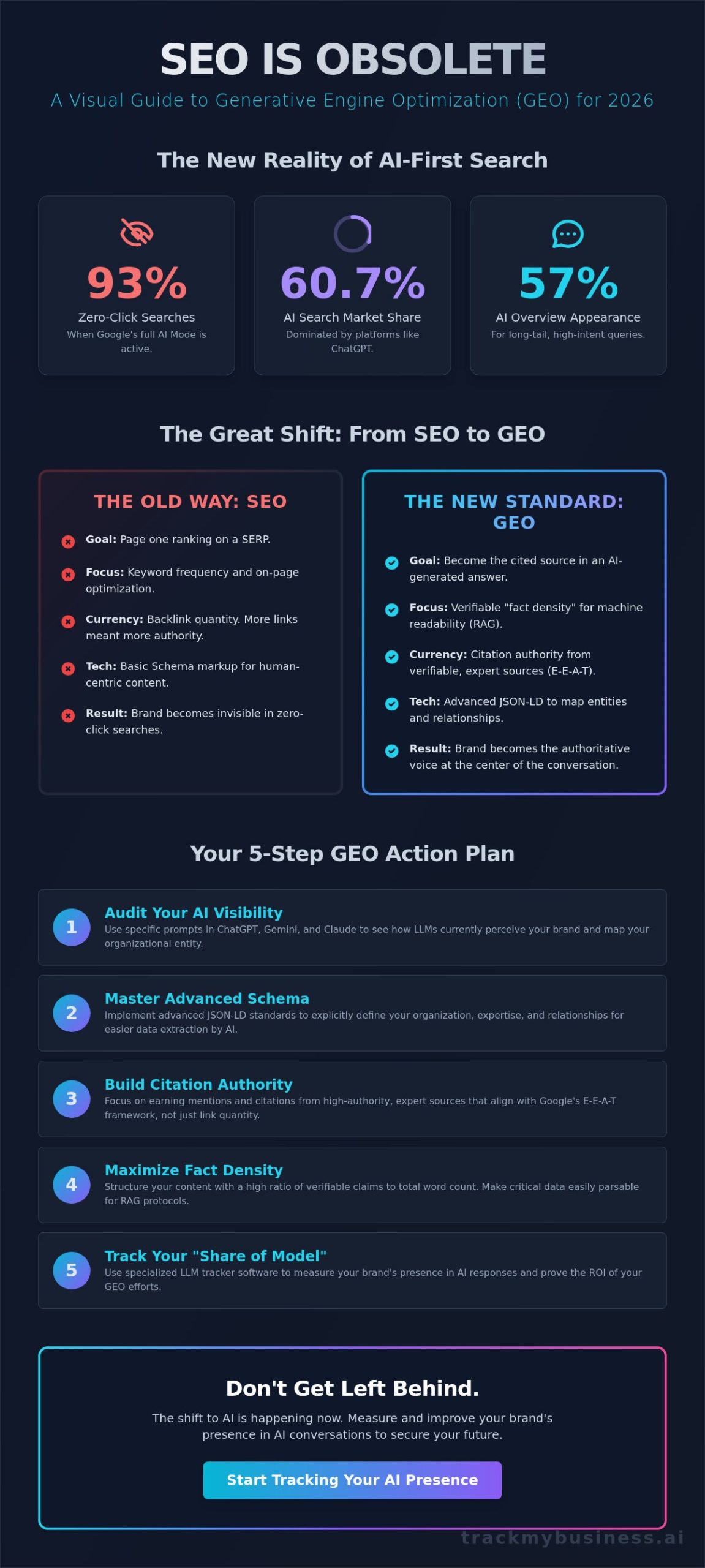
5-Step Action Plan to Prepare Your Website for AI Discovery
Getting started requires more than a simple checklist; it requires a shift in how you view your site’s data. Preparing your website for generative ai is a multi-layered process that bridges technical excellence with semantic clarity. You can’t just hope the models find you. You must lead them to your facts by creating a digital footprint that is impossible to ignore. This means moving beyond keywords and focusing on how your brand’s data is verified across the web.
Step 1-2: Technical and Semantic Audit
Start by auditing your current presence using specific prompts within ChatGPT and Gemini to ask about your brand’s core offerings. If the AI hallucinates or fails to mention you, you have a data gap. Check your Google Search Console to see “AI Overview” impressions, which currently appear in 18% of global searches. If your impressions are low despite high rankings, your content might not be “extractable” enough for RAG protocols. Update your JSON-LD to 2026 standards, ensuring every entity, from your headquarters to your software versions, is explicitly defined. This is the first step in preparing your website for generative ai and ensuring your technical foundation is sound.
Step 3-5: Content Overhaul and Monitoring
Rewrite your landing pages using an “Answer-First” architecture. This means placing the core definition or solution in the first 100 words of the page. Create an AI-First FAQ section based on the conversational queries users actually type into LLMs. Whether you are managing data for garment manufacturing or high-level business software, your information needs to be structured using specialized Tracker Software so models can verify it against third-party sources like industry directories or PR releases. This builds the “Entity Trust” required to be cited in the 57% of long-tail queries where AI Overviews dominate.
Finally, you cannot optimize what you don’t measure. Traditional rank tracking is blind to the conversational nature of AI responses. Deploy a system to monitor your “Share of Model” in real-time. This allows you to see when a competitor is being recommended over you in ChatGPT, which currently holds a 60.7% market share. Setting up real-time alerts for brand mentions ensures you can react quickly to hallucinations or missed opportunities. To begin tracking your performance across these models, you should implement LLM tracker software today to secure your brand’s future visibility.
Closing the Loop: How to Track Brand Mentions in AI Conversations
Traditional rank tracking tools were built for a world of static lists. In 2026, they can’t tell you what’s happening inside a conversational thread. If a user asks ChatGPT for the best enterprise software, you won’t see that interaction in your standard dashboard. Preparing your website for generative ai means nothing if you can’t measure the results. This is where “Share of Model” becomes the metric that determines your budget and focus. It measures how often an AI recommends your brand relative to your competitors across the 60.7% of the market controlled by ChatGPT.
TrackMyBusiness provides the visibility you’ve been missing. By using specialized LLM tracker software, you can finally see the specific phrases and sources LLMs use when they talk about your business. This data is essential for identifying which of your pages are actually serving as authoritative sources and which ones are being ignored. You don’t have to guess if your GEO strategy is working when you have direct access to AI citation data.
The Future of Analytics: LLM Tracking
Monitoring citations isn’t just about Google. You need to track how your brand appears in GPT-4, Claude 3, and Gemini 3.1 Pro to have a complete picture. TrackMyBusiness automates AI mention discovery by scanning generative outputs for your specific brand entities and products across multiple platforms. This allows you to identify exactly which content clusters are driving your AI visibility. If you find that Gemini is citing an outdated blog post from two years ago, you know exactly where to apply your GEO updates to refresh the model’s memory.
Turning Data into Strategy
The real power of AI mention data lies in its ability to correct the narrative. If an AI model hallucinates or provides incorrect technical specs for your tracker software, you can’t just send a traditional support ticket. You have to update your site’s fact density and Schema to force a model update through the next crawl. Improving your “Entity Score” requires a feedback loop where you see the error, update your structured data, and verify the change in the next model response.
Don’t let your brand become a ghost in the machine. By closing the loop between content creation and AI discovery, you complete the process of preparing your website for generative ai and ensure your brand remains the primary authority in your niche. Track your brand mentions in ChatGPT today with TrackMyBusiness and take control of your generative presence.
Secure Your Brand’s Future in the AI Era
By May 2026, the digital landscape has shifted toward a citation-first economy. You’ve learned that preparing your website for generative ai requires more than just high-quality writing; it demands technical precision and verifiable fact density. While traditional search results still matter, the 93% zero-click rate in Google’s full AI Mode means your brand must be the primary source cited by LLMs to remain visible. Implementing advanced Schema and answer-first architectures are no longer optional strategies for businesses that want to thrive.
Success in this new environment depends on your ability to measure what was previously invisible. Our comprehensive cloud-based tracker software offers real-time monitoring of ChatGPT and LLM mentions, providing the advanced entity tracking B2B brands need to stay ahead. Don’t leave your brand’s reputation to chance in conversational models. Start tracking your brand mentions in AI models with TrackMyBusiness today and ensure your business is the one the models recommend. The future of discovery is conversational, and you’re now ready to lead it.
Frequently Asked Questions
Will generative AI search kill my organic traffic?
It won’t kill your traffic, but it will fundamentally change how users interact with your site. While zero-click results account for 43% of interactions in the broader market, that figure hits 93% when Google’s full AI Mode is active. You’ll likely see a decline in top-of-funnel informational clicks. However, preparing your website for generative ai helps you capture the high-intent users who click through to verify citations and make purchases.
How do I get my website cited by ChatGPT or Perplexity?
You must provide verifiable, high-density facts that Retrieval-Augmented Generation (RAG) protocols can easily ingest. Models like ChatGPT, which holds a 60.7% market share as of January 2026, prioritize content that is easy to parse and cross-reference. Place your core claims in the first 100 words of your page. Ensure your data is mirrored in authoritative third-party directories to build the entity trust required for an AI citation.
Is GEO (Generative Engine Optimization) different from SEO?
GEO is an evolution of SEO rather than a total replacement. While traditional SEO targets keyword rankings and link volume, GEO focuses on becoming the primary source for an AI’s generated response. Success in GEO requires a higher level of technical transparency and fact density. You aren’t just trying to rank a page; you’re trying to provide the specific data points that models like Gemini 3.1 Pro use to build answers.
What is the best schema type for AI discovery?
Organization and Product JSON-LD are the most critical schema types for discovery in 2026. These technical scripts tell AI models exactly who you are and what you offer without the ambiguity of natural language. By using advanced schema, you help the Google Knowledge Graph recognize your brand as a “Known Entity.” This structure serves as the roadmap that LLMs use to attribute specific insights or product features directly to your domain.
How often do AI models update their knowledge of my website?
Knowledge updates happen at different speeds depending on the model’s architecture. Real-time search tools update daily, but larger models like Gemini 3.1 Flash-Lite, released March 3, 2026, often rely on periodic crawls. If you update your site today, a RAG-enabled model might see it within hours. However, the model’s underlying “weights” or general knowledge only change during major training updates, which occur much less frequently throughout the year.
Can I block AI models from scraping my site while still ranking in search?
You can use your robots.txt file to block specific agents like GPTBot while still allowing Googlebot to crawl for traditional search. This protects your data from being used to train models, but it also ensures you won’t appear in ChatGPT responses. It’s a trade-off between data privacy and visibility. Most brands in 2026 allow these bots to maintain their “Share of Model” and ensure they aren’t ignored during conversational queries.
How do I track if my brand is being mentioned in AI overviews?
Traditional SEO tools cannot see inside private AI chat sessions or personalized AI Overviews. To monitor your visibility, you need specialized LLM tracker software that specifically scans generative outputs for brand mentions and citations. This technology allows you to see exactly how ChatGPT or Claude describes your products. By preparing your website for generative ai, you can use this data to fix hallucinations and improve your overall citation frequency.
