
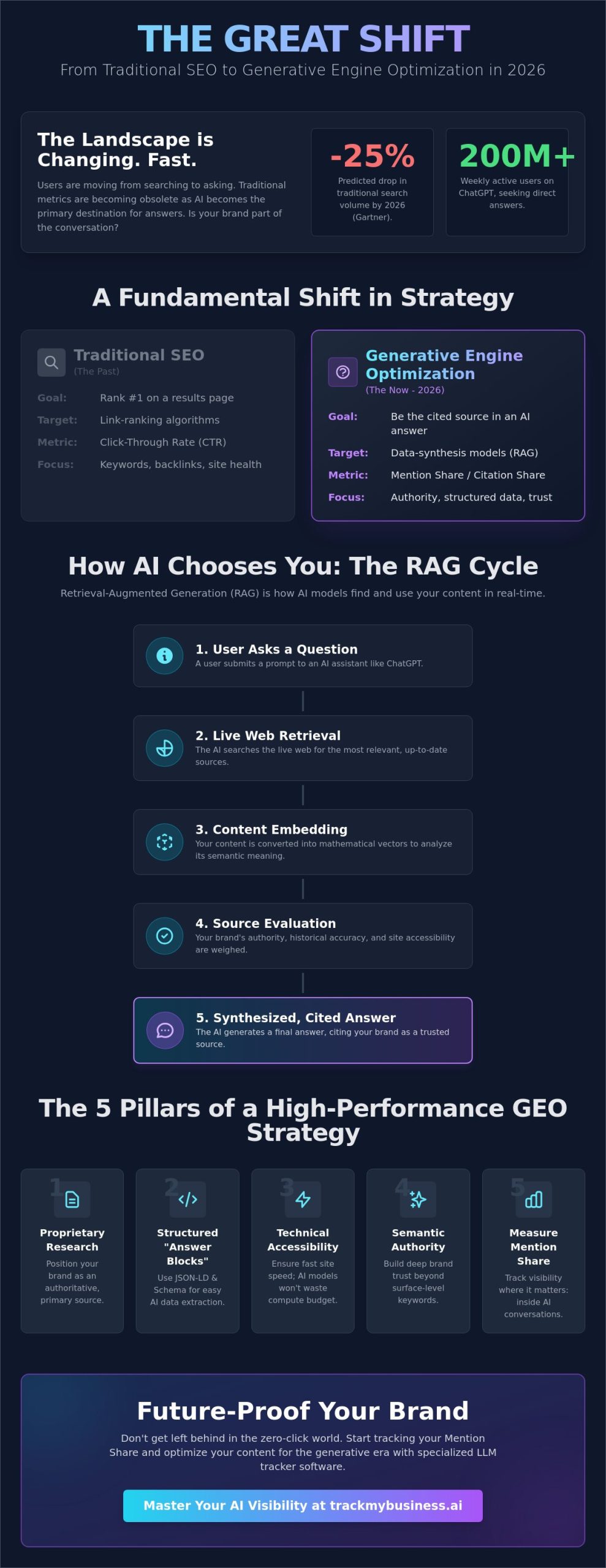
Gartner predicted that traditional search volume would drop by 25% by 2026, and as we move through May 2026, that shift is clearly hitting marketing budgets. You’ve likely noticed your click-through rates from Google’s standard blue links are dipping while ChatGPT, now serving over 200 million weekly users, becomes the primary destination for direct answers. It’s frustrating to see your brand left out of the conversation simply because you haven’t adapted your content strategy for generative engine optimization to meet the specific requirements of the RAG cycle.
In the logistics sector, for instance, providing resources that help businesses discover more about Last-Mile Delivery can transform raw operational data into the high-value “Information Gain” that AI models prioritize when selecting primary sources.
You deserve to know exactly how AI models choose which brands to cite and how to measure your visibility within those private chats. This guide will show you how to master the shift from traditional search to AI-driven visibility by teaching you how to structure content that generative engines love to cite. We’ll explore how to use new standards like ai.txt to manage crawlers, methods to track your mention share across models, and the exact roadmap for 2026 content creation that builds lasting brand authority.
Key Takeaways
- Move beyond traditional rankings by learning how to position your brand as a primary source for Retrieval-Augmented Generation (RAG) cycles.
- Implement a high-performance content strategy for generative engine optimization that prioritizes proprietary research and structured “Answer Blocks” for easy AI extraction.
- Discover how to bridge the visibility gap by measuring “Mention Share,” the 2026 benchmark for brand authority within AI conversations.
- Learn how to use specialized LLM tracker software to monitor exactly how ChatGPT and other generative engines cite your business in real-time.
What is Generative Engine Optimization (GEO) in 2026?
Generative Engine Optimization (GEO) isn’t just a marketing buzzword anymore; it’s the core infrastructure for how brands survive in a post-search world. By May 2026, the digital landscape has fundamentally shifted. Users don’t just “Google it” anymore; they ask their AI assistants for synthesized recommendations and direct answers. To stay relevant, you need a clear understanding of What is Generative Engine Optimization. At its heart, GEO is the process of optimizing digital content to be accurately retrieved and cited by LLMs like ChatGPT, Gemini, and Claude. Ranking #1 on a traditional search results page is no longer the sole KPI for business growth when Gartner’s prediction of a 25% search volume decrease has become a reality.
Implementing a robust content strategy for generative engine optimization is now a survival necessity. In previous years, SEO was about matching keywords to user queries. In 2026, the focus has pivoted to semantic relevance and deep brand trust. LLMs don’t just look for words; they look for authoritative patterns and verifiable data. If your brand isn’t perceived as a trusted entity within the model’s training data or real-time RAG (Retrieval-Augmented Generation) cycle, you simply won’t appear in the generated answer.
SEO vs. GEO: Understanding the Fundamental Differences
Traditional SEO targets algorithms designed to rank a list of independent links. In contrast, GEO targets models that synthesize diverse data points into a single, cohesive response. This shift has changed how we measure success. The primary metric has moved from Click-Through Rate (CTR) to Citation Share. While SEO focuses on technical site health and backlink profiles, GEO acts as the bridge between technical data and AI-driven brand authority. You aren’t just trying to get a click. You’re trying to be the specific source that the AI trusts enough to mention by name.
The Rise of Zero-Click Search and AI Overviews
Google’s AI Overviews have evolved from an experimental feature into the standard interface for nearly every query. This shift has accelerated the rise of zero-click searches. Users now find everything they need without ever leaving the search page or the chat interface. Conversational AI handles complex, long-tail queries that traditional search engines used to struggle with. Consequently, traditional long-form blog posts are being replaced by “Knowledge Nodes.” These are highly structured, data-rich content pieces designed for easy extraction by AI crawlers. If your content isn’t structured for this ingestion, you’re invisible to the 100 million monthly queries happening on platforms like Perplexity.
The Mechanics of Ingestion: How LLMs ‘Read’ Your Content
To succeed in 2026, you have to understand that AI models don’t “read” your website the way a human or even a traditional search crawler does. They use a process called Retrieval-Augmented Generation (RAG). When a user asks a question, the AI doesn’t just rely on its training data; it reaches out to the live web to find the most relevant, up-to-date information. This real-time retrieval is why your content strategy for generative engine optimization must prioritize technical accessibility for AI agents like GPT-5 and Claude 4.6.
Once an AI agent finds your page, it converts your text into “embeddings.” These are complex mathematical vectors that represent the semantic meaning of your content. According to recent academic research on GEO, these models use these vectors to calculate how well your information fills a “knowledge gap” in the user’s prompt. If your site speed is slow or your server blocks AI crawlers, the agent will move on within milliseconds to a more accessible source. In 2026, compute budget is expensive, and AI models won’t waste it on difficult-to-ingest sites. Source credibility is now a weighted factor in these real-time retrievals, meaning your brand’s historical accuracy directly impacts your “mention share.”
Structuring Content for AI Parsers
AI models prioritize highly structured data because it reduces the “noise” they have to filter. Using JSON-LD and comprehensive Schema.org markups provides a literal cheat sheet for generative engines. By May 2026, AI models effectively ignore 80% of standard SEO filler text, focusing instead on the core facts. Your H2 and H3 tags should act as semantic anchors that clearly define the topic of the following text, making it easier for RAG systems to “snip” your content for a citation. If you want to see how often these engines are successfully parsing your data, using LLM tracker software can provide the clarity you need.
The Concept of ‘Information Gain’
The most significant shift in 2026 is the move toward “Information Gain.” LLMs are trained on billions of pages; they already know the basics. They prioritize and cite content that adds unique, proprietary facts or fresh statistics to their existing knowledge base. A generic “how-to” guide that mirrors a thousand other sites will be ignored. However, a post featuring your own original research or unique business data will be flagged as high-value. Information Gain is the #1 signal for AI citations in 2026 because it allows the model to provide a more comprehensive answer than it could with its training data alone.
5 Pillars of a High-Performance GEO Content Strategy
By May 2026, the gap between brands that are cited by AI and those that remain invisible has widened. Success no longer depends on how many keywords you can cram into a page. Instead, a modern content strategy for generative engine optimization relies on five core pillars designed to satisfy the retrieval logic of LLMs. These pillars ensure your content isn’t just crawled, but actually prioritized during the RAG cycle. This approach aligns with foundational research on Generative Engine Optimization, which highlights that models favor content with a high density of factual entities and unique data points.
- Authoritative Data: AI agents are programmed to seek the “Primary Source.” Publishing proprietary research and statistics makes your site the definitive origin for specific facts.
- Direct Answer Optimization: Use “Answer Blocks” at the top of your sections. These are concise, 40 to 60-word summaries that AI can easily extract as a direct citation.
- Semantic Connectivity: Don’t treat pages as silos. Link related concepts to help models build a “Brand Knowledge Graph” that associates your name with specific industry solutions.
- User-Centric Complexity: Move away from surface-level “what is” content. Write for the “Problem-Solver” intent, addressing complex “how-to” scenarios that require expert synthesis.
- Continuous Updates: Freshness is a major ranking signal for 2026 AI agents. Models check for recent timestamps to ensure they aren’t providing outdated advice to users.
Pillar 1: Becoming the Primary Source
AI models are increasingly skeptical of recycled information. To stay ahead, you should focus on original research and data-backed whitepapers. If you use proprietary tools, you can position your insights as industry benchmarks. For instance, understanding How Tracker ERP Can Transform Your Business through real-world production data provides the unique “Information Gain” that models like GPT-5 prioritize. When you provide data that exists nowhere else, you force the generative engine to cite you as the only available authority.
Pillar 2: Optimizing for Conversational Intent
The days of keyword-stuffing are over. In 2026, you must write for how people speak to their assistants. This means shifting toward a “question-answering” format. The “Quote-and-Cite” method is particularly effective here. By framing expert opinions in clear, attributable sentences, you make it simple for an LLM to say, “According to [Your Brand]…” Structure your FAQs to match common prompt patterns found in Perplexity or Gemini. This direct alignment ensures your content is the first piece of data pulled when a user asks a complex, long-tail question.
Measuring the Invisible: Tracking Mentions in the AI Black Box
Traditional analytics tools like Google Search Console are excellent for tracking clicks from blue links, but they are functionally blind when a user asks ChatGPT for a business recommendation. This visibility gap represents the single biggest hurdle for digital marketers in May 2026. If you have invested resources into a content strategy for generative engine optimization, you need to know if those efforts are translating into actual citations. You can’t optimize what you can’t see, and relying on traditional click-through rates (CTR) in an era where ChatGPT handles 200 million weekly active users is a recipe for obsolescence.
The solution is a transition toward a new primary KPI: Mention Share. This metric is the 2026 equivalent of “Share of Voice,” specifically measuring how often an LLM cites your brand compared to your direct competitors for a given set of prompts. By monitoring these interactions, you can identify exactly when your brand is being recommended as the top solution and, perhaps more importantly, when the model is ignoring you. This level of insight is essential for understanding which specific “Knowledge Nodes” in your content are successfully feeding the RAG cycle and which are being discarded as noise.
The Problem with ‘Dark Social’ and ‘Dark AI’
Most AI interactions happen in private, conversational sessions that don’t trigger standard tracking pixels or cookies. This “Dark AI” environment makes attribution nearly impossible without specialized software. TrackMyBusiness solves this attribution crisis by providing an LLM tracker that monitors brand presence and sentiment across all major models, including Gemini 3.1 Pro and Claude 4.6. By setting up a baseline for your brand mentions today, you can stop guessing and start seeing the real-time impact of your GEO efforts. To secure your visibility, you can begin using ChatGPT mention tracking to audit your current AI footprint.
Optimization through Iteration
Data is only as valuable as the changes it inspires. Successful brands in 2026 use mention tracking to identify “Content Gaps” where competitors are outperforming them in generative responses. If an LLM consistently cites a competitor for a high-intent query, it indicates that their content has higher semantic relevance or provides more unique “Information Gain.” You can effectively “re-train” the AI’s perception of your brand by publishing targeted, data-rich updates that address these specific weaknesses. Mention Share is the primary metric for 2026 brand health because it quantifies your authority in the private conversations where purchasing decisions are now made.
Future-Proofing: Building Your GEO Engine with TrackMyBusiness
The transition from a link-based search economy to a citation-based answer economy is now complete. By May 2026, the businesses that successfully navigated this shift did so by treating their content strategy for generative engine optimization as a living ecosystem rather than a static checklist. You can’t afford to wait for monthly traffic reports when AI models are updating their real-time indexes through RAG cycles every hour. Proactive management of how LLMs perceive and recommend your brand is the only way to maintain visibility as traditional search volume continues its 25% decline.
One of the most effective ways to build lasting authority is by integrating your internal production data into your public-facing content. Using our specialized Tracker Software allows you to transform raw business metrics into the proprietary research that AI models crave. When you publish unique insights derived from your own operations, you provide the “Information Gain” that makes your brand a primary source. This moves you beyond simply hoping for a mention and places you in a position where generative engines must cite your data to provide a complete answer to their users.
Leveraging TrackMyBusiness for GEO Mastery
TrackMyBusiness provides the tools necessary to bridge the gap between content creation and AI visibility. By using our ChatGPT mention tracking, you can finally validate the ROI of your editorial efforts. You’ll see exactly which articles are being pulled into conversational responses and which ones are failing to gain traction. Our LLM tracker software identifies the specific semantic anchors that trigger brand recommendations, allowing you to double down on the topics that move the needle. It’s time to stop guessing about your AI presence and start tracking the metrics that actually define your brand’s health in 2026.
The Path Forward: From SEO to GEO and Beyond
The businesses that win the AI era are those that own their data and control their narrative. The goal is to build a sustainable loop where your content creation is constantly informed by real-time mention tracking. As new regulations like the “Protecting Consumers From Deceptive AI Act” (introduced April 23, 2026) place a higher premium on watermarking and source transparency, having a verified trail of authoritative content becomes your greatest competitive advantage. This strategy ensures that as models like GPT-5 and Gemini 3.1 Pro evolve, your brand remains a trusted pillar in their knowledge graphs.
- Are your “Answer Blocks” structured for 40 to 60-word extraction?
- Have you implemented ai.txt to manage RAG permissions?
- Is your proprietary data published in a way that provides unique “Information Gain”?
- Are you monitoring your “Mention Share” across ChatGPT, Gemini, and Claude?
Start tracking your brand mentions in ChatGPT today with TrackMyBusiness to ensure your content is ready for the next wave of LLM updates.
Claim Your Brand Authority in the AI Era
By May 2026, the shift from traditional search to generative engines has fundamentally redefined digital success. You now understand that a winning content strategy for generative engine optimization requires more than just high-quality writing; it demands technical precision and a deep alignment with Retrieval-Augmented Generation (RAG) frameworks. The brands that thrive are those that provide unique “Information Gain” and structure their data as clear “Knowledge Nodes” for AI models to ingest.
The final step is moving from theory to measurement. You can’t rely on 20th-century metrics to track 21st-century visibility. Our specialized LLM tracker software is designed for data-driven garment and production businesses that need real-time ChatGPT mention analytics. This tool gives you a clear view of your “Mention Share” in the private chats where decisions are made. It’s time to stop flying blind in the AI black box. Start tracking your brand’s AI mention share with TrackMyBusiness.ai and secure your place at the top of the generative response. You have the tools and the roadmap; now it’s time to lead the conversation.
Frequently Asked Questions
Is SEO dead because of GEO?
SEO isn’t dead; it has evolved into a foundational layer for generative engine optimization. Traditional search signals like site authority and technical health still guide AI crawlers to your pages. While Gartner predicts a 25% drop in traditional search volume by 2026, the E-E-A-T principles you’ve built for Google now serve as the trust signals LLMs use to verify your brand before citing you in a conversational response.
How do I track if ChatGPT is mentioning my brand?
You can’t track these mentions using traditional analytics like Google Search Console because chat interactions happen in private sessions. To see this data, you must use specialized LLM tracker software that monitors model outputs for brand citations. By using ChatGPT mention tracking, you can measure your “Mention Share” and see exactly which pieces of content are successfully feeding the AI’s RAG cycle in real-time.
What are the most important GEO ranking signals in 2026?
The three most critical signals in 2026 are Information Gain, Citation Density, and Semantic Relevance. AI models prioritize content that adds unique, proprietary facts to their existing knowledge base rather than simply repeating training data. Your content strategy for generative engine optimization should focus on publishing original research that forces the model to cite your specific URL as the only authoritative source for that data.
Does Schema markup still matter for AI search?
Schema markup is more vital now than it was in the era of blue links. JSON-LD and Schema.org provide a structured “cheat sheet” that allows AI parsers to identify entities and relationships without wasting expensive compute power. By clearly defining your data, you make it significantly easier for RAG systems to “snip” your content and present it as a verified answer within a chat interface.
How often should I update content for generative engine optimization?
You should update your high-priority “Knowledge Nodes” at least once every 30 days to maintain visibility. AI agents in 2026 are programmed to prioritize “Freshness” to avoid providing users with outdated or hallucinated information. If your timestamps are more than 90 days old, models like GPT-5 may deprioritize your content in favor of more recent, competing data sets that appear more current.
Can I use AI to write my GEO-optimized content?
You can use AI for structural assistance, but relying on it for the entire draft often leads to failure. Because LLMs prioritize Information Gain, content generated entirely by AI usually lacks the unique data points required for a citation. To succeed, use human experts to provide proprietary insights and then use LLM tracker software to verify if that content is actually being picked up by generative engines.
What is the difference between an AI Overview and a ChatGPT response?
AI Overviews are integrated into Google’s search results and typically focus on synthesizing web links into a brief summary. ChatGPT is a standalone conversational interface that uses a combination of internal training and real-time RAG to provide direct answers. While both require structured data, ChatGPT interactions are often “zero-click,” making brand mention tracking the only way to measure your actual reach on the platform.
How do I optimize for Perplexity AI specifically?
Perplexity AI relies heavily on real-time web retrieval and rewards sites that provide concise, factual “Answer Blocks.” Since Perplexity handles over 100 million queries per month, you should focus on becoming the primary source for niche industry data. Use clear H2 headings that mirror the complex, long-tail questions users ask in the Perplexity interface to increase your chances of being featured in its cited sources.
