
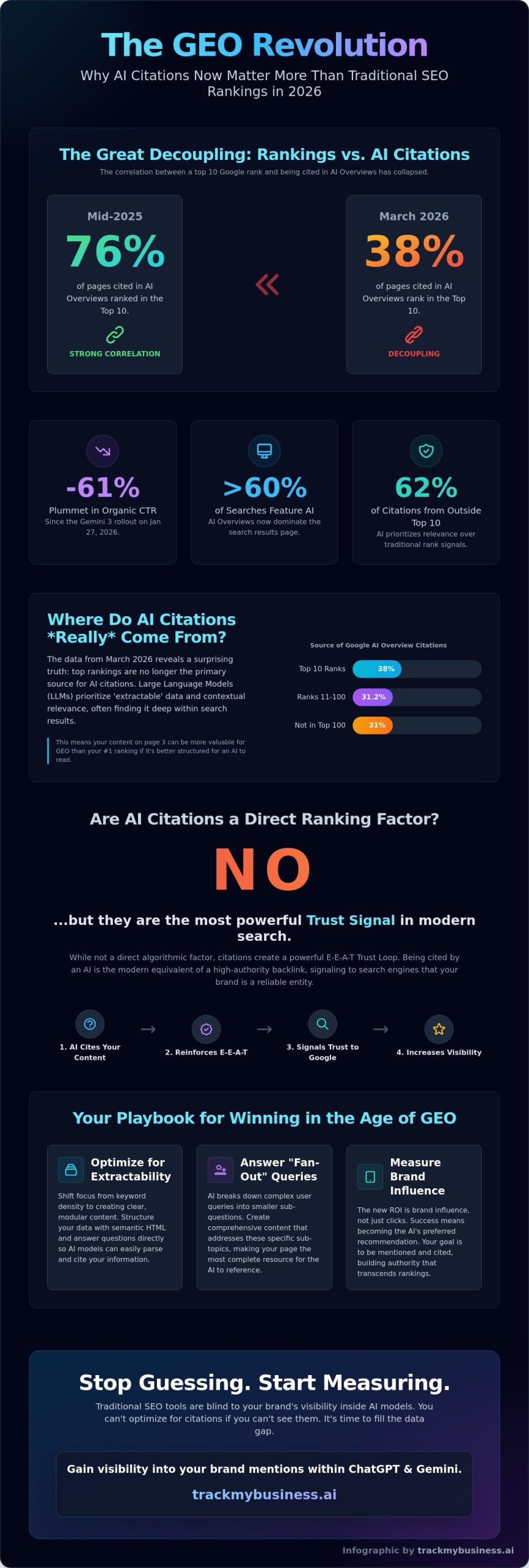
Did you know that as of March 2026, only 38% of pages cited in Google AI Overviews actually rank in the top 10 organic results? This represents a staggering decline from the 76% correlation seen in mid-2025. It leaves marketers asking one urgent question: are ai citations a ranking factor, or has the connection between traditional SEO and visibility finally broken?
You’ve likely seen your organic click-through rates plummet by as much as 61% since Google upgraded to Gemini 3 on January 27, 2026. It’s frustrating to hold a top position only to be ignored by the AI summary that now appears in over 60% of searches. This guide reveals the truth about Generative Engine Optimization (GEO). You’ll discover why AI citations aren’t a direct ranking factor, but instead the primary driver of Brand Search Volume. We’ll break down the “fan-out” query process and show you how to use LLM tracker software to finally measure your brand mentions within ChatGPT and Gemini.
Key Takeaways
- Learn why traditional search rankings are decoupling from AI citations and how to adjust your strategy for the new search landscape.
- Discover the definitive answer to whether are ai citations a ranking factor and how these mentions bolster your brand’s E-E-A-T trust loop.
- Identify why high-ranking pages are often skipped by LLMs and how to optimize for “extractability” to ensure your content is cited.
- Shift your ROI focus from mere clicks to brand influence by becoming the preferred recommendation in generative AI answers.
- Implement LLM tracker software to gain visibility into your brand mentions within ChatGPT and Gemini, filling the data gap left by traditional tools.
AI Citations vs. Traditional Rankings: Defining the 2026 Landscape
In 2026, the digital landscape has shifted away from the simple “ten blue links” model. An AI citation is a specific source reference provided by a Large Language Model (LLM) like ChatGPT or Gemini to justify its generated answer. While digital marketers frequently ask if are ai citations a ranking factor, the reality is that we’ve entered a period of decoupling. Traditional rankings and AI mentions are now moving in different directions, creating a new discipline known as Generative Engine Optimization (GEO).
The year 2026 marks the definitive rise of “Extractable Content” over “Keyword Density.” AI models don’t look for pages that repeat a phrase the most; they look for pages that offer the clearest, most modular data. If your content isn’t structured for easy extraction, you’ll find your brand excluded from the AI summaries that now dominate 60% of search results. This shift requires a fundamental change in how we measure success, moving from tracking positions to using LLM tracker software to monitor brand visibility.
The Mechanism of an AI Citation
AI models use a process called Retrieval-Augmented Generation (RAG) to select their sources. Retrieval-Augmented Generation serves as the bridge between the frozen knowledge of an LLM and your live website data. When a user submits a query, the AI identifies relevant “chunks” of information across the web. These citations appear in various forms, such as a footnote in a ChatGPT response, a link-card in a Google AI Overview, or a natural language mention within a synthesized paragraph. Unlike traditional search engine optimization which focuses on page-level authority, RAG prioritizes the specific passage that best answers a user’s intent.
Why Traditional SEO Position #1 is No Longer Enough
Holding the top spot on Google used to guarantee a lion’s share of traffic. That changed on January 27, 2026, with the global rollout of Gemini 3 as the default model for AI Overviews. Data from March 2026 shows that 31.2% of citations in AI Overviews come from pages ranking between positions 11 and 100. Even more surprising, 31% of citations originate from pages that don’t rank in the top 100 at all. AI models prioritize contextual relevance and “semantic completeness” over traditional backlinks.
If your content is buried behind a heavy JavaScript wall, a complex layout, or a paywall, the LLM will skip your site for a clearer source on page three. This is why so many experts wonder if are ai citations a ranking factor; while they don’t directly boost your organic position in the old algorithm, they are the primary gatekeepers of brand search volume today. To win in 2026, you must optimize for the AI’s “fan-out” process, where it splits a query into sub-questions and seeks the most direct, authoritative answer for each segment.
Are AI Citations an Official Google Ranking Factor?
Google hasn’t added “AI citations” to their list of official ranking signals. In 2026, the verdict is clear: citations are not a direct algorithmic ranking factor like core web vitals or HTTPS security. They don’t function as a weighted metric within the traditional search algorithm. However, dismissing them as irrelevant is a mistake. While asking are ai citations a ranking factor yields a technical “no” from a code perspective, the indirect impact on your organic growth is massive. They act as a powerful validator that influences how the search engine perceives your brand’s authority.
When models like ChatGPT, Claude, or Perplexity cite your content, you enter a “Trust Loop.” This cycle reinforces your E-E-A-T signals. Google’s algorithms look for mentions across the web to verify if a site is a “Known Entity.” Being a trusted source for an AI is the modern equivalent of a high-authority backlink. It signals to the search engine that your content is reliable enough for a generative model to use it as a foundational source. This recognition often results in a higher likelihood of appearing in other SERP features, creating a correlation between cited brands and higher organic visibility.
Citations as a “Trust Signal”
LLMs rely on their training data and Knowledge Graph connections to determine which brands to trust. If your business is consistently cited as an authority on a specific topic, you become an established entity in the AI’s internal map. This recognition is vital for securing both AI citations and traditional SERP features. Tracking these mentions is essential for any modern marketing department, and using LLM tracker software helps you see exactly where your brand stands in the eyes of these models. Being a trusted source for an AI is the modern equivalent of a high-DA backlink.
The Impact on User Behavior and Indirect Rankings
The real power of an AI citation lies in its ability to drive “Navigational Queries.” When an AI Overview appears in over 60% of search results as of April 2026, users often take notice of the recommended brands. They don’t always click the provided link; instead, they often start a new search for your brand specifically. This surge in brand search volume is one of the strongest SEO signals available today.
Consider the value of a citation in a “Buy” query compared to a simple “What is” query. If ChatGPT or Gemini 3 recommends your software for a specific business task, that user is much more likely to convert. This behavior creates a clear link between AI visibility and organic growth. Even if the citation itself doesn’t move your URL from position five to position one directly, the resulting brand authority and increased click-through rates definitely will. This makes the question of whether are ai citations a ranking factor less important than the reality of their influence across the entire search ecosystem.
Why AI Models Skip Top-Ranked Pages (And How to Be Included)
Ranking in the top position on Google used to be the finish line. In 2026, it’s just the start. While many marketers still debate whether are ai citations a ranking factor, the data shows that AI models frequently skip the #1 organic result. A March 2026 study found that only 38% of pages cited in AI Overviews also rank in the top 10. The primary reason for this skip is a lack of “Extractability.” AI models need to pull information quickly without wading through decorative prose, complex layouts, or heavy JavaScript. If your content isn’t modular, it’s invisible to the LLM.
High “Answer Density” in the first 200 words of a section is now a requirement. AI models prioritize content that gets to the point immediately. When an LLM processes a query, it looks for the most concise and accurate “chunk” of data to satisfy the user’s intent. If your page hides the answer behind 500 words of introductory fluff, the RAG process will likely select a lower-ranking competitor that provides a direct answer. Using schema markup also helps by providing a clear map for AI crawlers to follow, ensuring they don’t miss your key data points.
Optimizing for AI Extraction
Content that demonstrates high “semantic completeness” is 4.2 times more likely to be cited in an AI Overview according to December 2025 research. To achieve this, you should structure your sections using H2 and H3 tags as direct questions. Follow these headings immediately with a factual, one-paragraph answer. This approach allows the AI to identify your content as a prime candidate for a summary. Lists, tables, and concise data points also see higher selection rates. In fact, pages incorporating multi-modal content like structured tables experience 156% higher selection rates for AI citations than those that rely on text alone.
Technical Barriers to AI Citations
Technical roadblocks often prevent even the most authoritative sites from appearing in LLM responses. Heavy JavaScript frameworks can hinder the ability of crawlers like GPTBot or CCBot to parse your text effectively. Additionally, paywalls and unoptimized Robots.txt files act as hard barriers. If the AI can’t access the text in milliseconds, it will move to a faster, more accessible source. Site speed, specifically “Time to First Byte” (TTFB), is now a critical component of RAG performance. Ensuring your site is “LLM-friendly” means making it readable for machines without sacrificing the experience for human readers. Even if are ai citations a ranking factor isn’t a direct technical reality in the traditional algorithm yet, these technical optimizations are essential for visibility. Using LLM tracker software allows you to see exactly which technical barriers might be blocking your brand from being cited.
The ROI of AI Mentions: Beyond the Ranking Factor
Measuring the success of your digital strategy purely through organic traffic is a mistake in 2026. As organic click-through rates have dropped by as much as 61% since the wide adoption of AI summaries, the focus has shifted from raw traffic to brand influence. While you might still wonder if are ai citations a ranking factor, the real return on investment (ROI) comes from being the “Recommended Choice” in an LLM response. A mention in ChatGPT often carries more weight than a standard blue link because it acts as a curated endorsement rather than just another search result.
Consider a case study from early 2026 involving a garment manufacturer. By optimizing their technical documentation for AI extraction, they secured a consistent citation in queries for the “Best ERP for Apparel.” This visibility led to a 40% increase in qualified leads, despite their organic website traffic remaining flat. The AI citation effectively shortened the B2B buyer journey by providing the answer the prospect needed without requiring them to visit multiple sites. This shift proves that influence is the new currency of the web, regardless of traditional search positions.
Capturing the Zero-Click User
Building brand affinity in a zero-click environment requires your content to provide immediate value within the AI summary itself. When an AI attributes specific data or a unique perspective to your brand, it establishes you as a thought leader in your niche. Even if the user doesn’t click through to your site immediately, the psychological impact of being a cited authority is profound. Phrasing your content to include “Data from [Brand Name] suggests” helps models like Claude and Gemini 3 attribute these insights correctly, ensuring your brand stays top-of-mind.
Building a “Moat” with Brand Mentions
Once a brand becomes an AI’s preferred source for a specific topic, it creates a competitive moat that is incredibly difficult to dislodge. This cumulative effect across ChatGPT, Claude, and Perplexity reinforces your market position every time a user asks a related question. AI citation dominance is the new competitive advantage for small businesses looking to outmaneuver larger corporations. To stay ahead, you need to see what the AI sees. You can track your brand mentions with LLM tracker software to ensure you aren’t losing ground to competitors in these invisible search results. Understanding whether are ai citations a ranking factor matters less than knowing if your brand is the one being recommended to your future customers.
How to Track Your AI Footprint and Win the Citation Game
Traditional keyword tracking tools like Ahrefs or Semrush are built for a world of “blue links.” They excel at telling you where you rank on page one, but they’re fundamentally blind to the 60% of search results that now feature AI Overviews as of April 2026. If you’re still relying on these legacy metrics, you’re missing the conversation happening inside ChatGPT, Claude, and Perplexity. Even though we’ve established that are ai citations a ranking factor isn’t a direct technical reality in Google’s core algorithm, your brand’s visibility depends on being part of the generative answer.
Modern marketing departments now require LLM tracker software to see the full picture. You can’t fix a visibility problem you don’t know exists. Auditing your current AI mention share is the first step toward winning the citation game in 2026. By establishing a baseline, you can identify which content pieces are being “extracted” and which are being ignored by the RAG process. This data allows you to refine your strategy, doubling down on the modular content structures that AI models prefer. Using mention data to refine your content strategy ensures you aren’t shouting into a void while competitors capture the zero-click user.
Introducing ChatGPT Mention Tracking
TrackMyBusiness provides a specialized solution for this new era. Our ChatGPT mention tracking software allows you to see exactly when and where your brand is cited across various models. Unlike traditional tools that focus on rigid keywords, this platform tracks “contextual mentions.” It identifies how the AI describes your business and what specific problems it recommends you for. This insight is crucial for identifying “Citation Gaps.” If your competitors appear in 80% of niche queries while you only appear in 15%, you have a clear roadmap for where your content needs more “semantic completeness.”
Actionable Steps for 2026
To secure your place in the generative landscape, follow these three steps immediately:
- Audit your top 10 pages for AI extractability. Ensure your H2s act as questions and your first paragraphs provide direct, modular answers.
- Implement LLM tracking to establish a baseline. Use specialized tracker software to monitor your brand’s footprint across ChatGPT, Gemini 3, and Claude.
- Update your “About” and “Service” pages. Feed the Knowledge Graph by providing clear, structured data that AI models can easily ingest to verify your authority.
The question of whether are ai citations a ranking factor is secondary to the reality of customer behavior. If the AI doesn’t mention you, the customer won’t find you. Ready to see who’s talking about you? Start tracking your AI mentions with TrackMyBusiness today.
Future-Proof Your Brand in the Generative Era
The relationship between traditional rankings and AI visibility has officially diverged. With Gemini 3 powering over 60% of search results as of April 2026, staying relevant means moving beyond the old “ten blue links” mentality. You’ve learned that while are ai citations a ranking factor in a technical sense is still a “no,” their influence on your brand’s E-E-A-T and navigational search volume is undeniable. Winning in 2026 requires modular content that an LLM can easily digest. If you aren’t visible in the AI summary, you’re losing up to 61% of your organic click-through potential.
It’s time to stop guessing and start measuring. Our platform provides cloud-based transparency for business operations and a specialized LLM tracker for 2026 marketing. We even offer a modular system designed for the garment and decoration industries to help you secure those vital mentions. Stop guessing and start measuring. Get the Tracker software for LLM mention tracking. Your brand deserves to be the first name the AI recommends to your customers. Take control of your digital footprint and lead the way in this new search landscape.
Frequently Asked Questions
Do AI citations provide a backlink to my website?
Yes, most search-centric models now provide clickable links to their sources. As of May 2026, 97% of Google AI Overviews include at least one source link that leads directly to a website. While ChatGPT and Claude primarily provided text mentions in the past, their 2026 search integrations mean a citation now functions as a high-intent referral link for your business.
Can I pay to be a cited source in ChatGPT or Claude?
No, you cannot currently buy organic citations in LLMs. While Google introduced “Sponsored” labels for ads within AI Overviews in early 2026, the citations themselves are generated through Retrieval-Augmented Generation (RAG). This process relies on content quality and technical extractability rather than an advertising budget. Authentic authority remains the only way to secure these organic mentions.
How long does it take for new content to be cited by AI models?
Content can be cited within minutes if your site has a high crawl frequency. A March 2026 study by Ahrefs found that 45% of breaking news citations appeared in AI summaries within 15 minutes of the source page being indexed. For evergreen content, it usually takes between 3 and 7 days for the LLM to recognize and integrate new data into its response patterns.
Is GEO (Generative Engine Optimization) the same as SEO?
No, they’re distinct disciplines with different goals. SEO focuses on moving a URL to the top of the “ten blue links,” while GEO optimizes for inclusion within the AI’s generated response. When asking are ai citations a ranking factor, it’s helpful to remember that SEO targets the algorithm, while GEO targets the model’s ability to extract and summarize your specific data points.
Will AI citations replace traditional search engine rankings?
They’re currently operating in a hybrid model rather than a total replacement. While AI summaries appear in 60% of search results as of April 2026, traditional rankings still provide the foundational database for these models. You need traditional SEO to be indexed, but you need GEO to ensure the AI selects your content as the primary answer for the user.
How do I know if my website is being used to train AI models?
You can identify AI activity by checking your server logs for user agents like GPTBot, CCBot, or OAI-SearchBot. However, server logs won’t tell you if you’re actually being recommended to users. The only way to verify visibility is to use TrackMyBusiness to monitor when and how your brand appears in live generative responses across different platforms.
What is the most important factor for getting cited in an AI Overview?
Semantic completeness is the single most influential factor in 2026. Content that provides a direct, modular answer to a specific sub-question is 4.2 times more likely to be cited than long-form prose. AI models prefer “chunkable” data that they can easily synthesize into a summary without needing to rewrite complex introductory paragraphs.
Does social media activity influence AI citations?
Yes, social signals help establish your brand as a “Known Entity” in the Knowledge Graph. Models like Perplexity and Gemini 3 frequently pull real-time data from platforms like X and LinkedIn to verify current authority. A February 2026 analysis showed that 12% of citations for trending topics originated from professional social threads with high engagement, proving that social proof reinforces AI trust.
