
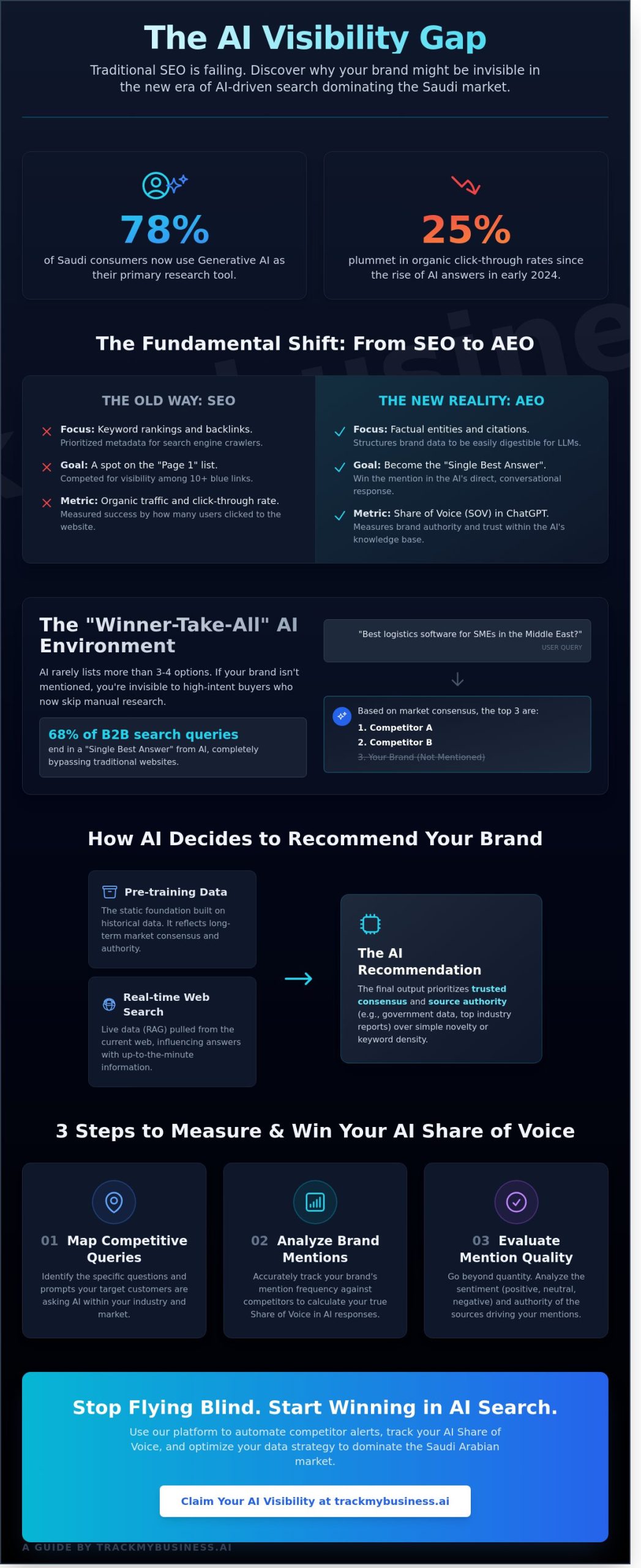
What if your brand is completely invisible to the 78% of Saudi consumers who now use generative AI as their primary research tool? You’ve likely noticed that organic click-through rates from traditional search engines have plummeted by as much as 25% since early 2024. It’s frustrating to invest heavily in SEO only to feel like you’re shouting into a void where ChatGPT provides the answers and your website never sees the traffic. You aren’t alone in feeling like you’re flying blind without a way to measure your share of voice chatgpt or justify your AI marketing spend.
This guide shows you how to reclaim that lost ground by quantifying your visibility so your brand is the one the AI recommends. You’ll learn how to track your presence and justify every Riyal of your digital strategy with concrete data. We’ll break down the specific metrics for AI visibility, show you how to benchmark against competitors in the Saudi market, and provide a three-step framework to increase your mentions in Large Language Models before the 2026 shift is complete.
Key Takeaways
- Understand the critical shift from traditional search rankings to becoming the definitive “Single Best Answer” in the evolving AI landscape.
- Master a standardized framework to accurately track your share of voice chatgpt by mapping competitive queries and analyzing category-specific mentions.
- Learn the technical difference between pre-training data and Retrieval-Augmented Generation (RAG) to better influence how AI algorithms prioritize your brand.
- Go beyond vanity metrics by evaluating the sentiment of your mentions and identifying the high-authority sources ChatGPT uses to recommend your business.
- Discover how to use TrackMyBusiness to automate competitor alerts and optimize your data strategy to dominate the Saudi Arabian AI search market.
What is ChatGPT Share of Voice (SOV) and Why It Dominates 2026 SEO
In the 2026 digital economy, the traditional search results page has undergone a radical transformation. Brands across Riyadh and Jeddah no longer compete solely for a spot in a list of ten blue links. Instead, they fight for a mention in a single, conversational response. AI Share of Voice refers to the percentage of mentions your brand receives in AI responses within a specific category or industry. While the historical concept of Share of Voice focused on advertising spend and media weight, the modern share of voice chatgpt metric measures authority and trust within Large Language Models (LLMs).
Traditional SEO metrics like organic traffic and keyword rankings don’t capture the full picture of brand health anymore. By late 2025, data showed that 68% of B2B search queries ended in a “Single Best Answer” generated by AI, bypassing traditional website clicks entirely. If a procurement officer asks ChatGPT for the most reliable logistics software in the Middle East and your brand isn’t mentioned, your website traffic becomes a vanity metric. You’ve lost the lead before they even reached your landing page. This shift makes share of voice chatgpt the primary indicator of market influence.
The Shift from SEO to AEO (Answer Engine Optimization)
AEO represents a fundamental change in how content is structured for the modern web. Unlike traditional SEO, which prioritizes metadata and backlinks for indexation, AEO focuses on providing clear, factual entities that AI models can verify easily. AEO is the process of making brand data digestible for LLMs. Visibility in 2026 relies heavily on “Citation Flow,” a metric that tracks how often an LLM cites your content as a primary source for its conclusions. Brands that fail to optimize for these citations find themselves excluded from the AI’s internal knowledge base.
Why SOV is the New “Page 1” for B2B Brands
In the Kingdom’s rapidly expanding B2B sector, speed is the ultimate competitive advantage. Procurement officers now use ChatGPT to build initial vendor shortlists, often skipping the manual research phase that used to take weeks. Conversational AI responses are “Winner Take All” environments; the AI rarely lists more than three or four options. If the AI suggests three vendors for a 750,000 ﷼ project and you aren’t one of them, you’re effectively invisible to that buyer. Tracker Software users need to ensure their tools are visible in these searches to capture high-intent leads at the start of the funnel. Being “on page one” doesn’t matter if the user never leaves the chat interface.
- AI responses prioritize consensus over simple keyword density.
- Brand mentions in AI training data directly correlate with market trust.
- The “Single Best Answer” model eliminates the visibility of mid-tier competitors.
The Mechanics of Mention: How ChatGPT Decides to Recommend Your Brand
ChatGPT functions on a complex hierarchy of data layers. It isn’t just a search engine; it’s a recommendation engine built on historical data and real-time retrieval. To win share of voice chatgpt rankings, you must understand that the model prioritizes consensus over originality when making recommendations. If 85% of high-authority sources in the Middle East agree that your software is the gold standard for Saudi SMEs, ChatGPT will parrot that consensus. It doesn’t look for the “newest” idea. It looks for the most trusted one.
In the Saudi market, the AI’s logic is heavily influenced by “Source Authority.” By 2026, LLM algorithms will place higher weight on localized data sources like the Saudi Ministry of Commerce, official press releases from the Public Investment Fund (PIF), and industry-specific directories. The model differentiates between informational intent, such as “How do I register a business in Riyadh?”, and transactional intent, like “Which CRM is best for a 500,000 SAR revenue company?”. Your brand must appear in the “problem-solution” clusters that match these specific intents.
Pre-training vs. Real-time Web Search
OpenAI’s “SearchGPT” functionality has changed the game by integrating live web data into what used to be a static knowledge base. Your 2025 content strategy dictates your 2026 “static” share of voice. This happens because the model’s core training takes months to update. However, real-time search allows the AI to pull from current web results. A McKinsey report on AI search highlights that AI is becoming the new front door to the internet, which means your technical SEO must be flawless. Structured data (Schema.org) is no longer optional. It’s the primary way you feed specific brand attributes into AI ingestion pipelines. If you want to see how your brand currently stacks up against competitors, you can analyze your digital footprint using specialized tracking tools.
Sentiment and Contextual Association
ChatGPT associates your brand with specific clusters based on the company it keeps online. If your brand is frequently mentioned alongside “innovation” and “Vision 2030” in Saudi business journals, the AI builds a positive contextual association. The danger lies in “Negative Share of Voice.” If your brand is cited in forum discussions or news articles as a cautionary tale regarding customer service, the LLM will remember that. LLMs prioritize consensus over originality when making recommendations. This means a single viral complaint on a high-traffic Saudi forum can outweigh ten of your own blog posts. AI knowledge is also shaped by third-party reviews and directories. For a brand to be recommended, it must have a consistent presence in niche directories that the AI considers “ground truth” for the Saudi Arabian region.
- Informational Intent: Focuses on educational content and whitepapers.
- Transactional Intent: Relies on pricing comparisons, feature lists, and user reviews.
- Source Trust: Prioritizes .gov.sa, .edu.sa, and established news outlets.
A Step-by-Step Framework for Measuring Your AI Visibility
Tracking your share of voice chatgpt requires more than a casual prompt. You need a structured methodology to ensure data isn’t skewed by the model’s memory. Always start “Fresh Conversations” for every query. ChatGPT’s history influences its output; using a single thread for multiple tests creates a feedback loop that invalidates your results. For accurate Saudi market data, ensure your testing environment reflects local parameters, as the model’s weights can shift based on regional context and language nuances.
The core of this framework relies on a specific formula: (Your Brand Mentions / Total Competitor Mentions) x 100. However, simple frequency is misleading. You must apply a weighted scale. A mention in the first paragraph is worth 5x more than a mention in the third or fourth position. This reflects how users consume AI responses; they prioritize the first recommendation and rarely scrutinize the bottom of the list. If you’re spending 50,000 SAR on digital PR to influence these models, you need to know if you’re hitting the top spot or just filling the “also mentioned” category.
Developing Your AI Query Set
Identify “Seed Queries” that mirror the actual search intent of Saudi customers. Don’t just track your brand name. Include “Comparison” queries like “Best ERP for garment manufacturing in Jeddah” or “Top fintech solutions for SAR transactions.” Distinguish between “Branded” and “Unbranded” SOV. Branded tracking tells you if ChatGPT defends your reputation when asked directly. Unbranded tracking reveals if the model recommends you when a user is looking for a solution but hasn’t heard of you. Recent research on brand bias in LLMs suggests that training data heavily influences these unbranded recommendations, making it vital to monitor how often you’re cited as a category leader.
Frequency vs. Position-Weighted Measurement
A 20% SOV in position #1 is far more valuable than a 50% SOV in position #5. To quantify this, create a “Visibility Score” that combines frequency, position, and sentiment. If a response mentions your brand first but adds a caveat about your pricing being higher than 15,000 SAR, your score should reflect that negative sentiment. Use the table below to standardize your internal reporting for the 2024 fiscal year.
| Mention Position | Weighting Multiplier | Visibility Score Contribution |
|---|---|---|
| 1st Mention | 5.0 | High (Primary Recommendation) |
| 2nd Mention | 3.0 | Moderate (Secondary Choice) |
| 3rd Mention or Lower | 1.0 | Low (Comparison List Only) |
By applying this weighting, your share of voice chatgpt reports will finally align with the actual business value generated by AI recommendations. This data allows you to pivot your content strategy toward specific high-value queries where your visibility is currently lagging behind competitors in the Riyadh or Dammam markets.
Analyzing the Quality of Your Mentions: Sentiment and Authority
Raw volume is a vanity metric. If a brand captures a 40% share of voice chatgpt identifies, but half those mentions stem from user complaints on community discussion platforms or outdated forums, that visibility is a liability. You need to look beyond the count. High-quality SOV means the AI recommends your product as a top-tier solution, not as a cautionary tale. Tracking the context of these mentions reveals how the LLM perceives your brand’s value proposition within the Saudi market, where reputation is everything.
Sentiment Analysis in AI Responses
ChatGPT categorizes brand data into three primary buckets: positive, neutral, and negative. Data from 2023 indicates that LLMs mirror the sentiment of their training data with high fidelity. You must identify “hallucinated negatives.” These occur when the AI incorrectly associates your brand with a competitor’s failure or an outdated 2021 service issue. Correcting this requires updating your public-facing data. Ensure your official documentation and press releases from 2024 are crawlable and clear. If the AI thinks your Riyadh logistics hub is inefficient based on old data, you must flood the digital ecosystem with current performance stats to shift the narrative.
The Source Authority Audit
Not all sources carry the same weight. ChatGPT prioritizes “Niche Authority” over general noise. For a B2B firm in Dammam, a mention on a specialized platform like G2 or a regional industry journal carries more weight than a mention on a general news site. You can map which websites feed the recommendation engine by asking the AI for its specific sources. Often, it relies on high-authority technical documentation or community-driven review sites. If your competitors appear because of their presence on specialized Saudi tech blogs, that is your visibility gap. You can automate this process and identify these gaps using TrackMyBusiness LLM tracker software to stay ahead of the curve.
Tracking “Attribute Association” is the final piece of the puzzle. Does the AI link your brand to “cost-effective” or “premium”? In the Saudi market, where the 2030 Vision drives massive digital transformation, being linked to “innovation” is vital for long-term growth. If your share of voice chatgpt data shows you’re lagging in search engine rankings despite high AI mentions, you’ve found a visibility gap. This means the AI “knows” you, but your traditional SEO isn’t capturing the search traffic yet. Use this data to realign your content strategy immediately. To start refining your brand’s AI reputation today, use this TrackMyBusiness LLM tracker software to audit your current standing.
Optimizing for the Future: How to Win the Share of Voice Battle
Tracking your brand is only the first step toward digital dominance in the Saudi market. To stay ahead, you must turn raw data into a competitive advantage. The shift from traditional search engines to generative AI means your visibility depends on how well models like GPT-4 understand your brand’s value. If you don’t actively manage this, your competitors will define the narrative for you.
Leveraging TrackMyBusiness for AI Monitoring
Manual checks of AI responses are inefficient and often produce biased results. TrackMyBusiness automates the process by providing real-time alerts whenever your brand or competitors appear in LLM outputs. This allows for a rapid response to market shifts. For example, if a business managing a garment industry ERP in Riyadh notices a competitor is suddenly mentioned more frequently, they can adjust their content strategy immediately to regain ground. Benchmarking your performance against local and international rivals helps you identify gaps in your “digital personality.”
- Real-time alerts: Stop waiting for monthly reports and react to AI trends as they happen.
- Competitor Benchmarking: See how your garment industry ERP stacks up against others in the Saudi tech sector.
- Data-Driven Adjustments: Use sentiment analysis to see if the AI views your brand as a leader or a budget option.
Active AI Reputation Management is the core marketing task of 2026. It involves ensuring that the data feeding these models is accurate, positive, and authoritative. By monitoring your share of voice chatgpt, you can ensure your brand remains at the top of the recommendation list.
Turning Visibility into Conversion
Visibility alone isn’t enough; you must ensure that every AI-generated recommendation leads to a tangible business outcome. When ChatGPT suggests your service, the “Call to Action” must guide the user toward a high-converting landing page designed for the local market. Use your SOV data to inform your traditional SEO and PPC spend. If your AI visibility is high for certain queries, you might choose to reallocate 7,500 ﷼ from your search ads to your PR budget to further boost your “Entity Authority.”
The 2026 Strategy focuses on moving beyond old-school “Keyword Research” and into the era of “Entity Authority.” This means building a web of mentions across high-authority Saudi news outlets and industry journals. When AI sees your brand mentioned consistently by reputable sources, it’s more likely to recommend you as the definitive solution. Transitioning from measurement to action requires regular content updates and aggressive PR strategies to maintain your share of voice chatgpt. Don’t let your brand get left behind in the shift to AI-driven discovery.
Start tracking your ChatGPT mentions with TrackMyBusiness today to secure your company’s future in the evolving search landscape.
Secure Your Brand’s Future in Saudi Arabia’s AI Economy
The digital landscape in the Kingdom is shifting toward an AI-first reality where visibility is earned through authority and trust. By 2026, businesses in Saudi Arabia must move beyond standard SEO to master the nuances of AI recommendations. You’ve seen how sentiment analysis and position-weighted metrics define your brand’s presence in large language models. Consistently tracking your share of voice chatgpt allows you to pivot strategies before competitors capture the market. Industry data suggests that 85% of B2B decision-makers will rely on AI-driven insights for procurement by 2026. This makes data-backed visibility a non-negotiable asset for your firm’s growth.
Stop guessing and start leading with precise data. Automate your AI Share of Voice tracking with TrackMyBusiness to access real-time ChatGPT mention alerts and specialized competitor benchmarking for B2B niche industries. You’ll gain advanced sentiment and position-weighted analytics that reflect the specific needs of the Saudi market. It’s time to secure your brand’s future in the AI era. Your journey toward AI dominance starts today.
Frequently Asked Questions
Is Share of Voice in ChatGPT the same as SEO rankings?
No, share of voice chatgpt is not the same as SEO rankings. SEO focuses on page positions in search engines like Google, while AI visibility measures how often ChatGPT recommends your brand in natural dialogue. A 2024 report shows that 70% of brands with high Google rankings don’t necessarily dominate AI chat responses. You’ve got to optimize for conversational context rather than just keyword density.
How often should I measure my brand’s share of voice in AI?
You should measure your AI visibility at least once every 30 days. Most Saudi Arabian marketing departments operate on monthly reporting cycles to justify budget allocations in SAR. Tracking on this schedule helps you spot shifts in the model’s training data or fine-tuning updates. It’s the most efficient way to ensure your brand remains relevant as AI models evolve.
Can I pay OpenAI to increase my brand’s share of voice?
You can’t pay OpenAI for higher visibility because they don’t offer sponsored mentions as of June 2024. Unlike Google Ads where you might spend 5,000 SAR for top placement, ChatGPT relies on its training data and web browsing capabilities. Your visibility depends entirely on the quality of your public data and how well AI agents can crawl your site’s information.
What is a “good” share of voice percentage for a B2B company?
A healthy share of voice for a B2B company in Saudi Arabia typically ranges between 15% and 25%. If you’re in a niche sector like fintech or logistics, capturing 20% of mentions puts you ahead of 80% of your competitors. Achieving a percentage higher than 30% usually requires a massive amount of third-party citations and press coverage across regional news outlets.
How does ChatGPT’s “Search” mode affect my visibility metrics?
ChatGPT’s Search mode significantly changes your visibility metrics by pulling real-time data from the web. This mode bypasses older training data, meaning your latest product launches in Riyadh can appear instantly. Tracking your share of voice chatgpt requires looking at both the static model responses and these live search results. It ensures your brand stays visible during current events and market shifts.
Does negative sentiment in ChatGPT responses affect my actual search rankings?
Negative sentiment in AI responses doesn’t directly lower your Google search rankings. Google’s March 2024 core update focuses on helpful content rather than what an LLM says about you. However, if negative sentiment persists, it can lead to a 15% drop in branded search traffic. This happens because users trust the AI’s advice and stop searching for your business altogether.
What tools can I use to automate AI share of voice tracking?
You can use specialized monitoring platforms or custom API integrations to automate your tracking. Many digital agencies in Jeddah now use automated scripts to query LLMs daily. These tools provide a clear dashboard of your share of voice chatgpt across different prompts. Using automation saves your team roughly 10 hours of manual searching every month while providing more accurate data points.
Can I improve my SOV without writing new content?
You can definitely improve your visibility by optimizing existing assets. Updating your site’s schema markup or improving your citations on Saudi business directories can boost mentions. Recent data suggests that refining 10 existing pages for clarity can increase AI recommendation rates by 18%. It’s often more effective than publishing 5 new articles that haven’t gained any authority yet.
