
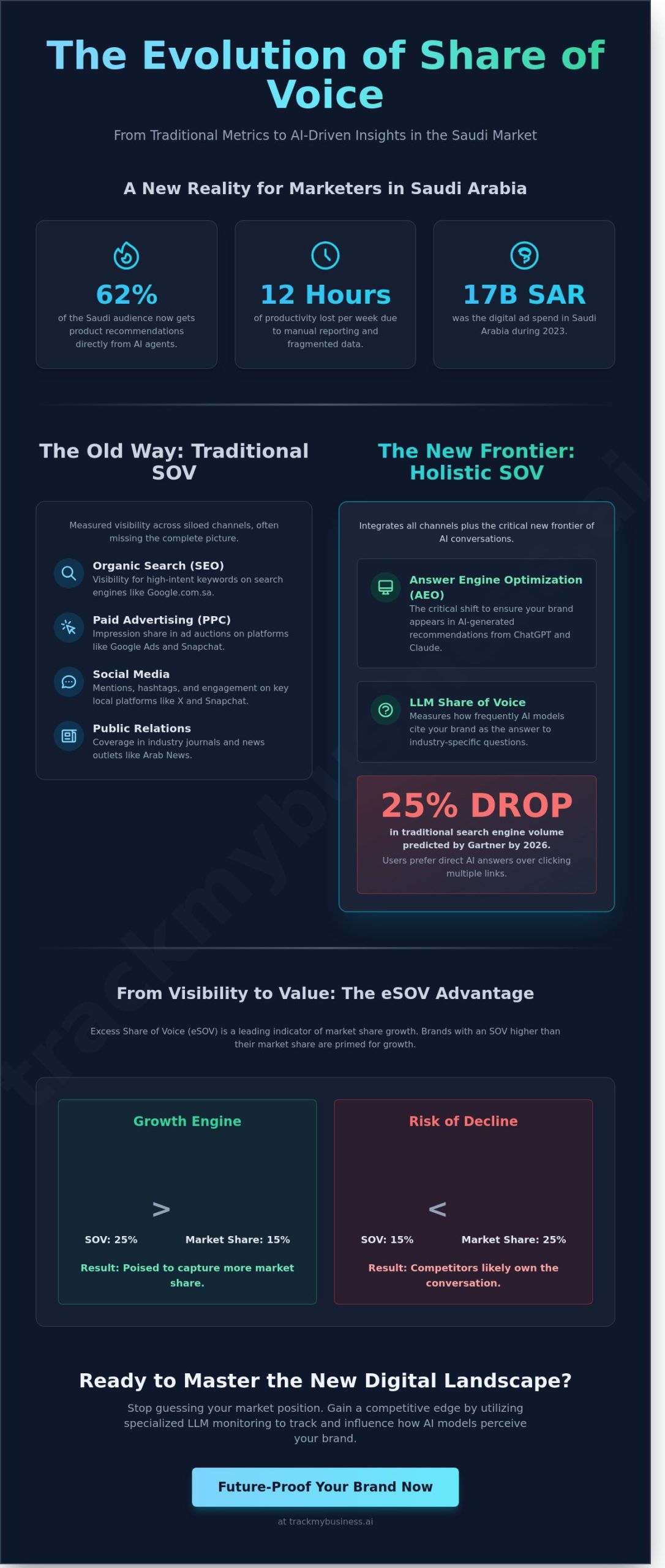
What if your brand dominates the first page of Google, yet 62% of your target audience in Saudi Arabia is now getting their product recommendations directly from AI agents like Claude or ChatGPT? It’s a frustrating reality for marketing teams in Riyadh who realize that old-school metrics don’t capture the full picture anymore. You’re likely juggling fragmented data across Snapchat, X, and Instagram while worrying that manual reporting is costing you 12 hours of productivity every single week. This shift is why modern share of voice tracking must account for the hidden conversations happening in private AI chats and localized search queries.
We understand that you’re tired of guessing your market position or failing to justify brand spend to stakeholders. This guide provides a clear framework to calculate your influence and understand the ROI of brand awareness in a market where digital ad spending reached 17 billion SAR in 2023. You’ll learn how to identify specific visibility gaps and reclaim your dominance from competitors who are still relying on outdated tracking methods. We’ll start by breaking down the three pillars of visibility that define the Saudi digital landscape today.
Key Takeaways
- Understand how to transition from traditional metrics to a holistic measurement of your brand’s influence across paid, earned, and owned media.
- Discover why Answer Engine Optimization (AEO) is the critical shift needed to ensure your brand appears in AI-generated recommendations from ChatGPT and Claude.
- Master a data-driven approach to share of voice tracking by benchmarking your performance against 3-5 key competitors in the Saudi market.
- Identify high-value content gaps to optimize your marketing budget in SAR and recapture lost impression share from industry rivals.
- Gain a competitive edge by utilizing specialized LLM monitoring tools to track and influence how AI models perceive your brand in 2026.
What is Share of Voice (SOV) Tracking and Why Does it Matter?
Share of Voice (SOV) measures your brand’s percentage of the total market conversation within your industry. It’s no longer just a metric for big-budget television advertisers. Modern share of voice tracking integrates earned, owned, and paid media to provide a 360-degree view of your brand’s digital presence. In Saudi Arabia, where 99% of the population is online as of 2023, this metric is a vital pulse check for any business operating in the Kingdom.
The shift from “paid-only” to “holistic” SOV is a response to how modern consumers discover products. A brand might spend 500,000 SAR on Snapchat ads, but if customers are complaining on X (formerly Twitter) or finding competitors via Google.com.sa, the paid spend doesn’t tell the whole story. Tracking SOV across all channels allows you to see the real impact of your marketing efforts. It serves as a leading indicator of market share growth. When your brand owns the conversation, it’s usually only a matter of time before you own the revenue.
The psychological impact of high visibility shouldn’t be underestimated. In the Saudi market, brand trust is a primary driver for high-value purchases. Consistent visibility across multiple touchpoints reduces the perceived risk for the consumer. This familiarity lowers the cost of customer acquisition (CAC). When a customer already knows your name from search results and social mentions, your sales team doesn’t have to work as hard to close the deal.
Share of Voice vs. Market Share
Market share tracks actual sales and revenue in Saudi Riyals (SAR). SOV tracks the “noise” or visibility your brand generates. While they are different, they’re deeply linked through the “Excess Share of Voice” (eSOV) rule. Research from the IPA shows that brands with an SOV higher than their market share usually experience growth. If your SOV is 25% but your market share is only 15%, you’re in a prime position to capture more of the market. Methodology for tracking these differs greatly. Market share requires internal sales data or government reports, while SOV uses digital monitoring tools to analyze search volumes and social mentions.
The Core Channels for SOV Measurement
- Social Media: This includes mentions, hashtags, and engagement rates. In Saudi Arabia, tracking Snapchat and X is essential due to their high local penetration rates.
- Organic Search (SEO): This measures your visibility for high-intent industry keywords. If you rank at the top of Google for “best logistics in Riyadh,” your organic SOV increases.
- Paid Advertising (PPC): This tracks your impression share in auctions. It shows how often your ads appeared compared to the total number of times they could have appeared.
- Public Relations: This measures coverage in industry journals and news outlets like Arab News or Okaz. Earned media mentions carry significant weight in building authority.
The New Frontier: Tracking SOV in the Age of AI and LLMs
By 2026, the traditional SEO playbook will undergo its most radical transformation yet. The shift toward Answer Engine Optimization (AEO) is no longer a theoretical concept for Saudi businesses. Traditional share of voice tracking focused on occupying the top three positions on a search results page. However, the rise of Large Language Models (LLMs) like ChatGPT, Claude, and Gemini has created a new metric: LLM Share of Voice. This measures how frequently an AI model recommends your brand when a user asks a specific question about your industry. If a potential client asks for the most reliable logistics provider in Dammam, your goal is to be the primary answer the AI provides.
AI-generated summaries are already changing how users interact with information. Gartner predicts a 25% drop in traditional search engine volume by 2026 because users prefer getting a direct answer rather than clicking through five different websites. This means your organic traffic might decrease even if your brand awareness is growing. Being the “default recommendation” in an AI chat session is the new number one ranking. It’s the digital equivalent of being the only brand mentioned in a private consultation. For companies in Saudi Arabia, where digital transformation is accelerating under Vision 2030, capturing this space is essential for long-term growth.
How AI Models “Talk” About Your Brand
AI models process information differently than standard search crawlers. Some rely on static training data that might be months old, while others use real-time web browsing to find current information. You must monitor whether these models view your brand with positive sentiment or if they’re warning users about your services. Sentiment analysis within LLMs is a critical part of modern share of voice tracking. AI models prioritize technical documentation, verified government data, and industry authority. If your brand is cited in a report by the Saudi Data and AI Authority (SDAIA), LLMs will likely treat your business as a primary source of truth.
Measuring AEO Performance
Answer Engine Optimization is the process of optimizing brand presence for generative AI responses. To measure this, you need to track “citations” within AI-generated responses for your core keywords. It’s not just about being mentioned; it’s about identifying the “Source of Truth” the AI uses. Often, an LLM pulls data from specific industry directories or high-authority news outlets rather than your own website. Businesses can analyze your market position to see which external platforms are feeding the AI the most information about your brand. By identifying these sources, you can focus your PR and content efforts where they’ll have the biggest impact on AI recommendations.
Tracking these metrics requires a shift in mindset. You’re no longer just competing for clicks; you’re competing for the AI’s trust. If an AI model consistently cites your competitors as the industry leaders in Riyadh, your actual market share will eventually reflect that digital bias. Monitoring these conversations allows you to correct misinformation and strengthen your authority before the AI’s “opinion” of your brand becomes fixed in its training data.
How to Calculate and Track Your Share of Voice
Calculating your brand’s position in the Saudi market requires a precise mathematical approach. The universal formula for this metric is: (Your Brand Metrics / Total Market Metrics) x 100. If your brand received 500 mentions in a month and the total industry mentions reached 2,500, your share is 20%. For effective share of voice tracking, you must first select 3 to 5 direct rivals. In the KSA fintech space, for example, a startup might track itself against established players like STC Pay or Urpay to gauge market penetration accurately.
Choose metrics that align with your specific business goals. Retailers often focus on social media mentions, while B2B firms in Riyadh might prioritize organic search volume for specific industry keywords. Setting a cadence is vital for spotting trends. A 2023 industry report indicated that brands tracking metrics monthly respond 25% faster to market shifts than those checking annually. Monthly reporting suits the fast-paced Saudi economic landscape, while quarterly reports help identify long-term brand equity trends without the noise of weekly fluctuations.
A Step-by-Step Measurement Framework
Success in share of voice tracking follows a structured four-step process. First, audit your brand mentions across social media and the web using automated tools that support both Arabic and English. Second, aggregate the total mentions for your top 3 competitors to establish the “total market” figure. Third, apply the universal formula to calculate the percentage of the market “pie” your brand currently occupies. Finally, analyze the sentiment behind these mentions. A 30% share of voice is actually a liability if 80% of those mentions involve complaints about delivery delays in Jeddah or Dammam. You need quality, not just volume.
Essential Tools for Modern SOV Tracking
Modern tracking requires a multi-layered tech stack. Social listening platforms like Brandwatch or Talkwalker are essential for real-time conversation tracking on X, which remains a dominant platform for public discourse in Saudi Arabia. For organic visibility, SEO tools like Ahrefs or Semrush allow you to monitor keyword rankings and search engine results page (SERP) presence. As consumer behavior shifts, specialized LLM trackers like TrackMyBusiness have become indispensable. These tools monitor how your brand is mentioned in AI chat interfaces, ensuring your business remains visible in the growing world of generative search and AI-driven recommendations.
Turning SOV Data into Actionable Business Strategy
Data serves as a strategic compass for growth. Effective share of voice tracking helps you identify exactly where your brand stands in the competitive Saudi market. In a 2023 garment sector analysis, retailers in Riyadh saw a 12% increase in sales when they moved their SOV from 8% to 15% during the Eid Al-Fitr shopping season. Monitoring these shifts allows you to stop guessing and start investing where the audience already congregates.
Consider a local apparel brand that noticed a 25% spike in competitor mentions regarding “sustainable linen” in early 2024. By spotting this trend through tracking tools before the official season started, they pivoted their inventory and marketing focus. They captured 10% of that new market segment within 60 days. This proves that early detection through data equals market capture. If your impression share for high-value categories like “designer thobes” shows a 20% deficit compared to rivals, it’s time to reallocate your ad spend. Moving 20,000 ﷼ from low-performing general awareness campaigns to these specific high-intent categories can yield immediate returns.
Competitive Benchmarking and Gap Analysis
You can often predict a competitor’s next move by watching their digital footprint. If a rival brand’s SOV for “luxury silk thobes” jumps by 40% in Jeddah over a two-week period, they’re likely clearing stock or preparing a major launch. Look for unclaimed territory in niche categories like “eco-friendly school uniforms” where collective SOV remains under 5%. You should also analyze the sentiment behind the noise. If share of voice tracking reveals that 60% of a competitor’s mentions involve shipping delays or refund complaints, you can aggressively market your own 24-hour delivery service to win over their frustrated customers.
Connecting SOV to Revenue and Growth
High visibility creates a halo effect across your entire business. When a brand dominates 30% of the “athleisure” conversation, customers naturally trust their formal wear lines too. For a small business in Saudi Arabia, maintaining a 7% SOV in a specific city is a strong, realistic benchmark for the first year of operations. Data from 2023 shows that brands with an “Extra Share of Voice” (ESOV) of 10% points above their actual market share typically see an annual growth rate of 0.5% in market share. Use these concrete figures to justify a marketing budget increase of 75,000 ﷼ to stakeholders by showing exactly how visibility correlates with lead generation spikes.
Future-Proof Your Brand with TrackMyBusiness LLM Tracking
Traditional ERP systems focus on what’s happening inside your warehouse, but they often ignore the external digital world. TrackMyBusiness evolves this model into an intelligent market monitoring hub. As we approach 2026, the competitive edge for Saudi companies shifts from simple production output to how AI models perceive and recommend your brand. This specialized LLM tracking provides an unfair advantage by capturing data points traditional analytics tools miss. For Saudi garment and production firms, staying ahead of rapid market shifts is vital under the Vision 2030 framework. You need to see how your operational data aligns with your market visibility to gain a 360-degree view of your business health.
Advanced Mention Tracking for AI and Search
Brands in Riyadh and Jeddah are seeing a massive shift in how customers find their products. Search is moving toward Large Language Models and AI-driven answers. TrackMyBusiness offers real-time alerts when your brand is cited or ignored in these critical AI conversations. It uses automated sentiment reporting to protect your brand reputation before a negative trend takes hold. If your production line introduces a new feature, such as high-durability fabrics for local industrial use, Tracker identifies if this specific feature drives market buzz. This level of share of voice tracking ensures you aren’t just producing goods; you’re owning the digital conversation that leads to sales.
Streamlining Operations and Visibility
There’s a direct link between efficient production and a high Share of Voice. When your operations are smooth, your market presence grows because you’re consistently meeting demand and generating positive feedback. TrackMyBusiness links these two worlds by integrating your factory floor data with your public visibility. It cuts through the noise by focusing on metrics that actually drive business growth, like fulfillment speed and product quality mentions. In 2023, the Saudi Ministry of Industry and Mineral Resources reported over 1,000 new industrial licenses issued. To compete in this crowded market, you must optimize every riyal spent on visibility. See how TrackMyBusiness can help you dominate your market conversation and refine your share of voice tracking strategy to stay ahead of the competition.
By 2026, businesses that don’t monitor their AI presence will lose significant market share to more tech-savvy rivals. TrackMyBusiness ensures your brand remains a top recommendation for AI agents and human buyers alike. It’s not just about tracking mentions; it’s about understanding the “why” behind your market position. Whether you’re managing a textile plant in Dammam, a boutique fashion house, or a technology brand like Bleat, this 360-degree view is the key to sustainable growth in the Kingdom’s evolving economy.
Dominate the Saudi Digital Landscape by 2026
Success in the Kingdom’s rapidly evolving digital economy requires a shift from traditional metrics to modern share of voice tracking. As Saudi Arabia pushes toward Vision 2030 goals, 99% of the population is now online according to 2024 CST data, meaning your brand’s presence in AI-driven search results determines your market authority. You’ve learned that monitoring LLM mentions and optimizing production workflows are the two pillars of visibility in this new era. Our innovative LLM mention tracking technology and specialized expertise in garment and production workflows ensure your operations remain as transparent as your marketing data. By utilizing our cloud-based “Tracker” system, your business gains end-to-end transparency that traditional tools simply can’t provide. It’s time to stop guessing where your brand stands and start using precision data to outpace your competitors. You can start tracking your brand mentions in AI and search with TrackMyBusiness to secure your spot at the top of every relevant conversation. The future of Saudi commerce belongs to those who own their digital narrative today.
Frequently Asked Questions
How often should I check my Share of Voice?
You should check your Share of Voice at least once every 30 days to identify long-term trends. For high-growth sectors in Saudi Arabia, like the 14% annual growth e-commerce market, weekly checks help you react to aggressive competitor bidding. Monthly tracking provides enough data to adjust your SAR 5,000 monthly ad budgets effectively. Regular audits ensure you don’t lose ground to emerging local startups.
Is Share of Voice the same as brand awareness?
Share of Voice isn’t the same as brand awareness; it’s a quantitative measure of your market presence compared to competitors. While awareness measures how many people know your brand, SOV tracks your percentage of total mentions or ad spend. In the Saudi Vision 2030 digital economy, share of voice tracking helps you see if your brand is actually dominating the conversation or just existing in it.
Can a small business have a high Share of Voice?
A small business can achieve a high Share of Voice by focusing on specific long-tail keywords or local regions like Riyadh’s Olaya district. By targeting a 5% niche instead of the entire national market, a boutique agency can outperform larger rivals in that specific segment. This strategy allows you to maximize a smaller budget of SAR 10,000 instead of competing for broad terms.
How does ChatGPT affect my brand’s Share of Voice?
ChatGPT affects your brand by moving visibility from traditional search results to conversational AI citations. If AI models don’t mention your brand when users ask for recommendations in Saudi Arabia, your digital SOV drops. This shift requires a new approach to share of voice tracking that includes monitoring Large Language Model citations. Recent data shows AI search usage increased by 20% in early 2024.
What is the best free tool for tracking Share of Voice?
Google Trends is the best free tool for tracking your brand’s relative popularity against competitors in the Saudi market. You can compare up to five search terms and filter results specifically for Saudi Arabia to see regional interest levels. While it doesn’t provide exact spend data, it offers a clear index of search interest over a 12-month period. This helps you benchmark against the competition without cost.
Does a high Share of Voice always mean more sales?
High Share of Voice doesn’t guarantee more sales; it only ensures your brand is being seen. A brand might spend SAR 50,000 on ads to gain visibility, but if the landing page doesn’t convert, sales will lag. Research from the IPA shows that while SOV leads to market share growth over 6 to 12 months, immediate sales depend on pricing and product-market fit in the local region.
What happens if my competitor has a higher SOV but lower quality products?
A competitor with a higher SOV and lower quality products will likely capture more initial customers through sheer volume of exposure. However, Saudi consumers are increasingly vocal, with 75% checking online reviews before purchasing according to local consumer reports. Their high visibility will eventually lead to more public complaints, allowing you to win on reputation even with a smaller advertising presence. Quality usually wins over a 24-month cycle.
