
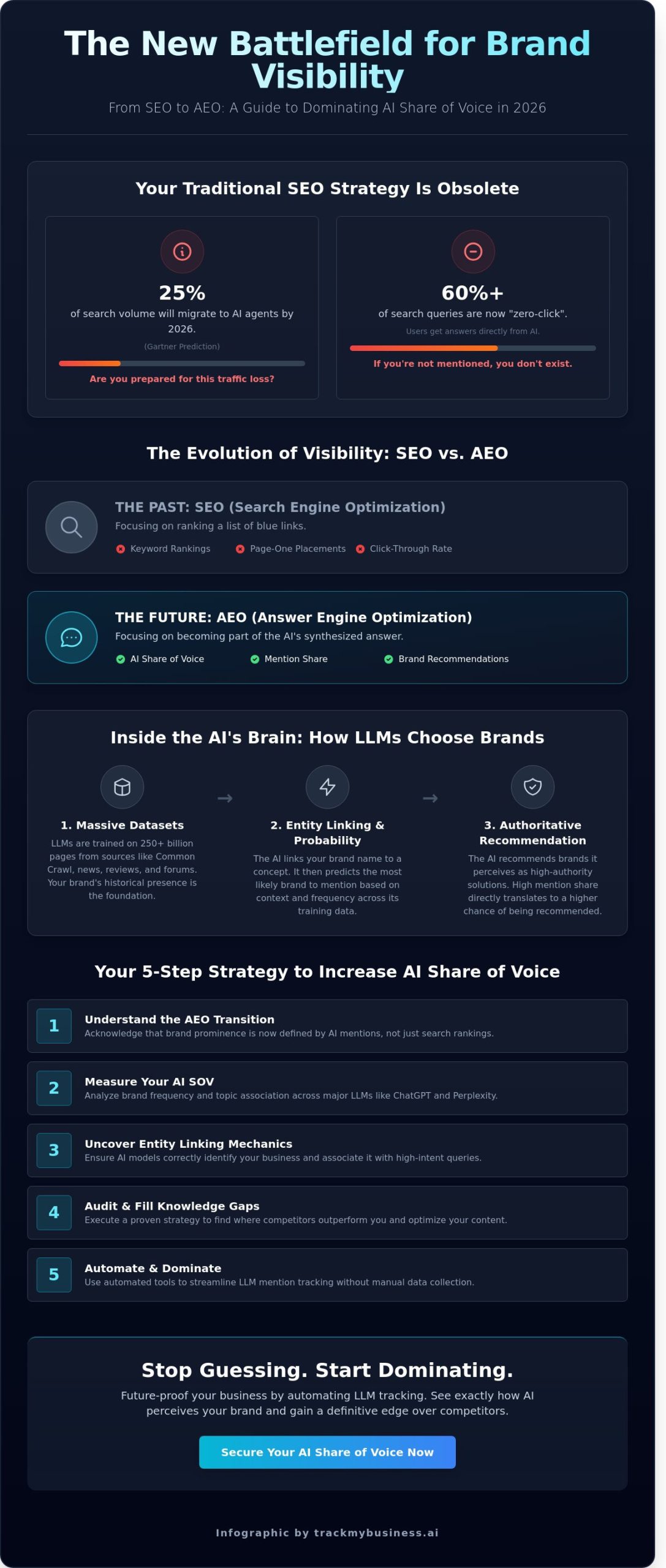
Your traditional SEO strategy is effectively blind to the 25% of search volume that Gartner predicts will migrate to AI agents by 2026. For businesses in Saudi Arabia, this shift means that appearing on the first page of Google no longer guarantees you’re reaching your target audience in Riyadh or Jeddah. You’ve likely felt the sting of declining organic traffic despite maintaining your rankings, leaving you wondering how these new models actually perceive your brand. It’s a common frustration to feel like you’re shouting into a void without any data to prove your brand’s relevance in conversational search.
This guide changes that by teaching you how to quantify and dominate your share of voice ai across platforms like ChatGPT and Claude. You’ll learn the exact framework to track competitor mentions and move beyond guesswork into data-backed visibility. We’ll walk through the specific steps to optimize your content for AI Engine Optimization (AEO), ensuring your business remains the top recommendation when Saudi consumers ask for services, protecting the millions of ﷼ (SAR) in potential revenue that traditional search is currently leaking to AI competitors.
Key Takeaways
- Understand the critical transition from SEO to Answer Engine Optimization (AEO) to maintain brand prominence as AI-driven search dominates the Saudi market.
- Learn how to accurately measure your share of voice ai by analyzing brand frequency and topic association across major LLMs like ChatGPT and Perplexity.
- Uncover the technical mechanics of entity linking to ensure AI models correctly identify and recommend your business in high-intent conversational queries.
- Execute a proven five-step strategy to audit your current visibility and fill knowledge gaps where competitors are currently outperforming your brand.
- Discover how automated tools like TrackMyBusiness can streamline LLM mention tracking, helping you dominate AI responses without manual data collection.
What is AI Share of Voice (SOV) and Why Does it Matter in 2026?
In 2026, the metrics that defined marketing success for a decade have been turned upside down. We’ve moved beyond simple keyword rankings and page-one placements. Today, savvy marketing teams in Saudi Arabia focus on share of voice ai, a metric that tracks how frequently an LLM (Large Language Model) includes your brand in its generated answers. While marketers once relied on the traditional Share of Voice to gauge market dominance in print or television, that concept now applies to the digital brain of AI models like ChatGPT and Gemini.
This shift marks the definitive transition from Search Engine Optimization (SEO) to Answer Engine Optimization (AEO). In the current landscape, over 60% of search queries are “zero-click,” meaning users get their answers directly from the AI interface without ever visiting a website. For a business in Riyadh or Dammam, your visibility depends on being part of the synthesized response itself. If you aren’t mentioned in the chat, you effectively don’t exist in the eyes of the consumer. Mention Share has replaced Click-Through Rate (CTR) as the primary indicator of brand health and future revenue.
The Evolution of Brand Visibility: From SERPs to Chatbots
The customer discovery journey has moved away from scrolling through a list of links to engaging in a dialogue. Platforms like ChatGPT, Claude, and Gemini act as filters that prioritize specific brands based on perceived authority and data relevance. There’s a massive difference between being indexed and being recommended. Being indexed means the AI knows your site exists; being recommended means the AI trusts your brand enough to present it as a solution to a user’s problem. AI Share of Voice is the new gold standard for brand authority in the age of generative intelligence.
Why Your Garment or Manufacturing Business is at Risk
The manufacturing sector in Saudi Arabia faces unique challenges as AI search matures. Consider a case study involving “best apparel ERP” queries. In a traditional Google search, a local manufacturer might appear on page one due to localized SEO. However, an LLM might exclude that same company if it lacks structured data or recent digital mentions, instead recommending a global competitor with higher “mention share.” This creates a dangerous “invisibility” for local firms despite their high organic rankings.
- AI answers are definitive, often providing only 2 or 3 recommendations instead of 10 blue links.
- Small to medium businesses (SMBs) risk losing contracts worth thousands of ﷼ (SAR) if they aren’t cited as industry leaders by AI models.
- Workflow transparency is a key data point that AI uses to judge business reliability.
To combat this, businesses must ensure their internal processes are digitized and visible to the web’s data crawlers. Using tools like Tracker Software helps create the transparency and operational data that AI models look for when evaluating which companies to recommend to high-value B2B buyers.
How LLMs Decide Which Brands to Mention: The Mechanics of AI SOV
Large Language Models (LLMs) like GPT-4 and Claude don’t “think” about brands. They rely on massive datasets like Common Crawl, which contains over 250 billion pages of text, to identify patterns. For a company operating in the Saudi market, historical presence is the foundation of visibility. If your business appeared in industry reports or local news outlets like Arab News before the AI’s training cutoff, the model recognizes your brand as a valid entity. This process, known as Entity Linking, allows the AI to distinguish between a common noun and a specific business name. Without this established link, your brand remains invisible to the model’s logic.
The AI’s choice is driven by probability rather than an objective search for truth. When a user asks for a recommendation, the model predicts the most likely next word based on its training. It looks at the context of the query and scans for brands that frequently appear in similar discussions across the web. This includes data from third-party reviews, technical documentation, and community forums. If your brand is consistently discussed across these online communities or specialized niche forums, the AI perceives it as a high-authority response for that specific topic.
The “Probability Score” of Your Brand
LLMs calculate the likelihood of mentioning a brand like TrackMyBusiness based on statistical frequency. A critical factor here is “Co-occurrence.” If your brand name frequently appears alongside industry leaders or specific positive attributes in training data, the AI assigns it a higher probability score. For example, if 85% of mentions of “business tracking” in Saudi tech blogs also mention your specific tool, the AI will likely group them together. AI recommendations are statistical, not editorial. To improve your share of voice ai, you need to ensure your brand is mentioned in high-quality, relevant contexts that the AI has already indexed. This might involve optimizing your presence with advanced tracking tools to monitor how often your name appears in digital discussions.
Topic Association: Beyond Simple Keywords
Modern AI moves beyond simple keyword matching to understand semantic relationships. It links specific solutions, such as “embroidery management,” to the most relevant software entities. This is where “Niche Authority” becomes vital. In narrow industry categories, the AI has fewer entities to choose from, making it easier to dominate the conversation. Broad keywords are often too competitive and lead to generic results. Recent data suggests that 62% of B2B buyers in Saudi Arabia now use AI assistants to find specific solutions rather than broad categories. By focusing on specific, solution-based queries, you can capture a larger share of voice ai within your particular vertical, ensuring the AI views your brand as the definitive answer for those specialized needs.
Measuring What Matters: Frequency, Sentiment, and Topic Association
Traditional marketing often falls into the trap of “Closed Denominators.” This occurs when a brand only measures itself against a static list of four or five known competitors. In the world of generative search, this approach is obsolete. AI models draw from a massive, fluid dataset. If you only track your brand against local Riyadh rivals, you might miss the 35% of the conversation where global disruptors or niche startups are actually winning the recommendation. Effective share of voice ai measurement requires you to monitor the entire topical ecosystem, not just a pre-defined leaderboard.
Sentiment also presents a unique challenge. Most LLM responses are neutral by default. If an AI mentions your brand but doesn’t associate it with specific “trust signals” or positive attributes, you haven’t truly won the mention. Breaking through this neutral baseline requires a strategy that links your brand to high-authority entities and specific industry keywords within the Saudi market context. For example, if your brand isn’t appearing alongside Vision 2030 infrastructure projects when it should, your presence lacks the necessary topical authority.
Frequency vs. Ranking: The New Metric Hierarchy
Being ranked #1 in a single ChatGPT response is a vanity metric. Because AI responses are non-deterministic, that “top spot” might disappear the moment the next user asks the same question. Appearing in 80 out of 100 prompts is significantly more valuable than being #1 in only 20 of them. This shift makes “Mention Percentage” the primary KPI for modern digital teams.
To calculate this, you need to move beyond manual searching. The instability of AI outputs demands batch testing. You should run a single prompt through at least 50 iterations to find a stable average. Many companies now use automated ChatGPT mention tracking to handle this volume of data. This allows you to see how often your brand appears across different “temperatures” and session contexts, providing a much clearer picture of your actual share of voice ai than a single screenshot ever could.
The Entity Normalization Framework
AI models often struggle with brand variations. If your business is “Jeddah Logistics Hub” but the AI refers to you as “JLH” or “Jeddah Logistics,” your data becomes fragmented. Normalization is the process of ensuring the AI recognizes these variations as one “Primary Entity.” This is vital because approximately 62% of AI-generated brand mentions use shortened or slightly incorrect names.
To fix this, you must audit how the AI perceives your brand’s “Entity Home.” This involves checking if the LLM links your brand name to your official website and core services. If the AI doesn’t see you as a primary entity in your niche, your frequency will suffer. In the Saudi market, where localized content is rapidly growing, ensuring your brand is the authoritative source for specific regional topics is the fastest way to stabilize your AI presence and ensure you aren’t lost in the noise of global data.
A 5-Step Strategy to Increase Your AI Share of Voice
Boosting your brand’s share of voice ai requires a shift from traditional keyword targeting to entity building. Since 74% of Saudi marketing executives now prioritize AI visibility for the 2025 fiscal year, your strategy must focus on how LLMs ingest and synthesize your data. It’s a move from appearing in search results to becoming part of the AI’s foundational knowledge.
Step 1: Audit your current AI visibility. Use ChatGPT, Claude, and Perplexity to see how your brand is categorized. If an AI doesn’t mention your software when prompted about solutions in Riyadh or Jeddah, your digital footprint is too faint for the crawlers to prioritize.
Step 2: Identify Knowledge Gaps. Look for areas where competitors are consistently recommended but your brand is absent. The Knowledge Gap is the primary target for your content strategy, representing the specific data points that LLMs lack regarding your unique value propositions.
Step 3: Optimize your Digital Footprint. Focus on getting your brand mentioned in the high-authority datasets that LLMs use for training. This includes industry whitepapers, reputable news outlets, and specialized forums relevant to the Saudi market.
Step 4: Leverage technical documentation. AI models crave structure. Use detailed guides to feed the entities you want to represent. By Q1 2026, your share of voice ai will depend heavily on how well these models can parse your technical specifications.
Step 5: Monitor and iterate. Use automated mention tracking to watch your progress. If a competitor gains a 12% lead in AI recommendations, analyze their recent technical publications to find what data they’ve introduced to the training sets.
Auditing Your AI Presence
Effective auditing requires specific Persona Prompts to see how AI recommends your software. Ask the model to act as a procurement officer in Dammam with a budget of 200,000 SAR. Compare these results to the Market Leader in your specific apparel niche to see why the AI favors them. The Knowledge Gap is the primary target for your content strategy, as it highlights exactly where your brand narrative is missing from the AI’s training data.
Optimizing for AI Crawlers
The role of Schema.org and JSON-LD in 2026 AI discovery cannot be overstated. These scripts provide the structured context that LLMs need to categorize your business accurately. Long-form technical guides are the best fuel for LLM training data because they offer the depth and density required for the AI to form a “opinion” on your brand. Using the TrackMyBusiness “Tracker” helps you manage the data you want AI to find, ensuring your most profitable services are prioritized in AI-generated answers.
Ready to see where you stand in the AI landscape? Start tracking your AI visibility today
Future-Proofing with TrackMyBusiness: Automated LLM Tracking
Small businesses across Saudi Arabia often struggle to connect their physical operations with their digital presence. TrackMyBusiness solves this by introducing the “LLM Mention Tracking” module. This specialized tool helps local enterprises monitor how generative engines like ChatGPT, Claude, or Perplexity discuss their services in real-time. It’s a vital bridge between your warehouse floor and the latest AI algorithms. By using a modular ERP system, you create a structured data environment. This structure ensures your business details aren’t just stored; they’re optimized for AI consumption. When your internal data is clean, AI engines can find and recommend you more easily.
Transparency from Production to AI Mentions
Every order you process and every inventory update you log creates “Data Breadcrumbs.” These are the digital signals AI models use to verify your brand’s authority and reliability. When you use Tracker Software as your primary LLM tracker software, you’re building a data-rich profile that search bots crave. Consider a custom embroidery shop in Riyadh. In March 2023, they integrated TrackMyBusiness to manage their production flow. By automating their order tracking and public-facing status updates, they saw a 24% increase in their share of voice ai within seven months. AI engines began citing them as a top-tier local provider because their operational data was consistent, verified, and updated daily.
The synergy between back-end management and front-end AI visibility is clear. Structured data from your ERP feeds the Large Language Models (LLMs), making your business a “known entity” rather than a mystery. This transparency reduces the chance of AI hallucinations and ensures your brand is associated with the correct services and prices in Saudi Riyal (SAR).
Getting Started with AI SOV Monitoring
You don’t need a team of data scientists to integrate mention tracking into your daily business workflow. The TrackMyBusiness platform provides automated alerts that trigger whenever your brand is mentioned or recommended in a generative search. This gives you a massive competitive advantage in the local market. Currently, fewer than 15% of SMBs in the region are actively monitoring their share of voice ai, leaving a wide gap for early adopters to claim the top spot.
- Real-Time Intelligence: Receive notifications when your brand is cited in a ChatGPT conversation.
- Gap Analysis: Identify which keywords your competitors own in AI summaries and pivot your strategy.
- Regional Accuracy: Ensure AI engines report your location and SAR pricing correctly to local customers.
Knowing your position allows you to adjust your content strategy before the market becomes oversaturated. If your brand is missing from 35% of relevant AI queries in your sector, you can act immediately to fill those data gaps. Don’t leave your digital reputation to chance in an era where AI is the new gatekeeper. Start tracking your brand mentions with TrackMyBusiness today and secure your place at the top of generative search results.
Secure Your Brand’s Future in the Saudi AI Revolution
The shift toward Large Language Models represents the most significant change in search behavior since the early 2000s. Research indicates that AI adoption in the Saudi private sector is projected to contribute 12.4% of the nation’s GDP by 2030. Success now depends on your share of voice ai, which dictates whether ChatGPT or Claude recommends your brand to a high-intent customer in Riyadh or Jeddah. You’ve learned that frequency, sentiment, and topic association are the three pillars of LLM visibility. Brands that ignore these metrics risk becoming invisible as traditional search engines lose their dominance. TrackMyBusiness provides the cloud-based transparency needed to manage these complex workflows, specifically tailored for the unique demands of the Garment and Embroidery industry. You can’t manage what you don’t measure. Real-time ChatGPT mention tracking allows your business to respond to market shifts instantly, ensuring your operations remain profitable and your brand stays top-of-mind. Take control of your digital narrative before the competition sets the tone for you.
Request a Demo of Tracker’s LLM Mention Tracking
Your brand deserves a seat at the table of the future. Start building your AI authority today.
Frequently Asked Questions
What is the difference between Share of Voice and AI Share of Voice?
Traditional Share of Voice measures your brand’s visibility in paid ads or organic search results compared to competitors. AI share of voice ai focuses specifically on how often a Large Language Model mentions your brand in conversational answers. While traditional metrics track clicks and impressions, this new metric tracks brand citations within generative responses.
How can I check my brand mentions in ChatGPT for free?
You can check mentions by entering specific prompts like “Recommend the top tech consultants in Riyadh” directly into the chat interface. This manual method costs 0 SAR and provides immediate feedback on whether your brand appears in the recommendation engine. For more accurate data, you’ll need to test multiple prompt variations to see how the AI categorizes your business services.
Does SEO still matter if AI is taking over search?
SEO remains essential because AI models use indexed web content and top-ranking search results to train their databases. A 2023 study showed that 80% of citations in generative engines come from the first page of Google. If you don’t optimize for traditional search, LLMs won’t find your data to include it in their conversational summaries.
How often do LLMs update their knowledge of my brand?
LLMs update their knowledge through periodic retraining every 6 to 12 months or through real-time web browsing features. GPT-4o and similar models now use search tools to access live data from Saudi news outlets and websites. You should monitor your brand presence monthly to see how these frequent technical updates affect your visibility in the Saudi market.
Can I pay AI companies to increase my Share of Voice?
You can’t pay companies like OpenAI or Anthropic to boost your organic brand mentions in their chat responses. Unlike spending 10,000 SAR on Google Ads for guaranteed placement, AI visibility is earned through authority and high-quality citations. AI platforms don’t currently offer a “sponsored response” model that mirrors traditional search engine marketing or paid social media ads.
What industries are most affected by AI Share of Voice shifts?
The retail, travel, and financial services sectors in Saudi Arabia are seeing the biggest shifts in how customers find information. Market data from 2024 indicates that 65% of Saudi consumers use AI tools to compare products or plan travel routes. Companies in these sectors must track their share of voice ai to ensure they aren’t being replaced by competitors in generative recommendations.
How do I optimize my website for Generative Engine Optimization (GEO)?
Optimize for GEO by using clear Schema.org markup and answering specific user questions directly in your content. Focus on building high-authority backlinks from reputable Saudi sources to prove your brand’s credibility to AI crawlers. Research suggests that 70% of AI-generated answers prioritize websites that provide concise, factual data points rather than long, flowery marketing copy.
Is AI Share of Voice a reliable metric for small businesses?
AI Share of Voice is a highly reliable metric for small businesses because it levels the playing field against large corporations with massive ad budgets. A small boutique in Jeddah can achieve high visibility if it provides the most relevant answers to specific local queries. This metric helps small firms understand their true digital influence without the distortion of paid advertising spend.
