
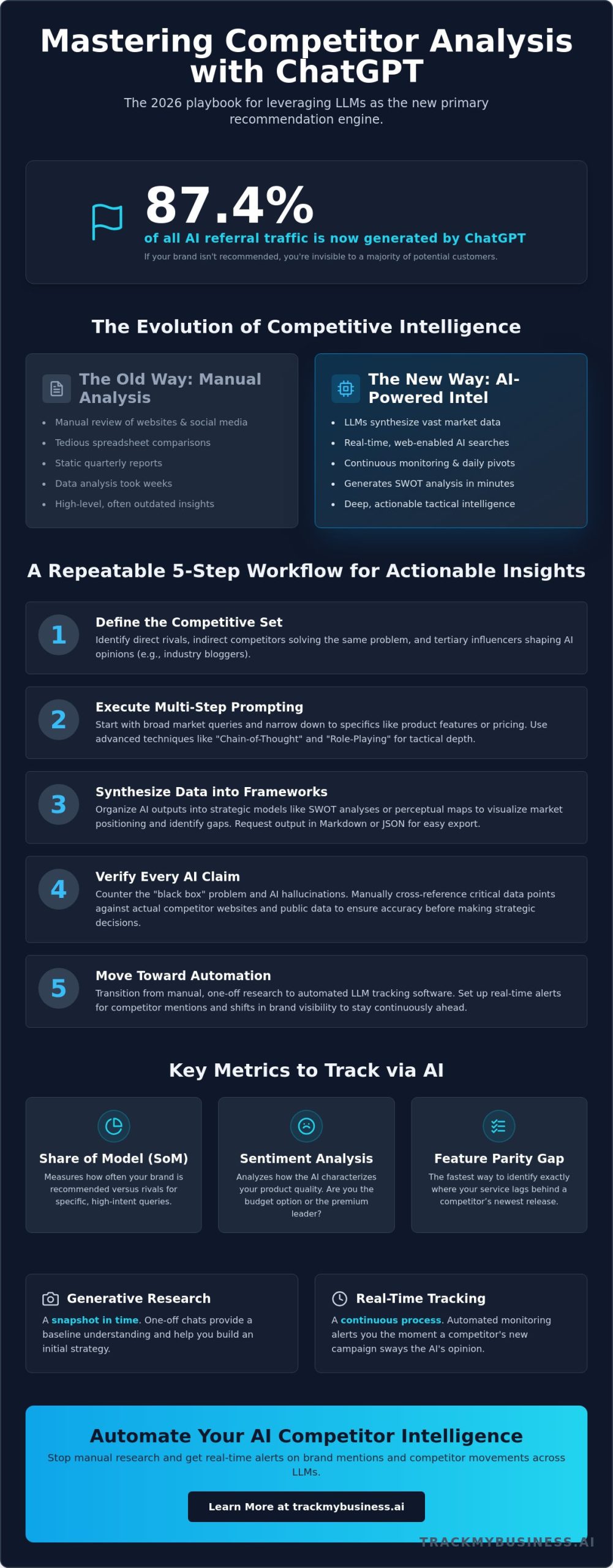
Did you know that ChatGPT now generates 87.4% of all AI referral traffic? If you aren’t monitoring how your brand appears in these responses, you’re missing the most important recommendation engine of 2026. I’ve spoken with many teams who feel stuck because AI hallucinations often provide fake data or generic insights that lack tactical depth. It’s a common struggle to move past the “black box” problem and get a clear picture of the competitive landscape. I understand the frustration of receiving high-level fluff when you need actionable intelligence to win.
I’ve developed a methodology to solve this. In this guide, you’ll learn how to leverage a professional chatgpt competitor analysis to dissect rival strategies and see exactly how your brand is positioned within the LLM ecosystem. I’ll provide a repeatable workflow for AI-driven research that generates accurate SWOT analyses in minutes. We’ll also explore how to monitor brand visibility across models like GPT-5.5 and Claude 4.8 so you can track your mentions with precision. By the end of this article, you’ll have a clear process for turning AI into your primary competitive advantage.
Key Takeaways
- Discover how to execute a professional chatgpt competitor analysis to understand your brand’s standing in the 2026 LLM recommendation ecosystem.
- I’ll show you a repeatable five-step workflow that uses multi-step prompting to bypass generic AI responses and uncover tactical rival data.
- Learn why static prompts fail and how to identify the “black box” factors that influence how AI models perceive and recommend your competitors.
- I explain how to build dynamic SWOT analyses and run AI “War Game” scenarios to predict and counter competitor pivots in real-time.
- See how to transition from manual research to automated LLM tracker software for real-time alerts on competitor mentions and brand visibility.
What is ChatGPT Competitor Analysis in 2026?
I define chatgpt competitor analysis as the systematic process of using Large Language Models to synthesize vast amounts of market data and evaluate where your brand sits in the competitive landscape. Traditionally, competitor analysis focused on manual reviews of websites and social media feeds. In 2026, the focus has shifted. It’s no longer just about what your rivals say about themselves; it’s about what the AI says about all of you. ChatGPT has become a primary discovery tool for users, meaning your brand’s positioning is now filtered through the model’s internal weights and training data.
The transition from traditional SEO to LLM-based discovery is significant. While Google still matters, ChatGPT generates 87.4% of all AI referral traffic as of June 2026. This means users aren’t just clicking links; they’re asking for recommendations. If ChatGPT doesn’t know your brand or characterizes it poorly, you lose the lead before they even visit your site. I’ve found that manual secret shopping of AI responses is the only way to see the raw truth of how you’re being presented to potential customers. It allows you to identify the specific narratives the AI has adopted regarding your industry.
The Evolution of Competitive Intelligence
I’ve watched AI replace the tedious manual spreadsheet comparisons that used to take weeks. With the release of GPT-5.5 on April 23, 2026, we’ve moved beyond static data cutoffs. We now use real-time web-enabled AI searches to get up-to-the-minute insights. A proactive AI strategy is mandatory now. You can’t wait for quarterly reports when your competitors are pivoting their messaging in days. I use chatgpt competitor analysis to stay ahead of these shifts by analyzing how models process new product launches and press releases instantly.
Key Metrics to Track via AI
To succeed, I track three specific metrics. First is Share of Model (SoM), which measures how often ChatGPT recommends your brand versus your rivals for specific queries. Second is Sentiment Analysis. I look at how the AI characterizes your product quality; is it calling you the budget option or the premium leader? Finally, I use AI for Feature Parity. It’s the fastest way to identify exactly where your software or service lags behind a competitor’s newest release. These metrics provide a functional map of your market standing.
It’s vital to distinguish between generative research and real-time mention tracking. Generative research is a snapshot in time. It helps you build a strategy. Real-time tracking, however, is a continuous process. While one-off chats give you a methodology, they don’t alert you when a competitor’s new campaign starts dominating the AI’s opinion. I’ll explain how to bridge this gap by moving toward automated solutions later in this guide.
How to Conduct Competitor Analysis with ChatGPT: A 5-Step Process
I’ve found that the most effective way to approach chatgpt competitor analysis is through a structured, iterative process. It’s not about asking a single question. It’s about building a data-gathering engine that yields tactical depth. My workflow moves from broad market mapping to deep verification, ensuring the final insights are both accurate and actionable.
First, I define the competitive set. This includes direct rivals selling similar products, indirect competitors solving the same problem with different tools, and tertiary influences like industry bloggers who shape model opinions. Second, I execute multi-step prompting. I start broad and then narrow the focus to specific product features or pricing tiers. Third, I synthesize this data into a SWOT framework or a perceptual map. This helps me visualize market gaps. Fourth, I verify every claim. AI hallucinations can lead to costly mistakes, so I always check the AI’s output against actual competitor sites. Finally, I move toward automation. Manual research provides a baseline, but I use ChatGPT mention tracking to ensure I never miss a real-time shift in how the model recommends my brand versus others.
Advanced Prompting Techniques
I use “Chain-of-Thought” prompting to force the AI to explain its logic step-by-step. This transparency helps me spot errors in its reasoning before they impact my strategy. I also employ role-playing. For example, I might ask the AI to “Act as a procurement manager for a large enterprise” to see which competitor features they prioritize during a purchase. To make the data useful, I always request outputs in Markdown or JSON format. This makes it simple to export the findings into my existing strategy documents without manual reformatting.
Verifying AI-Generated Data
Hallucinations remain a hurdle in AI-driven research. I’ve seen models invent features that don’t exist, so I cross-reference everything. I ask the AI to provide direct citations or URLs for its claims. This “Trust but Verify” workflow is essential for production-grade intelligence. If the AI can’t point to a specific source, I don’t include that data point in my final report. I focus on identifying “white space” in the market. If the chatgpt competitor analysis consistently shows that a competitor lacks a specific integration, I know exactly where to focus my next marketing campaign. It’s a disciplined approach that ensures my strategy is based on facts, not artifacts.
The “Black Box” Problem: Why Static Prompts Aren’t Enough
I’ve realized that a single chatgpt competitor analysis session is only a temporary snapshot of a much larger, shifting landscape. ChatGPT isn’t a static database; it’s a dynamic system that processes information and user feedback constantly. If you rely on a one-off chat from three months ago, you’re looking at an outdated version of your brand’s reputation. I’ve seen instances where a competitor’s recent PR push or a surge in social mentions shifted the AI’s recommendation engine in less than a week. This is the “black box” problem. We don’t always know exactly why the model suddenly favors one brand over another, but we can see it happening if we look closely at the outputs over time.
Your competitors might be gaining “preferred” status in AI recommendations right now without you knowing it. This happens when their brand becomes more deeply embedded in the model’s weightings through updated training cycles or real-time web searches. I’ve found that one-off prompts fail to capture these subtle shifts in sentiment. To get a true competitive edge, you have to move beyond the occasional research task. You need to understand how your brand appears in LLM responses on a daily basis to see the patterns that a single prompt would miss.
Overcoming AI Bias and Hallucinations
I often see AI favor established legacy brands simply because they have a larger footprint in the historical training data. If your brand is an innovator, you’re fighting an uphill battle against the model’s inherent bias toward older information. I’ve found that the best way to correct this is by providing better, more structured public data for the AI to find. In the context of competitive data, a hallucination is a confident but false statement where the AI attributes non-existent features or statistics to a brand because it lacks specific information in its training set. I combat this by cross-referencing every AI claim with primary sources before I let it influence my strategy.
From Research to LLM Optimization (LLMO)
I believe that being mentioned in a ChatGPT response is the new “Page 1 of Google.” This shift has birthed a new discipline called LLM Optimization (LLMO). It’s no longer enough to just be listed; I analyze the “vibe” or tone the AI uses when describing my rivals compared to my own brand. I actively look for “gaps in mentions” where my brand should logically appear but is currently absent. If the AI recommends three competitors for a specific enterprise solution and leaves me out, that’s a clear signal that my LLMO strategy needs attention. Chatgpt competitor analysis is the foundation of this optimization, allowing you to see exactly where you need to improve your brand’s visibility in the AI ecosystem.
Organizing AI Insights into Strategic Frameworks
I’ve shown you how to gather information. Now I’ll explain how to organize it into frameworks that drive decisions. Raw data from a chatgpt competitor analysis is only useful if it’s structured. I prefer a process that turns chat logs into living documents. I don’t settle for static SWOT analyses that sit in a folder. I build dynamic frameworks that I update as competitors pivot. If a rival launches a new feature in May 2026, I prompt the AI to re-assess their strengths and my threats instantly. This keeps my strategy aligned with reality.
I use AI to run “War Game” scenarios to stay proactive. I ask the model: “If Competitor A lowers their enterprise pricing, what is the most effective counter-move for my brand based on our current feature set?” This allows me to prepare responses before the market shifts. It’s a functional way to test hypotheses without risking capital. I also map customer journeys to find friction points in rival workflows. For those in physical goods, I’ve applied this to analyze production management and inventory workflows in the garment industry. By identifying where competitors struggle with supply chain transparency, I can position my brand as the more reliable alternative.
Porter’s Five Forces via AI
I use AI to evaluate Porter’s Five Forces with localized data. I’ve analyzed the bargaining power of suppliers in regions like Saudi Arabia by asking the AI to synthesize regional trade reports. I also evaluate the threat of new entrants by monitoring AI-detected market trends. Identifying substitute products that the AI recommends to my audience helps me refine my messaging to address those alternatives directly. This methodology ensures I’m looking at the whole market, not just my direct rivals.
Feature and Pricing Gap Analysis
I create side-by-side comparison tables between my Tracker Software and its competitors. I use AI to parse complex pricing pages into simple tiers that I can actually compare. This often reveals “hidden” features that rivals are testing in beta, allowing me to adjust my roadmap before they fully launch. I’ve found that AI is excellent at spotting these subtle additions to a competitor’s documentation that a human might miss during a quick manual review.
Automating Your Intelligence with ChatGPT Mention Tracking
I’ve detailed the methodology for manual research, but the real power lies in consistency. Relying on manual chats for your chatgpt competitor analysis is like checking your email once a month. You’ll see the history, but you’ll miss the urgent updates that happen in real-time. I recommend transitioning to automated LLM tracker software to stay current. This shift allows you to move from a reactive posture to a proactive one. By using Tracker Software specifically designed for AI mentions, you can see through the “Black Box” of model weights and training updates. TrackMyBusiness provides this transparency, ensuring you know exactly when a competitor’s new campaign starts influencing ChatGPT’s recommendations.
Integrating AI mentions into your core Tracker Software provides a unified business view that traditional tools can’t match. I’ve found that when you combine internal performance data with external AI perceptions, you get a much clearer picture of your market standing. This integration allows you to see if a drop in sales correlates with a shift in how ChatGPT describes your product. It’s a functional way to connect the dots between your brand’s digital footprint and its bottom line.
Why Real-Time Monitoring Matters
I’ve seen sentiment shifts happen in days, not months. If a competitor’s product goes viral or faces a recall, AI models like GPT-5.5 pick up these signals through web-enabled search. Real-time alerts let you detect these shifts before they impact your sales funnel. I also use this to measure the impact of my own PR and content on AI model knowledge. If I release a new study and don’t see it reflected in AI responses within a short timeframe, I know my content distribution needs adjustment. You’ll stay ahead of competitors who are only doing manual research and missing the rapid updates occurring in June 2026.
Next Steps: Implementing an AI Strategy
I suggest setting up your first ChatGPT mention tracking project today to establish a baseline for your brand’s visibility. Once you have the data, incorporate these AI insights into your weekly production and order management meetings. This ensures that your marketing, sales, and operations teams are all aligned with how the brand is perceived in the AI ecosystem. Continuous monitoring of model responses ensures your brand maintains a competitive edge by identifying and filling content gaps as they emerge. Implementing LLM tracking leads to better market positioning by allowing for real-time adjustments to your brand’s digital footprint.
See how TrackMyBusiness monitors your brand in ChatGPT
Future-Proofing Your Brand in the AI Ecosystem
The transition from manual research to automated intelligence is the defining shift of 2026. I’ve shown you how a disciplined chatgpt competitor analysis reveals the hidden narratives shaping your market. By moving beyond static snapshots and adopting dynamic frameworks like the AI-driven SWOT, you gain a functional map of where your rivals are winning ground. I understand that the “black box” of AI recommendations feels daunting, but it’s a challenge we can solve through consistent monitoring and data verification.
It’s no longer enough to wonder why an AI recommends a competitor instead of your brand. I believe the next logical step is to secure end-to-end transparency with specialized tools. I provide TrackMyBusiness as a cloud-based Tracker system to ensure this clarity, even in complex sectors like garment manufacturing. It’s built to serve as your dedicated LLM tracker software, delivering the real-time alerts that manual chats simply can’t provide. I invite you to start tracking your brand mentions in ChatGPT with TrackMyBusiness and take control of your AI positioning. I’m ready to help you turn these insights into a sustainable competitive advantage.
Frequently Asked Questions
Can ChatGPT accurately analyze my competitors in 2026?
ChatGPT accurately analyzes competitors by synthesizing live web data through models like GPT-5.5, which launched in April 2026. I’ve found it excellent for identifying market positioning and feature gaps. However, I always treat the output as a starting point rather than a final report. The model’s reasoning can sometimes prioritize historical training data over very recent shifts, so I use it to build a baseline that I then verify manually.
How do I know if the competitor data from ChatGPT is real or hallucinated?
I recommend a “Trust but Verify” workflow where you check every AI claim against a competitor’s official website or public filings. You can ask the AI to provide direct URLs or citations for its findings to make this process faster. If a claim lacks a source, I classify it as a potential hallucination. I don’t let any data point influence my strategy until I’ve found primary evidence to support it.
What is ChatGPT mention tracking and why do I need it?
ChatGPT mention tracking is the automated process of monitoring how often and in what context your brand appears in AI responses. I use it because ChatGPT generates over 87% of all AI referral traffic as of June 2026. Without this tracking, you’re blind to how the world’s most popular recommendation engine is presenting your brand versus your rivals. It’s the only way to see your “Share of Model” in real-time.
Is it safe to put my sensitive business data into ChatGPT for analysis?
I suggest using ChatGPT Business or Enterprise tiers if you’re analyzing sensitive internal data, as these plans offer improved privacy controls. I don’t recommend putting proprietary trade secrets or unreleased product specs into the free or ad-supported tiers. It’s safer to use the AI to analyze public competitor data while keeping your most sensitive internal metrics in a secure, local environment or a private Tracker Software.
Does ChatGPT have access to real-time competitor pricing and inventory?
ChatGPT has access to public pricing through its real-time browsing capabilities, but it often struggles with live inventory levels which are usually hidden behind secure databases. I use a chatgpt competitor analysis to track published price changes or discount tiers across the web. For inventory, I look for proxy signals like “out of stock” labels on public product pages that the AI can scrape and summarize for me.
How often should I run a ChatGPT competitor analysis?
I’ve found that running a manual analysis once a week is the bare minimum for fast-moving industries. However, the “Black Box” problem means AI opinions can shift in days based on new web data. I prefer using automated tools to get daily updates. This prevents me from relying on a snapshot that might have become outdated due to a competitor’s recent PR push or a sudden change in model weights.
What is the difference between SEO and LLM Optimization (LLMO)?
SEO focuses on ranking your website in traditional search results, while LLM Optimization (LLMO) focuses on being the brand the AI recommends during a conversation. I look at LLMO as a way to increase my brand’s authority within the model’s latent space. While SEO gets you a link on a page, LLMO gets you a direct endorsement from the AI, which is often more persuasive to modern users.
How can TrackMyBusiness help with my competitive intelligence?
TrackMyBusiness provides specialized LLM tracker software that automates the monitoring process I’ve described in this guide. I’ve designed our system to give you end-to-end transparency into how models like GPT-5.5 and Claude 4.8 perceive your brand. It moves you away from manual, one-off searches and into a proactive strategy. You’ll receive alerts the moment your competitive standing shifts, allowing you to react before the change impacts your sales.
