
What if the reason GPT-5.5 recommends your biggest rival isn’t because their product is better, but because their digital footprint is more legible to the model? I’ve seen many brands struggle as their organic traffic declines while competitors dominate the citations in AI-generated answers. It’s a frustrating shift that leaves many feeling invisible in this new era of search. I’ve spent time analyzing how these models process data, and I’ve found that learning how to stop ai from citing competitors starts with understanding that these citations are not random. They are the direct result of how well your brand’s information integrates with the specific datasets used for Retrieval-Augmented Generation.
I want to help you master the technical and content signals that drive LLM visibility. You’ll learn how to audit your presence across platforms like Claude Opus 4.8 and Gemini 3.1 Pro to ensure your brand is the one being recommended. I’ll provide a clear, process-oriented framework to help you displace your rivals and regain control over how AI perceives your business. This guide offers a deep dive into the methodology of AI tracking and the proactive steps required to secure your place in the 2026 digital landscape.
Key Takeaways
- Identify the specific differences between traditional search engine crawlers and generative engines to understand why your current SEO strategy might be missing the mark.
- Master the technical signals of citation density and contextual co-occurrence that influence which brands an LLM chooses to recommend in chat responses.
- Execute a detailed AI audit to learn how to stop ai from citing competitors and start optimizing your product pages for direct model extraction.
- Transition your reporting from traditional keyword rankings to “Share of Model” metrics by utilizing specialized LLM tracker software.
- Use ChatGPT mention tracking to gain clear visibility into how often your brand is mentioned and where your competitors are currently winning the conversation.
The Rise of AI Search: Why LLMs Cite Your Competitors
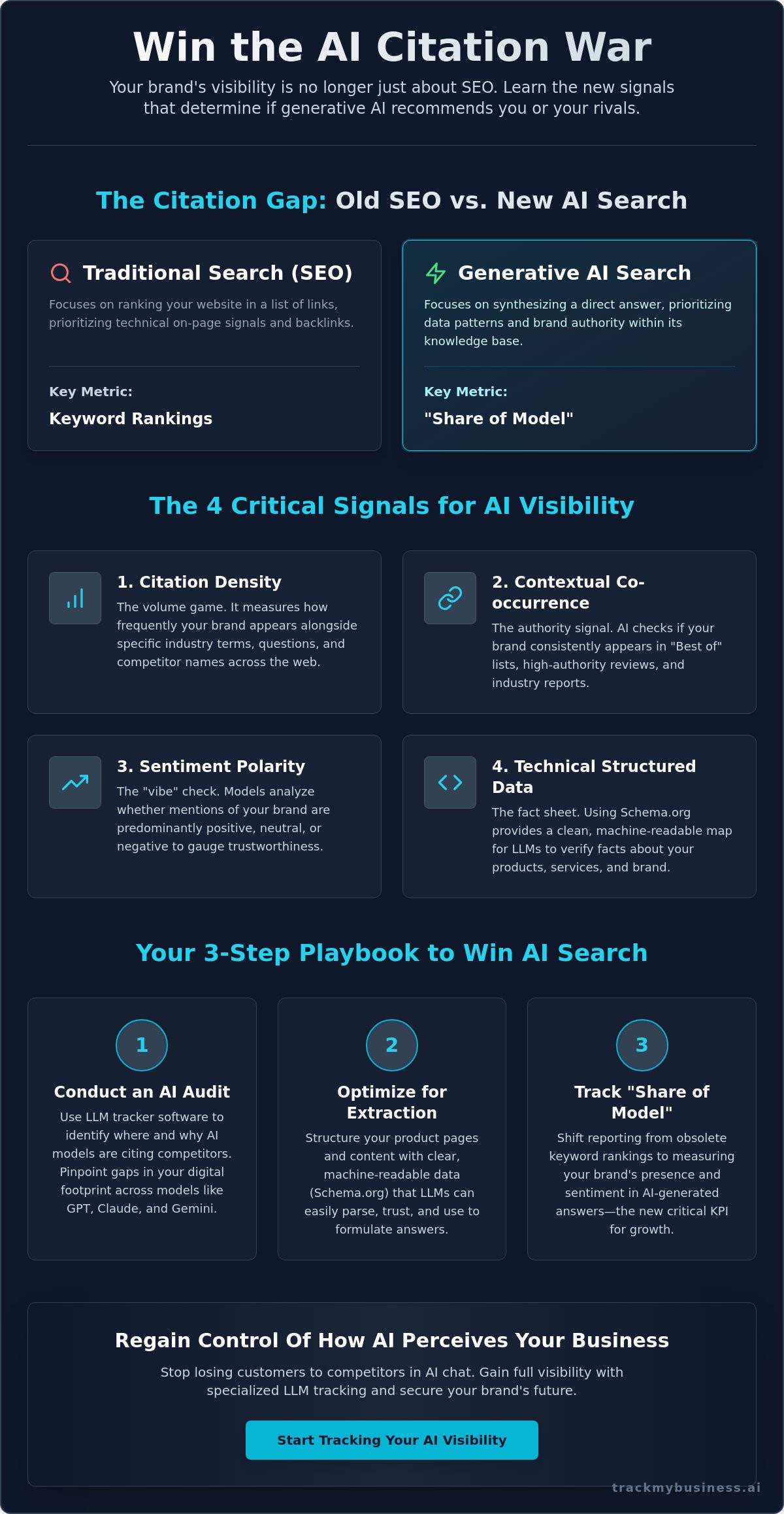
I’ve seen a growing disconnect between traditional search performance and AI visibility. You might hold the top spot for a high-value keyword on Google, yet when a user asks Gemini 3.1 Pro for a recommendation, your competitor gets the spotlight. This is the “Citation Gap.” It represents the distance between being indexable and being authoritative enough for an LLM to cite you as a primary source. Understanding how to stop ai from citing competitors starts with acknowledging that generative engines don’t work like traditional crawlers. They don’t just list results; they synthesize conclusions.
Traditional search engines prioritize relevance and backlinks to rank blue links. In contrast, Large language models prioritize probability and contextual coherence. They aren’t just looking for a keyword match. They’re predicting the most helpful answer based on vast datasets. If your brand isn’t woven into the narrative of those datasets, you become invisible. I’ve even seen cases where models hallucinate a competitor into a response simply because that brand has a higher density of mentions in the model’s training data, even if your product specs are objectively superior.
Understanding the RAG Mechanism
I’ve found that the key to modern visibility lies in Retrieval-Augmented Generation, or RAG. This process allows models like Claude Opus 4.8 to pull in external data to ground their answers. However, the context window of these models is limited. They can only process a specific amount of information at once. If your brand isn’t consistently mentioned across high-authority third-party reviews and industry lists, you won’t make the cut. Models often weigh these external perspectives more heavily than your own website because they perceive third-party data as more objective.
The Cost of Being Excluded
The stakes for being left out are high. We’re seeing a massive rise in zero-click conversions where the user gets everything they need directly from the AI interface. When an AI recommends a brand, it carries a psychological authority that a sponsored ad simply cannot match. If you aren’t visible here, you aren’t just losing traffic; you’re losing trust. I believe that being excluded from the primary training sets and RAG retrieval pipelines is a long-term business risk that traditional SEO cannot fix. Learning how to stop ai from citing competitors is now a requirement for brand survival.
The 4 Critical Signals AI Models Use to Select Brands
I’ve analyzed how models like GPT-5.5 and Claude Opus 4.8 select which brands to feature. It isn’t just about SEO anymore. Instead, these models rely on four primary signals to determine which entities deserve a citation. If you want to understand how to stop ai from citing competitors, you must first master these signals. I’ve found that these models prioritize entities that demonstrate a high degree of connectivity across the web. They don’t just look for your site; they look for the consensus of your existence.
First is Citation Density. This measures how frequently your brand appears alongside specific industry terms. It is essentially a volume game. Second is Contextual Co-occurrence. AI models look for patterns in data. If your competitor consistently appears in “Best [Product Category]” lists while you don’t, the model assumes they are the market leader. Third is Sentiment Polarity. Models check if the mentions are positive or negative. As noted by Stanford on LLMs, these systems process massive amounts of text to predict the most probable and helpful response. If the general “vibe” of your brand in the training data is poor, you won’t be cited. Finally, there is Technical Structured Data. Using Schema.org provides a clean, machine-readable map that LLMs use to verify specific facts about your brand.
Authority and Digital Trust
I believe that trust is the foundation of AI visibility. LLMs use “ground truth” anchors like Wikipedia and major news outlets to verify information. If your brand is missing from these high-authority nodes, the model might skip you in favor of a competitor who has that established footprint. I’ve also found that your LinkedIn and social media presence are no longer just for engagement. They serve as additional proof of activity and authority that models scrape to build their brand profiles. A dormant social presence can actually hurt your citation probability because the model lacks recent verification of your relevance.
The Role of User Sentiment
The way people talk about you on industry-specific forums and community discussion boards heavily influences AI “opinions.” If there are unresolved negative threads about your product in public spaces, the model will likely pick up on that friction. This is a critical part of how to stop ai from citing competitors. You need to ensure the sentiment around your brand is overwhelmingly positive in the spaces where users have honest discussions. I recommend using LLM tracker software to monitor how these sentiment shifts affect your visibility in real-time. Addressing negative sentiment in public forums can directly improve your chances of being cited by an LLM.
How to Displace Competitors in AI Responses: A Step-by-Step Guide
I’ve found that displacing a competitor in an AI response requires a tactical shift from traditional ranking to strategic presence. It’s a methodical process. First, I recommend conducting a thorough AI audit. You must use specific prompts across multiple platforms to understand exactly which competitors are winning the current conversation. This initial data collection is the only way to determine how to stop ai from citing competitors effectively. I’ve seen brands waste months on SEO only to realize the LLM was pulling data from a single, obscure industry forum they hadn’t monitored.
Once you’ve identified the gaps, focus on your internal assets. I suggest optimizing your “About Us” and “Product” pages for direct extraction. LLMs like GPT-5.5 and Claude Opus 4.8 prefer clear, declarative statements over marketing fluff. Next, execute a targeted citation campaign. I’ve seen that models prioritize consistency across multiple high-authority sources rather than just one strong link. Don’t forget the technical side. Implementing advanced Schema and JSON-LD allows generative engines to consume your data without ambiguity, making you a much safer brand to cite.
The final step is ongoing. Visibility in 2026 is fluid and can change with every model update. I use specialized tracker software to monitor “Share of Model” data. This metric tells you exactly how much of the AI’s “mindshare” you own compared to your rivals. If you see a dip, it’s a signal to revisit your third-party mentions and refresh your technical signals.
Optimizing for Generative Engine Optimization (GEO)
I’ve observed that “citation-friendly” language is a game changer. This means writing in a way that is easy for LLMs to summarize and repeat. I always include a clear executive summary at the top of every key page. This provides a “hook” for the model to grab during the retrieval phase. “How-to” content is particularly powerful here. It’s the most cited format because it answers the user’s intent with direct, actionable steps that models can easily format into a list.
Targeting Third-Party Citations
You can’t rely on your own site alone. AI engines pull heavily from the broader web to verify facts and build trust. I recommend identifying the specific review sites and “Top 10” lists the AI currently favors for your keywords. Getting featured in these lists is essential to how to stop ai from citing competitors. Recent research on LLM manipulation highlights how consistent mentions across independent platforms can shift a model’s recommendation engine in your favor. Managing your presence on industry directories ensures you aren’t left out of the digital consensus.
Measuring ‘Share of Model’: Why You Need LLM Tracker Software
I’ve found that traditional rank tracking is no longer enough to understand your market position in South Australia. While a standard SEO tool might tell you that your website ranks first for a specific keyword on a search results page, it doesn’t tell you if GPT-5.5 or Gemini 3.1 Pro actually mentions your brand when a local user asks for a recommendation. I’ve seen that “Share of Model” is the new “Share of Voice.” This metric tracks the percentage of time an LLM includes your brand in its response compared to your rivals. If you want to know how to stop ai from citing competitors, you must first quantify exactly how often those competitors are winning the prompt.
I suggest tracking very specific, high-intent prompts to get the most accurate data for your specific niche. For example, a business in the Adelaide manufacturing sector shouldn’t just track “software,” but rather a specific query like “What is the best production management software for the garment industry?” I’ve observed that historical data is critical here. It allows you to see if the AI is becoming more aware of your brand over time or if it’s starting to ignore you. Without this longitudinal view, you’re just guessing at your visibility.
The Limitations of Manual Prompting
I’ve seen many marketers try to audit their AI presence by manually typing questions into ChatGPT once a week. This isn’t a viable strategy. AI responses are subject to personalization bias based on your account history and even your geographic location within SA. A model might cite a competitor in Adelaide to a user in Port Adelaide while ignoring them for a user in Mount Gambier. Manual checks are too narrow to capture these regional variations, and they don’t provide the scale needed to make informed business decisions.
Introducing ChatGPT Mention Tracking
I believe that automation is the only way to gain a true picture of your AI visibility. Using automated ChatGPT mention tracking allows you to monitor thousands of prompts simultaneously across different regions and model versions. This data is essential for proving the ROI of your optimization efforts. It also helps you identify “hallucination risks” where a model might be sharing incorrect data about your brand. I recommend using our LLM tracker software to gain the transparency you need to fight back against competitor dominance. Once you have this visibility, you can begin the technical work of how to stop ai from citing competitors by refining the data signals the models rely on most.
Gain Full Visibility with TrackMyBusiness AI Tracking
I’ve seen firsthand how businesses struggle to understand why they are being left out of the AI conversation. It’s a common source of frustration when you know your product is superior, yet the models continue to point users toward your rivals. I believe that the first step in learning how to stop ai from citing competitors is to move away from guesswork and toward data-driven monitoring. Without clear visibility into the specific prompts and responses where your brand is ignored, you cannot formulate a successful strategy for displacement.
Our ChatGPT mention tracking provides the transparency you need to fight back against these citation gaps. TrackMyBusiness offers a professional-grade LLM tracker software designed to monitor your brand’s AI footprint across the entire ecosystem. I’ve built this methodology to help you identify exactly which competitors are stealing your citations and the specific third-party sources they are using to do it. By understanding the “why” behind their visibility, you can begin to execute the citation campaigns and technical optimizations I described in the previous sections.
The Tracker Software Advantage
I’ve integrated monitoring for ChatGPT, Perplexity, and other major LLMs into a single interface. This allows you to see your brand’s performance across different model architectures simultaneously. One of the most critical features is our real-time alert system. You’ll receive a notification when your brand is mentioned, or more importantly, when a competitor is recommended for a query you should own. These actionable insights go beyond simple rankings. I provide data on the “source” of the AI’s information, showing you which review sites or directories are currently influencing the model’s output.
Start Your AI Visibility Journey Today
I don’t think any brand should let an AI decide its future without direct input. As we move further into 2026, the cost of being invisible in AI-generated answers will only increase. I invite you to get a clear picture of your “Share of Model” with our specialized tools. This is the only way to ensure your brand remains relevant as traditional search continues to evolve. You can Discover how TrackMyBusiness can track your AI mentions today and take the first proactive step in learning how to stop ai from citing competitors. My goal is to provide the methodology you need to regain your brand’s authority in this new digital era.
Secure Your Authority in the Generative Era
I’ve shown that the transition from traditional search to AI-driven answers requires a fundamental shift in your digital strategy. You now understand that citations are the result of specific data signals like citation density and sentiment polarity rather than just simple backlinks. Mastering how to stop ai from citing competitors involves a methodical approach to optimizing your technical data and securing mentions in the third-party lists that LLMs trust as ground truth anchors. I’ve found that consistency across these nodes is the most reliable way to displace rivals in model responses.
I believe that transparency is the only way to navigate this fragmented landscape. By using a specialized LLM tracker software, you can move beyond manual audits and gain a clear view of your “Share of Model” across different platforms. I’ve developed a cloud-based modular system to provide this exact visibility through a transparent problem-solution methodology. It’s time to take control of your brand’s narrative. You can track your brand’s AI mentions with TrackMyBusiness today to ensure you are the one being cited. I’m confident that with the right data, you can secure your brand’s future.
Frequently Asked Questions
How do I know if ChatGPT is citing my competitors?
I recommend using ChatGPT mention tracking to identify which brands are appearing in responses. You can manually enter prompts, but this often leads to biased results based on your personal account history. Automated tools provide a broader view of how your brand compares to rivals across various queries. I’ve seen that consistent monitoring is the only way to catch when a competitor starts gaining ground in your niche.
Can I pay OpenAI or Google to cite my brand in AI search?
Currently, there is no “pay-to-play” model for organic AI citations in systems like ChatGPT or Gemini. These models generate responses based on their underlying training data and real-time retrieval processes. I believe the best approach is to build a dense footprint of mentions on high-authority sites. This naturally increases the probability that the model will select your brand as a primary source for users during the generation process.
Does traditional SEO help with AI citations?
Traditional SEO helps by making your content discoverable, but it doesn’t guarantee an AI citation. LLMs look beyond keywords to analyze the consensus across the web. To understand how to stop ai from citing competitors, you must move beyond backlinks and focus on how your brand is described in sentiment-rich environments like forums and review platforms. I’ve found that this contextual authority is what truly drives citations in modern models.
What is Generative Engine Optimization (GEO)?
Generative Engine Optimization is the process of formatting your content to be easily digested by AI. I focus on creating “citation-friendly” structures like executive summaries and clear bullet points. This helps models like Claude Opus 4.8 summarize your key offerings without making errors. I’ve observed that brands using GEO see much higher extraction rates during the retrieval-augmented generation process than those using traditional long-form copy alone.
How often do AI models update their training data or citations?
Update frequencies differ between the static training sets and the live retrieval layers. While the core knowledge of a model like GPT-5.5 stays the same until a new version is released, the retrieval-augmented generation layer updates constantly. I’ve seen that new blog posts or news mentions can influence AI answers within hours if the model is connected to a live search index to verify its current responses.
What should I do if an AI model is citing incorrect information about my business?
I recommend first auditing the third-party sources the AI is likely pulling from. If a model is hallucinating or using old data, it’s often because it found conflicting information on an industry directory. I suggest updating your Schema.org markup and ensuring your “About Us” page has clear, factual statements. This provides the “ground truth” that models need to override their own incorrect predictions during the response phase.
Is there a way to track my brand’s ‘Share of Model’ automatically?
You can track these metrics automatically by using professional LLM tracker software. These tools simulate thousands of user interactions to give you a statistically significant view of your brand’s presence. I’ve found that this is the only reliable method for learning how to stop ai from citing competitors because it reveals the specific prompts where your brand is currently being excluded or misrepresented across different geographic locations.
Why does AI sometimes hallucinate competitors that don’t exist?
Hallucinations happen when a model’s predictive patterns fail to match reality. If your brand isn’t prominent in the training data, the model might invent a name that sounds like a plausible competitor. I’ve seen this happen most often in niche industries with low digital footprint density. Strengthening your brand’s presence on high-authority nodes like Wikipedia or major news outlets helps anchor the model to factual information and reduces these errors.
