
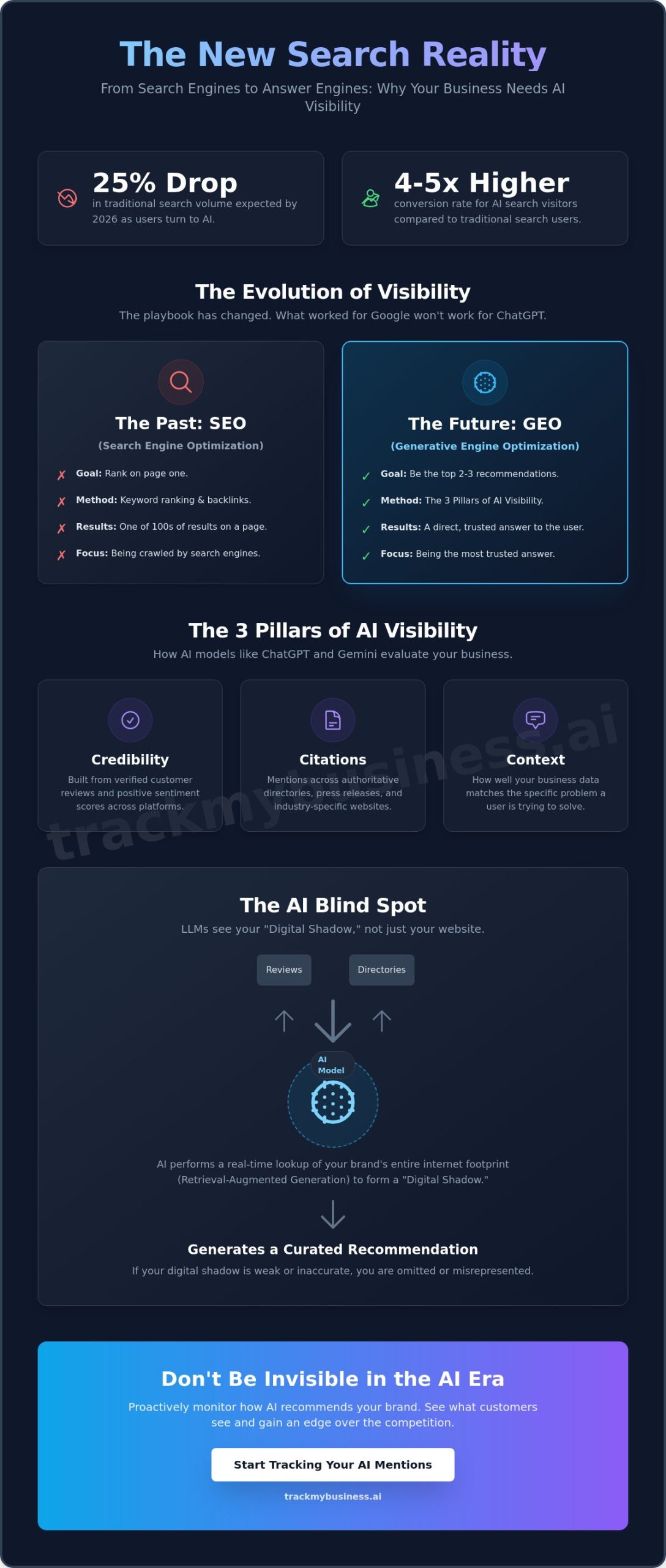
By the end of 2026, traditional search volume is expected to drop by 25% as more users turn to AI chatbots for answers. I recognize that for many owners, this shift feels like a direct threat to your organic traffic. It is frustrating to see competitors recommended by ChatGPT while your brand remains invisible, especially since AI search visitors convert four to five times higher than traditional search users. You might feel that effective llm brand monitoring for small business is out of reach due to complex technical requirements or enterprise level price tags that don’t fit your budget.
I am here to show you that tracking your AI visibility is both manageable and affordable. While manual monitoring is a viable starting point, I acknowledge it has its limits in terms of scale and consistency. In this guide, I will explain how to use tracker software to monitor your mentions across platforms like ChatGPT and Gemini. I will provide a clear process for measuring your AI “Share of Voice” and outline practical steps to improve your visibility. I’ve designed this methodology to help you move from being overlooked to being a top recommendation in the AI era.
Key Takeaways
- I explain why shifting your focus from traditional search to “Answer Engines” is necessary to capture high-converting AI traffic.
- You will learn how to identify the specific review sites and directories that LLMs use to evaluate your business reputation.
- I compare traditional keyword rankings to AI “Share of Voice” metrics to help you prioritize your marketing budget effectively.
- I provide a step-by-step framework to benchmark your brand using core discovery prompts across major platforms like ChatGPT and Gemini.
- Discover how implementing llm brand monitoring for small business with specialized tracker software allows you to respond to AI recommendation shifts in real-time.
The New Search Reality: Why Small Businesses Need LLM Brand Monitoring in 2026
I define LLM Brand Monitoring as the technical process of tracking how AI models like ChatGPT, Claude, and Gemini mention and recommend your business to users. In my experience, the transition from “Search Engines” to “Answer Engines” has fundamentally changed the click-through rate for local companies. Traditional search engines might show a hundred results across several pages. AI models act as a digital concierge, narrowing those options down to just two or three specific recommendations based on the user’s prompt. If your brand isn’t part of that curated set, you lose the opportunity before the customer even sees your website. This shift means that being on page one of Google is no longer the ultimate victory.
Small businesses face a unique challenge in this new environment. While global brands have enough data points to ensure accuracy, smaller entities are more vulnerable to AI hallucinations or complete omissions. If an LLM doesn’t find enough verified data about your specific location or services, it might simply leave you out or provide incorrect information to a high-intent lead. I’ve seen cases where models suggest a business is closed simply because they couldn’t find a recent citation. Using llm brand monitoring for small business is the only way to see what these models are saying behind the scenes and correct these gaps before they impact your revenue.
The Shift from SEO to GEO (Generative Engine Optimization)
Traditional keyword ranking is evolving into contextual relevance. I’ve observed that being crawled by Google is no longer enough to be recommended by an LLM. To gain visibility, your business must satisfy the three core pillars of AI visibility: Credibility, Citations, and Context. Credibility comes from verified reviews. Citations involve mentions across authoritative directories. Context is how well your data matches the specific problem a user is trying to solve. I find that GEO requires a more holistic approach to data than traditional SEO ever did. It’s about being the most trusted answer, not just the most optimized link.
The Cost of Being Invisible in AI Conversations
When you’re invisible in AI conversations, you lose “ready to buy” customers who rely on chatbots for quick decisions. These users have a conversion rate significantly higher than standard searchers because they’ve already moved past the discovery phase. AI models often favor competitors due to outdated training data or better-structured citations that are easier for the model to ingest. I believe that modern reputation management must include a proactive look at how these models interpret your brand data. LLM monitoring is the essential radar for the 2026 marketing stack. It’s the only way to ensure your business remains a primary choice when the digital concierge speaks.
Understanding the AI Blind Spot: How LLMs Evaluate Your Business
I’ve found that many small business owners make a dangerous assumption. They believe that if their website is optimized for Google, ChatGPT will automatically recommend them. This is a significant misconception. LLMs evaluate your business using a process called Retrieval-Augmented Generation, or RAG. When a user asks a question, the AI doesn’t just pull from its memory. It performs a real-time lookup of your “digital shadow,” which is the collective footprint of your brand across the entire internet. This shadow includes your review profiles, industry directories, and official documentation.
The AI then categorizes your brand using a sentiment score. It decides if you are a “premium” or “budget” option, and whether you are “reliable” or “risky” based on the patterns it finds in your mentions. This is why maintaining always-on brand health is no longer optional. A major blind spot I’ve identified is the gap between public web data and private LLM conversations. You can see a search result on a screen, but you can’t see a private recommendation unless you use specialized tracker software to monitor those interactions. Effective llm brand monitoring for small business requires looking beyond your own website to see how the rest of the web defines you.
The Role of Citations and Sources
AI models have “preferred sources” just like humans do. They prioritize third-party validation from press releases, niche industry blogs, and established directories over your own marketing copy. I recommend implementing structured data, specifically Schema markup, to help these models understand your product offerings without guesswork. When you provide clear, machine-readable data, you increase the likelihood of becoming a cited source in an AI’s response. This validation acts as a trust signal that models use to verify your claims.
Detecting and Correcting AI Hallucinations
Hallucinations happen when an AI lacks consistent data and fills in the blanks with incorrect information. It’s common for ChatGPT to claim a business provides services it doesn’t actually offer. I’ve seen this lead to frustrated customers and lost leads. The solution is maintaining consistent brand data across every sales channel and directory. Our “Tracker” software helps identify these errors before they damage your reputation. By monitoring these mentions, I can pinpoint exactly where the model is getting its facts wrong and help you update the source data to fix the hallucination at its root.
LLM Tracking vs. Traditional SEO: Choosing the Right Strategy for Your Budget
I find that many owners struggle to decide where to put their marketing dollars as traditional search behavior continues to shift. Traditional SEO focuses on keyword rankings, which is a slow game. It often takes months to see a movement in search results. In contrast, llm brand monitoring for small business focuses on “Share of Voice.” This metric tells you how often an AI model chooses you over a competitor in a direct conversation. Because LLMs update their knowledge frequently, your visibility can change with a single model refresh or a data update. This faster feedback loop allows you to be more proactive than traditional SEO ever permitted.
I recommend that you pivot at least 20% of your current SEO budget toward LLM tracking. While traditional search still matters, AI search visitors convert at a significantly higher rate than standard organic traffic. To manage this shift, I suggest looking at the top LLM monitoring tools to understand your current standing. I also use a specific verification process to ensure these mentions aren’t just vanity metrics. By using UTM parameters and tracking referral paths from AI interfaces, I can verify if an AI recommendation actually leads to a checkout. This data-driven approach ensures your budget is spent on visibility that actually drives revenue.
Why Traditional Social Listening Tools Fail
I’ve noticed that standard social listening tools are largely useless for monitoring private LLM prompts. These tools track public hashtags and mentions on platforms like X or LinkedIn, but they can’t see what happens inside a private ChatGPT session. There is a fundamental difference between a public mention and a recommendation in a private chat. To see what the AI actually says, you need prompt-based testing. I use specific queries to trigger the model’s recommendation engine, which reveals the true experience your customers are having when they use AI as a digital concierge.
The Small Business Advantage: Agility
Small brands have a distinct advantage in the AI era: speed. I can update a small business’s digital footprint across niche directories much faster than a massive corporation can navigate its own internal approvals. By feeding AI models accurate, structured data, you ensure the models have the most current information. Data accuracy is your greatest weapon. Implementing llm brand monitoring for small business allows you to identify gaps in your data and fix them before a competitor takes your spot in the recommendation set.
A Practical Framework for Small Business LLM Monitoring
I’ve developed a five step framework to help you manage your visibility without needing an enterprise size budget. First, you must identify your “Core Discovery Prompts.” These are the specific phrases a potential buyer types into an AI when they are looking for a solution. If you operate in the textile sector, a prompt might be “best apparel manufacturer in Saudi Arabia for sustainable fabrics.” Once you have these, step two is benchmarking. I recommend running these prompts through ChatGPT, Claude, and Gemini to see if your brand appears in the initial response. Effective llm brand monitoring for small business starts with knowing exactly what the digital concierge tells your customers today.
Step three involves a direct analysis of your competition. If the AI recommends a rival instead of you, I look for the “why” in the response. Is it because the competitor has more recent reviews or a more detailed service list? Step four is a citation audit. You must verify that your business name, address, and product details are identical across every niche industry directory. Finally, step five is implementing a weekly tracking cadence. I find that AI sentiment can shift after a single model update, so I use LLM tracker software to monitor these changes automatically. This process ensures you don’t find out about a visibility drop only after your leads dry up.
The “Secret Shopper” Method for AI
I suggest using persona based prompts to see how different users discover your brand. You might ask the AI to “recommend a supplier for a fashion startup” and then ask it to “find a bulk manufacturer for a global retailer.” These tests reveal how AI intent varies between informational and transactional queries. I also watch for “Competitor Poaching,” which occurs when an AI suggests a rival brand even when a user specifically asks about your business. If this happens, it usually indicates that your competitor has stronger contextual relevance in the model’s training data.
Optimizing Your Content for AI Retrieval
To improve your chances of being recommended, I recommend an “FAQ Strategy.” You should publish clear answers to the exact questions AI models are likely to be asked by your customers. I use functional, direct language that is easy for a machine to parse and categorize. Data accuracy is the small business’s greatest weapon in the AI era. You can also learn how to unify your order management to ensure your product data remains consistent across all sales channels. When your internal data matches your public citations, AI models can recommend you with much higher confidence. Start tracking your AI visibility today to see where your brand stands in the new search reality.
Future-Proofing Your Brand with TrackMyBusiness AI Mentions
I recognize that managing a physical product line is complex enough without worrying about how AI search results might misrepresent your inventory. I’ve built our ChatGPT mention tracking to function as a modular extension of your business operations. By connecting your production data with LLM visibility insights, I help you maintain a single source of truth for your brand. This ensures that when a potential customer asks an AI for a recommendation, the model has access to the most current facts about your business. I believe that transparency is the foundation of a successful digital reputation. My process-oriented approach allows you to see exactly where your brand data is strong and where it needs adjustment to remain competitive.
I find that many businesses in the garment sector struggle with outdated data being fed into AI models. If ChatGPT tells a buyer that you don’t offer a specific fabric type when you actually do, you lose that lead instantly. Our Tracker software identifies these gaps by monitoring how models categorize your offerings. This level of llm brand monitoring for small business is essential for maintaining a professional image. I focus on providing functional tools that help you manage your digital presence with the same diligence you apply to your physical production. It’s about ensuring that your digital shadow reflects your actual business capacity in real-time.
Modular Management: Beyond Just Monitoring
I’ve designed our system to fit into a larger production management framework. Tracking AI mentions shouldn’t be a standalone task; it should inform your broader strategy. I help you move from asking “What is the AI saying?” to understanding “How does this affect my order volume?” By leveraging my Saudi Arabia based expertise, I provide localized brand protection that accounts for regional market nuances. This modular approach ensures that your LLM visibility grows alongside your physical operations. It allows you to scale your digital presence without overcomplicating your daily routine.
Getting Started with Tracker
I understand that you don’t have hours to spend on complex software setups. You can set up your first LLM tracker in under 10 minutes by following my straightforward onboarding process. I emphasize professional diligence in maintaining your digital reputation because I know how quickly a single model update can shift market perception. Once your tracker is active, you will receive clear insights into how AI models perceive your brand. You can see how TrackMyBusiness tracks your brand in ChatGPT to begin securing your place in the future of AI search. I am here to ensure your small business remains a top recommendation in every relevant AI conversation.
Secure Your Place in the AI Recommendation Age
The transition from search engines to answer engines is no longer a future prediction; it is a current reality that requires your immediate attention. I have shown you how to identify the blind spots in your digital shadow and why data accuracy is your most effective tool against AI hallucinations. By implementing a consistent framework, you can ensure that ChatGPT and other models recognize your brand as a credible recommendation. Adopting llm brand monitoring for small business allows you to protect your reputation while capturing high-converting traffic that competitors are already losing.
I invite you to use our cloud-based modular system to gain clear insights into your AI presence. My software is specifically designed for physical product businesses that need to integrate production data with visibility tracking. I provide transparent, process-oriented support to help you navigate every model update with professional diligence. You don’t have to leave your AI visibility to chance. Start tracking your brand mentions in ChatGPT with TrackMyBusiness today and take control of your brand’s narrative. I am confident that with the right tools, your business will thrive in this new era.
Frequently Asked Questions
What is the difference between LLM monitoring and traditional SEO?
Traditional SEO focuses on ranking your website for specific keywords in a list of search results. I define LLM monitoring as tracking how AI models synthesize information to recommend your brand in a conversational answer. While SEO aims for clicks on a link, my process for llm brand monitoring for small business aims for “Share of Voice” within the model’s generated response.
Can I track what people are saying about my business in private ChatGPT conversations?
You cannot access individual private chat logs due to privacy protections. I use simulated, persona-based prompts to observe how ChatGPT describes your business to different types of users. This methodology reveals the model’s underlying sentiment and recommendation patterns without violating user privacy or requiring access to private data.
How often do AI models update their information about my small business?
Models update their knowledge through periodic training refreshes and real-time retrieval-augmented generation. I’ve observed that information can change weekly as models crawl new reviews and directory listings. I recommend a steady tracking cadence to catch these shifts before they affect your lead generation or brand reputation.
Do I need to be a developer to set up LLM brand monitoring?
You don’t need any technical or coding knowledge to use my tracker software. I designed the setup process to be direct and functional for busy owners who manage physical product lines. You can begin monitoring your brand mentions and AI visibility in under 10 minutes through a simple, cloud-based interface.
Is LLM brand monitoring expensive for a small business?
I prioritize affordability by offering modular tools that avoid the high costs of enterprise software. You only pay for the tracking features you need for your specific niche. This approach ensures that llm brand monitoring for small business remains accessible for companies that have limited marketing budgets but need to remain competitive.
What should I do if ChatGPT is giving out incorrect information about my brand?
You must first identify the outdated source the AI is using for its retrieval process. I recommend auditing your citations across industry directories and ensuring your Schema markup is current. Once the source data is corrected, the AI will eventually update its response to reflect the accurate facts during its next knowledge lookup.
How does LLM monitoring help with my business growth?
It ensures your brand is included in the “digital concierge” recommendation set for high-intent buyers. Visitors coming from AI search convert four to five times more often than traditional organic visitors. By improving your AI visibility, you capture this high-value traffic and increase your overall order volume through more targeted referrals.
Can I use LLM monitoring to see what my competitors are doing?
Yes, I use competitive benchmarking to see which rivals the AI recommends and why it chooses them over your brand. This process highlights where your competitors have stronger citations or better sentiment scores. I then help you use these insights to close the gap and reclaim your share of the AI conversation.
