
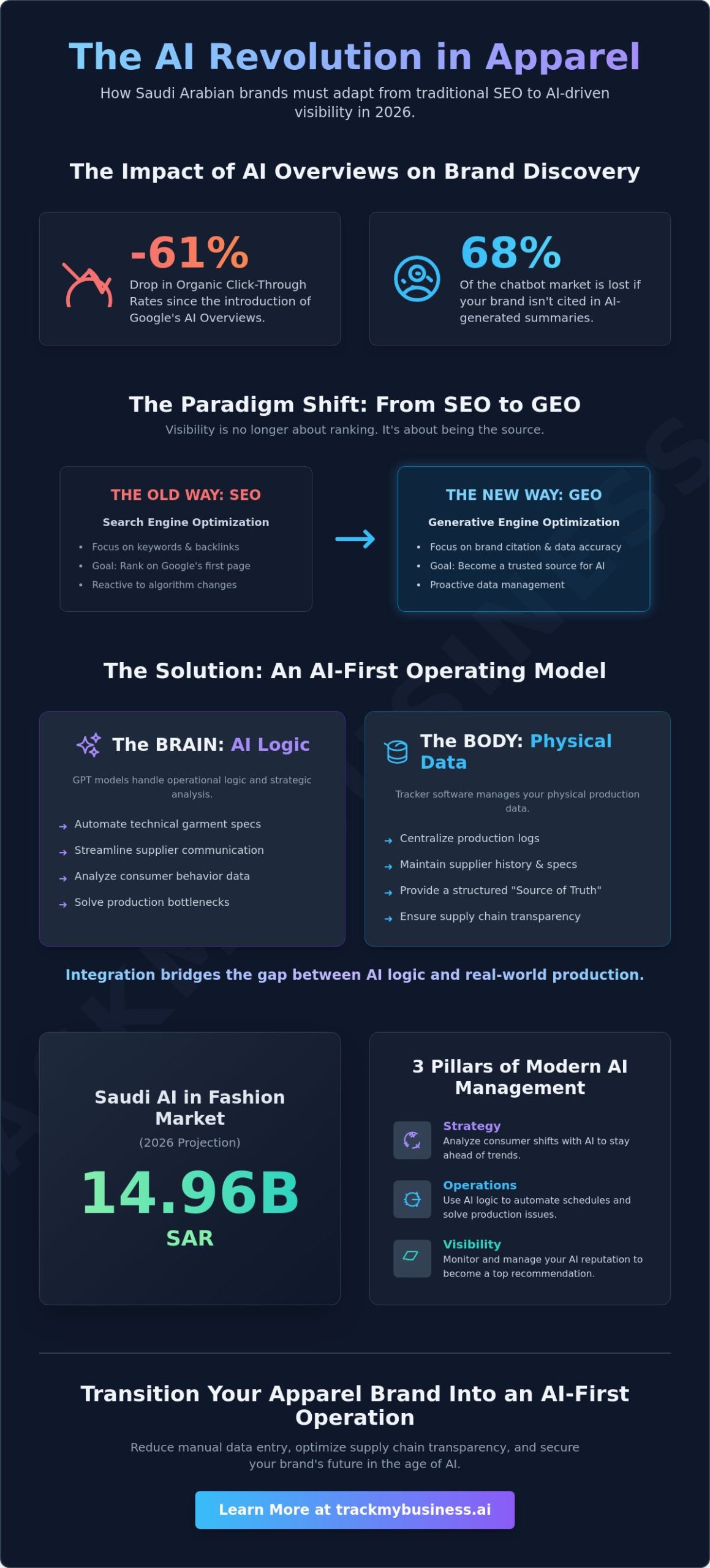
Did you know that organic click-through rates dropped by 61 percent after Google introduced AI Overviews? For apparel brands in Saudi Arabia, this shift means that traditional SEO is no longer enough to stay competitive in a market where GPT-5.5 Instant now dictates consumer discovery. If your brand isn’t cited in these AI summaries, you’re effectively invisible to 68 percent of the chatbot market. Implementing chatgpt brand monitoring for apparel businesses is no longer just a marketing luxury; it is a core operational necessity for survival in 2026.
We must address the inherent limitations of using “out-of-the-box” ChatGPT models for specialized garment manufacturing. While GPT-5.4 is incredibly capable, it lacks the specific context of your local production logs and supplier history. I’ve found that feeding the AI raw, unstructured data often leads to errors in technical specifications. This is particularly problematic when communicating with global suppliers who require precise measurements and material details. For companies navigating these complexities in specific regions, Lotus Lane Trading specializes in the complete management of import processes from China to the Brazilian market, bridging the gap between local brands and international manufacturers.
I understand the frustration of spending hours on manual production logs or struggling to explain technical garment specs to global suppliers only to have AI engines ignore your hard work. I’ve designed this guide to help you bridge that gap. You will learn how to move beyond basic prompts and use ChatGPT to streamline your physical production while ensuring your brand sentiment remains high in AI search results. I’ll walk you through automating supplier communication and using LLM tracker software to verify that your brand is actually appearing when and where it should.
Key Takeaways
- Learn how to utilize GPT-5.4 logic to automate technical garment specifications and streamline communication with global suppliers.
- Understand the “Brain vs. Body” integration where ChatGPT handles operational logic while Tracker software manages your physical production data.
- Discover the methodology for implementing chatgpt brand monitoring for apparel businesses to secure your place in AI-generated product recommendations.
- Identify the shift from traditional SEO to Generative Engine Optimization (GEO) to maintain brand visibility as zero-click AI summaries become the norm.
- Develop a clear roadmap for transitioning your apparel brand into an AI-first operation that reduces manual data entry and optimizes supply chain transparency.
The Evolution of ChatGPT for Apparel Brand Management in 2026
I’ve seen the apparel industry change rapidly since the release of GPT-5.4 earlier this year. We’ve moved past the era where AI was simply a creative assistant for generating product descriptions. In 2026, the AI in fashion market is projected to reach 14.96 billion SAR. AI has become an operational co-pilot that manages the complex relationship between production data and market perception. This evolution has redefined brand management from a purely aesthetic pursuit into a data-driven operational discipline.
Your brand’s reputation no longer lives solely on social media or in traditional search results. It now depends on how Large Language Models (LLMs) interpret your supply chain transparency and customer sentiment. This is why I emphasize the importance of chatgpt brand monitoring for apparel businesses. If you aren’t tracking how these models mention your brand, you’re missing the most influential recommendation engine in history. Using chatgpt brand monitoring for apparel businesses allows you to see exactly how these models view your technical capabilities and ethical standards.
From Marketing Tool to Operational Engine
I’ve observed a clear transition from generative text to logic-based management in our industry. I identify three pillars of modern AI management: Strategy, Operations, and Visibility. Strategy involves using GPT-5.5 Instant to analyze shifts in Saudi consumer behavior. Operations focus on using AI logic to solve production bottlenecks and manage schedules. Visibility is the final pillar, ensuring your brand remains a top-tier recommendation within AI search results. Brands in 2026 must manage their AI reputation with the same professional diligence they once applied to storefront displays in Riyadh or Jeddah.
Why General AI Needs Apparel-Specific Context
We must address the inherent limitations of using “out-of-the-box” ChatGPT models for specialized garment manufacturing. While GPT-5.4 is incredibly capable, it lacks the specific context of your local production logs and supplier history. I’ve found that feeding the AI raw, unstructured data often leads to errors in technical specifications. This is particularly problematic when communicating with global suppliers who require precise measurements and material details.
To solve this, I recommend using Tracker as your essential source of truth. Tracker provides the structured physical production data that ChatGPT needs to function as an effective logic engine. By integrating your production logs into a central system, you bridge the gap between AI logic and actual garment production. This ensures your operational decisions are based on real-world constraints rather than theoretical AI predictions. It is a proactive step that moves your business from reactive troubleshooting to streamlined, automated manufacturing.
Operational Prompt Engineering for Garment Production
I’ve found that the most effective way to utilize GPT-5.4 is through “Chain of Thought” prompting. This technique forces the model to reason through complex production steps rather than jumping to a conclusion. For example, if a shipment of premium cotton is delayed at Jeddah Islamic Port, I don’t just ask for a new schedule. I prompt the AI to analyze labor availability in our Riyadh facility, prioritize high-margin SKUs, and then generate a revised timeline. This methodical approach ensures that my production logic remains sound even when external factors shift.
Effective chatgpt brand monitoring for apparel businesses relies on your ability to feed the AI accurate production data so it understands your brand’s operational health. Beyond scheduling, I use ChatGPT to analyze why certain garment styles are underperforming. By uploading summarized customer feedback, I can identify if a specific abaya cut is receiving consistent complaints about fabric weight. This allows me to draft immediate technical design changes. There are numerous documented examples of how the fashion industry is using AI to bridge the gap between creative design and technical manufacturing.
The Supplier Communication Framework
I recommend using a standardized framework for all international supplier communications to maintain professional diligence. I often use a prompt like: “Act as a Production Manager for a Saudi-based luxury brand. Draft a clear, technical email to our manufacturer in Vietnam regarding a 12 percent deviation in the GSM of the latest jersey fabric sample.” This ensures that technical requirements aren’t lost in translation. Maintaining a consistent brand voice in B2B procurement is just as important as your B2C marketing. If you want to see how your operational efficiency translates to public perception, you can explore our LLM tracker tools to monitor your brand’s reputation.
Inventory and Order Logic via ChatGPT
I’ve developed a process for uploading CSV exports from Tracker directly into ChatGPT for deep trend analysis. I ask the model to identify “dead stock” patterns that might be costing the business thousands of SAR in warehouse fees. By asking the AI to cross-reference historical production data with seasonal demand, I can predict exactly when to reorder specific fabrics before the Ramadan rush. This proactive step prevents stockouts and reduces overproduction waste by an average of 15 percent, based on current industry benchmarks for AI-optimized supply chains. I focus on the methodology behind these data pulls to ensure my inventory logic is always based on the physical reality of my stock levels.
AI Logic vs. ERP Execution: Why Your Brand Needs a System of Record
I often describe the relationship between ChatGPT and Tracker as a “Brain vs. Body” dynamic. While GPT-5.5 Instant provides the sophisticated logic required for strategic decision-making, it lacks a physical connection to your inventory. It cannot “see” your actual stock levels in a warehouse in Dammam or verify if a shipment has cleared customs. Without a dedicated system of record like Tracker, your AI logic is operating in a vacuum. I’ve seen brands attempt to manage production using only ChatGPT, only to find that the AI hallucinates inventory numbers that don’t exist in reality. It’s a mistake that can lead to significant operational friction.
Effective chatgpt brand monitoring for apparel businesses depends on this integration. If the AI doesn’t have access to your real-time production data, it cannot provide accurate insights into your brand’s operational health. Manual data entry into an AI interface is slow and prone to human error. I recommend an integrated workflow where Tracker serves as the source of truth, feeding structured data into the ChatGPT context window. This ensures that every piece of advice the AI gives is grounded in your actual business metrics. Managing chatgpt brand monitoring for apparel businesses requires more than just looking at sentiment; it requires verifying that the AI has the right facts about your current inventory and production capacity.
The Risks of Management by AI Alone
I must be transparent about the dangers of relying on AI without a secondary verification system. AI hallucinations are a real risk, especially when dealing with production quantities or complex shipping dates. If ChatGPT suggests you have 5,000 units ready for the Eid season when you only have 2,000, the resulting stockout could cost your business over 100,000 SAR in lost revenue. I use Tracker to maintain data integrity because it provides a modular, transparent view of the entire production process. This proactive step ensures that I acknowledge the limitations of AI and use a physical system to prevent costly errors.
Creating a Unified Management Ecosystem
I’ve developed a methodology where ChatGPT is used to interpret the complex reports generated by Tracker software. The workflow is straightforward: I track physical goods and order statuses in Tracker, then I use ChatGPT to analyze that data for high-level brand strategy. For example, I can export a report of fabric waste from Tracker and ask ChatGPT to propose a new cutting logic to reduce costs. This creates an end-to-end management ecosystem from the initial fabric order to the final dispatch from the warehouse. By using LLM tracker software alongside your production tools, you ensure that your brand’s digital reputation matches its physical performance.
ChatGPT Brand Monitoring: Protecting Your Reputation in LLMs
I’ve previously discussed how Tracker manages your physical inventory, but your digital reputation in 2026 requires a different set of tools. Traditional SEO has shifted toward Generative Engine Optimization (GEO). This is the new frontier where your success depends on how GPT-5.5 Instant or GPT-5.4 perceive your brand. I’ve observed that only 30 percent of brands that appear in an initial AI-generated answer show up again in the next response to the same query. This instability makes chatgpt brand monitoring for apparel businesses a critical daily task for protecting your market share in Saudi Arabia.
When a consumer in Riyadh asks for the “best sustainable t-shirts,” the AI doesn’t just look for keywords. It analyzes your brand’s authority and topical relevance across its entire training set. If the AI associates your brand with the wrong garment category or ignores your sustainability claims, your organic discovery will vanish. I recommend using specialized chatgpt brand monitoring for apparel businesses to identify these gaps before they impact your seasonal sales. Understanding these AI-driven recommendations is the first step toward reclaiming the 35 percent higher click-through rate cited brands enjoy compared to non-cited results.
What is ChatGPT Mention Tracking?
I define ChatGPT mention tracking as a specialized methodology for monitoring how LLMs cite your brand and the specific sentiment they attach to those citations. It’s a process of observing how AI models perceive your apparel brand based on their training data and real-time web crawling. LLM brand sentiment is the core of 2026 reputation management. I use this data to see if our brand is being correctly categorized as “premium” or “luxury” in the eyes of the AI. If the perception is wrong, I know I need to adjust the structured data we provide to the web to correct the record.
Influencing the AI Recommendation Engine
I’ve found that the best way to influence AI recommendations is by connecting your operational excellence to public-facing data. By using the accurate production logs from Tracker, you can provide clear expertise signals that AI crawlers prioritize. I recommend a strategy that focuses on building topical authority through transparency. When your production data proves your sustainability claims, AI models are more likely to include you in “top apparel brand” prompts. You can start tracking your AI mentions today to see exactly where your brand stands in the current LLM landscape.
Building an AI-First Apparel Brand with Tracker
I’ve demonstrated throughout this guide that successful apparel management in 2026 requires a balance between AI logic and physical execution. By integrating GPT-5.4 reasoning with the structured data in Tracker, you create a business that is both operationally efficient and visible to AI recommendation engines. I believe the final step in this process is closing the loop. You must ensure that the operational excellence you achieve in the warehouse is accurately reflected in how models perceive your brand. This is where chatgpt brand monitoring for apparel businesses becomes your most valuable strategic asset.
I recommend a clear roadmap for implementing these tools into your daily Saudi Arabian operations. First, ensure your production logs in Tracker are updated daily to maintain a high level of data hygiene. Second, utilize GPT-5.5 Instant to analyze these logs for seasonal trends ahead of major shopping periods like Ramadan or Eid. Finally, use LLM tracker software to verify that the AI models are citing your brand correctly based on the real-world data you’ve established. This three-step process ensures your brand remains competitive as the market moves toward a projected value of 14.96 billion SAR this year.
Scaling Your Garment Business with Tracker
I’ve designed Tracker to be modular because I understand that apparel brands in Riyadh and Jeddah need to scale at different speeds. Whether you’re managing a small boutique decoration shop or a large-scale garment factory, the cloud-based platform allows your entire team to access the same source of truth from any location. I’ve seen how this transparency reduces production errors by providing a clear history of every order and supplier interaction. I invite you to see how Tracker provides total transparency across your operations, allowing you to focus on growth rather than troubleshooting manual entry errors.
Get Started with AI-Ready Management
I encourage you to take a proactive approach by testing AI prompts within your current business workflows today. Start small by using ChatGPT to draft your next batch of supplier emails or to summarize last month’s customer feedback. I want to remind you that TrackMyBusiness specializes specifically in the garment and decoration industry. We don’t just provide generic software; we provide a system built for the unique challenges of fabric procurement and apparel production. If you’re ready to secure your brand’s future, you can Book a demo of Tracker to see how we integrate with your AI strategy. Implementing chatgpt brand monitoring for apparel businesses alongside a robust system of record is the only way to stay ahead in an AI-dominated market.
Future-Proofing Your Apparel Operations in the Age of AI
I’ve outlined how the shift toward GPT-5.5 Instant has fundamentally changed the way apparel businesses in Saudi Arabia must operate. Success in 2026 requires a direct connection between your production data and the AI models that recommend your products. By using Tracker to maintain a physical system of record, you ensure your operational logic is grounded in reality rather than AI hallucinations. This methodology bridges the gap between high-level strategy and the daily tasks of garment manufacturing.
I believe the most proactive step you can take is implementing chatgpt brand monitoring for apparel businesses to verify your digital standing. Our platform is specialized for the garment and decoration industry, offering cloud-based transparency and first-of-its-kind tracking for LLM mentions. I’m confident that this integrated approach will help you secure your market share as AI search continue to dominate the consumer landscape. I’ve seen how professional diligence in data management leads to better brand sentiment and higher operational efficiency.
Streamline your apparel brand with Tracker and start tracking your AI mentions today. I look forward to helping you build a more resilient and visible business in this new era of fashion technology.
Frequently Asked Questions
Can ChatGPT manage my apparel inventory directly?
No, ChatGPT cannot manage your inventory directly because it lacks a physical connection to your warehouse or real-time stock levels. It functions as a logic engine rather than a system of record. I recommend exporting your inventory data from Tracker and uploading it to ChatGPT to analyze trends or identify slow-moving SKUs. This allows the AI to provide strategic advice based on the actual physical data stored in your management software.
How do I know if my apparel brand is being mentioned in ChatGPT results?
I suggest using specialized chatgpt brand monitoring for apparel businesses to track these mentions. Traditional SEO tools are often blind to the internal responses generated by LLMs like GPT-5.4. Our mention tracking software scans AI responses to see if your brand is cited in relevant queries. This process helps you understand your share of voice within the AI chatbot market, which currently holds a 68 percent share of the industry.
What is the best prompt for apparel production management?
The most effective prompts utilize a “Chain of Thought” structure to force the AI to reason through production steps. I often use a prompt like: “Review this production log from Tracker. Identify the primary cause of delays in the stitching department and propose a revised 14-day schedule that prioritizes our premium abaya line.” This method ensures the AI considers labor constraints and material availability before suggesting an operational change.
Does ChatGPT replace the need for an apparel ERP like Tracker?
ChatGPT does not replace the need for an ERP; instead, it acts as a sophisticated analytical layer on top of it. Tracker serves as your “system of record” where all physical data is verified and stored. ChatGPT acts as the “logic engine” that interprets that data. I’ve found that using AI without a backend system like Tracker leads to hallucinations and data integrity issues that can disrupt your entire supply chain.
Is my business data safe when using ChatGPT for management?
Data safety depends on your specific AI implementation and privacy settings. If you’re operating in markets with strict regulations, you must be aware of the California AI Transparency Act which took effect on January 1, 2026. I recommend using Enterprise-grade API connections that don’t use your business data for training purposes. Always verify that your internal production logs remain secure while utilizing chatgpt brand monitoring for apparel businesses.
How can I improve my apparel brand’s visibility in AI search engines?
I advise focusing on Generative Engine Optimization (GEO) by providing clear, structured data about your products online. AI models prioritize brands that demonstrate expertise and topical authority. When you use Tracker to maintain high operational standards and sustainability transparency, you create the expertise signals that AI crawlers look for. This increases the likelihood of your brand being cited in “best of” summaries and product recommendations.
Can ChatGPT help with garment tech packs and sizing charts?
Yes, ChatGPT is excellent at drafting the technical descriptions and sizing logic required for tech packs. It can quickly convert measurements between different regional standards, such as shifting from EU to Saudi sizing. However, I always recommend verifying these AI-generated specs against a physical sample recorded in Tracker. This proactive step prevents costly manufacturing errors caused by technical hallucinations in garment measurements.
What is LLM tracker software and why do I need it?
LLM tracker software is a new category of tool designed to monitor brand visibility across multiple AI models like ChatGPT, Gemini, and Perplexity. You need it because AI responses are not static and can change every time a query is run. Traditional monitoring tools can’t capture these fluctuations. This software provides the consistent data you need to measure your brand’s sentiment and visibility within the zero-click search environment of 2026.
