
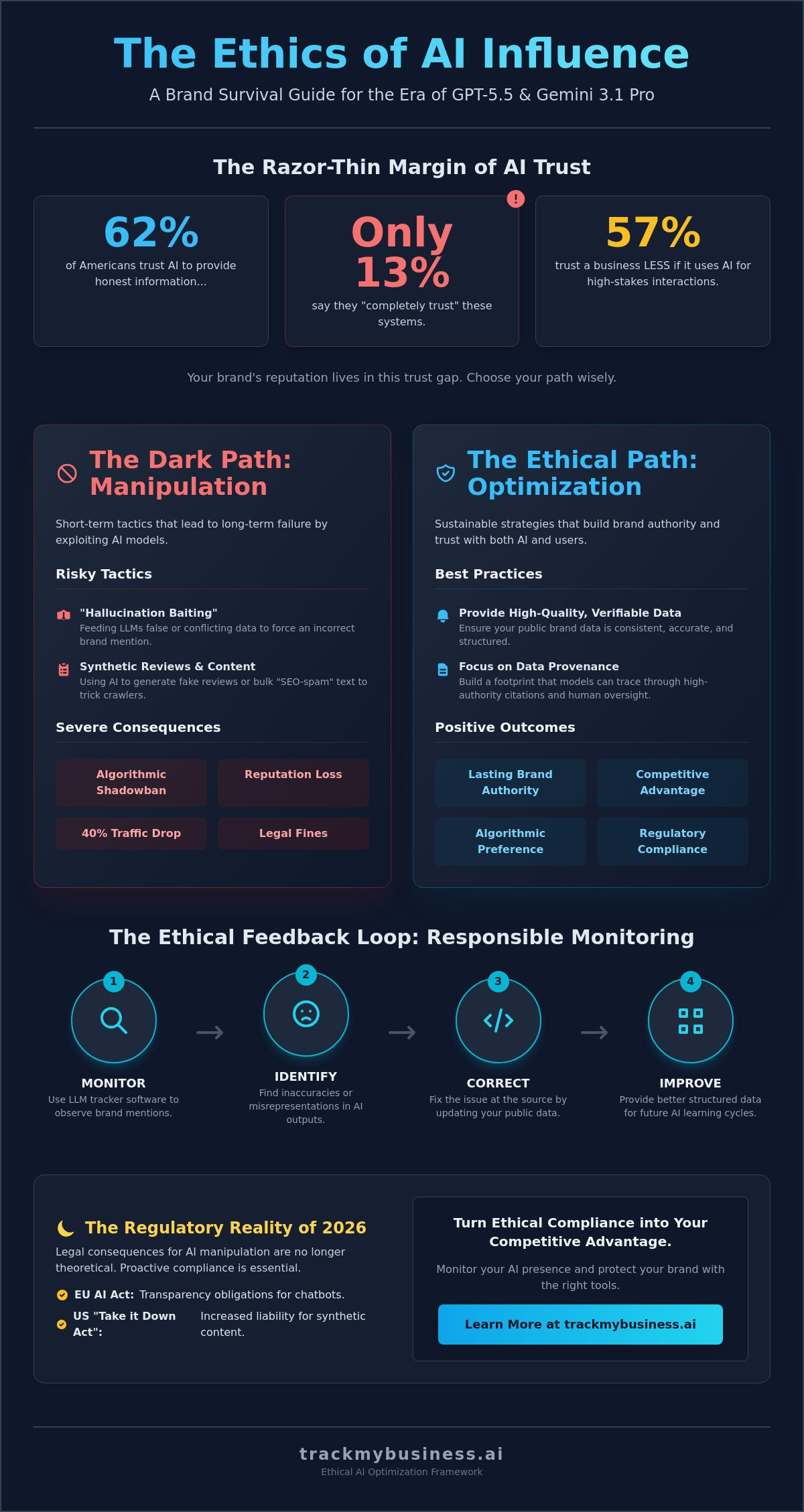
While 62% of Americans now trust AI to provide honest information, only 13% say they “completely trust” these systems. This gap represents the razor-thin margin where your brand reputation lives in 2026. As you work to improve your visibility in models like GPT-5.5 or Gemini 3.1 Pro, the ethical considerations of influencing ai have shifted from theoretical debates to hard legal requirements under the EU AI Act and California’s SB 53. I recognize the anxiety of operating within a black-box system where the fear of an algorithmic penalty feels constant. It’s often difficult to distinguish between legitimate optimization and what models might flag as misinformation or “hallucination baiting.”
I’ll show you how to manage your brand presence in LLMs without crossing ethical boundaries or risking a shadowban. You’ll gain a clear framework for AI optimization and learn how to use LLM tracker software to monitor your mentions responsibly. I’ve structured this guide to help you provide high-quality, verifiable data that helps AI models serve users accurately while protecting your standing in the digital ecosystem. By following a process-oriented approach, you can turn ethical compliance into a competitive advantage.
Key Takeaways
- I’ll show you how to shift from traditional SEO to AI-native discovery by prioritizing the quality of the data you provide to LLMs.
- You’ll learn why “hallucination baiting” and synthetic reviews backfire, leading to reputation loss and potential algorithmic penalties.
- I’ve detailed the ethical considerations of influencing ai so you can use structured data to help ChatGPT and other models categorize your products accurately.
- I’ll explain how to use LLM tracker software to monitor your mentions without crossing the line into unethical manipulation.
- You’ll get a practical five-step framework for building brand authority that satisfies both AI models and human users.
What Does It Mean to Influence AI? Definition and Scope
I define AI influence as the strategic practice of improving brand visibility within the conversational outputs of Large Language Models. We’ve moved past the era of simple keyword ranking on a search results page. In 2026, brand discovery happens inside the chat interface where GPT-5.5 or Claude 4.7 synthesizes information to provide a direct answer. This shift makes the ethical considerations of influencing ai a priority because the “black box” nature of these models often hides how they arrive at a conclusion. It’s difficult to see exactly which data point triggered a specific recommendation. This opacity makes the line between helpful optimization and deceptive manipulation harder to draw for many marketing teams.
The Mechanics of LLM Learning
I’ve observed that 2026 models are more sensitive to data provenance than their predecessors. They don’t just scrape the web indiscriminately. They evaluate the authority and origin of the information. LLMs learn through three primary channels: initial training data, fine-tuning, and Retrieval-Augmented Generation (RAG). Your public web presence acts as the primary source for these models. If your brand data is inconsistent or lacks structure, the AI might misrepresent your services. I focus on providing clear, verifiable information because models like Gemini 3.1 Pro now prioritize content with a traceable history of human oversight. Your goal is to ensure the model has access to the most accurate version of your brand story.
Why Ethical Frameworks Matter Now
Attempting to “poison” training sets with low-quality or fake information is a strategy that backfires quickly in the current regulatory environment. AI developers now use advanced detectors to filter out coordinated inauthentic behavior. I believe the long-term value of brand trust far outweighs any temporary gain from manipulating the system. When you focus on ethical considerations in AI, you’re building a foundation that survives algorithmic updates. I recommend using LLM tracker software to observe how your brand is being discussed in real-time. This allows you to identify inaccuracies and correct them at the source by improving your public documentation. It’s a proactive step that respects the integrity of the AI ecosystem while ensuring your brand isn’t left behind. This methodology ensures you’re visible for the right reasons.
The Dark Side: Why Manipulating AI Models Backfires
I define “hallucination baiting” as the practice of feeding LLMs conflicting or false data to force a specific, often incorrect, brand mention. While it might seem like a clever shortcut for visibility, it creates massive reputational risk. In 2026, models like GPT-5.5 and Gemini 3.1 Pro are designed to cross-reference multiple sources. If an AI detects you’re trying to trick it into making false claims, it doesn’t just ignore the data; it flags your domain as unreliable. This is why the ethical considerations of influencing ai are so critical for long-term survival. Tricking a model today leads to a shadowban tomorrow.
Legal consequences are no longer a distant threat. The EU AI Act’s transparency obligations for chatbots take effect in August 2026, and the US Federal “Take it Down Act” went into effect on May 19, 2026. These laws make it harder to hide behind synthetic content. If you use synthetic review generation to boost your brand, you’re not just risking a ban from the model; you’re inviting regulatory scrutiny that can lead to heavy fines. I’ve found that transparency in how you present your brand data is the only way to maintain a positive reputation in an AI-driven economy.
The Risk of Algorithmic Penalties
AI developers are moving toward “Verified Sources” lists to combat misinformation. I’ve seen brands lose 40% of their AI-driven traffic overnight because they were caught using “SEO-spam” patterns. These patterns include bulk synthetic text and hidden metadata meant only for crawlers. Once a model like Claude 4.7 excludes a brand from these trusted lists, regaining that status is nearly impossible. Short-term visibility isn’t worth becoming digitally invisible. I focus on building a footprint that models can verify through high-authority citations rather than volume.
Social and Ethical Consequences
Consumer trust is fragile. While 62% of Americans trust AI for general info, 57% say their trust in a business decreases if it uses AI predominantly for high-stakes interactions. When an AI recommends a product based on biased or manipulated data, the consumer blames both the AI and the brand. I believe brands have a responsibility to keep the digital ecosystem healthy. If you’re concerned about how these models represent you, using ChatGPT mention tracking helps you see what’s being said without resorting to manipulation. According to recent AI ethics trends for 2026, accountability is the new standard. I recommend a proactive approach that prioritizes accuracy over aggressive influence.
Core Pillars of Ethical AI Engagement: Fairness and Accuracy
I believe that accuracy is the non-negotiable baseline for any brand attempting to influence AI. While 62% of Americans trust AI for reliable info, that trust breaks if your brand provides conflicting data. I focus on ensuring every public claim is verifiable. If a model like GPT-5.5 finds your site says one thing and a third-party review site says another, it creates a “hallucination” risk. Most discussions focus on how engineers build AI. I want to focus on how you, as a brand manager, consume and influence it. This is where the ethical considerations of influencing ai become a daily operational task.
Fairness is the second pillar. Disparaging competitors in your training data is a shortcut to an algorithmic penalty. Modern models like Claude 4.7 are trained to identify biased comparisons. I suggest focusing on your unique value proposition instead. Transparency in authorship is also vital. The EU AI Act requires watermarking and labeling AI-generated content by December 2, 2026. I recommend implementing clear metadata now. This tells the model, and the user, exactly where the information came from. Respecting these boundaries prevents your brand from being flagged for manipulation.
The Role of Data Provenance
I use schema markup (JSON-LD) as a primary tool for establishing data provenance. It provides a “single source of truth” for AI models. In the apparel industry, being transparent about inventory and production isn’t just good for customers. It’s essential for AI crawlers that need structured data to categorize your brand correctly. I’ve found that third-party citations, like ISO/IEC 42001:2023 certifications, act as high-value signals for AI trust. This methodology ensures that your brand data is traceable and reliable for every model that scans your site.
Avoiding Bias in Brand Representation
Diverse representation in your data is essential. If your visual or text data is narrow, the AI’s perception of your brand will be limited too. I also caution against “sentiment steering.” This is the practice of flood-filling forums with artificial positive sentiment. It’s a form of manipulation that developers are actively fighting in 2026. I prefer using tracker software to observe existing sentiment and addressing issues directly through better service. This approach maintains the integrity of the conversation while protecting your reputation. It allows you to track brand mentions ethically without resorting to deceptive practices.
How to Optimize for AI Search Ethically: A 5-Step Framework
I’ve developed a framework that moves beyond traditional keyword stuffing to address the unique requirements of Large Language Models. In 2026, the ethical considerations of influencing ai require a focus on truth and structure rather than volume. My five-step process ensures your brand remains visible without triggering the safety filters of models like GPT-5.5 or Gemini 3.1 Pro. I recommend these core actions:
- Prioritize Authority: Focus on high-authority, human-verified content. Models now filter for data provenance to comply with the EU AI Act transparency rules.
- Implement JSON-LD: Use structured data to help AI understand your product hierarchy. This reduces the chance of the model miscategorizing your services.
- Build Entity Identity: Focus on “entity-based” SEO. I work to link your brand to specific concepts in the Knowledge Graph so AI sees you as a definitive source.
- Monitor Sentiment: Engage in authentic community discussions. LLMs use these as sentiment signals to determine if a brand is trustworthy.
- Conduct Regular Audits: I suggest auditing how AI models describe your business every month to catch inaccuracies early.
Step 1: Audit Your Current AI Footprint
My first step involves identifying “hallucination gaps” where an AI lacks accurate data about your business. If a model doesn’t have enough facts, it might invent them. I use ChatGPT mention tracking to see exactly what GPT-5.5 and other LLMs say about my brand. I then define a single sentence brand mission to serve as a benchmark. For example: “We provide transparent, process-oriented tracking software for the AI era.” I compare every AI output against this benchmark to identify where the model is drifting from the truth. This identifies exactly which pages on my site need more clarity.
Step 2: Optimize for Fact-Density
I focus on replacing marketing fluff with specific, extractable data points. AI models crave utility. Instead of saying a product is “fast,” I provide the exact technical specifications. My methodology involves using LLM tracker software to ensure these specific data points are being picked up accurately by the models. This fact-density helps the AI provide better answers to user queries, which increases the likelihood of a brand mention. By providing the structured data these systems require, I help the AI do its job more effectively without resorting to manipulation. This approach satisfies both the algorithm and the human user who needs reliable information.
Monitoring Your AI Presence: The Role of Ethical Tracking
I’ve found that manual checking of AI outputs is no longer sufficient in 2026. With 31.3% of the US population using AI tools as of Q1 2026, the volume of brand mentions has surpassed what any human team can manage effectively. I view ethical monitoring as a process of observation rather than interference. The ethical considerations of influencing ai require a clear boundary between understanding how a model perceives your brand and attempting to force it into a specific, biased answer. By utilizing tracker software, I can identify misinformation at the source before it becomes a permanent part of the model’s training data. This proactive approach protects your reputation without resorting to the manipulative tactics that often lead to algorithmic penalties.
Integrating AI mention data into your broader business management workflow is a necessity for maintaining a healthy digital footprint. It isn’t just about PR; it’s about data integrity. When I see an LLM misrepresenting a product feature, I don’t try to “fix” the AI. I fix the source data on my own website. This methodology ensures that the next time a model like GPT-5.5 or Gemini 3.1 Pro crawls the web, it finds consistent, high-quality information. It’s a transparent way to influence the conversation while respecting the autonomy of the AI system.
The Value of Real-Time LLM Insights
I use real-time insights to track a metric called “Share of Model.” This provides a clear picture of my brand’s visibility compared to competitors across different platforms. Identifying shifts in AI sentiment is just as critical. If a model suddenly starts describing your brand in a negative light, you need to know which public data point triggered that change. TrackMyBusiness helps you stay informed about your AI reputation by aggregating these mentions into a functional dashboard. This allows me to see the methodology behind the model’s conclusions and address inaccuracies through better documentation rather than deceptive “sentiment steering.”
Closing the Loop: From Insight to Action
The final step is closing the loop by turning these insights into tangible business actions. I use the data to correct technical errors on my own site that frequently lead to AI hallucinations. If the AI is confused about your service area or technical specifications, it’s usually because your structured data is inconsistent or outdated. Using LLM tracker software to inform product development and inventory management ensures your business remains aligned with actual user needs. I’ve integrated these tools into my daily workflow to ensure my brand remains a trusted entity in a complex ecosystem. See how our ChatGPT mention tracking can protect your brand and help you maintain a transparent, ethical presence in the AI-driven market.
Future-Proofing Your Brand in the Conversational Economy
I’ve outlined how the shift from traditional search to AI discovery engines requires a fundamental change in your marketing strategy. Success in 2026 depends on high-quality data provenance and structured technical specifications rather than content volume. By focusing on accuracy and fairness, you avoid the algorithmic penalties and shadowbans that come with deceptive manipulation. The ethical considerations of influencing ai are no longer just a compliance checkbox; they’re the foundation of long-term digital trust. I recommend moving from manual audits to automated systems that provide real-time LLM sentiment analysis. This allows you to catch hallucinations early and refine your brand story at the source. My modular Tracker software provides specialized insights for the garment and decoration industry, ensuring your data integration remains seamless and verifiable. You have the tools to build a visible, respected brand that thrives alongside advancing models like GPT-5.5. Taking these proactive steps today ensures your brand remains a reliable source for the millions of users relying on AI for information. Start tracking your brand mentions in ChatGPT today to protect your reputation and lead your industry with integrity.
Frequently Asked Questions
Is it ethical to use SEO techniques to rank higher in AI search results?
I believe it’s ethical as long as your techniques focus on data accuracy and user utility. Ethical optimization involves providing clean, verifiable information that helps the AI serve the user correctly. It only becomes unethical when you use deceptive tactics like cloaking or hidden text to trick the model into making false associations. I focus on transparency as the guiding principle for all AI-native discovery efforts.
What is hallucination baiting and why is it considered unethical?
Hallucination baiting is the intentional act of seeding the web with conflicting or false data to force an AI into making specific, incorrect claims. It’s unethical because it poisons the digital information ecosystem and intentionally deceives users. This practice violates the core ethical considerations of influencing ai by prioritizing brand visibility over factual integrity. It often leads to permanent algorithmic penalties for the offending brand.
How can a brand correct false information that an AI model is spreading?
You correct misinformation by identifying the source of the error and updating your public documentation with verifiable facts. AI models rely on the most authoritative and recent data they can find. I recommend updating your structured data and securing third-party citations to provide a single source of truth. This process-oriented approach ensures that future model updates reflect the correct information about your business.
Do LLMs prioritize brands that provide structured data like JSON-LD?
Yes, LLMs like GPT-5.5 and Gemini 3.1 Pro prioritize structured data because it’s significantly easier to parse and verify. JSON-LD provides a clear hierarchy that reduces the computational effort needed for the model to understand your brand. I’ve observed that brands using schema markup are more likely to appear in verified sources lists. This methodology provides the technical clarity that AI systems require to function accurately.
Is it unethical to use AI to write the content that trains other AI models?
It isn’t inherently unethical, but it requires strict human oversight and total transparency. The risk is creating a model collapse where AI-generated errors are amplified in future training sets. I suggest labeling AI-generated content with clear metadata as required by 2026 transparency laws. This ensures that developers can weigh the provenance of the data correctly when training their next-generation models for the market.
How does mention tracking differ from traditional social media monitoring?
Mention tracking focuses on the latent space of Large Language Models rather than public social feeds. Traditional monitoring looks for what humans are saying, whereas LLM tracker software analyzes how a model synthesizes your brand identity. This allows me to see the share of model and understand the specific logic the AI uses to recommend your products. It’s a more technical, data-driven approach to reputation management.
Can influencing AI lead to legal trouble for my business?
Yes, deceptive practices can trigger legal repercussions under new frameworks like the EU AI Act and state-level laws in California and Colorado. If your optimization efforts involve spreading misinformation or “deepfake” content, you may face heavy fines or removal from major platforms. I prioritize a compliant approach that respects the Take it Down Act and other 2026 regulations. Staying within these legal boundaries is essential for any modern brand.
What is the most important ethical principle for AI optimization in 2026?
Accountability is the most important principle. You must take responsibility for the data your brand contributes to the digital ecosystem. This means auditing your outputs and being transparent about your influence strategies. I believe that brands which treat the ethical considerations of influencing ai as a core business requirement will build the most trust with both AI developers and end-consumers over the next decade.
