
If your brand fails to provide a single, unambiguous version of its truth across the web, AI models will simply invent one for you. You’ve likely experienced the frustration of seeing ChatGPT hallucinate features your product doesn’t have or watching a competitor get recommended for your core keywords. It’s a common struggle in 2026 as organic traffic shifts toward zero-click AI summaries. I understand how unsettling it feels to lose control over your brand narrative to a “black box” algorithm.
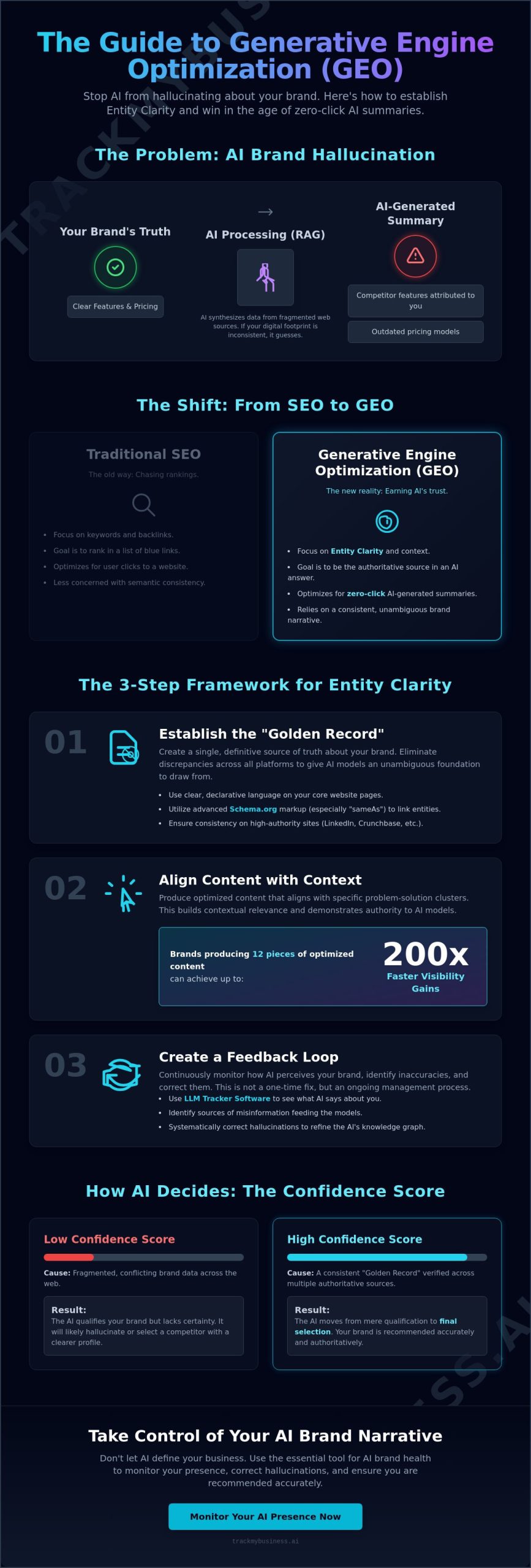
I will show you exactly how to improve ai brand recommendation accuracy by establishing “Entity Clarity” that models like Gemini and Claude can actually process. Research shows that brands producing 12 pieces of optimized content can achieve up to 200x faster visibility gains than those sticking to traditional methods. This guide outlines the precise methodology to ensure your brand is cited authoritatively. I’ll walk you through the shift from SEO to Generative Engine Optimization and show you how to use LLM tracker software to monitor exactly how AI perceives your business.
Key Takeaways
- I will show you how to build a “Golden Record” of your brand architecture to ensure AI models have a single, unambiguous source of truth.
- You will learn to align your content with specific problem-solution clusters to improve contextual relevance and authority in AI-generated advice.
- I’ll explain exactly how to improve ai brand recommendation accuracy by identifying and correcting hallucinations through a structured feedback loop.
- You will discover how LLM tracker software and ChatGPT mention tracking provide the data needed to manage your brand’s presence in generative engines.
What is AI Brand Recommendation Accuracy?
I define AI brand recommendation accuracy as the precise alignment between your actual business offerings and how a Large Language Model (LLM) describes them to a user. In 2026, search intent has shifted fundamentally. Users are no longer looking for a simple list of blue links to click. They are seeking direct advice. When a user asks a model for the best software in your category, the AI acts as a sophisticated recommender system. If the model incorrectly describes your pricing or attributes your competitor’s features to you, the cost is immediate. You lose qualified leads before they even reach your site. This accuracy depends heavily on Retrieval-Augmented Generation (RAG), where the AI pulls data from diverse web sources to synthesize a response. If your digital footprint is fragmented, the RAG process fails.
Understanding how to improve ai brand recommendation accuracy is now a core requirement for any digital strategy. If the model lacks a clear “Golden Record” of your brand, it will fill in the gaps with probabilistic guesses. This leads to brand dilution and a significant drop in conversion rates. I see this most often when companies focus on traditional SEO keywords but ignore the semantic context that AI models use to build their internal knowledge graphs. Without a unified narrative, you’re essentially letting the AI guess what you do.
Qualification vs. Selection: The AI Choice Architecture
AI models follow a specific choice architecture when responding to prompts. First, the model qualifies an entity by determining if it belongs in the “candidate set” for a specific query. I focus on helping you move from mere qualification to final selection. The AI chooses to recommend you based on “Confidence Scores.” These scores represent how certain the model is that the information it has about you is true and relevant. If your brand data is inconsistent across different platforms, the model’s confidence drops. It will likely select a competitor with a clearer, more authoritative profile. Learning how to improve ai brand recommendation accuracy starts with boosting these internal scores.
The Problem of Brand Hallucinations
Hallucinations often occur when the AI encounters conflicting information across different sales channels or outdated press releases. I’ve seen rebranded companies struggle with “legacy hallucinations” where the AI continues to associate them with retired products or old pricing models. This happens because the LLM tries to resolve contradictions by blending facts. This creates a version of your brand that doesn’t exist. When you provide clear, machine-readable data, you reduce the likelihood of the AI inventing features or limitations that harm your reputation. If you don’t manage your data, the AI will create a narrative for you, and it’s rarely accurate.
The Foundation of Accuracy: Establishing Entity Clarity
I believe the foundation of any generative engine strategy is the “Golden Record.” This is a single, definitive source of truth about your brand that AI crawlers can rely on. When I look at why brands fail to rank in AI summaries, the number one cause is fragmented messaging. If your LinkedIn says you are a software company but an old Crunchbase profile still lists you as a consultancy, the AI model faces a contradiction it cannot resolve. To understand how to improve ai brand recommendation accuracy, you must first eliminate these discrepancies. I recommend starting with your own “About Us” and “Services” architecture. These pages should use clear, declarative sentences that state exactly what you do and who you serve.
Managing your reputation in this way involves more than just text updates. Many organizations now use AI-driven sentiment analysis to see how their brand is perceived across the web in real-time. This helps identify where conflicting data might be poisoning the AI’s understanding of your business. If you aren’t sure where the AI is getting its information, using tracker software can help you identify exactly which sources are feeding the model’s responses. Consistency across high-authority third-party sites is not optional. It is the primary signal AI uses to verify your identity.
Advanced Schema.org for 2026
I use Schema.org markup to provide the technical scaffolding for brand clarity. In 2026, the “sameAs” property is your most powerful tool. It explicitly tells the AI that your website, your social profiles, and your industry directory listings all represent the same entity. I also suggest using “Organization” and “Product” schema with extreme granularity to define specific features. Schema acts as a Rosetta Stone for LLMs by translating human-readable web content into a structured format that machines can parse without ambiguity.
Cleaning the Digital Footprint
Old data is a liability. I’ve found that legacy information, such as discontinued services or old office addresses, often persists in the training data of LLMs. You need to audit third-party directories and high-authority sites like Wikipedia or Wikidata, as these often serve as a “Source of Truth” for many models. If your brand name is similar to another entity, you must use distinct identifiers in your copy to avoid brand confusion. This proactive cleaning ensures the AI doesn’t mix your history with someone else’s current operations.
Improving Sentiment and Contextual Relevance
I’ve discussed how entity clarity forms your foundation. Now, I will explain why the context surrounding your brand mentions is equally vital. LLMs prioritize relevance over simple volume. They categorize your brand based on “problem-solution” clusters. If your name appears frequently in discussions about high-end logistics, the AI will associate you with that premium tier. Conversely, if your brand is mentioned in threads about “cheap alternatives,” that’s where the AI will place you. Academic research on AI personalization highlights that the accuracy and relevance of these associations are critical for maintaining consumer trust and loyalty.
To build these clusters, I focus on contextual backlinks. These aren’t just links for SEO; they are mentions in articles that solve specific user pain points. When an industry publication discusses how to solve a manufacturing bottleneck and cites your tool as the solution, the AI learns that specific relationship. Community forums and Q&A sites like Quora also heavily influence this. I monitor these mentions to ensure the AI isn’t picking up negative sentiment from unresolved user complaints. This is a key part of how to improve ai brand recommendation accuracy because it shapes the “vibe” the AI attributes to your brand.
Influencing the AI Sentiment Score
I track the specific adjectives AI models use to describe a brand. There is a massive difference between being called “expensive” and being called “premium.” To influence this, I recommend seeding long-form content that addresses nuances in your service. You should also encourage customers to leave specific reviews. Instead of a generic “great service,” a review stating it’s the “best tool for real-time inventory tracking” helps the LLM understand your functional value. Using LLM tracker software allows me to see these sentiment shifts in real-time so I can adjust the content strategy accordingly.
Positioning for Industry-Specific Queries
I’ve seen apparel brands dominate the “sustainable manufacturing” recommendation set by aligning their terminology with their ideal customer profile. You can achieve this by creating comparison tables on your site. These tables are easy for AI to ingest and cite directly. If you provide a clear side-by-side comparison of your features against industry standards, you are essentially feeding the AI the exact data points it needs to recommend you. This helps the system understand how to improve ai brand recommendation accuracy by removing the need for the model to guess your competitive advantages or feature sets.
The Feedback Loop: Monitoring and Correcting Inaccuracies
I’ve established that entity clarity and contextual relevance are the building blocks of visibility. However, you can’t treat your AI brand strategy as a static project. The models are constantly re-evaluating their sources. If a single high-authority site publishes incorrect data about your pricing or features, it can trigger a cascade of inaccuracies across multiple LLMs. This is why a feedback loop is essential. I use a structured process to identify and neutralize these hallucinations before they impact your conversion rates. Understanding how to improve ai brand recommendation accuracy requires a proactive stance toward data hygiene.
A major part of this process involves “Citation Correction.” When an AI model like Gemini or Perplexity provides a response, it often cites its sources. I analyze these citations to find the “patient zero”: the specific website hosting the misinformation. Once I’ve identified it, I reach out to that source to request a correction. If the AI is pulling from a stale directory or an outdated press release, fixing the source is the only way to ensure the LLM’s next crawl reflects the truth. You can start tracking your brand mentions today to see exactly which sources are shaping your AI profile.
Step 1: Audit Your Current AI Recommendations
I start by using specific prompting strategies to uncover hidden brand biases. I ask models like ChatGPT to compare my brand against three competitors for a specific use case. This reveals “Competitor Overlap” and highlights where I’m losing the recommendation. I document every instance where the AI describes a feature we don’t have or gets our pricing wrong. This audit creates the baseline for all subsequent corrections.
Step 2: Trace the Source of Misinformation
Once I find an error, I trace it back. Perplexity is particularly helpful here because it provides direct links. I look for the specific phrasing the AI uses; often, the model lifts entire sentences from obscure blogs or outdated forums. I also use ChatGPT mention tracking to monitor these occurrences in real-time. This helps me catch inaccuracies before they become entrenched in the model’s long-term “memory” of my brand.
Step 3: Update and Re-index
After I correct the source data, I use a “Force Crawl” technique. I submit the corrected URLs through Search Console to encourage immediate re-indexing. I also update our “Golden Record” in high-authority directories. I’ve found that wait times vary. While a RAG-based model might show the correction in a few days, deeper model updates can take weeks. This is another reason why knowing how to improve ai brand recommendation accuracy is about persistence, not just a one-time fix.
TrackMyBusiness: The Essential Tool for AI Brand Health
I’ve detailed the manual steps for establishing entity clarity and fixing hallucinations. However, manual audits alone cannot keep pace with the speed of generative AI updates. I use TrackMyBusiness to bridge the gap between your operational reality and how AI models perceive your brand. This LLM tracker software transforms a reactive feedback loop into a proactive visibility strategy. For B2B brands, particularly those in the apparel supply chain, this level of transparency is vital in 2026. If an AI model incorrectly describes your order management capabilities, it directly impacts your bottom line before you can even intervene.
Using ChatGPT mention tracking allows me to see exactly when and how a brand is cited in user conversations. This is a critical part of how to improve ai brand recommendation accuracy because it identifies the specific prompts that trigger hallucinations. I no longer have to guess which parts of a brand narrative are failing; I can see the data in a functional, direct dashboard. This transition from basic “tracker” software to a full LLM visibility suite ensures that your brand remains authoritative and accurately represented across all major models, including Gemini, Perplexity, and Claude.
Real-Time Insights into AI Mentions
I monitor ChatGPT conversations to find every brand reference as it happens. My methodology includes using sentiment analysis dashboards to see the “emotional” health of a brand. If the AI starts associating a business with “shipping delays” or “poor integration,” I see it immediately. I also use competitor benchmarking to understand why an AI might prefer one brand over another for specific queries. This data-driven approach allows me to adjust content strategies based on what the models are actually outputting, rather than relying on traditional SEO metrics that don’t always apply to generative engines.
Integrating Operations with Marketing
I find that many brands fail because their marketing copy doesn’t match their operational capabilities. I use tracker software to ensure that technical inventory and order management features are correctly cited by AI crawlers. By feeding accurate, structured data into the digital ecosystem, I help the AI build a more reliable knowledge graph of the business. This integration is a proactive step in learning how to improve ai brand recommendation accuracy by aligning technical specs with public-facing content. You can see how TrackMyBusiness can protect your brand narrative by exploring our full suite of monitoring tools.
Securing Your Brand’s Narrative in the Generative Age
I’ve explained that maintaining a precise brand presence in 2026 requires more than just high-quality content. It demands a “Golden Record” of entity clarity and a rigorous feedback loop to identify and neutralize hallucinations. By establishing a centralized architecture and correcting citations at their source, you ensure that LLMs like ChatGPT and Gemini have the accurate data they need to recommend you. This shift from traditional SEO to Generative Engine Optimization is no longer optional for brands that want to remain visible in a zero-click environment.
I’ve developed a methodology for how to improve ai brand recommendation accuracy that relies on functional data, not guesswork. Using specialized LLM tracker software is the only way to manage this at scale. My platform provides real-time alerts for brand mentions and offers specialized support for businesses in the garment and manufacturing sectors. I’m ready to help you take control of your digital reputation with a transparent, process-oriented approach. Start tracking your ChatGPT mentions and brand accuracy today to ensure your business is always described correctly. You have the tools to shape how AI perceives your brand; it’s time to use them.
Frequently Asked Questions
How do I know if ChatGPT is recommending my brand?
I recommend using specialized LLM tracker software to monitor mentions across various models. While you can manually prompt ChatGPT, the results often vary based on user history and session context. Our ChatGPT mention tracking provides a systematic view of how often and in what context your brand appears. This data is essential for understanding your current baseline before you implement any optimization strategies to improve visibility.
Can I pay OpenAI or Google to improve my brand recommendation accuracy?
No, you cannot currently pay for placement or accuracy within the generative responses of models like ChatGPT or Gemini. These systems rely on algorithmic processing of web data and RAG sources rather than an advertising model. Instead of an ad spend, you must focus on how to improve ai brand recommendation accuracy through technical data clarity and consistent messaging across high-authority third-party platforms.
How long does it take for AI models to update their information about my business?
The timeline for updates depends on the model’s specific architecture. Systems that use Retrieval-Augmented Generation, such as Perplexity or Gemini’s live search, can reflect changes in a few days once the source page is re-indexed. However, deeper updates to the core training weights of a model can take several months. I suggest using Search Console to force a crawl of corrected pages to speed up the retrieval process.
What is the difference between SEO and GEO (Generative Engine Optimization)?
SEO focuses on ranking your website in a list of search results to drive organic clicks. GEO aims to have your brand correctly cited and recommended within the AI’s generated response itself. While SEO prioritizes keywords and backlinks, GEO emphasizes entity clarity and providing a single source of truth that an LLM can parse easily. Both are necessary but solve different visibility problems in 2026.
Why does the AI keep mentioning my competitor for my specific product features?
This often happens when the AI encounters conflicting information or when a competitor has established stronger entity clarity for those specific features. If your website lacks structured data or uses vague language, the LLM might default to a competitor with more declarative, machine-readable content. I find that auditing your services architecture is the first step in reclaiming these specific feature associations from your competition.
Does social media activity affect my AI brand recommendation accuracy?
Yes, social media activity plays a significant role in how models perceive your brand’s authority and sentiment. LLMs often crawl high-authority social platforms and forums to understand real-world user experiences. Consistent activity and positive engagement help the model associate your brand with the correct industry clusters. This is a key component of how to improve ai brand recommendation accuracy by building a broader context for the AI to process.
Can I use robots.txt to stop AI from hallucinating about my brand?
No, robots.txt only prevents AI bots from crawling your site in the future. It doesn’t fix hallucinations based on existing training data or incorrect information hosted on third-party websites. In fact, blocking AI crawlers might make accuracy worse because the model will rely on external data instead of your official information. I recommend keeping your site open and using structured schema to provide the model with better data.
How often should I audit my brand visibility in AI search?
I suggest a monthly audit of your brand visibility and accuracy at a minimum. AI models are updated frequently, and new web content can quickly shift the model’s perception of your business. Using tracker software to monitor mentions in real-time allows you to catch inaccuracies as they appear. This proactive approach ensures your brand narrative remains stable even as the underlying AI algorithms and training sets evolve.
