
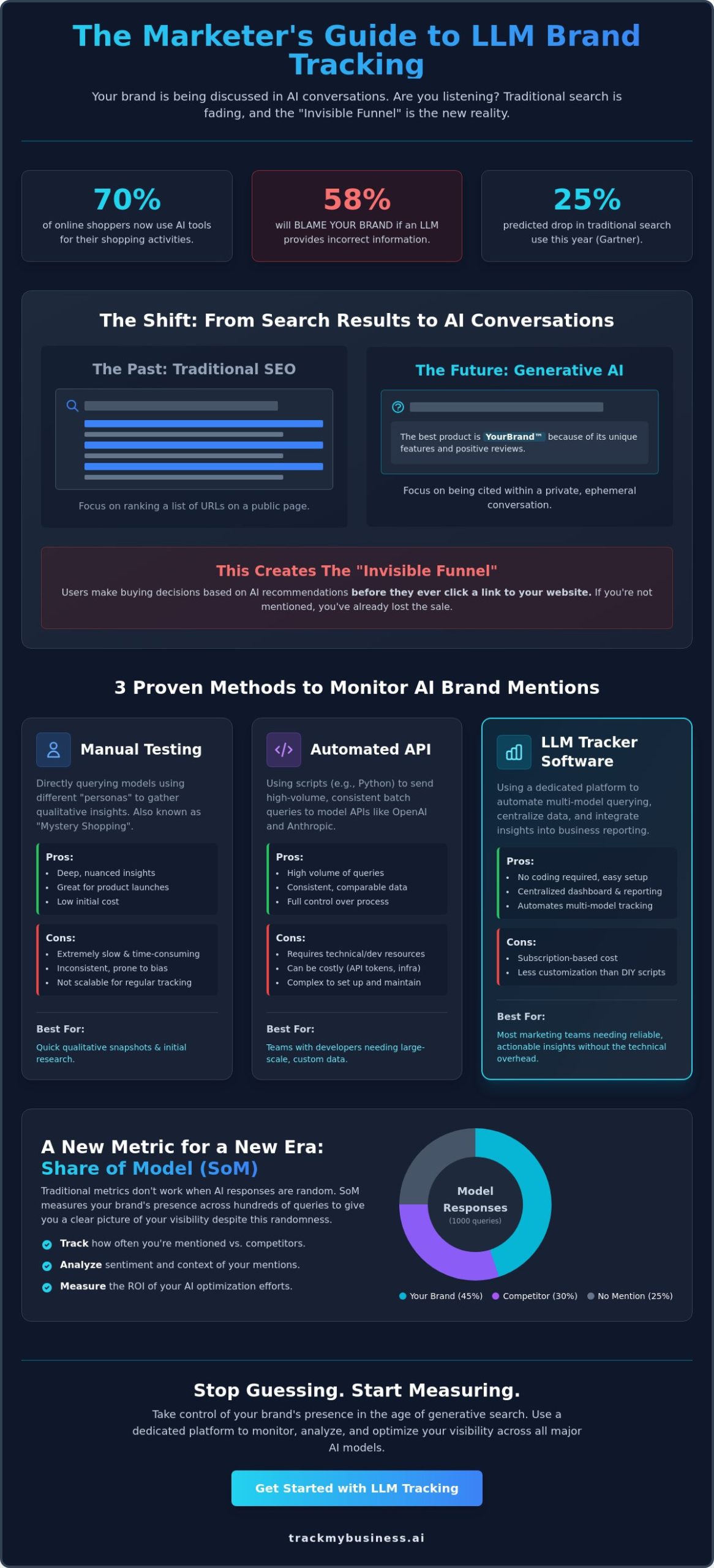
Did you know that 70% of online shoppers now use AI tools for their shopping activities, yet 58% will blame your brand if an LLM provides incorrect information? It’s a frustrating reality for modern marketers because these AI responses are ephemeral and don’t show up in standard Google search results. I understand the struggle of manual testing. It’s time-consuming, inconsistent, and makes it nearly impossible to prove the ROI of your optimization efforts. If you don’t have a system to monitor these conversations, you’re essentially flying blind in a market where Gartner predicts traditional search use will drop by 25% this year.
In this guide, I’ll show you exactly how to track mentions across different llms so you can stop guessing and start measuring. I’ve developed a repeatable process for monitoring brand sentiment inside ChatGPT, Claude, and other leading models. We will explore the specific tracker software required to automate multi-model querying and discuss how to integrate these insights into your monthly business reporting. By the end, you’ll have a clear methodology for maintaining your brand’s presence in the age of generative search.
Key Takeaways
- Transitioning from traditional SEO to AI visibility requires a new understanding of how models cite brands in their responses rather than just ranking URLs.
- I will outline the specific steps for how to track mentions across different llms using a core query set that targets your most important products and categories.
- You’ll learn to calculate “Share of Model” (SoM), a new metric that helps you measure brand presence despite the randomness of AI-generated content.
- I compare manual testing methods against automated API scripting to help you decide which methodology fits your current resource level.
- Discover how to centralize your data using specialized LLM tracker software, ensuring that AI insights are integrated directly into your business reporting.
Why LLM Tracking is the New Frontier of Brand Visibility
I see many marketing teams relying on traditional search metrics while their audience moves elsewhere. LLM mention tracking is the process of systematically querying AI models to find where and how your brand appears in their generated responses. It differs from standard SEO because you aren’t just looking for a ranking on a page. You are looking for a citation within a conversation. Learning how to track mentions across different llms is no longer optional; it’s a core requirement for brand protection in 2026.
The landscape has shifted from a list of blue links to a single, authoritative answer. This shift creates what I call the “Invisible Funnel.” In this scenario, users make buying decisions based on AI recommendations before they ever click a link to your website. If ChatGPT or Claude doesn’t mention your product when a user asks for a recommendation, you’ve lost the lead before you even knew it existed. With Gartner predicting a 25% drop in traditional search engine use by the end of 2026, the stakes for being present in these AI answers have never been higher.
The Difference Between Web Crawling and LLM Querying
Websites are public and static. When I use a standard crawler, I’m looking at what is visible to everyone on the open web. LLM responses are different. They are ephemeral and generated in private sessions. This is the primary reason why Google Search Console cannot report on your brand’s performance in Claude or Perplexity. To understand this gap, we must look at what are large language models and how they process information. These systems don’t just index pages; they predict text based on massive datasets and, increasingly, real-time Retrieval-Augmented Generation (RAG). I focus on both the “baked-in” training data and the live web access to get a full picture of brand visibility.
Why Your Brand Cannot Afford to Stay in the Dark
Staying unaware of your AI presence is a significant business risk. AI hallucinations can lead a model to claim your product lacks a feature it actually possesses. If I don’t know this is happening, I can’t fix the underlying source content that the AI is reading. Negative sentiment in these recommendations directly impacts your conversion rates, especially since 58% of shoppers blame the brand when an LLM provides incorrect information. I use this data to inform my content and product development strategy. By understanding how to track mentions across different llms, I can identify which specific models are misrepresenting my features and take proactive steps to update the structured data they rely on.
The 3 Proven Methods to Monitor AI Brand Mentions
I’ve categorized the current landscape of AI monitoring into three distinct paths. Each path offers a different level of granularity and cost. Knowing how to track mentions across different llms effectively means matching your methodology to your specific business goals. I start by evaluating whether I need a quick qualitative snapshot or a massive, quantitative dataset for board reporting.
Manual Testing: When and Why to Do It
Manual “Mystery Shopping” involves querying models directly. I find this best for deep-dive qualitative research, especially during a product launch. I use various “Personas” to see how recommendations change. For example, I might prompt ChatGPT as a “skeptical tech reviewer” versus a “first-time buyer.” This reveals the nuance in how models perceive brand value. However, manual testing has significant limitations. It’s slow and prone to human bias. You can’t possibly query every model version 100 times a day to get a statistically significant sample. It’s a helpful starting point, but it isn’t a long-term solution for a growing brand.
Automated API Monitoring: Building a Custom Tracker
For those with technical resources, automated API scripting is the next step. I often use Python to send batch queries to OpenAI and Anthropic APIs. This approach allows for much higher volume. The key here is the “System Prompt.” If your prompt varies even slightly, the model’s output might shift, ruining your data consistency. You must maintain a strict control set of questions to ensure the responses are comparable. While this gives you control, the cost of running your own infrastructure adds up. Token costs and developer hours are significant investments. As researchers at Harvard explore the evolution of AI in marketing, they highlight that data-driven prediction is becoming the standard. Building a custom tool is one way to meet that standard, but it’s labor-intensive.
Specialized LLM Monitoring Platforms: The Enterprise Approach
The third method is using specialized LLM tracker software. This is the most scalable option for brands that need to monitor sentiment across dozens of models simultaneously. These platforms centralize disparate data points into a single dashboard. They handle the API connections, the prompt rotations, and the sentiment analysis for you. If you need to report on “Share of Model” to your board, this is the only viable path. I recommend looking at a dedicated tracker software to automate this process. It removes the manual labor and provides a repeatable framework for your reporting. When I evaluate how to track mentions across different llms at scale, I prioritize tools that can distinguish between a simple mention and a high-intent recommendation.
Overcoming the Black Box: Context, Sentiment, and Randomness
I’ve found that the biggest hurdle in how to track mentions across different llms is the inherent randomness of the models. Unlike a search engine that serves a consistent index, LLMs are non-deterministic. If I ask ChatGPT to “recommend a CRM for small businesses” five times in a row, I might get three different lists. This ephemeral nature makes data collection feel like chasing a moving target. I address this by moving away from binary “yes/no” tracking and toward a statistical sampling model.
To measure success, I use a metric called “Share of Model” (SoM). I calculate this by taking the total number of times my brand is mentioned across a set of category-specific prompts and dividing it by the total mentions of all competitors. If I’m mentioned in 40 out of 100 queries for a specific category, my SoM is 40%. This provides a concrete number for business reporting that accounts for the model’s variability. I also keep a close eye on “Competitor Proximity.” If an LLM always recommends my brand alongside a specific rival, it tells me how the model’s training data has grouped our market positions. It allows me to see who the AI considers my true peers.
Dealing with Non-Deterministic Responses
I rely on the “N=10” Rule to handle variance. I never trust a single response. I query each model at least ten times for every core prompt to establish a baseline. When exploring how to track mentions across different llms through an API, I set the “temperature” to 0.0. This forces the model to be as predictable as possible, though it doesn’t eliminate randomness entirely. I also version-control every response. Since models are updated frequently, I need a historical audit trail to see if a drop in mentions is due to a model update or a change in our brand’s online reputation. This process-oriented approach ensures the data remains reliable over time.
Sentiment Analysis Beyond Positive/Negative
A simple mention isn’t enough. I categorize citations into three buckets: Recommendations, Comparisons, and Citations. A recommendation is a high-intent win. A comparison might list my brand alongside others, which is often neutral. I also track “Feature Specificity.” I want to know if the AI actually understands my product’s unique selling points or if it’s just repeating generic category fluff. Finally, I monitor “Source Attribution.” If the model provides a link, I check if it’s pointing to my documentation or a third-party review site. This helps me understand which external content is actually influencing the AI’s “opinion” of my brand, allowing me to adjust my off-site SEO strategy accordingly.
A Step-by-Step Framework for Your LLM Tracking Strategy
I’ve developed a five-step framework to help marketing teams move from guesswork to precise data collection. Learning how to track mentions across different llms requires a structured approach to ensure the information you gather is actually actionable. I start by defining a “Core Query Set.” This set includes your brand name, your primary products, and your top three category competitors. You need to know how you stack up against these leaders in the AI’s internal ranking system.
Next, I select a “Model Portfolio.” While ChatGPT currently dominates with 84.1% of trackable AI discovery traffic, I don’t ignore the others. I include Claude 3.5, Gemini Pro, and Llama 3 to get a full view of the landscape. Once the models are selected, I establish a “Neutral Prompting” baseline. I never ask the AI to “tell me why our brand is great.” Instead, I ask open-ended questions that force the model to choose between us and our rivals without bias. Finally, I schedule regular “Sweeps.” Since model updates and training shifts happen constantly, I recommend using specialized LLM tracker software to automate these checks every month. This process allows me to translate simple mentions into operational business insights that the whole company can use.
Crafting the Perfect Tracking Prompt
The quality of your data depends entirely on your prompt engineering. I use three specific types of prompts to get a clear picture of brand visibility. The “Category Neutral” prompt asks, “What are the top 5 tools for [Category]?” This reveals if we are even in the model’s consideration set. The “Competitor Head-to-Head” prompt asks, “How does [Brand] compare to [Competitor]?” This shows me exactly where the AI thinks we are weaker or stronger. Lastly, I use the “Problem-Solution” prompt: “How do I solve [Pain Point]?” This tells me if the AI associates our brand with the specific problems we solve.
Analyzing the Results for Business Growth
I don’t just collect these mentions; I analyze them to find gaps in our public documentation. If an LLM is confused about a specific feature, it’s usually because our own site content is unclear or poorly structured. I also use these mentions to validate our “Unique Selling Proposition” (USP). If the AI consistently highlights a feature we don’t consider a priority, it might be time to pivot our marketing. Industry data indicates that AI-referred traffic converts at 2 to 3 times the rate of traditional channels. This makes tracking your brand mentions a direct way to identify and optimize for your most profitable traffic sources.
Integrating LLM Insights into Your Business Operations
I’ve seen many companies treat AI monitoring as a marketing-only task. This is a mistake. Silos kill the value of this data. When you understand how to track mentions across different llms, you shouldn’t just keep that information in a spreadsheet. It needs to move from marketing into operations. If an AI model is consistently praising a specific product feature while your operations team is considering cutting it, there’s a disconnect that could cost you sales. My goal is to ensure that these insights inform every level of the organization.
Using specialized LLM tracker software like TrackMyBusiness “Tracker” allows me to centralize these disparate data points. I can see what ChatGPT, Claude, and Gemini are saying about a brand in one place. This centralization is essential for maintaining business transparency. For instance, a client in the garment industry can use mention sentiment to adjust production priorities. If AI recommendations are suddenly highlighting “sustainable linen” as a brand strength, that data should go straight to the sourcing team. It’s about moving from simple order management to a proactive AI visibility strategy that anticipates market demand.
The Tracker Advantage: Visibility Across the Whole Business
I focus on connecting what the AI says to what customers are actually ordering. By using modular Tracker software, I can bolt these metrics onto an existing business dashboard. This creates a 360-degree view of the business. Custom software integrations play a vital role here. They allow the data to flow into your ERP or CRM, ensuring that every department understands the brand’s current AI reputation. When I know exactly how to track mentions across different llms and feed that into our core systems, the data becomes a tool for growth rather than just a report to be filed away.
Next Steps: From Tracking to Influencing
Once you’ve mastered the monitoring phase, the next step is influencing the results. I use the tracking data to improve our “AI Engine Optimization” (AEO). If the data shows the models are using outdated specs, I immediately update our public-facing technical docs and structured data. This feeds the models better information for the next training cycle or RAG query. It’s a continuous loop of monitoring and refinement. You can see how Tracker can streamline your business data today to begin this integration process and secure your brand’s future in the age of AI.
Securing Your Brand’s Future in the AI Discovery Era
The shift from traditional search to AI-driven answers is happening now. To stay visible, you must move beyond manual checks and adopt a statistical approach. By applying the “N=10” rule and focusing on your Share of Model, you can turn the “black box” of LLM responses into a predictable stream of business intelligence. I’ve outlined the framework; now it’s your turn to apply it.
Understanding how to track mentions across different llms is just the first step. The true value lies in integrating these mentions into your core operations. I recommend a cloud-based modular system that provides transparency for specialized sectors like the garment and decoration industry. My team provides Saudi Arabia based support and implementation to ensure your tracker software works for your specific needs.
If you’re ready to stop guessing and start measuring your AI presence, I invite you to Request a Demo of Tracker’s Business Intelligence System. You’ve got the methodology to succeed. Now is the time to put it into action and lead your industry into the future of AI search.
Frequently Asked Questions
Can I track mentions in ChatGPT for free?
You can track mentions for free by manually typing prompts into the ChatGPT interface. This method works for occasional checks but fails at scale. You won’t get historical data, sentiment trends, or automated reports without using specialized tracker software. I find that manual testing is too inconsistent for a professional brand strategy.
How often do LLMs update their knowledge of my brand?
Knowledge updates happen in two ways: through new training cycles and real-time web access. Core training data might only be updated every few months. However, models using Retrieval-Augmented Generation (RAG) can see your website updates within hours or days. I recommend scheduling weekly sweeps to catch these shifts in real-time information retrieval.
What is the most accurate tool for tracking AI mentions in 2026?
Accuracy depends on whether you need broad visibility or deep sentiment analysis. Tools like the Semrush AI Visibility Toolkit provide a high-level score, while specialized LLM tracker software offers more granular data on specific product citations. I suggest choosing a tool that allows you to query multiple models simultaneously to ensure your data isn’t biased toward a single provider. This is a critical step in learning how to track mentions across different llms effectively.
Does a mention in an LLM improve my Google SEO ranking?
There is no direct evidence that an LLM mention acts as a ranking signal for Google’s traditional search results. While they are separate systems, a mention in an AI response often leads to a significant increase in direct traffic. This surge in high-intent visitors can indirectly strengthen your site’s overall authority and performance metrics over time.
How do I stop an LLM from hallucinating incorrect facts about my business?
You cannot directly edit an LLM’s internal weights, but you can influence its outputs by improving your “data footprint.” I’ve found that updating your Schema markup and technical documentation is the most effective proactive step. When models use real-time search to verify facts, they prioritize well-structured, authoritative data from your official domain.
Is LLM tracking compliant with data privacy regulations like GDPR?
LLM tracking is generally compliant because it focuses on public brand data rather than private user information. You are querying the model’s public knowledge base, not accessing private user chat histories. As long as your tracking process doesn’t involve scraping protected personal data, it falls within standard market research guidelines.
What is the difference between LLM tracking and social media monitoring?
Social media monitoring captures what humans are saying in real-time on public platforms. LLM tracking analyzes the “opinion” of an algorithm based on its massive training dataset. Understanding how to track mentions across different llms is unique because you’re monitoring a synthesized output rather than a direct human conversation. Both are necessary for a complete brand health picture.
How much does it cost to use APIs for brand monitoring at scale?
API costs are based on token usage and vary significantly between providers like OpenAI and Anthropic. If you’re running thousands of queries across multiple models, these costs can escalate quickly. I’ve seen brands save money by using a consolidated tracker software that manages API calls more efficiently than a custom-built script. You should check the latest developer pricing for each model to estimate your monthly overhead.
