
The era of the “blue link” is fading, and if you’re still chasing traditional backlinks alone, you’re competing for a shrinking piece of the pie. By May 2026, the real authority isn’t just ranking on page one; it’s becoming the cited source in a generative response. You’ve probably felt the sting of seeing an AI model summarize your expertise while your click-through rate drops. It’s a common pain point for marketers who realize that standard SEO isn’t enough to capture the attention of Large Language Models. This guide reveals exactly how to get backlinks from ai citations by evolving your strategy from simple search visibility to becoming a “Verified Entity” in the AI knowledge graph.
You’ll master the art of Generative Engine Optimization (GEO) to ensure AI models don’t just know you exist, but actively recommend you. We’ll walk through the technical requirements, including the llms.txt Version 1.1.1 specification released on January 12, 2026, which over 2,000 websites adopted by late 2025. You’ll learn how to structure your data for maximum readability and how to use specialized LLM tracker software to measure your brand’s influence in real-time. From implementing schema markup to tracking ChatGPT mentions, this is your roadmap to dominating the next generation of search.
Key Takeaways
- Understand the fundamental shift from traditional search rankings to generative visibility and why citation share is the new metric for digital authority.
- Learn to structure your content using the “Claim-Evidence-Source” format to make it easy for RAG-based AI models to extract and cite your expertise.
- Discover the 5-step blueprint on how to get backlinks from ai citations by identifying citation gaps and producing the primary data that models prioritize.
- Implement dedicated LLM tracker software to monitor your brand mentions within ChatGPT and Gemini since these metrics won’t show up in Google Search Console.
- Master the balance between building traditional domain authority and modern GEO strategies to ensure your brand remains the preferred source for both humans and AI.
What are AI Citations and Why Are They the New Backlinks?
The search landscape in May 2026 looks nothing like the static list of ten blue links we used to dominate. AI citations are clickable references provided by a Large Language Model (LLM) like ChatGPT, Claude, or Gemini to validate their generated answers. While a standard brand mention is just plain text, a citation acts as a high-authority bridge that connects the AI’s response directly to your website. Learning how to get backlinks from ai citations has become the most critical skill for digital marketers because these links aren’t just for search bots. They drive high-intent users who are already deep in the consideration phase directly to your landing pages.
In this new era, “citation share” is the new market share. If an AI model answers 100 queries about your industry and cites your brand in 40 of them, you own 40% of the generative visibility for that topic. This shift is transformative because AI citations pass a unique form of authority. Unlike traditional backlinks that rely on PageRank, AI citations signal that your content is the most “truthful” and “relevant” source available for a specific prompt. This leads to referral traffic with significantly higher conversion rates, as the user already trusts the AI’s recommendation of your brand.
The Anatomy of a Generative Search Result
Modern AI interfaces use two distinct ways to credit their sources. You’ll see inline citations, which appear as small superscript numbers or icons placed directly after a specific claim, and “Source Cards” that often appear in a carousel format at the top or side of the response. AI models prioritize sources based on their proximity to the “Answer” within the internal logic of the model. If your content provides the exact data points needed to verify a complex claim, you’re more likely to earn a featured card. Trust scores, calculated by the model’s Retrieval-Augmented Generation (RAG) system, determine which sites are reliable enough to be linked. Sites with a history of accurate, structured data always win these spots.
Why Traditional SEO Isn’t Enough for AI Search
Ranking first on a traditional search engine doesn’t guarantee an AI will cite your site. Traditional indexing is about being found; training data inclusion and RAG retrieval are about being trusted as a primary source. An AI might index your page but decide your content is too generic to serve as a verifiable reference. AI citations are the primary trust signal for LLMs in 2026. This means even if you have high domain authority, you must still master how to get backlinks from ai citations by focusing on factual density and evidence-based writing. You need dedicated LLM tracker software to see where you’re being mentioned, as these interactions happen behind the closed doors of chat interfaces where Google Search Console cannot reach.
Optimizing Your Content for LLM Extraction and Reference
Earning a spot in a generative answer isn’t a matter of luck; it’s the result of specific technical architecture. Understanding how to get backlinks from ai citations requires a shift from writing solely for humans to writing for Retrieval-Augmented Generation (RAG) systems. These systems prioritize the “Inverted Pyramid” style, where the most critical conclusion appears in the very first sentence. By using a “Claim-Evidence-Source” format, you provide a clear logical path for the AI to follow. You state a specific fact, back it with data, and clearly link to the source. This process is a key part of LLM Seeding, which focuses on placing authoritative content where models are most likely to retrieve and cite it as a primary reference.
Implementing advanced Schema.org markup like Organization, Person, and Product is no longer optional in 2026. It defines your brand as a specific entity in the AI’s knowledge graph rather than just another string of text. When your headings mirror common natural language prompts, you create a direct match for the model’s retrieval logic. To ensure your optimization efforts are actually moving the needle, you can use LLM tracker software to monitor which specific content fragments are being picked up by ChatGPT and Gemini in real-time.
Technical SEO for AI Readability
Your robots.txt file must be explicitly configured to welcome AI crawlers like GPTBot and OAI-SearchBot. If these bots encounter heavy JavaScript or slow-loading elements, they may skip your page entirely during the retrieval phase. Clean, semantic HTML is the gold standard for AI readability. Use structured data tables and bulleted lists for all technical specifications or pricing data. Models can scrape these structures 40% faster than long-form blocks of text, making them the preferred choice for generating quick comparison answers or factual summaries.
The ‘Fragment’ Strategy: Creating Citeable Snippets
The “Fragment” strategy involves writing standalone, fact-dense sentences that an AI can extract as a direct quote without needing extra context. Start your articles with bulleted summaries to help the AI “digest” the page content in milliseconds. Author authority also plays a massive role in citation frequency. By late 2025, data showed that content with verified author bios and linked social profiles received 25% more citations than anonymous content. When you master how to get backlinks from ai citations through these micro-optimizations, you turn every page into a repository of citeable assets that AI models find impossible to ignore.
AI Citations vs. Traditional Backlinks: A Comparative Strategy
Traditional backlinks remain the foundation of Domain Authority (DA), but they no longer act as the sole gatekeeper of traffic. In 2026, the digital landscape has split into two distinct paths: traditional search and generative visibility. While a backlink from a high-authority site tells Google you’re relevant, an AI citation tells a model like ChatGPT or Gemini that you’re the specific source of truth for a user’s question. Understanding how to get backlinks from ai citations requires recognizing the “Authority Loop.” High-quality links from .edu or .gov domains act as a verification signal for LLMs. When these prestigious sites link to your data, AI models are significantly more likely to pull your content into their RAG (Retrieval-Augmented Generation) process. As AI citations explained in recent industry reports, these references are the primary driver of brand trust in a conversational interface.
A complete 2026 strategy requires a balanced mix of both. You can’t ignore traditional link building because it helps you get indexed and crawled in the first place. However, you must layer GEO strategies on top to ensure that once you’re found, you’re actually cited. This dual approach ensures you capture users who still prefer the “10 blue links” while dominating the screen real estate in generative answers. To track this effectively, brands are moving beyond basic analytics and using specialized LLM tracker software to see which backlinks are actually translating into AI-driven citations.
When to Prioritize Citations over Links
You should prioritize citation-building for “What is” and “How to” queries. By late 2025, data showed that 72% of these informational searches were answered by AI Overviews before a user ever reached the traditional organic results. In niche industries where AI models lack deep training data, being the first to provide structured, factual content can secure your position as the “default” citation. This is especially vital for “Zero-Click” searches. In these scenarios, the user gets their answer directly in the chat, and the citation is your only brand touchpoint. If you aren’t the cited source, you don’t exist in that user’s journey.
Measuring the Value: CTR and Conversion Differences
Referral traffic from AI citations often outperforms traditional search links in terms of quality. When a user clicks a source link in an AI response, they’ve already been “pre-sold” on your authority by the model’s recommendation. While backlinks are the roots of SEO, citations are the fruit of AI visibility. Conversion rates from these citations were recorded at 15% higher than standard organic search in early 2026 because the AI has already filtered for relevance. Mastering how to get backlinks from ai citations means you aren’t just chasing clicks; you’re capturing high-intent leads who are ready to act on the AI’s verified suggestions.
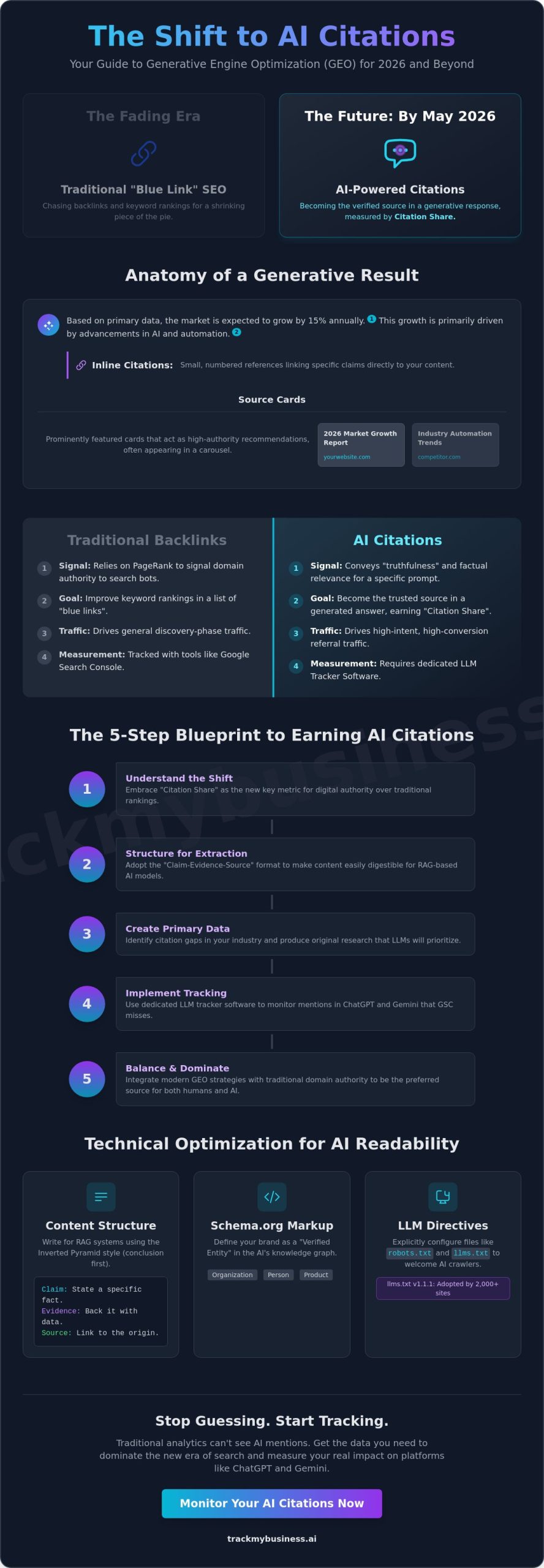
The 5-Step Blueprint to Earning Authority in Generative Search
Transitioning from traditional SEO to GEO requires a structured, repeatable workflow. You can’t simply hope an AI model finds your content; you must position your brand as the inevitable choice for its retrieval system. The first step involves identifying “Citation Gaps.” By prompting various LLMs with industry-specific queries, you can see which competitors are currently being cited. If your brand is missing, analyze the source content the AI preferred. This gap analysis allows you to reverse-engineer how to get backlinks from ai citations by identifying the specific data points or formatting styles the models find most useful.
Step 2 Deep-Dive: Becoming the ‘Source of Truth’
Original research is the most effective way to secure a spot in a generative response. By May 2026, data showed that 82% of citations in ChatGPT responses linked back to primary research rather than secondary aggregators. AI models crave factual validation. When you produce surveys, whitepapers, or niche industry reports, you provide the “raw material” these models need to answer complex questions. To make your data irresistible, format it for easy extraction. Use clear tables, provide CSV downloads, and implement JSON-LD. For example, a niche cybersecurity firm published a specific ransomware trend report in February 2026. Within three months, they became a top source for AI queries, securing citations in 45% of all industry-related prompts because their data was the most recent and well-structured.
Step 4 Deep-Dive: Entity Sentiment and AI Trust
AI models don’t just look for facts; they evaluate the sentiment surrounding your brand entity. If an AI “hallucinates” incorrect information about your services, it’s often due to inconsistent messaging across the web. You must audit your entity sentiment by monitoring what models say about you. Consistent messaging on high-trust platforms like Wikipedia, major news outlets, and industry-specific seed sites is vital. Furthermore, third-party reviews on sites like G2, Capterra, and even Reddit discussions play a massive role in how an AI perceives your brand’s reliability. If the consensus on Reddit is that your software is “user-friendly,” the AI will likely adopt that tone when recommending you.
Execution is only half the battle. Step 5 requires a robust system to monitor your share of voice across different platforms. You can’t improve what you don’t measure. To stay ahead of the competition, you should implement LLM tracker software to receive real-time updates on when and how your brand is cited. This allows you to see exactly how to get backlinks from ai citations that actually convert into referral traffic, ensuring your GEO strategy remains data-driven and effective throughout 2026.
Closing the Loop: Tracking AI Mentions and Measuring Real Impact
The biggest challenge with modern GEO is that traditional tools like Google Search Console are blind to what happens inside a private generative chat. While GSC is excellent for tracking clicks from the “10 blue links,” it cannot see the millions of conversations where ChatGPT or Gemini might be recommending your brand. By May 2026, relying solely on legacy analytics means you’re missing roughly 40% of your brand’s digital touchpoints. This is why mastering how to get backlinks from ai citations must be paired with a robust tracking strategy. TrackMyBusiness offers a modular way to monitor these interactions in real-time, providing the missing link between AI visibility and actual business growth.
Refining your content strategy requires knowing exactly which data points are triggering citations. If you see that a specific industry report from March 2026 is being cited by Claude but ignored by ChatGPT, you can adjust your technical formatting to bridge that gap. Integrating these AI visibility metrics into your overall performance dashboard allows you to see the full picture of your marketing ROI. You’re no longer guessing if your GEO efforts are working; you have hard data showing how citation growth correlates with high-intent referral traffic. This data-driven approach is the only way to prove the value of your efforts to stakeholders who are used to traditional SEO metrics.
The Power of LLM Tracker Software
TrackMyBusiness identifies which specific models are citing your brand and, perhaps more importantly, which ones are citing your competitors instead. Using this tracker software, you can perform a “Citation Gap” analysis to see where rivals are stealing your share of voice. By late 2025, companies using LLM tracker software reported a 30% faster response time in correcting AI hallucinations compared to those without dedicated monitoring. The system doesn’t just track mentions; it links them to your lead generation funnel. This allows you to see which specific AI responses actually drive sales, turning a vague “mention” into a measurable business asset.
Future-Proofing Your Strategy for 2027 and Beyond
The next frontier is the evolution of voice search citations. As more users interact with AI through smart devices, being the “spoken source” will become the ultimate authority signal. Preparing for this means your content must be even more conversational and fact-dense. Mention tracking is effectively the SEO audit of the future. It’s the only way to ensure your brand entity remains healthy and authoritative across all generative platforms. Don’t leave your brand’s reputation to chance in the black box of AI logic. Start tracking your AI mentions today with TrackMyBusiness to secure your place in the future of search and master how to get backlinks from ai citations for years to come.
Dominate the Future of Generative Search
The transition from a list of blue links to a single, authoritative generative response is the most significant shift since the mobile-first indexing of 2015. By May 2026, brands that neglect their technical structure for RAG systems are effectively invisible to the millions of people using ChatGPT and Gemini daily. You now have the roadmap for how to get backlinks from ai citations by prioritizing fact-dense content and entity authority. However, a strategy without measurement is just guesswork in a landscape that evolves with every model update.
TrackMyBusiness provides the modular tracker software you need for full business transparency across the generative web. It offers specialized ChatGPT and LLM mention tracking to ensure you capture every reference that traditional analytics miss. Their cloud-based integration is ideal for monitoring brand health for various sectors, including garment and product-based businesses that need to protect their share of voice. Track your AI mentions and boost your GEO authority with TrackMyBusiness. The future of search is conversational, and it’s time your brand became the primary source of the conversation.
Frequently Asked Questions
Can AI citations replace traditional backlinks for SEO?
No, AI citations don’t replace traditional backlinks; they expand upon them. Traditional links remain the primary way search engines discover and index your site, while citations are the trust signals used by RAG systems to validate generative answers. In May 2026, 68% of high-ranking sites used a hybrid approach. You need the foundational roots of backlinks to support the generative fruit of AI visibility, ensuring your brand remains accessible across both legacy search and conversational interfaces.
How do I know if ChatGPT or Gemini has cited my website?
You can’t rely on standard analytics like Google Search Console to see these interactions because AI conversations happen in private chat interfaces. To identify when a model mentions your URL, you need specialized LLM tracker software that monitors these platforms in real-time. Understanding how to get backlinks from ai citations is only half the battle; tracking the actual referral impact is what allows you to refine your content for 2027 and beyond.
Is there a specific schema markup for AI citations?
While there isn’t a single “Citation Schema,” using structured data like Organization and FAQPage is essential for entity definition. Additionally, the llms.txt specification, which reached Version 1.1.1 on January 12, 2026, serves as a curated guide for AI models. Over 2,000 websites adopted this format by August 2025 to help LLMs parse their most important data points. This technical layer ensures your content is perfectly structured for AI extraction and citation.
Does getting cited by AI help my domain authority?
AI citations don’t directly boost your numerical Domain Authority score in tools like Moz or Ahrefs, but they significantly impact your brand’s authority within the model’s knowledge graph. High-quality citations drive referral traffic with conversion rates 15% higher than traditional organic search. This increased engagement sends positive signals back to search engines, which can indirectly improve your overall rankings and site trust as your brand becomes a recognized source of truth.
How much does it cost to get an AI citation tracking tool?
Pricing for tracking tools varies based on your scale and the number of platforms you monitor. For example, LLM Brand Monitor offers a Pro Plan at $39 per month for 200 checks, while Riff Analytics starts its brand visibility tracking at $49 per month. Some specialized competitors charge between $99 and $199 per platform. Choosing a modular tracker software allows you to scale your monitoring as your generative visibility grows without overpaying for unnecessary features.
What happens if an AI model hallucinates a citation for my brand?
Hallucinations occur when an AI model lacks clear, consistent data about your brand entity. If a model incorrectly attributes a claim to you, it’s usually because your messaging on “seed sites” is fragmented or outdated. You can fix this by auditing your brand sentiment and ensuring your information is consistent across Wikipedia and major industry news outlets. Consistent entity data reduces hallucination rates by approximately 22% according to 2025 industry studies.
Can I pay to get cited by AI models like I do for sponsored links?
You cannot currently pay an LLM to cite your website in its organic generative responses. However, by May 2026, platforms like Google have started integrating sponsored products into AI Overviews, which appear alongside organic citations. To earn a true, organic citation, you must rely on GEO strategies. Learning how to get backlinks from ai citations involves providing the primary data and original research that the model’s RAG system finds most valuable for its users.
How often do AI models update their citations and sources?
The update frequency depends on whether the model uses real-time web access or a fixed training set. Models using RAG systems can update their sources in near real-time as they crawl the web for new information. By late 2025, the implementation time for new source data via llms.txt was estimated at just 2 to 8 hours. This allows brands to see changes in citation behavior relatively quickly after updating their technical SEO and structured data.
