
What if your biggest competitor is winning the majority of recommendations in ChatGPT while your brand remains invisible? I’ve developed a functional methodology for tracking competitor mentions in chatgpt because I understand the professional frustration of operating in a data vacuum. It’s difficult to build a strategy when you can’t see the specific queries users are making or why AI responses seem to shift from one day to the next.
I agree that the transition from search engines to answer engines feels like a black box. You likely feel the pressure to adapt but lack the visibility to justify your next move. This article provides the exact methodology I use for monitoring competitors in AI conversations and the strategic steps required to increase your brand’s share of voice. I’ve focused on a transparent, process-oriented approach that acknowledges current technical limitations while providing a proactive path forward.
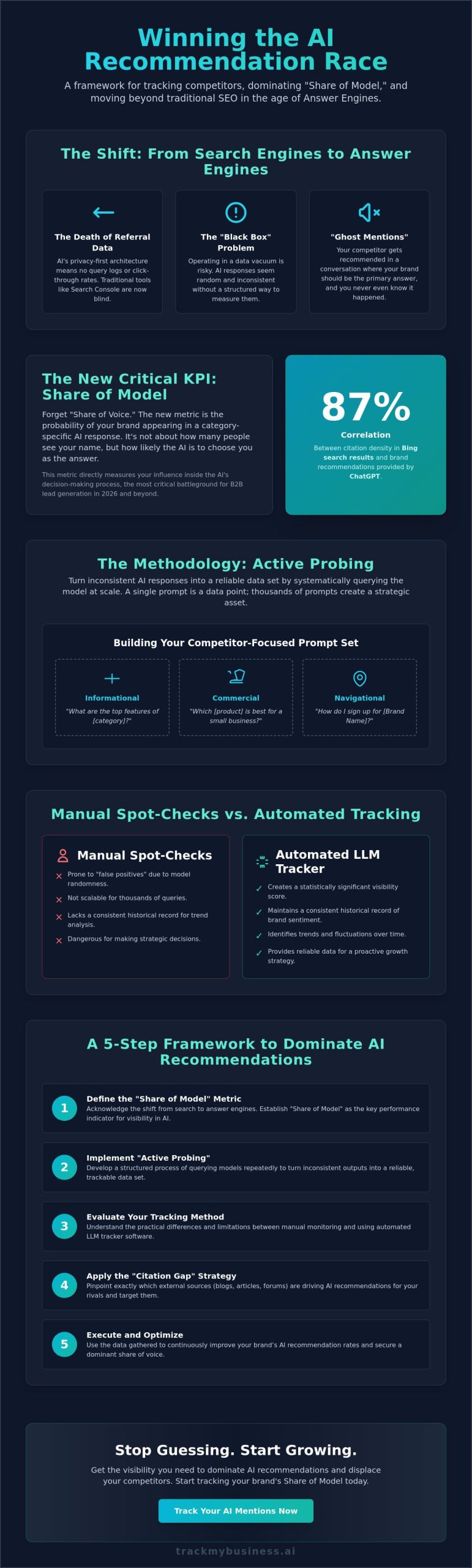
I’ll walk you through a repeatable process for measuring mentions and benchmarking your performance against global rivals. You’ll also learn a clear roadmap to improve your recommendation rates by leveraging the 87% correlation between Bing results and ChatGPT citations. By the end, you’ll have a functional framework to stop guessing and start growing your visibility in the GPT-5.5 era.
Key Takeaways
- Define the shift from “Search” to “Answer” engines and why I view “Share of Model” as the critical successor to traditional organic rankings.
- Implement the methodology of “Active Probing” to turn inconsistent AI responses into a reliable data set for tracking competitor mentions in chatgpt.
- Evaluate the practical differences between manual monitoring and using automated LLM tracker software to maintain a consistent historical record of brand sentiment.
- Apply the “Citation Gap” strategy to pinpoint exactly which external sources are driving AI recommendations for your rivals.
- Master a five-step optimization framework designed to improve your brand’s AI recommendation rates and secure a dominant share of voice.
Why Competitor Tracking in ChatGPT is the New SEO Frontier
The transition from traditional search to generative answer engines has fundamentally changed how I approach competitive intelligence. In 2026, traditional SEO tools have become effectively blind to the most influential conversations happening online. While we used to monitor keyword rankings and backlink profiles, those metrics don’t capture the synthesized recommendations generated by GPT-5.5. I’ve found that tracking competitor mentions in chatgpt is now the only way to see “Ghost Mentions.” These occur when a rival brand is recommended in a thread where your business should be the primary answer.
This shift is particularly complex in the Saudi Arabian market. LLM visibility there faces unique challenges due to the specific training weights assigned to regional dialects and the localized nature of data retrieval. If you aren’t actively probing how these models perceive your brand in specific geographic contexts, you’re likely losing market share to competitors who have optimized for these nuances. Relying on old data sources won’t help you understand why a competitor is suddenly the “preferred” recommendation in Riyadh or Jeddah.
The Death of the Search Console for AI
I’ve noticed that many marketers still wait for referral data that will never arrive. OpenAI’s privacy-first architecture means ChatGPT doesn’t provide query logs or click-through rates to external site owners. You can’t open a dashboard to see which prompts led users to your site. This lack of transparency makes manual spot-checking a dangerous game. It often leads to “false positives” because the model’s output is probabilistic. A single positive response on your personal laptop doesn’t represent the experience of a thousand other users.
The Business Impact of AI Recommendations
In the 2026 B2B buying cycle, AI recommendations act as a primary filter. If a procurement officer asks for the most reliable provider of LLM tracker software and your brand isn’t mentioned, you’ve lost the lead before the first human contact. Research from May 2026 indicates an 87% correlation between citation density in Bing and the recommendations provided by ChatGPT. This means that visibility isn’t just about being “known”; it’s about being cited by the sources the model trusts most.
Share of Model is the probability of a brand appearing in a category-specific AI response. It’s a shift from measuring how many people see your name to measuring how likely the AI is to choose you as the answer. Relying on traditional Share of Voice is no longer enough when the “voice” is now a synthesized, authoritative output from a model.
The Methodology of Active Probing: How to Monitor AI Mentions
I’ve found that effective monitoring requires a shift from passive observation to active probing. This involves simulating specific user behaviors to extract model data that isn’t publicly available through standard analytics. When I talk about tracking competitor mentions in chatgpt, I’m referring to a structured process of querying the model repeatedly to see how its recommendations fluctuate across different contexts. A single prompt is merely a data point; a set of 1,000 prompts is a strategic asset. This scale is necessary because of “Synthetic Sampling,” which allows me to create a statistically significant visibility score that accounts for the model’s inherent randomness.
Recent academic work on auditing brand preferences in LLMs highlights that these models often harbor subtle biases toward established market leaders based on their training sets. To counter this, my methodology focuses on data transparency. I prioritize showing the raw response data alongside synthesized scores so you can verify the logic behind every insight. This process-oriented approach ensures that the data gathering is functional and directly applicable to your marketing strategy.
Building Your Competitor-Focused Prompt Set
I categorize my prompt library into three distinct types to mirror the user journey:
- Informational: “What are the top features of [category]?”
- Commercial: “Which [product] is best for a small business?”
- Navigational: “How do I sign up for [Brand Name]?”
I also include regional modifiers, such as asking for the “best provider in Riyadh,” to test how local training weights affect regional visibility. The “Alternative To” strategy is another core component. By asking ChatGPT for alternatives to your own brand, you can identify exactly which competitors the model considers your direct peers in the current model iteration.
Executing Synthetic Sampling at Scale
Running these prompts once isn’t enough because model responses “drift” over time as background updates occur. I execute these prompt sets across different time intervals to capture these shifts and identify trends. Whether the model is GPT-4o or a newer iteration, I maintain the same prompt structure to ensure the data remains comparable. Consistency in prompt execution is more valuable than prompt volume. If you’re looking for a way to automate this process, I suggest exploring how TrackMyBusiness handles large-scale data gathering to remove the manual burden from your team.
Manual Spot-Checks vs. Automated LLM Tracker Software
I’ve noticed that most marketing teams begin their AI visibility journey by manually typing queries into a chat interface. It’s an intuitive starting point. However, I’ve learned that this approach carries a heavy hidden cost. Manual tracking is tethered to your personal account history and location, which skews the results. When I talk about tracking competitor mentions in chatgpt, I’m advocating for a data set that isn’t influenced by your own browsing habits. You need a neutral perspective to understand how the model behaves for the average user.
Automated LLM tracker software provides the objective baseline required for serious optimization. While a manual check might tell you if a competitor is mentioned once, it won’t tell you the sentiment of that mention or which specific websites the AI cited to form its answer. I find that source analysis is the most critical feature of automation. It allows you to see the “why” behind the recommendation. By identifying the exact third-party articles or reviews that power your competitor’s visibility, you can build a more effective counter-strategy. You’re moving from simple counting to functional competitive intelligence.
When Manual Checks are Sufficient
Manual checks have a specific, limited place in a functional strategy. If you’re a small, localized niche business with only one or two direct competitors, a daily “vibe check” might be enough to understand the narrative. I use manual prompts when I want to get a qualitative feel for how the model describes a brand’s personality. Don’t rely on the “incognito window” as a bypass for bias. In 2026, OpenAI’s architecture still considers your IP address and broader session metadata, meaning your “clean” search isn’t as neutral as you think. It’s a useful tool for a quick pulse check, but it’s not a foundation for a global strategy.
The Advantages of Professional LLM Tracking
I recommend professional tracker software for any business operating in a competitive category. The primary benefit is historical trend mapping. You need to see if your share of model is growing or shrinking over months to judge the success of your content strategy. Automation also enables precise competitor benchmarking. You can see exactly which 3-5 brands dominate your category across thousands of synthetic queries. This level of detail is impossible to achieve by hand. Finally, automated alerting is essential for managing brand attacks. If a model starts hallucinating negative information or a competitor’s negative PR campaign begins to influence AI outputs, you’ll know immediately rather than discovering it weeks later through a lost sale.
5 Steps to Increase Your Share of AI Voice and Displace Competitors
I’ve found that tracking competitor mentions in chatgpt is only half the battle. Once you’ve established your baseline data, you must shift from simple monitoring to active optimization. My process involves a “Citation Gap” strategy. I identify the specific high-authority domains that ChatGPT uses to formulate answers for my competitors. If a rival brand is consistently recommended, it’s usually because they’re cited on industry platforms or news sites that the model trusts. By securing mentions on those same sources, you can displace them in the model’s retrieval process. It’s a functional, direct way to reclaim your share of voice.
I also leverage Retrieval-Augmented Generation (RAG) principles to feed the model the most relevant information. RAG is how modern AI systems pull in fresh data from the web to answer user queries. If your content isn’t structured to be easily “retrieved,” you’ll remain invisible. I focus on making brand data as accessible as possible for AI bots by prioritizing clarity and technical structure over traditional keyword stuffing. This ensures that when the model looks for a solution, your brand is the most logical answer it finds.
Identify and Fill Content Gaps
I use tracking data to map out specific topics where competitors are mentioned but my brand is absent. In 2026, simply having the information on your site isn’t enough. It must be in an “LLM-friendly” format. This involves using highly structured data and clear, declarative sentences that AI bots can easily parse. I recommend updating your existing assets to improve their “crawlability.” Focus on answering the specific questions your tracking data shows users are asking within ChatGPT.
Strengthening Brand Association
I focus on “Association Strength” through targeted content clusters. AI models favor brands with high “Co-occurrence” with industry-standard terms. For businesses targeting the Saudi Arabian market, building authority in regional hubs is essential. I’ve seen brands win local intent by ensuring their name co-occurs with terms like “Vision 2030” or specific industry developments in Riyadh. I also use “Cloze Testing” to measure this. I prompt the AI to finish a sentence about a category to see if my brand is the natural completion it suggests.
Monitoring the “Narrative Drift”
Finally, I watch for “Narrative Drift” to ensure the AI’s description of my brand remains accurate. LLMs can develop misconceptions based on outdated training data or negative third-party mentions. By tracking these shifts, I can use PR and strategic content updates to stabilize my reputation. This allows me to correct misconceptions before they become part of the model’s permanent narrative. If you’re ready to start this process, you can sign up for our LLM tracker software to get the data you need to execute these steps.
Monitoring Brand Mentions with TrackMyBusiness LLM Tracking
I realized early on that tracking competitor mentions in chatgpt shouldn’t happen in a vacuum. If you see a spike in AI recommendations for a specific product category, your supply chain needs to know about it before the orders start pouring in. This is why our LLM tracker software integrates directly with the core TrackMyBusiness “Tracker” platform. We built this specific functionality because we needed to see our own blind spots. I wanted to move past the uncertainty of manual checks and create a system that connects digital visibility to physical operational data in a way that’s actually useful for a business owner.
Our commitment to transparent data gathering means I don’t just give you a score. I show you the functional methodology behind the information we gather. This is particularly vital for Saudi Arabian businesses looking to dominate their local AI landscape. The regional nuances in how LLMs retrieve data for Riyadh or Jeddah require a tracker that understands localized intent. By using our software, you can ensure your brand is correctly represented in the high-authority domains that AI models prioritize for regional queries.
The Power of Integrated Data
I find that tracking mentions is most effective when it’s tied to your order and inventory management. When I use our software to monitor brand mentions, I’m looking for more than just a name in a text block. I’m looking for predictive signals. If tracking competitor mentions in chatgpt reveals that a rival’s visibility is rising, you can use that data to predict shifts in production demand. This integrated approach ensures that your marketing strategy isn’t just a list of keywords, but a functional driver for business efficiency. It allows you to align your stock levels with the “Share of Model” you’re actively building.
Getting Started with Your AI Audit
I’ve streamlined the onboarding process for the TrackMyBusiness “Tracker” system to be as direct as possible. We start by defining your specific industry parameters and identifying the key rivals you need to monitor. From there, I generate a custom LLM tracking report that highlights your current share of model and identifies the citation gaps we discussed in previous sections. This audit provides the functional baseline you need to begin your optimization journey without the guesswork. If you’re ready to move from invisibility to authority, you can Schedule your AI Visibility Audit with TrackMyBusiness today.
Own Your Narrative in the Generative Future
I’ve outlined why traditional SEO tools no longer suffice for the 2026 landscape. We’ve looked at how active probing and synthetic sampling provide the only reliable data for tracking competitor mentions in chatgpt. You now understand that visibility in the age of GPT-5.5 is a probabilistic game. It requires a functional strategy that targets specific citation sources and regional intent to ensure your brand isn’t left behind by the shift to answer engines.
My goal was to provide a transparent look at how our modular “Tracker” system bridges the gap between AI visibility and your core business operations. I’ve used our localized expertise in the Saudi Arabian market to build a methodology that prioritizes steady, process-oriented data gathering over guesswork. This approach allows you to move from being a passive observer to an active participant in how AI models perceive and recommend your brand to potential customers.
Start tracking your AI Share of Voice with Tracker Software
I’m confident that applying these steps will help you reclaim your share of model and secure your brand’s future. You have the methodology and the tools to succeed. It’s time to turn these insights into a lasting competitive advantage.
Frequently Asked Questions
Can I see the exact prompts users are typing into ChatGPT to find my brand?
No, you cannot access user-level query logs due to OpenAI’s privacy-first architecture. Unlike traditional search engines that provide referral data, ChatGPT does not share what individual users type. I recommend using active probing to simulate common user intents instead. By running thousands of synthetic queries through our LLM tracker software, I can help you understand the types of questions that trigger brand recommendations without compromising user privacy.
How often should I track competitor mentions in ChatGPT to get accurate data?
I suggest tracking competitor mentions in chatgpt at least once a week to account for model drift and background updates. AI responses are probabilistic and change as the model’s retrieval system indexes new data from the web. If you only check once a month, you’ll miss these subtle shifts. Regular monitoring allows me to identify whether a sudden drop in visibility is a temporary glitch or a long-term trend.
What is the difference between a brand mention and a source citation in AI?
A brand mention occurs when the model includes your company name in its generated response. A citation is the specific link or source the model provides as evidence for its answer. I’ve observed that citations are the primary drivers of mentions. If a model consistently cites a specific industry review site for your competitors, that site is likely the reason they’re winning the share of model.
Does my share of voice in ChatGPT affect my ranking in Google AI Overviews?
There is a strong indirect correlation between the two. While Google and OpenAI use different models, they both rely on high-authority third-party sources like Wikipedia and top-tier news outlets. If you improve your visibility in ChatGPT by securing citations on these platforms, you’ll likely see a corresponding improvement in Google AI Overviews. Both systems prioritize authoritative, cited data over simple keyword optimization on your own domain.
Why does ChatGPT recommend my competitor even though my website has better SEO?
ChatGPT doesn’t rank websites based on traditional technical SEO factors like meta descriptions or site speed. It prioritizes “Association Strength” and how often your brand co-occurs with industry-standard terms on trusted third-party sites. If your competitor has a higher citation density on the platforms ChatGPT uses for training and retrieval, the model will perceive them as more authoritative, even if your own website is technically superior.
Is there a specific tool for tracking LLM mentions in Saudi Arabia?
Yes, our LLM tracker software includes localized expertise specifically for the Saudi Arabian market. I’ve designed the system to account for regional training weights and local intent modifiers, such as queries focused on Riyadh or Jeddah. This allows me to provide functional data that reflects how users in the Kingdom interact with AI, rather than relying on generic global data sets that may ignore regional nuances.
How can I “force” ChatGPT to mention my brand more often?
You can’t force a specific output, but you can influence the model’s retrieval-augmented generation (RAG) process. I recommend focusing on the “Citation Gap” strategy I mentioned earlier. By earning mentions on the specific domains that ChatGPT already trusts for your competitors, you increase the probability of being selected as a relevant answer. It’s a process of making your brand the most logical choice for the model’s retrieval system.
What happens if ChatGPT says something negative about my business?
Negative responses are often the result of “hallucinations” or outdated third-party data. If I detect a negative shift through our tracker software, the first step is to identify the source of that information. Once we find the incorrect data on a cited website, you can take steps to correct it or update your own structured data. Proactive monitoring ensures you can address these misconceptions before they become part of the model’s permanent narrative.
