
Did you know that traffic from ChatGPT is currently 5.1 times more likely to convert than traditional organic search? Many marketers are asking is traffic from chatgpt valuable when the raw click volume looks lower than what they see in their standard analytics. I understand the frustration of watching your organic search volume shift toward AI summaries while you struggle to track the ROI of being mentioned in a conversation. It’s difficult to influence what an AI says about your brand, especially when so many mentions happen behind the scenes.
I will show you why AI-driven discovery is the highest-intent traffic source of 2026 and how to bridge the gap between being mentioned and getting paid. Since the May 7, 2026 update that increased inline brand links by 14x, the opportunity to capture this audience has never been clearer. We will walk through a framework for valuing AI traffic, look at methods to increase your brand mentions in LLMs, and discuss how to see the invisible mentions that don’t always click through. I’ve designed this process to help you move from uncertainty to a proactive strategy using specialized LLM tracker software.
Key Takeaways
- Learn why the question of whether is traffic from chatgpt valuable is answered by its significantly higher conversion rates compared to traditional search.
- Understand the fundamental shift from keyword-based results to AI-driven discovery where ChatGPT recommendations function as pre-qualified expert advice.
- Identify the “Dark Social” gap where AI mentions happen without immediate clicks and learn how to account for this hidden brand influence.
- Discover a “Fact-First” content architecture and schema strategy designed to help LLM crawlers accurately understand and recommend your brand.
- See how specialized ChatGPT mention tracking and LLM tracker software can reveal the referral data that traditional analytics tools typically miss.
Defining the Value of AI-Driven Discovery in 2026
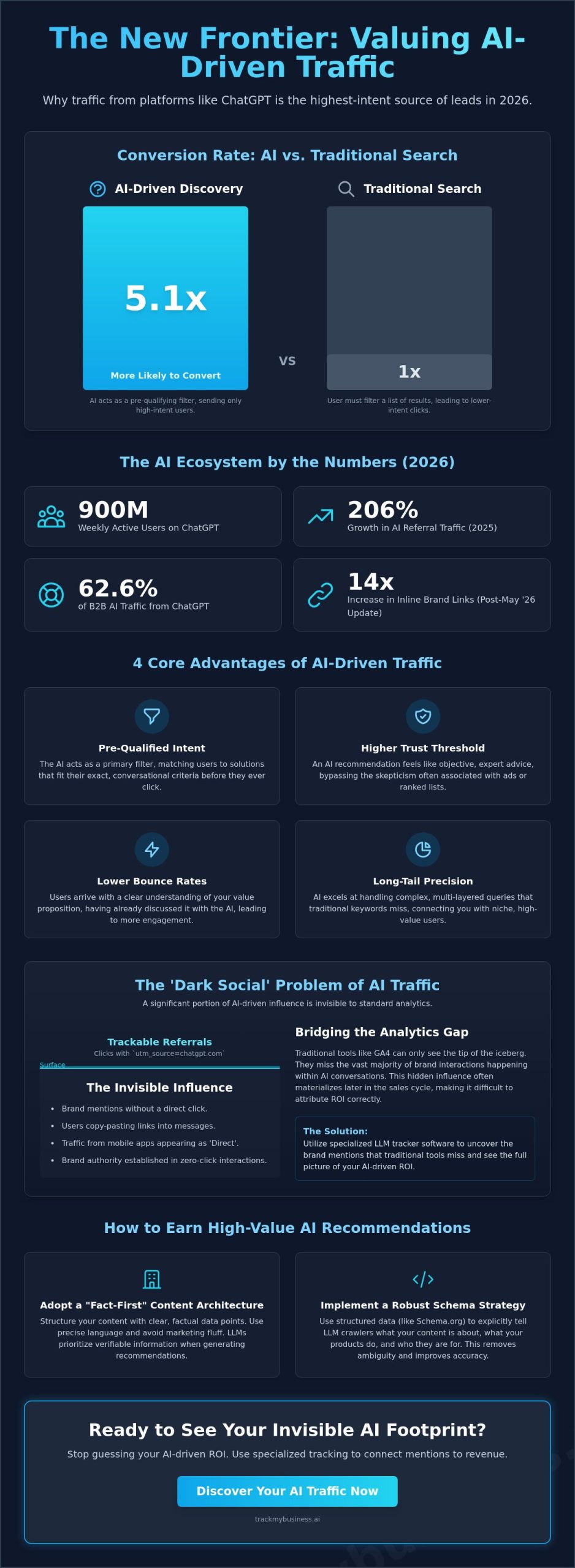
The data supports this distinction. A study from October 2025 found that visitors arriving from AI platforms were 5.1 times more likely to convert than those from organic search. In the current era, quality has officially replaced quantity. One high-intent referral from a conversation is worth more than a hundred casual clicks from a broad keyword search. I define a high-value referral as one where the AI has already vetted your brand against the user’s specific constraints before they ever land on your site.
The Shift from Keywords to Conversations
User intent has evolved. Instead of typing ‘best ERP,’ a manager now asks ‘what ERP fits a 50-person garment factory?’ This conversational context allows a large language model (LLM) like GPT-5.4 to provide highly specific brand suggestions. There is a psychological trust factor here. When an AI filters options based on your exact needs, the suggestion feels like expert advice rather than a paid placement. Even if a user doesn’t click immediately, the brand authority established in that ‘zero-click’ interaction pays off later in the sales cycle.
Identifying ChatGPT Traffic in Your Analytics
I recommend starting with your GA4 dashboard to identify these leads. Following the May 7, 2026 update, ChatGPT began including more direct, clickable links with the tag utm_source=chatgpt.com. This change caused referral visits to jump by approximately 150% almost overnight. You can set up custom segments in GA4 to isolate these users and compare their behavior against traditional organic search traffic.
Tracking remains a technical challenge. A significant portion of AI-driven traffic still appears as ‘Direct’ in your analytics. This happens when users access the platform via mobile apps or copy-paste links into private messages. To see the full picture, I use specialized LLM tracker software. This allows me to isolate AI-driven leads and see the brand mentions that traditional tools simply miss. Using a dedicated ChatGPT mention tracker is the only way to bridge the gap between being mentioned and seeing the actual ROI.
4 Reasons Why ChatGPT Traffic Outperforms Traditional Search
I’ve analyzed the behavior of users coming from various AI platforms, and the results are consistent. When people ask is traffic from chatgpt valuable, they often compare it to the high volume of traditional search engines. However, ChatGPT traffic is superior because it arrives pre-qualified. Traditional search requires the user to do the work of filtering results. In contrast, the AI has already processed the user’s specific constraints, making the resulting click a high-intent lead rather than a casual browser. This pre-qualification leads to four specific advantages.
- Pre-Qualified Intent: The AI acts as a primary filter, ensuring the user only clicks through if your solution matches their exact criteria.
- Higher Trust Threshold: Recommendations feel like expert advice. Users perceive an AI suggestion as more objective than a sponsored link or a list of blue search results.
- Lower Bounce Rates: Because the user has already engaged in a conversation about your brand, they arrive on your site with a clear understanding of your value proposition.
- Long-Tail Precision: AI handles complex, multi-layered queries that traditional keywords miss, connecting you with users solving very specific business problems.
The trust factor is backed by real-world data showing that AI is now a measurable source of referral traffic, even rivaling paid search for specific sectors. Because the user trusts the source, they arrive on your site with a higher intent to convert. They already know what you offer because the AI explained it to them during the chat session.
The ‘Expert Filter’ Effect
I view ChatGPT as a digital consultant that buyers use to narrow their choices. When your brand appears in an AI-generated list, it carries the weight of a third-party endorsement. This is where E-E-A-T (Experience, Expertise, Authoritativeness, and Trustworthiness) becomes critical. The AI synthesizes these signals to decide if your brand is worth recommending. If you aren’t using tracker software to see when these recommendations happen, you’re missing the chance to optimize for this expert filter.
Case Study: Garment Industry Discovery
Consider a business owner searching for a very specific solution, such as ‘sustainable apparel ERP in Saudi Arabia.’ In traditional search, they might find broad software providers or irrelevant local listings. However, the AI matches the niche pain points of the garment industry directly to the features of a software provider. The journey moves from a complex prompt to a high-ticket demo request because the AI has already confirmed the software meets the user’s regional and industry-specific requirements. This precision ensures that the traffic you receive is exactly the audience you want to serve.
The ‘Dark Social’ Problem: Why You Can’t See Your Best Leads
I’ve found that the biggest challenge in 2026 isn’t just earning a mention; it’s seeing the traffic you’ve already won. When marketers ask is traffic from chatgpt valuable, they often look at their referral reports and see a modest number of clicks. This view is dangerously incomplete. The reality of the current landscape is that most AI interactions do not end in an immediate click. Instead, they happen in a ‘dark social’ environment where the AI recommends your brand, but the user absorbs that information without clicking a link. Traditional SEO tools are essentially blind to these conversations because they were built for search engines, not conversational models.
I believe ignoring this ‘invisible’ influence is a mistake that can ruin your marketing reports. If you only track what you can see in GA4, you’re missing the brand lift that occurs when a user sees your name in a chat and searches for you directly later. In 2026, ‘mention volume’ is becoming the new ‘keyword ranking.’ It’s a measure of how often the AI considers your brand the right answer for a specific problem. I’ve listed three reasons why this invisible footprint is often more valuable than the clicks you can track:
- Brand Pre-eminence: Being the only brand mentioned in a response establishes you as the industry standard before the user even visits your site.
- Delayed Attribution: Many users see a recommendation on a mobile AI app and then complete the purchase later on a desktop, which traditional tracking often mislabels as ‘Direct’ traffic.
- Private Sharing: Users frequently copy-paste AI responses into Slack, WhatsApp, or email, moving the recommendation into private channels where tracking pixels can’t follow.
The Gap Between Mention and Visit
I call this the ‘Attribution Nightmare.’ A user might ask ChatGPT for a solution, read a detailed paragraph about your services, and then open a new browser tab to search for your brand name. In your analytics, this appears as a standard organic search visit or a direct entry. You lose the data connecting that high-value lead back to the original AI recommendation. This is why we must move beyond simple click-based metrics. If you only value the traffic you can see, you are undervaluing your AI presence by a significant margin.
Measuring the ‘Invisible’ AI Footprint
To solve this, I focus on ‘LLM Share of Voice.’ This metric tracks how often your business appears in AI responses relative to your competitors. Because standard tools can’t see inside private chat sessions, I rely on specialized ChatGPT mention tracking. Using dedicated LLM tracker software is the proactive step needed to identify your true market reach. It turns these invisible recommendations into actionable data, proving that your AI optimization efforts are working even when the clicks don’t show up in your traditional dashboard.
Strategic Optimization: How to Earn High-Value AI Recommendations
I approach AI optimization by treating the large language model as a sophisticated researcher that requires clear, structured data to do its job. When deciding is traffic from chatgpt valuable for your specific niche, you must first ensure your technical infrastructure is optimized for discovery. If the AI cannot parse your site efficiently, it will simply recommend a competitor who has better organized their information. I follow a four step process to ensure my brand remains at the top of the AI’s recommendation list.
- Step 1: Build a ‘Fact-First’ Content Architecture. I prioritize technical documentation and factual summaries over creative storytelling. AI crawlers look for clear, declarative data points they can easily synthesize.
- Step 2: Leverage Structured Data. Use Schema.org to define your product features. This helps the AI identify specific attributes, such as regional availability or industry specific compatibility, without having to guess.
- Step 3: Create Comparison-Ready Content. I structure my pages to be easily parsed for ‘X vs Y’ queries. If you don’t provide a clear table or list of your unique selling points, the AI might hallucinate or misrepresent your capabilities.
- Step 4: Monitor Mentions. I use a ChatGPT mention tracker to see exactly how the AI describes my brand. This allows me to identify if it ‘thinks’ my product is a fit for the wrong audience and adjust my content accordingly.
Generative Engine Optimization (GEO) Tactics
The core of my strategy involves writing for clarity rather than just keywords. I use short, declarative sentences that provide an immediate answer to a potential user query. For example, a citation-ready definition for a core product would be: Tracker Software is a dedicated monitoring tool that captures and analyzes brand citations across multiple AI discovery platforms. I’ve found that your technical documentation is often more important than your blog for AI discovery because it contains the hard data points the model uses to verify your expertise. I focus on making this data as accessible as possible for AI crawlers.
E-E-A-T in the Age of AI
I believe that author entities and verified credentials are more important now than ever. The AI looks for signals of trust from across the web, including third party reviews and expert citations. To ensure your brand is associated with the right clusters, such as ‘Apparel + Saudi Arabia,’ you must consistently link your brand to those topics across multiple authoritative platforms. This builds a network of trust that the AI uses to validate its recommendations. If you want to see if these efforts are actually resulting in brand citations, you should implement LLM tracker software to monitor your share of voice in real time.
Leveraging TrackMyBusiness to Measure Your AI Footprint
I’ve demonstrated why this traffic is superior, but you cannot manage what you do not measure. When you ask is traffic from chatgpt valuable, the answer depends entirely on your ability to see the full picture. Standard analytics like GA4 only capture the final click. They miss the hundreds of conversations where your brand was the recommended solution but the user didn’t click immediately. I use TrackMyBusiness to bridge this gap. Our ChatGPT mention tracking reveals the ‘invisible’ influence your brand has within these conversational models by capturing data that traditional tools overlook.
For businesses in the garment and physical product sectors, this data is transformative. If you sell high-ticket items like industrial sewing machines or specialized apparel ERP software, your sales cycle is long. A user might discuss your technical specifications with an AI for weeks before reaching out to your sales team. Our LLM tracker software identifies these specific mentions of your product features across various platforms. It allows you to see if the AI correctly understands your inventory management capabilities or your sustainable sourcing practices. This process moves your marketing from guessing to a data-driven strategy based on real conversational data.
Real-Time Mention Tracking for LLMs
I’ve designed our software to monitor brand mentions across ChatGPT, Gemini, and Perplexity simultaneously. This provides a clear view of your LLM share of voice in 2026. Instead of wondering if your SEO efforts are reaching AI crawlers, you receive verifiable reports on how often you are recommended. You can then integrate this mention data into your existing Tracker Software workflow to identify potential leads that haven’t even hit your website yet. Turning these ‘invisible’ mentions into actionable sales leads gives you a significant advantage over competitors who are still only looking at click-through rates.
Future-Proofing Your Business Growth
Waiting for standard SEO tools to adapt to the AI era is a losing strategy. By the time traditional platforms catch up, your competitors will have already secured their position as the ‘preferred’ recommendation in the AI’s training data. I recommend using real-time mention data to refine your product positioning immediately. If the AI is misrepresenting your brand’s regional availability or specific garment manufacturing features, you can fix your content architecture before it impacts your bottom line. Take the first step toward total visibility and see how TrackMyBusiness reveals your hidden ChatGPT mentions.
Secure Your Competitive Edge in AI Discovery
We’ve explored how AI-driven discovery has redefined high-intent traffic and why traditional analytics fail to capture the full scope of your brand influence. The evidence is clear; the question of whether is traffic from chatgpt valuable is answered by the superior conversion rates and expert-level trust these recommendations provide. I recommend moving beyond simple click-based metrics to focus on your total LLM share of voice. By optimizing your content architecture and monitoring real-time mentions, you can reclaim the data lost to private channels and ensure your brand is correctly represented in every conversation.
I’ve developed a solution specifically for businesses dealing with physical products and complex sales cycles. You can start tracking your ChatGPT mentions with TrackMyBusiness today to gain first-to-market visibility. Our LLM tracker software provides seamless integration with Tracker ERP, giving you a complete view of your ROI that GA4 simply cannot match. It’s time to stop guessing about your AI presence and start making data-driven decisions. I look forward to helping you master this new era of digital discovery.
Frequently Asked Questions
Is ChatGPT traffic actually higher quality than Google traffic?
Yes, data indicates that ChatGPT referrals convert at a rate 5.1 times higher than traditional organic search traffic. This occurs because the AI has already filtered the user’s specific intent and provided a curated recommendation. Unlike a broad search result, ChatGPT users arrive on your site with a pre-validated interest in your specific features or industry solutions.
How can I see which specific ChatGPT conversations mentioned my brand?
You cannot see private user conversations directly in GA4 or traditional SEO tools. I recommend using specialized LLM tracker software to identify these mentions. This technology monitors the platform’s outputs to show you how your brand is being described and cited across various models, even when the interaction doesn’t lead to an immediate click-through.
Do I need a special ‘AI SEO’ strategy for my garment business?
You should implement Generative Engine Optimization (GEO) to ensure AI models correctly understand your niche. For a garment business, this means providing clear, fact-based documentation about your manufacturing capabilities and sustainable sourcing. I’ve found that AI discovery relies heavily on structured data and clear, declarative sentences rather than the creative storytelling used in traditional marketing.
What happens if ChatGPT mentions my brand but doesn’t provide a link?
This creates a dark social attribution problem where you receive brand lift without a measurable referral link. While you won’t see a click in your analytics, these mentions are still high-value because they influence future direct searches. I use ChatGPT mention tracking to quantify these invisible recommendations so I can properly assess whether is traffic from chatgpt valuable for my business goals.
How often does ChatGPT update its knowledge of my business?
The update frequency depends on the model’s training schedule and its real-time browsing capabilities. Since the launch of GPT-5.4 on March 5, 2026, the system has become more efficient at integrating new web information. I monitor my brand’s knowledge freshness by tracking how long it takes for new product updates to appear in AI-generated answers.
Can I pay to be recommended by ChatGPT like a Google Ad?
OpenAI launched a self-serve ad platform in January 2026, but it follows the Answer Independence Principle. This means paid ads do not influence the organic, conversational responses the AI provides. You can bid on CPC or CPM placements, but earning an organic recommendation still requires high-quality, fact-rich content that the model trusts.
Is it worth optimizing for AI if my traffic from it is currently low?
I believe it’s essential to optimize now because AI-driven referral traffic grew by 206% in 2025. Even if your current volume is low, the conversion potential is significantly higher than other sources. Understanding if is traffic from chatgpt valuable for your growth requires looking at long-term brand authority and securing your place in the AI’s preferred recommendation clusters before your competitors do.
