
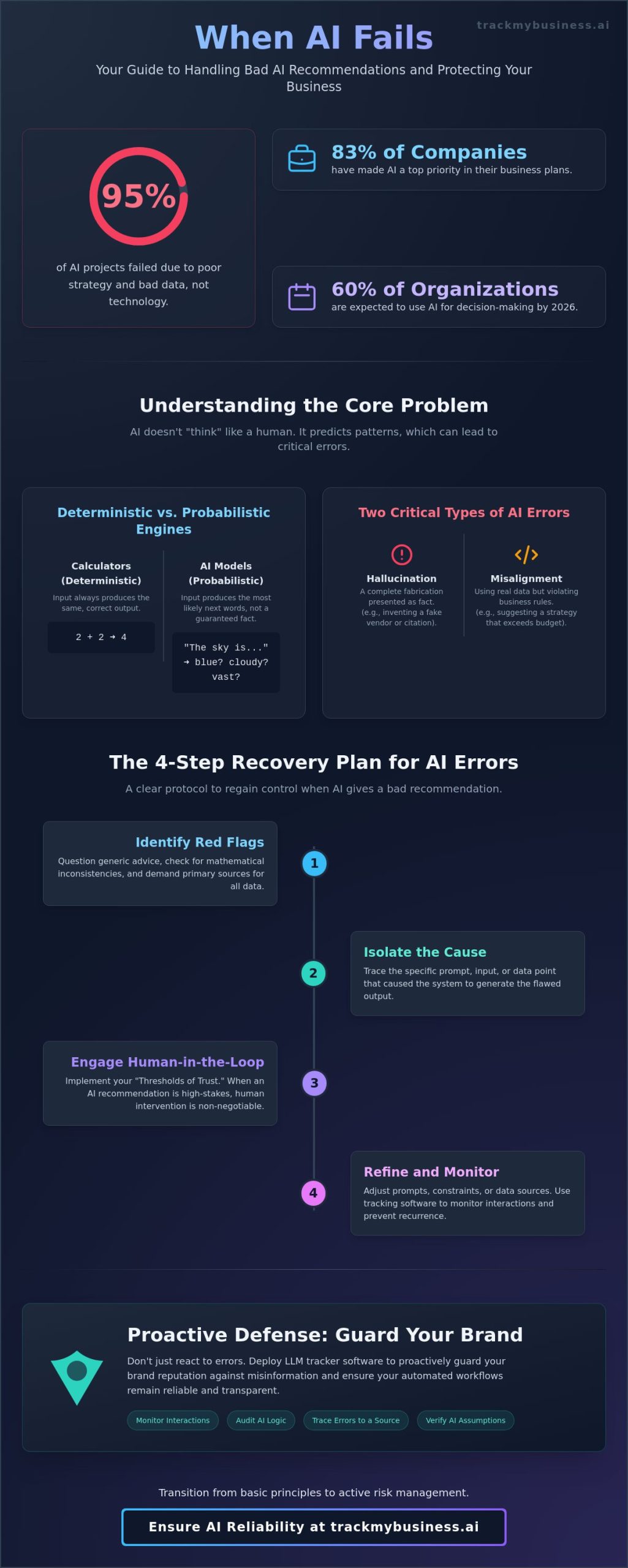
Up to 95% of AI projects failed in 2025 because of poor strategy and bad data rather than technological shortcomings. It’s a sobering reality for the 83% of companies that have made AI a top priority in their business plans. When you’re part of the 60% of organizations expected to use AI for decision-making by 2026, knowing what to do when ai gives a bad recommendation isn’t just a technical skill; it’s a critical survival requirement. I recognize the frustration of watching a tool meant for efficiency turn into a source of brand risk and wasted hours spent chasing confident-sounding lies.
You likely feel the pressure to innovate while fearing the moment an LLM presents a hallucination as a hard fact. I’m here to provide a clear protocol to help you regain control. I’ll show you the exact steps to identify these errors, correct them immediately, and build a Human-in-the-Loop safety net that actually works. We’ll explore how to transition from basic principles to active risk management by using LLM tracker software to ensure your automated workflows remain reliable and transparent. By the end of this guide, you’ll have the methodology needed to use AI as a precise tool rather than an unpredictable replacement.
Key Takeaways
- Learn to distinguish between probabilistic and deterministic outputs to identify hallucinations before they reach your customers.
- Master a clear recovery protocol that isolates errors and traces the specific prompt or input that caused the system to slip.
- Define your “Thresholds of Trust” to decide what to do when ai gives a bad recommendation and when human intervention is non-negotiable.
- Deploy LLM tracker software to proactively guard your brand reputation against misinformation generated by third-party AI models.
Understanding Why AI Recommendations Miss the Mark
I’ve observed that many business leaders approach AI as if it were a calculator. They expect a deterministic result where 2+2 always equals 4. In reality, Large Language Models (LLMs) are probabilistic engines. They don’t retrieve data from a static database; they predict the most likely next sequence of words based on patterns. This fundamental shift in how information is generated explains why knowing what to do when ai gives a bad recommendation is now a core operational requirement for any modern enterprise.
The most dangerous aspect of these systems is the “Confidence Trap.” An AI hallucination often carries the same authoritative tone as a verified fact. Because the model is designed to minimize the mathematical “loss” between its prediction and its training data, it will often manufacture a plausible answer rather than admit it lacks the information. In a 2026 business environment, where market conditions shift weekly, relying on models trained on 2025 data creates a massive gap between recommendation and reality. I see this most often when users ask for real-time market analysis from a model with a fixed knowledge cutoff.
The Difference Between Hallucinations and Misalignment
I categorize these errors into two distinct buckets to determine the next steps. A hallucination is a complete fabrication, like an AI inventing a vendor or a specific inventory number that doesn’t exist. Misalignment is subtler. The AI might use real data but suggest a strategy that violates your specific budget or safety constraints. Identifying the type of error is the first step in deciding what to do when ai gives a bad recommendation. A hallucination requires a data audit, while misalignment requires a change in how you structure your prompts.
Why ‘Yes-Man’ AI is Dangerous for Operations
LLMs are often fine-tuned to be helpful and agreeable. I’ve seen this lead to a “Yes-Man” effect where the AI reinforces a user’s flawed assumptions instead of challenging them. If a manager suggests an aggressive inventory increase, the AI might provide supporting logic simply because it’s programmed to be helpful. This creates dangerous echo chambers in procurement and sales. It’s one reason why I recommend using LLM tracker software to monitor these interactions. Without a record of how the AI is agreeing with your team, you’ll struggle to spot incorrect inventory forecasts before they impact your bottom line.
How to Spot a Bad AI Recommendation Before It Costs You
Identifying an error before it triggers a chain reaction is the best way to manage risk. I recommend implementing a “Source-First” rule for every output your team receives. If an LLM provides a statistic or a market trend, I don’t accept it until I see the primary source. This is especially vital when dealing with the Ethical Implications of Using Artificial Intelligence, as models have been documented generating entirely fabricated citations to support their logic.
I also suggest looking for “genericism” in the responses you get. If the advice sounds like it could apply to any company in any sector, the AI has likely ignored your specific business constraints. To catch these slips, cross-reference the AI logic against your internal records. Using comprehensive Tracker Software allows you to see if the AI’s assumptions align with your actual historical performance. If the numbers don’t match your internal data, you’ve found your first red flag.
Finally, I use a Logic Stress Test for any high-stakes suggestion. I ask the AI to explain its reasoning step-by-step. If the model stumbles or changes its answer when I question its premises, the initial recommendation was likely a probabilistic guess rather than a data-driven insight. This process helps you decide exactly what to do when ai gives a bad recommendation before that advice reaches your executive board or impacts your customers.
Red Flags in AI-Generated Business Strategy
Mathematical inconsistencies are the loudest warning signs in any automated report. I’ve seen models project revenue growth that exceeds total market capacity or suggest production counts that ignore machine downtime. I also watch for recommendations that bypass industry regulations or safety standards. If your internal software flags an outlier event, such as a supply chain delay, and the AI ignores it, the recommendation is compromised. These errors often stem from the model’s inability to process “black swan” events that fall outside its static training data.
The ‘Triangulation’ Method for Verification
I use a three-point check to verify any suggestion that involves significant capital. First, I compare the AI’s suggested inventory levels against historical ERP data to spot impossible growth curves. Second, I consult a differently-trained LLM for a second opinion. If GPT-4 and Claude 3.5 disagree on a strategy, it’s a clear signal on what to do when ai gives a bad recommendation: stop and verify. Finally, I ensure a subject matter expert performs a manual review of the logic before any decision is finalized.
The 4-Step Recovery Plan for AI Hallucinations
Once you’ve identified a hallucination, you must move quickly to contain the fallout. I’ve found that many teams make the mistake of simply ignoring the error and moving on. This approach is dangerous because it allows bad data to seep into your permanent business records. My methodology for what to do when ai gives a bad recommendation focuses on a structured recovery that cleanses your data pipeline and prevents a recurrence.
Step 1: Isolate the error. I immediately flag the incorrect output to ensure it isn’t used in any downstream reports or client communications. Step 2: Trace the ‘Data Lineage’. I look back at the specific prompt, uploaded documents, or API calls that led to the slip. I need to know if the model was working with outdated information or if the prompt was simply too ambiguous. Step 3: Correct the ‘Context Window’. I provide the AI with the verified facts it missed. This “re-anchors” the model to reality. Step 4: Document the failure. I record the incident in an internal process log. This allows me to use LLM tracker software to see if this is a one-time glitch or a pattern of failure for a specific model.
Isolating Contaminated Data
I prioritize purging bad recommendations from your production management systems before they cause automated cascading errors. If one incorrect inventory count enters your system, it can ruin ten subsequent supply chain reports. I flag the specific LLM session for a future audit and ensure that any staff member who viewed the output is notified of the correction. This prevents the “echo” of the error from persisting in your team’s decision-making process. Using tracker software during this stage helps me maintain a clear audit trail of what was removed and why.
Re-Prompting for Accuracy
I use three specific techniques to fix a model that has gone off the rails. First, I apply “Negative Constraints” by telling the AI exactly what data points to ignore or which phrases to avoid. Second, I use “Few-Shot” examples, where I provide the model with three or four instances of what a correct recommendation looks like. Finally, I employ the “Role-Play” technique. I command the AI to act as a cynical auditor whose only job is to find flaws in its previous response. This forced self-criticism often reveals the logic gaps that led to the initial mistake. Knowing what to do when ai gives a bad recommendation requires this level of proactive engagement to maintain the integrity of your automated workflows.
Building a ‘Human-in-the-Loop’ Safety Net for Your Workflow
I’ve learned that 100% automation is a myth, particularly in high-stakes industries like garment manufacturing. When a mistake in a material specification or a lead time calculation occurs, the financial impact is immediate. Relying solely on an AI for these decisions is a gamble I don’t recommend. Instead, I focus on building a “Human-in-the-Loop” system. This approach ensures that your team knows exactly what to do when ai gives a bad recommendation by making human verification a mandatory part of the workflow. It’s about creating a safety net where the AI suggests and the human decides.
I categorize every task by its potential for damage. This allows me to set “Thresholds of Trust.” For example, an AI-generated draft for an internal meeting might require only a 10% review. However, a procurement order for thousands of units requires 100% human oversight. By shifting your team’s role from “AI Users” to “AI Editors,” you create a culture of accountability. They aren’t just clicking buttons; they’re auditing logic against real-world constraints. This mindset is the most effective defense against the “Confidence Trap” discussed earlier.
Defining Your Audit Tiers
- Tier 1: Low-risk tasks. These include things like internal email drafts or basic scheduling. I use light review for tone and clarity.
- Tier 2: Medium-risk tasks. Inventory summaries or performance reports fall here. I require a data cross-check against current stock levels.
- Tier 3: High-risk tasks. Procurement orders or safety protocols are in this bucket. These must have a mandatory dual-signature from two human experts.
Using Tracker Software as the Ultimate Filter
I use centralized data to prevent AI from hallucinating based on fragmented information. AI hallucinations usually happen because the model is working with incomplete datasets. By integrating your ERP data into a “Single Source of Truth,” you create a closed-loop system. The AI is restricted to drawing insights from your verified database rather than making probabilistic guesses based on general training data. This real-time transparency in production management is the ultimate filter. To start building this level of oversight, you can implement LLM tracker software to monitor every recommendation against your actual records. It ensures that if you’re wondering what to do when ai gives a bad recommendation, your first step is simply checking the tracker to see where the model diverged from the facts.
Proactive Defense: Using LLM Tracking to Guard Your Brand
The risks I’ve discussed so far focus on internal errors, but a new threat is emerging outside your organization. You need to consider what happens when an AI gives other people bad recommendations about your business. If a prospective client asks an LLM for a supplier list and the model hallucinates a negative compliance report about you, your revenue suffers before you even get a chance to bid. Understanding what to do when ai gives a bad recommendation in this context requires a shift from reactive recovery to proactive brand defense.
I recommend implementing a system for ChatGPT mention tracking to identify these external hallucinations in real-time. By monitoring how models describe your services, you can spot misinformation before it becomes a consensus. When you find an error, you can’t just delete it from the model. Instead, you must influence the model’s future outputs by updating your structured data and public documentation. This ensures that the next time a model crawls your information, it has the verified facts needed to correct its previous mistakes. Moving to a proactive posture means you’re no longer just fixing errors; you’re managing your LLM reputation.
Why You Need to Track ChatGPT Mentions
More customers are using AI as their primary search and discovery tool for manufacturers. If an AI generates a false product feature or attributes a non-existent delay to your brand, that information can spread rapidly. LLM tracking is the SEO of the AI era. Without it, you’re essentially invisible to the logic models that are currently shaping market perceptions. By tracking these mentions, you can identify if a model is using outdated training data from 2024 to make claims about your 2026 operations.
How TrackMyBusiness Solves the AI Trust Gap
I’ve seen how integrating Tracker Software with LLM monitoring creates a complete safety net. For example, a customer in the garment industry recently used our LLM tracker software to audit their automated procurement summaries. They discovered the AI had hallucinated a fabric shortage based on a misunderstood email thread. Because they were using our integrated tools, they caught the procurement error before the order was dispatched to the factory floor. This level of oversight is exactly what to do when ai gives a bad recommendation to ensure your operations remain profitable. You can protect your business with Tracker’s LLM monitoring tools and gain the transparency needed to lead in an AI-driven market.
Securing Your Business Against AI Instability
I’ve outlined how to transition your operations from relying on probabilistic guesses to using deterministic, verified data. You now have a framework for establishing human-in-the-loop auditing tiers and using LLM tracker software to protect your brand from external hallucinations. By implementing these protocols, you’ll know exactly what to do when ai gives a bad recommendation before it impacts your production line or your reputation. My methodology focuses on transparency and process, ensuring that AI remains a helpful tool rather than a liability. It’s about moving from a state of reactive fear to one of proactive control.
Since 2020, I’ve provided cloud-based transparency specifically for the garment and decoration industries. My software integrates internal data with external LLM mention tracking to give you a complete picture of your business health. You don’t have to navigate these technical slips alone. I invite you to Request a demo of Tracker’s AI-ready inventory system to see how we bridge the trust gap. With the right systems in place, you can lead your industry with confidence and precision. You have the tools to build a more resilient, data-driven future.
Frequently Asked Questions
Can I trust AI for financial forecasting in 2026?
I don’t recommend trusting AI for financial forecasting without a human-in-the-loop and a verified data source. While 60% of organizations are expected to use AI for decision-making by 2026, these models are still probabilistic and can’t predict market shifts that fall outside their training data. I suggest using Tracker Software to cross-reference every AI projection against your actual ledger to ensure the numbers remain grounded in reality.
What is the fastest way to fix an AI hallucination in my report?
The fastest way to fix a hallucination is to isolate the incorrect data immediately and re-prompt the model using specific, corrected facts. I advise tracing the “Data Lineage” to determine if a vague prompt or a bad data upload caused the slip. Once you’ve identified the source of the error, you can provide the AI with a “Few-Shot” example of what the correct output should look like.
Is it possible to completely stop an AI from lying?
It’s currently impossible to completely stop an AI from generating false information because these models predict word sequences based on probability rather than factual truth. You can significantly lower the error rate by using LLM tracker software to monitor outputs and identify patterns of failure. However, knowing what to do when ai gives a bad recommendation will always require a human expert to perform a final logic check.
How do I know if an AI is giving me biased advice?
I identify bias by asking the AI to explain its reasoning step-by-step and comparing that logic against my own internal records. I look for “genericism” where the model provides a one-size-fits-all answer that ignores my specific business constraints. If the AI consistently suggests a strategy that favors a certain outcome despite your data suggesting otherwise, it’s likely reflecting a bias from its training set.
What are ‘negative prompts’ and how do they help with bad recommendations?
Negative prompts are instructions that tell an AI exactly what to avoid or exclude from its response. If you’re wondering what to do when ai gives a bad recommendation, you can use negative prompts like “do not use unverified third-party statistics” to narrow the model’s focus. This technique forces the model to stay within your safe data boundaries and reduces the likelihood of it inventing plausible but false information.
Should I fire an AI tool if it gives one bad recommendation?
I don’t suggest abandoning an AI tool after a single mistake, especially since up to 95% of AI project failures are linked to poor strategy rather than tech issues. Instead, I treat the error as a process failure and audit the data I provided to the model. If the tool continues to hallucinate after you’ve improved your prompts and data quality, then you should consider switching to a different LLM.
How does LLM mention tracking work for small businesses?
LLM mention tracking works by monitoring what different AI models say about your brand when prompted by potential customers or partners. For a small business, this is a proactive way to catch and correct “hallucinated” complaints or false product features before they damage your reputation. I use this software to ensure that the AI models talking about my business are using the most accurate and up-to-date information available.
