
Did you know that AI referral traffic now converts at 14.2 percent, which is five times higher than the 2.8 percent conversion rate of Google organic search? I have observed many brands lose significant visibility because they still focus on traditional links while 67 percent of shoppers use AI for product research. This shift makes perplexity ai brand monitoring an essential process for protecting your digital footprint. I recognize the frustration of seeing a competitor recommended as the top choice simply because they appear more frequently in the AI source graph.
I understand the challenge of tracking mentions that happen behind the closed doors of conversational interfaces. In this guide, I will explain how to monitor your brand citations and implement strategies to increase your recommendation share. You will learn how to use specialized LLM tracker software to build a clear dashboard of your mentions across the generative web. I will also outline the methodology for improving your authority within the datasets that power these engines. By the end of this article, you will have a proactive plan to ensure your brand is not just indexed, but actively cited by Perplexity AI.
Key Takeaways
- I explain how to shift your focus from traditional click-through rates to Recommendation Share and citation frequency.
- You will learn the mechanics of Retrieval-Augmented Generation (RAG) and how Perplexity selects sources from real-time web data.
- I provide a four-step strategy to identify and close citation gaps where competitors are currently being recommended over your brand.
- I detail how to implement perplexity ai brand monitoring using specialized tracker software to receive real-time alerts on your visibility.
- You will discover how to use LLM tracker software to audit your current AI presence and improve your authority in generative datasets.
Why Perplexity AI Brand Monitoring is Essential in 2026
I define perplexity ai brand monitoring as the systematic process of identifying where and how an AI model cites your brand as a source or recommends your services. In 2026, the digital environment has moved beyond simple rankings. We are seeing a transition from Click-Through Rate (CTR) to Recommendation Share. This metric measures the percentage of conversational prompts where an AI actively suggests your brand to a user. Traditional SEO tools often fail here because they track keyword positions rather than the complex sentiment and synthesis found in Large Language Models (LLMs).
If you rely solely on old-school tracking, you risk “AI exclusion.” This happens when your brand disappears from the conversational loop entirely. I have observed that even brands with high organic search rankings can be ignored by AI engines if their data isn’t structured for retrieval. This creates a visibility gap that can be difficult to close without a functional methodology for tracking AI mentions. Monitoring these interactions is the only way to ensure your brand remains a part of the AI-driven buyer journey.
The Shift from Search Engines to Answer Engines
Google has historically provided a list of links, but Perplexity AI focuses on delivering synthesized answers. Users no longer want to click through five different websites to find a solution. Instead, they use conversational prompts to get a direct answer. This trend has led many consumers to bypass websites entirely. If your brand isn’t part of that summary, you effectively don’t exist in that user’s journey. I have seen that capturing user intent in these conversations requires a deeper understanding of how AI models retrieve and present information. It’s not about being on page one anymore; it’s about being the answer.
The Business Impact of Being “Uncited”
The risk of being uncited is a significant threat to modern businesses. When a B2B procurement officer asks for the “best software for mention tracking,” and your brand is missing from the footnotes, you lose that lead before they even reach your site. Missing citations lead to a direct loss in the consideration phase of the marketing funnel. I believe brand monitoring is now a core part of business operational transparency. Without a clear view of your AI visibility, you cannot verify if the information being spread about your company is accurate or if competitors are dominating the “Best of” queries. I recommend using specialized LLM tracker software to monitor these interactions. This technology allows you to see exactly where your brand stands in the AI source graph, providing the data needed to adjust your strategy effectively.
How Perplexity Works: Understanding the Citation Mechanism
I find that understanding the technical foundation of this engine is the first step toward effective perplexity ai brand monitoring. Unlike ChatGPT, which primarily relies on its initial general knowledge training, Perplexity uses a process called Retrieval-Augmented Generation (RAG). This methodology allows the engine to browse the live web, identify relevant pages, and synthesize those findings into a single answer. It effectively acts as a bridge between a traditional search index and a generative model. By pulling real-time data, it ensures that answers are grounded in current facts rather than outdated training sets.
When I analyze how Perplexity determines brand authority, I look at the “Source Graph.” This is a map of how different websites and documents connect to support a specific claim. If multiple high-authority sites mention your brand in a specific context, the AI is more likely to cite you as a primary recommendation. Comprehensive brand monitoring requires looking beyond your own domains to see how the broader web validates your presence. It is a process-oriented approach where I track how third-party validation influences the final answer provided to the user.
Source Authority and Real-Time Indexing
Perplexity prioritizes real-time data, including recent news, product reviews, and official documentation. I have noticed a clear hierarchy in how it selects citations. Primary sources, such as your official website, are essential for factual accuracy. However, aggregator citations from third-party review sites or industry journals often carry more weight in commercial recommendations. I estimate that your own website accounts for only about 20 percent of your total visibility in AI answers. The remaining 80 percent depends on external mentions and how well those sources are indexed.
The Role of Prompt Context in Recommendations
The citation landscape shifts based on the context of the conversation. Follow-up questions can narrow the focus, often leading the AI to swap out general sources for more specific ones. Perplexity also uses “Prompt Clusters” to group related brand mentions. If a user asks about “marketing tools” and then “tracking mentions,” the engine looks for brands that appear in both contexts. When it encounters conflicting information, it typically favors the most recent or most frequently cited source. If you want to see how these clusters affect your visibility, I suggest using LLM tracker software to monitor your presence across different conversational paths. This data helps me identify where information is inconsistent so I can take proactive steps to correct the record.
Key Metrics for Tracking Your Brand in AI Search
I focus on four primary metrics to evaluate brand visibility within generative engines. These data points provide a functional methodology for tracking progress and identifying where a strategy needs adjustment. Monitoring these values is the core of effective perplexity ai brand monitoring because it moves beyond simple link counting into the territory of brand authority and influence. I track these metrics to understand not just if a brand is mentioned, but how it is perceived by the retrieval model.
- Recommendation Share: This is the percentage of category-specific prompts where the AI suggests your brand as a solution.
- Citation Frequency: I measure how often your specific URLs or official documents appear in the footnotes of a generated answer.
- Source Diversity: This tracks the number of unique, high-authority domains that cite your brand favorably across different queries.
- Sentiment Alignment: This metric evaluates whether the AI’s summary accurately reflects your current brand identity and value proposition.
In PCMag’s review of Perplexity, the platform’s strength in sourcing and transparency is clearly established. I use this transparency to my advantage by auditing every link the engine provides. If a brand isn’t appearing in the footnotes for commercial queries, it’s a clear signal that the underlying source graph doesn’t recognize the brand as a topical authority.
Measuring Recommendation Share
I baseline brand performance by testing non-branded queries. If I ask for the “best logistics software,” I calculate how often my brand appears compared to the competition. This “Share of Voice” for category prompts is essential for understanding market position. I also track regional recommendation variances. I’ve observed that an AI might recommend a brand in Riyadh or Jeddah but ignore it in other regions across Saudi Arabia based on the availability of local citations. Identifying these gaps allows me to propose proactive steps for localized content creation that resonates within the SA market.
Analyzing Citation Quality and Sentiment
I frequently encounter “Off-Message” citations where the AI uses outdated data or incorrect pricing from old press releases. To combat this, I score the authority of every site Perplexity uses to describe a brand. If a low-quality blog is the primary source for a product description, I know I need to secure mentions on higher-authority platforms. I define Sentiment Alignment as a key performance indicator that measures how closely the AI’s summary matches your actual brand value proposition. I use LLM tracker software to automate this sentiment analysis. This ensures that the AI isn’t just mentioning the brand, but is doing so in a way that supports current business goals.
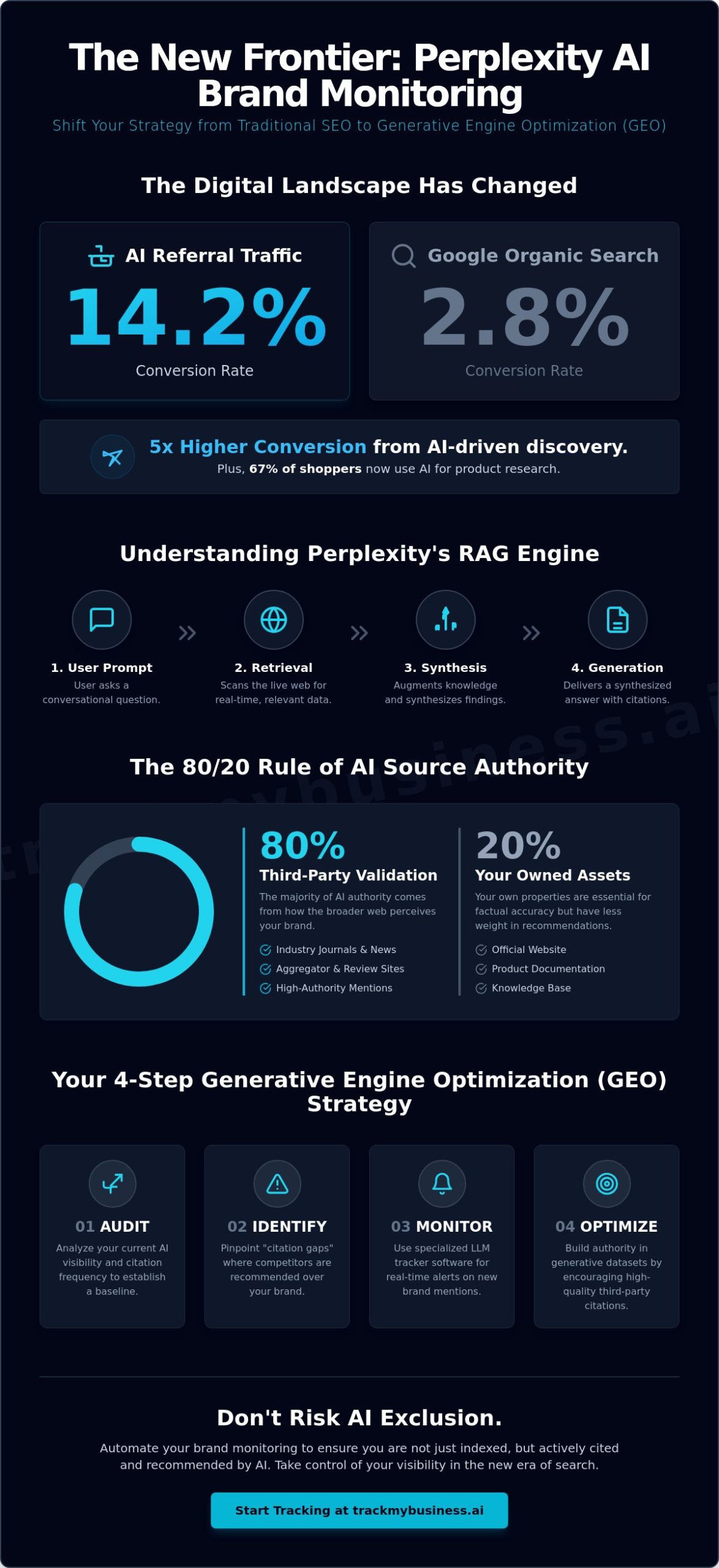
A 4-Step Strategy for Generative Engine Optimization (GEO)
I recommend a structured methodology for improving your presence in AI-generated answers. Since 47 percent of brands currently lack a GEO strategy, I see a significant opportunity for those who act early. I begin every optimization project with a comprehensive audit. I use my perplexity ai brand monitoring workflow to identify which queries currently trigger a brand mention and which do not. This initial data collection reveals the current state of your visibility and highlights the specific areas where competitors are outperforming you. I find that using a dedicated LLM tracker is the only way to get an accurate baseline in this conversational environment.
I follow a problem-solution structure to address these visibility gaps. If my audit shows that a brand is missing from commercial recommendations, I identify the cause as a lack of “Proof Blocks.” These are factual snippets that an AI uses to verify a claim. My next step is to execute a proactive plan to place these blocks on high-trust platforms that the AI indexer prioritizes. This process ensures that the engine has the necessary data to synthesize a favorable answer about your brand.
Closing the Citation Gap
I identify citation gaps by analyzing the footnotes of your competitors. If Perplexity consistently cites a specific technical journal or a professional community portal to describe a competitor’s features, I know I must secure a presence there. I focus on getting mentioned on third-party sites that Perplexity trusts, such as industry-specific wikis and reputable review aggregators. For B2B companies, I’ve found that technical documentation and white papers are essential. These documents provide the deep, structured data that AI models need to cite you as an authority in complex procurement queries. To see which sites are currently feeding the AI’s knowledge of your industry, you can use our tracker software to map the source graph.
On-Site Optimization for AI Parsing
I optimize on-site content by making it as easy as possible for a retrieval model to parse. I use clear, factual headers that directly answer “How” and “Why” prompts. I also implement Schema.org markup to provide a structured layer of data that sits behind the visible text. This helps the AI understand the relationship between your products and their specific benefits. I’ve observed that direct language improves LLM extraction by reducing ambiguity and providing clear, declarative statements that the model can easily synthesize. I avoid flowery marketing copy and instead focus on providing the raw information that the RAG process seeks during its real-time indexing phase.
Automating Your Brand Monitoring with TrackMyBusiness
I have observed that manual prompt testing is the primary bottleneck for brands trying to manage their AI visibility. Checking individual queries is a reactive approach that fails to capture the full scope of the conversational web. I propose a shift toward automated monitoring using our Tracker Software. This modular solution provides a direct connection to how AI engines perceive your brand across thousands of potential interactions. By implementing automated perplexity ai brand monitoring, you can move from guessing to knowing exactly where your citation share stands. This transition is essential for maintaining a competitive edge as the GEO market continues its projected growth toward 17.02 billion dollars by 2034.
Our ChatGPT mention tracking and Perplexity alerts work in tandem to provide real-time updates. When a new citation appears or a competitor gains ground in a specific prompt cluster, the system notifies you immediately. This speed is critical because 60 percent of global consumers now interact with AI at least weekly. If a model starts synthesizing incorrect data about your features, you need to know before that information influences a purchase decision. I see this as a necessary evolution of business intelligence rather than a simple marketing task. It allows you to protect your reputation in the datasets that matter most.
Operational Transparency through AI Tracking
I believe that AI tracking should not exist in a silo. When you use our Tracker to see what LLMs are saying about your products, you gain data that can inform your entire operation. If the AI frequently mentions a specific product feature that you are planning to phase out, you can adjust your strategy to highlight new innovations instead. This “Single Pane of Glass” approach allows you to see all brand mentions in one place. It helps you align your marketing decisions with the reality of how your brand is represented in generative answers. This level of transparency ensures that every department is working with the same set of facts, preventing the spread of outdated information.
Getting Started with LLM Tracker Software
I recommend starting your journey by setting up specific prompt clusters for monitoring. These clusters should include your most important commercial keywords and the names of your top competitors. Once the software begins collecting data, I look for patterns in the citation graph. If you notice that your brand is being excluded from “best of” lists, you can trace the missing link back to a specific source gap. Interpreting this data allows you to drive content updates that directly improve your authority. If you are ready to see how this methodology can protect your brand, you can request a demo of our LLM tracking module to explore the full capabilities of our software.
Securing Your Brand’s Future in the AI Source Graph
I have shown that the transition from blue links to synthesized answers requires a fundamental change in how we track brand authority. You now understand that your visibility depends on the Source Graph and the quality of external citations rather than just your own website’s performance. While manual checking is possible, it’s limited by the sheer scale of conversational data. I believe that focusing on Recommendation Share and closing citation gaps is the only way to ensure your brand stays within the conversational loop. I don’t want you to miss out on the high conversion rates that AI referrals provide.
Implementing a consistent workflow for perplexity ai brand monitoring is the proactive next step for any business looking to protect its reputation in 2026. I recommend using specialized LLM tracker software to automate this process and receive real-time citation alerts. Our platform offers a cloud-based modular ERP integration that connects your brand monitoring directly to your operational data. This methodology ensures you have the transparency needed to adjust your strategy as generative engines evolve.
Start tracking your brand mentions on Perplexity with TrackMyBusiness and take control of your AI visibility today. I am confident that these tools will help you build a stronger, more resilient digital presence.
Frequently Asked Questions
What is the difference between SEO and GEO?
SEO prioritizes ranking in a list of blue links, whereas GEO focuses on having your content synthesized into a direct AI answer. I view SEO as a way to capture traffic through clicks and GEO as a way to capture authority through citations. While SEO relies on keywords and backlinks, GEO requires structured data and factual “Proof Blocks” that an AI can easily retrieve and summarize for a user. This shift is fundamental for brands that don’t want to lose visibility in 2026.
Can I pay Perplexity to recommend my brand?
You cannot currently pay for specific brand recommendations within Perplexity’s generated answers. I’ve found that the engine relies on its RAG process to select the most relevant and authoritative sources available on the live web. To improve your visibility, you must focus on earning citations from high-trust platforms rather than looking for a traditional advertising or “pay-to-play” model within the conversational interface. It’s a merit-based system where the most credible data wins the citation.
How often does Perplexity update its source index?
Perplexity updates its source index in real-time using live web search capabilities. I’ve observed the engine citing news articles and press releases within minutes of their publication. This real-time indexing is a core part of its methodology, allowing it to provide more current information than models that rely solely on static training datasets. This speed makes frequent monitoring essential for brand accuracy because it ensures you’re always aware of what the AI is telling your potential customers.
Why is Perplexity citing my competitors instead of me?
Perplexity likely cites your competitors because they have more “Proof Blocks” on high-authority third-party websites. I see this as a sign that the AI’s Source Graph finds more corroborating evidence for their brand than yours. This often happens when competitors are mentioned more frequently in industry journals, review aggregators, or technical documentation that the AI uses to verify its generated responses. You’ll need to identify these gaps to start reclaiming your share of recommendations.
Do I need different strategies for Perplexity vs. ChatGPT?
You should use different strategies because these platforms retrieve information using distinct methods. I focus on real-time web optimization for Perplexity to capitalize on its live search features. For ChatGPT, I emphasize long-term brand sentiment and presence in foundational datasets. While Perplexity values recent news and verified links, ChatGPT often relies on broader authority established over a longer period across the digital landscape. It’s important to recognize that a single approach won’t work for every engine.
How can I track brand mentions in Perplexity automatically?
You can automate this process by using specialized LLM tracker software to monitor conversational prompts. I use this technology to implement perplexity ai brand monitoring at scale, setting up real-time alerts for specific brand citations. This methodology eliminates the need for manual testing and provides a consistent stream of data that you can use to inform your marketing and operational decisions. It’s the most efficient way to maintain a clear dashboard of your mentions across the generative web.
What are “Citation Gaps” and how do I find them?
Citation Gaps are specific areas in the AI’s knowledge where a competitor is mentioned but your brand is excluded. I find these by auditing the footnotes of category-specific queries like “best ERP software.” Once I identify which third-party sites are providing the data for your competitors, I can take proactive steps to secure your own mentions on those same authoritative platforms. This process is essential for closing the gap and ensuring your brand isn’t left out of the conversation.
Is brand monitoring on Perplexity worth it for small businesses?
Perplexity ai brand monitoring is extremely valuable for small businesses because AI referral traffic converts at a rate of 14.2 percent. I believe this high conversion rate makes it a cost-effective way to compete without the massive budget required for traditional SEO. Tracking your citations ensures that your small business remains visible when local customers use AI to research products and services in their area. It’s a powerful tool for leveling the playing field against larger competitors.
