
Did you know that 73% of millennials and Gen Z consumers now prefer AI-assisted research over traditional search engines? As of June 2026, ChatGPT has reached 900 million weekly active users, and AI-powered platforms influence over 40% of all consumer purchasing decisions. I recognize the challenge of implementing generative engine optimization for startups when click-through rates from Google are dropping and established brands dominate the search results. It’s difficult to scale when the criteria for how LLMs like GPT-5.4 or Claude 4.6 select their sources feels like a black box.
I’ve developed this guide to show you how GEO acts as the great equalizer. By focusing on unique information gain rather than legacy authority, you can get your brand recommended by ChatGPT, Claude, and Perplexity. I’ll provide a clear roadmap for content optimization and explain the methodology behind tracking your AI mentions. You’ll learn how to manage new transparency requirements, such as the EU AI Act, while building a presence that ensures your startup is the one AI models trust and cite.
Key Takeaways
- Understand why users are migrating from search engines to answer engines and how this shift redefines digital discovery.
- Learn a 5-step framework for generative engine optimization for startups that prioritizes information gain over traditional domain authority.
- Explore the mechanics of Retrieval-Augmented Generation (RAG) to understand how AI models pull and cite real-time data from your website.
- Identify how to balance your existing technical SEO foundation with new strategies that fill industry information gaps.
- Discover how to use LLM tracker software to move beyond guesswork and accurately measure your brand’s share of voice in AI responses.
What is Generative Engine Optimization (GEO) and Why Does it Matter in 2026?
I define What is Generative Engine Optimization (GEO) as the technical process of ensuring your startup’s content is the primary source retrieved and cited by Large Language Models. By June 2026, the digital environment has moved beyond the simple indexing of web pages. Users now expect direct, synthesized answers from models like GPT-5.4 or Claude 4.6 rather than a list of blue links. For many founders, generative engine optimization for startups is the only way to remain visible when AI-powered platforms influence over 40% of consumer purchasing decisions. Traditional SEO still matters for site health, but it’s no longer the primary driver of discovery for new brands.
I’ve observed that GEO levels the playing field in a way traditional search never did. A startup founded last month can outrank a billion-dollar legacy brand if its content provides more unique value to the AI’s retrieval system. I see this as a proactive opportunity for agile teams to bypass the years of backlink building usually required to compete in traditional search results. The goal is no longer just to be found; it’s to be the trusted source that the AI uses to build its response.
The Death of the ‘Ten Blue Links’
The era of scrolling through pages of search results is ending. Google AI Pro and Perplexity have turned “Position Zero” into the only answer that many users ever see. This shift has caused a significant decline in traditional click-through rates. When an AI provides a comprehensive summary of the best tools in your niche, users rarely click through to the tenth link on page one. I’ve found that conversational interfaces prioritize clarity. If your startup isn’t part of that single generated response, you’re effectively invisible to the 73% of younger consumers who prefer AI-assisted research.
GEO vs. SEO: Understanding the Core Differences
I’ve categorized the core differences below to help you prioritize your roadmap. Understanding these technical shifts is vital for resource allocation.
- Keywords vs. Context: LLMs don’t just look for keyword matches. They process intent and semantic meaning. They want to know if your content actually solves the user’s specific problem.
- Backlinks vs. Citations: While links still build domain authority, being quoted as a trusted source within an AI’s response is the new gold standard for generative engine optimization for startups.
- Content Length vs. Information Density: In 2026, fluff is fatal. AI models prioritize information density. They want the highest “information gain” per paragraph to satisfy the user’s query quickly.
The Mechanics of LLM Visibility: How AI Decides to Mention Your Startup
I’ve analyzed how models like GPT-5.4 and Claude 4.6 process information, and it comes down to a process called Retrieval-Augmented Generation (RAG). Unlike older models that relied solely on static training data, 2026 models pull live data from the web to ground their answers. This is the foundation of generative engine optimization for startups. If your site isn’t structured for these retrievers, you don’t exist in the AI’s “brain” during a query. The model essentially searches for the most relevant snippets of text, digests them, and then synthesizes a response that credits the source.
I’ve found that The Mechanics of LLM Visibility rely heavily on semantic density. Models convert your text into high-dimensional vectors, or embeddings. They look for how closely your content’s meaning aligns with the user’s intent. This is why writing for embeddings is different than writing for humans alone. You need to provide high-density information that provides a clear, unambiguous solution to a specific problem. If your content is too vague, the vector won’t align with the search query, and you’ll be left out of the answer.
The “Citation Loop” is another critical factor I monitor. When one model cites your startup, it often creates a ripple effect. Other models and scrapers see that citation, which reinforces your authority across the entire AI ecosystem. It becomes a self-fulfilling prophecy of brand authority. To see where you currently stand in this loop, you can use tracker software to monitor your brand’s presence in these generated summaries across different platforms.
Information Gain: The Startup’s Secret Weapon
I define information gain as the unique value your content adds beyond what is already available in the model’s training set. AI filters are now sophisticated enough to ignore “me-too” content. If you’re just summarizing what others have said, the RAG process will skip you. I’ve seen niche startups gain 40% more AI mentions simply by publishing original data or unique case studies that didn’t exist elsewhere. This original insight is your primary ranking factor in 2026 because it provides the AI with something new to tell the user.
Understanding the ‘Context Window’ and Retrieval
The context window is the limited amount of information an AI can “think about” at one time. To make the cut, your content must be easy to parse. I recommend using structured data like JSON-LD to help AI models identify your core offerings quickly. Freshness is also a major factor. In 2026, recent data often wins over legacy authority because it provides more relevant context for the user’s immediate needs. If your data is outdated, you’ll be replaced by a competitor with more current insights, regardless of how many backlinks you have.
SEO vs. GEO: Where Should Startups Invest Their Limited Resources?
I’ve encountered many founders who feel paralyzed by the choice between traditional search and AI discovery. I believe this is a false dichotomy. Technical SEO remains the essential foundation because if your site isn’t crawlable, the AI agents powering RAG cannot index your data. However, I suggest a significant pivot in how you allocate your content budget. While traditional SEO often chases high-volume, broad keywords, generative engine optimization for startups focuses on answering specific, high-intent questions. I’ve observed that seed-stage companies benefit most from a GEO-first approach. They often lack the domain authority to rank for broad terms on Google, but they can become the definitive source for highly specific technical queries in a ChatGPT response.
I’ve conducted cost-benefit analyses for various growth stages and found that Series A startups should maintain a 60/40 split between SEO and GEO. At this stage, you have enough authority to capture traditional traffic while building a moat in AI responses. For earlier seed-stage teams, I recommend a 30/70 split. Your goal is to own the “Information Gain” in your niche. By publishing original research or unique methodologies, you provide the “missing data” that LLMs are hungry for. I see this as a way to bypass the high cost of competing with established brands for legacy keywords that no longer drive the same click-through rates they did three years ago.
When to Prioritize GEO Over Traditional SEO
I recommend prioritizing GEO if you operate in “AI-first” niches like software development, complex B2B services, or research-heavy sectors. In these fields, users have already shifted their behavior toward conversational interfaces. I’ve noticed that traditional SEO is a losing battle in niches dominated by “Zero-Click” results where Google provides a summary that satisfies the user immediately. If your current analytics show a steady decline in CTR despite stable rankings, it’s a clear signal to shift resources toward AI visibility. I’ve found that being the cited source in a Perplexity answer often leads to higher quality leads than a generic page-one organic visit.
Tactics That Work for Both Channels
I’ve identified several strategies that provide a dual benefit for your growth roadmap. High-quality, long-form content that establishes E-E-A-T is vital for both Google’s ranking systems and an LLM’s retrieval system. I suggest following generative engine optimization best practices by using clear, hierarchical heading structures from H1 to H3. This helps crawlers understand your site architecture while providing AI models with the specific “hooks” they need to extract relevant snippets for their answers. I always emphasize that information density is the bridge between these two worlds. If you provide genuine expertise without unnecessary fluff, you’ll satisfy both the algorithm and the model.
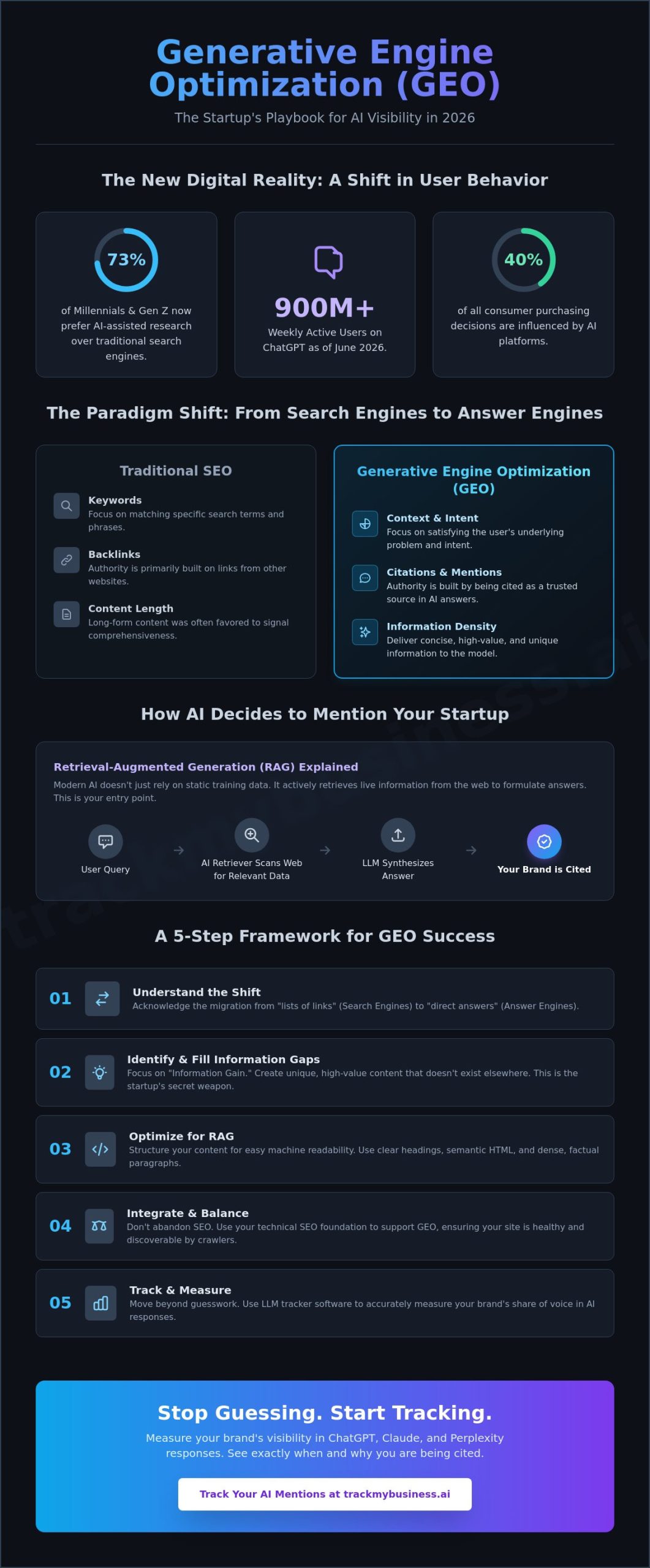
How to Implement GEO: A 5-Step Framework for Emerging Brands
I’ve developed this five-step methodology to help founders move from theoretical understanding to practical execution. Generative engine optimization for startups isn’t about gaming a system; it’s about making your brand the most logical choice for an AI to cite. I recommend following this process in sequence to build a foundation that scales as new models are released.
Step 1: Audit your current ‘LLM footprint.’ I start every project by asking ChatGPT, Claude, and Perplexity direct questions about the niche. If your startup doesn’t appear in these initial queries, you lack a presence in their retrieval context. You need to know your baseline before you can improve it. To simplify this process, you can use tracker software to monitor your brand’s share of voice across different models automatically.
Step 2: Finding Your Unique Information Angle
I’ve found that AI models struggle with “Information Gaps,” which are areas where public data is outdated or generic. I suggest using proprietary data from your startup’s operations to fill these holes. For instance, you could publish a report on anonymized user trends from the previous quarter. I recommend interviewing your internal experts to document insights that aren’t available elsewhere on the open web. I’ve seen great success by writing a single, punchy sentence that defines your category with a specific, citeable statistic. This becomes a “knowledge nugget” that models can easily ingest and attribute to you.
Step 3: Optimize for ‘Quotability.’ I define this as structuring your claims so they’re easy for an AI to extract. Use bold definitions and clear, factual claims. I advise you to avoid corporate jargon that obscures the underlying data. If a model can’t easily parse your main point, it will move on to a competitor’s site that is more direct.
Step 4: Building the ‘Citation Web’
AI models don’t just look at your website; they look for consensus across the digital ecosystem. In 2026, being mentioned on niche community forums and expert Q&A platforms is critical for GEO. These platforms act as high-signal sources for RAG systems because they represent human-verified expertise. I’ve observed that getting your startup into specialized industry software directories provides the necessary cross-reference that LLMs need to trust your brand. This helps you enter the “knowledge graph” of the AI models, making your brand a recognized entity rather than just a collection of keywords.
Step 5: Implement ‘Structured Context.’ Finally, I recommend using FAQ schemas and clear internal linking. This technical layer ensures that when an AI agent retrieves your page, it can accurately map your content to user questions. I’ve found that a well-structured site hierarchy is the best way to ensure your most important data is prioritized during the retrieval process.
Closing the Loop: Tracking ChatGPT Mentions and LLM Performance
I’ve seen many founders treat AI visibility as a “vibe” or a stroke of luck. I believe that’s a fundamental mistake. If you can’t measure your results, you can’t optimize your strategy. Generative engine optimization for startups is a technical challenge that requires a consistent data-driven feedback loop. Without a clear way to see if ChatGPT or Claude actually recommends your product when prompted, you’re essentially flying blind. I view measurement as the final, critical piece of the GEO framework that turns a content experiment into a predictable growth channel.
I focus on visibility as a technical problem rather than a marketing one. Traditional analytics tell you who visited your site, but they don’t tell you why an AI model chose to ignore your startup in a summary. I’ve found that using dedicated LLM tracker software is the only way to get a clear picture of your brand’s share of voice. This software allows you to move beyond manual prompting and provides a structured methodology for gathering mention data across multiple platforms simultaneously.
Key Metrics for GEO Success
I track three primary metrics to determine if a startup’s GEO strategy is actually moving the needle. I’ve listed them below to help you structure your reporting:
- Mention Frequency: I monitor how often your brand appears in specific prompt categories compared to your direct competitors. This shows your relative authority in the eyes of the model.
- Sentiment and Accuracy: I’ve observed that AI models sometimes hallucinate details about a startup. You need to know if the model is describing your features correctly or if it’s confusing your brand with a competitor.
- Citation Quality: I check which specific pages or third-party sources the LLM uses to ground its answer. This tells me which pieces of content are actually working as effective “knowledge nuggets.”
Using TrackMyBusiness for GEO Mastery
I recommend using TrackMyBusiness to automate the heavy lifting of ChatGPT mention tracking. It provides a centralized dashboard that monitors how different models interpret and recommend your startup’s data. By utilizing this tracker software, you can identify exactly which “Information Gaps” you’ve successfully filled and where the models still struggle to find your information. I’ve found that integrating this data into your core business operations allows you to refine your content strategy in real-time. This iterative approach ensures that your startup stays visible as models like GPT-5.4 or Gemini 3.1 Pro continue to evolve. Start tracking your AI mentions today with TrackMyBusiness.
Mastering the New Era of AI Discovery
I’ve outlined the technical shift from traditional search to generative answers. By focusing on information gain and structured data, you can bypass legacy authority and become the preferred source for LLMs. I believe that generative engine optimization for startups is no longer an optional experiment; it’s a necessary pillar for early-stage growth in 2026. The transition from “links” to “answers” requires a fundamental change in how you produce and structure your brand’s digital footprint.
I’ve found that the most successful founders treat AI visibility as a measurable technical problem. You need to move beyond manual testing and adopt a systematic approach to monitoring your share of voice. I recommend using specialized LLM tracker software to gain direct visibility into how models like ChatGPT and Claude perceive your brand. This methodology allows you to refine your content strategy based on actual citation data rather than assumptions. Track your startup’s mentions in ChatGPT and Claude with TrackMyBusiness to ensure your business operations are correctly reflected in AI responses. I’m confident that this process-oriented approach will help you secure a dominant position in the future of search.
Frequently Asked Questions
What is the difference between SEO and GEO for startups?
I define SEO as the process of ranking in a list of links, whereas GEO is the practice of becoming the synthesized answer provided by an AI. While SEO relies on domain authority and backlinks, GEO focuses on information density and how well your content answers specific user intent. I’ve found that startups can often bypass legacy competitors by providing the direct, technical answers that LLMs prioritize during retrieval.
How do I know if my startup is being mentioned by ChatGPT?
I recommend using specialized tracker software to monitor your brand’s presence across different models. Manual prompting is inconsistent and doesn’t provide a scalable view of your visibility. By using a dedicated tool like TrackMyBusiness, you can see exactly which queries trigger a mention of your startup and whether the AI is describing your product features accurately to potential customers.
Is GEO expensive to implement for a small team?
I’ve found that generative engine optimization for startups is remarkably affordable for lean teams. While specialized agency services can be a significant investment, you can manage the process internally using DIY tools that cost between $10 and $250 per month. This allows you to compete with established brands by focusing on the quality of your original data rather than the size of your marketing budget.
Which AI engines should startups optimize for first?
I suggest prioritizing ChatGPT and Perplexity. With ChatGPT reaching 900 million weekly active users as of February 2026, it is the primary platform for consumer discovery. Perplexity is equally vital because its retrieval-augmented generation (RAG) system specifically looks for real-time web citations. Optimizing for these two platforms ensures your startup is visible where the majority of generative searches occur.
Can GEO help my startup rank higher on Google Search too?
Yes, the technical improvements required for GEO naturally align with Google’s modern ranking signals. Clear heading structures, structured data, and high information density satisfy both AI retrievers and traditional search crawlers. I’ve observed that content designed to be “quotable” by an LLM often achieves high E-E-A-T scores, which helps maintain your visibility in traditional search results while you grow your AI presence.
What is ‘Information Gain’ and why is it important for AI?
Information Gain refers to the unique data or perspective your content provides that doesn’t exist in the AI’s current training set. I view this as the most important ranking factor for 2026. If you simply repeat what is already on the web, the AI has no reason to cite you. By publishing proprietary research or unique case studies, you provide the “new” information that the model needs to satisfy a user’s query.
Does social media impact my startup’s GEO performance?
Yes, niche community forums and specialized Q&A platforms are critical. I’ve observed that AI models use these environments to cross-reference your site’s claims with human discussion. By participating in expert forums, you build the consensus that LLMs require to verify your brand as a trusted authority. This external validation is a core component of the citation loop that reinforces your brand across the AI ecosystem.
How long does it take to see results from GEO optimization?
I’ve found that you can see shifts in AI mentions within just a few weeks. Unlike traditional SEO, which requires building long-term domain authority, generative engine optimization for startups relies on the immediate retrieval of relevant, high-density data. If you provide a clear answer to a common industry “information gap,” models like GPT-5.4 or Claude 4.6 can begin citing your content almost as soon as it is indexed.
