
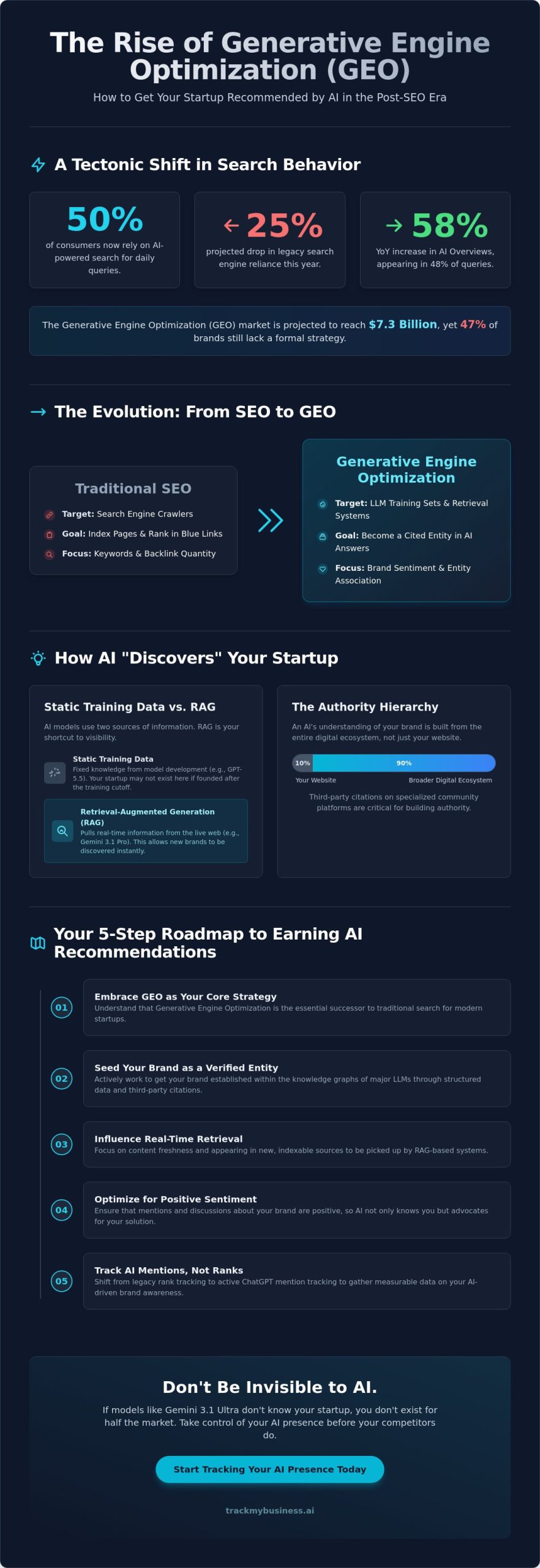
50% of consumers now use AI-powered search, which means the era of the blue link is effectively over. You’re likely asking how to get my startup mentioned by ai as you notice traditional organic traffic patterns shifting toward synthesized answers. I understand the frustration of feeling invisible to models like GPT-5.5 or Gemini 3.1 Ultra. It’s a common challenge in 2026, especially as the reliance on legacy search engines is projected to drop by 25% this year.
I’ve analyzed how these systems retrieve information and found that visibility is the result of a deliberate process called Authority Seeding. I acknowledge that we cannot directly force an LLM to change its internal weights; however, we can influence the retrieval nodes it uses for real-time answers. This guide provides the exact steps to influence Large Language Models so your startup is recommended by AI chatbots and search engines. I’ll break down the methodology behind structured data requirements, the importance of third-party citations on specialized community platforms, and how to maintain content freshness to ensure you stay relevant in a GEO market projected to reach $7.3 billion.
Key Takeaways
- Understand why Generative Engine Optimization (GEO) is now the essential successor to traditional search strategies for modern startups.
- Master the exact process for how to get my startup mentioned by ai by seeding your brand as a verified entity within the knowledge graphs of major LLMs.
- Learn how to influence real-time retrieval systems and authority nodes to ensure your product appears in AI-generated recommendations.
- Discover techniques to optimize for sentiment analysis so that chatbots don’t just know you exist, but actively advocate for your solution.
- Implement ChatGPT mention tracking to replace legacy rank tracking and provide measurable data on your brand’s AI-driven awareness.
The New Search Reality: Why AI Mentions are the Gatekeepers of 2026
I’ve watched the search environment transform rapidly over the last year. In June 2026, we’ve reached a point where 50% of consumers rely on AI-powered search for their daily queries. This isn’t just a trend; it’s a complete restructuring of the digital gatekeeper system. If you’re wondering how to get my startup mentioned by ai, you’re already ahead of the 47% of brands that still lack a formal strategy. The traditional list of ten blue links has been largely replaced by synthesized answers that provide immediate value without requiring a single click.
Traditional SEO focused on matching keywords to content. In contrast, Generative Engine Optimization (GEO) focuses on building an association between your brand and specific solutions within an LLM’s knowledge graph. Users now value these synthesized recommendations because they feel objective and data-driven. I’ve noticed that users are becoming increasingly skeptical of traditional search results. While a sponsored ad is a paid interruption, an AI mention is a perceived endorsement based on the model’s synthesis of the entire web. This shift requires a move away from keyword stuffing toward building genuine authority in your niche.
From SEO to GEO: What Has Changed?
I see GEO as the natural successor to traditional optimization. While SEO targeted crawlers to index pages, GEO targets the training sets and retrieval mechanisms of models like GPT-5.5 and Claude Opus 4.8. We’ve entered the era of the “Zero-Click” buyer journey. According to BrightEdge data from 2026, AI Overviews now appear in 48% of search queries, which is a 58% increase year-over-year. I focus on brand sentiment and entity association now, rather than just backlink quantity, as I refine my process for how to get my startup mentioned by ai in a competitive landscape.
The Cost of Being Invisible to AI
If a model like Gemini 3.1 Ultra doesn’t recognize your startup, you simply don’t exist for a massive segment of the market. These AI gatekeepers now influence everything from B2B procurement to individual consumer choices. I’ve seen startups lose significant market share because they were either excluded from AI summaries or suffered from “AI hallucinations” that categorized them incorrectly. This happens when the AI lacks enough structured data to understand what you actually do. In a market where traditional search reliance is dropping by 25%, your presence in the AI’s synthesized answer is your most valuable digital asset. It’s the difference between being a leader in your category or becoming a footnote in the history of the web.
Understanding the LLM Knowledge Graph: How AI Discovers Your Startup
I find that many founders treat Large Language Models as a “black box,” but the logic behind their recommendations is actually quite structured. To solve the problem of how to get my startup mentioned by ai, you have to understand the distinction between what a model “knows” from its initial training and what it “finds” through real-time search. A Knowledge Graph is a network of real-world entities and their interrelations used by AI to provide context. Research into Understanding the LLM Knowledge Graph shows that models calculate a “probability of relevance” every time a user asks for a recommendation. They look for “Entities,” which represents your startup, and “Nodes,” which are the specific categories or problems you solve. When these are closely linked in the data, the AI is more likely to cite you as a solution.
Static Training vs. RAG: Where Do You Fit In?
I categorize AI knowledge into two distinct buckets: static training data and Retrieval-Augmented Generation (RAG). Static data is fixed during the model’s development, such as the massive datasets used to build GPT-5.5. If your startup was founded after the training cutoff, you won’t exist in that model’s “memory” yet. However, newer systems like Gemini 3.1 Pro and Perplexity use RAG to pull information from the live web. This is your primary shortcut. You don’t have to wait for the next multi-billion dollar model update to be discovered. If you appear in fresh, indexable sources, RAG-based systems will find you immediately. I’ve observed that your own website typically accounts for only 10% of this puzzle; the rest comes from the broader digital ecosystem.
The Authority Hierarchy in AI Training
Not all sources carry the same weight in an AI’s decision-making process. Models prioritize information from Wikipedia, high-tier news outlets, and vertical-specific databases. They evaluate the “truthfulness” of a brand claim by looking for “Co-occurrence,” which is the frequency of your brand appearing next to established industry leaders in the same text. If your startup is consistently mentioned alongside top-tier competitors, the AI begins to associate you with that same level of authority. This clustering effect is a primary signal for how to get my startup mentioned by ai when a user asks for “the best” solution in your niche. I’ve found that monitoring these associations is the only way to know if your strategy is working. You can use LLM tracker software to see exactly how these models are categorizing your brand in real-time.
The 5-Step Roadmap to Earning AI Recommendations
I’ve organized the process of how to get my startup mentioned by ai into a specific, five-step roadmap. This sequence moves from foundational entity creation to sophisticated technical optimization and ongoing measurement. While traditional SEO often feels like a guessing game, GEO is a process-oriented discipline that relies on feeding the right data into the right nodes. I follow this chronological order to ensure no gaps exist in a brand’s digital footprint.
- Step 1: Entity Seeding. I begin by establishing the startup as a unique, defined entity. This involves creating consistent profiles across the most authoritative databases that LLMs use as ground truth.
- Step 2: Vertical Dominance. I focus on securing mentions within industry-specific authority nodes. If an AI is looking for “the best AI security tools,” it will check specialized aggregators before it checks your homepage.
- Step 3: Structured Data Optimization. I implement comprehensive Schema.org markup. This provides the AI with a machine-readable map of your products, founders, and organizational history.
- Step 4: Strategic Narrative PR. I build a consistent brand story across high-authority platforms. AI models prioritize consensus; if five different news sites describe your startup the same way, the AI will adopt that narrative.
- Step 5: Active Monitoring. I use LLM tracker software to measure the effectiveness of these steps. This allows for real-time adjustments based on how models like GPT-5.5 or Gemini 3.1 are currently citing the brand.
Seeding Your Entity in Authority Nodes
I’ve found that startups must look beyond their own domains to influence AI memory. Since most startups won’t have a Wikipedia page immediately, I target the “Wikipedia Alternatives” that AI models frequently crawl. This includes maintaining robust profiles on Crunchbase, LinkedIn, and specialized industry databases. I also prioritize getting mentioned on “Best [Niche] Software” lists. These lists act as high-weight nodes in an LLM’s knowledge graph. When I secure a spot on these aggregators, I am effectively teaching the AI that my startup belongs in that specific category.
Technical Optimization for AI Crawlers
My technical approach focuses on making the site as easy as possible for AI agents to parse. I implement advanced Schema for products and founders to ensure there is no ambiguity about who we are. I also check the robots.txt file to ensure that agents like GPTBot and OAI-SearchBot have full access to high-value content. I use natural language headings that mirror common user prompts. Instead of a vague heading like “Our Methodology,” I use “How our platform solves data encryption,” which directly aligns with how users ask questions. This increases the likelihood of the AI selecting that specific block of text for a RAG-based answer when I am working on how to get my startup mentioned by ai.
Optimizing for Sentiment: Ensuring AI Recommendations are Positive
I’ve discussed how to establish your brand as an entity, but visibility alone isn’t enough. If an AI knows your startup exists but doesn’t understand your value proposition, you risk falling into a “Neutral Hallucination.” This is where the AI mentions you but fails to provide a compelling reason for the user to choose you. I solve this by focusing on sentiment analysis, which is how LLMs evaluate the emotional tone and reliability of the data they retrieve. Models like GPT-5.5 don’t just look for your name; they look for the context of your success.
I often hear the objection that founders can’t control what an AI says. While it’s true that you don’t have a direct “edit” button on these models, you can influence the training and retrieval data. I recommend a process of sentiment correction. This involves flooding high-authority platforms with factual, positive case studies and technical deep-dives. By providing the AI with more “positive tokens” to ingest, you shift the probability of a favorable recommendation. This is a critical part of the strategy for how to get my startup mentioned by ai in a way that actually drives conversions.
The Power of Unprompted Social Proof
I prioritize community forums and industry-specific discussion boards because AI models treat them as authentic human signals. Natural language reviews that describe specific problem-solving scenarios carry more weight than generic testimonials. I encourage users of tracker software to share their specific workflow successes online. When these stories are indexed, they serve as high-weight sentiment signals that the AI uses to validate your brand’s effectiveness. You can start monitoring these sentiment shifts today with ChatGPT mention tracking.
Correcting AI Misconceptions
I also use direct feedback mechanisms within tools like Gemini 3.1 and ChatGPT to flag inaccuracies. If a model provides outdated or incorrect information about your startup, use the feedback feature to submit the correct data. Simultaneously, I update “About Us” and “FAQ” pages to explicitly answer the questions I see users asking AI chatbots. AI sentiment is a reflection of the collective digital consensus across third-party reviews and news. By aligning your owned content with the questions the AI is trying to answer, you provide a clear path for the model to correct its own misconceptions. This is a proactive step in my methodology for how to get my startup mentioned by ai with accuracy.
Closing the Loop: Tracking Your AI Presence to Refine Strategy
I’ve spent the previous sections detailing the methodology of influencing AI models, but the most significant hurdle founders face is measurement. Traditional rank tracking is essentially useless in this new environment because there’s no static list of results to monitor. In the click-based era, we tracked positions on a page. In the citation-based era, we must track the presence of our brand within synthesized answers. If you aren’t measuring your visibility, you can’t determine how to get my startup mentioned by ai effectively over the long term.
I rely on ChatGPT mention tracking as the essential KPI for 2026. This data allows me to identify which specific user prompts trigger a brand mention and which ones result in a competitor’s recommendation. By analyzing these mentions, I can see exactly where my “Entity Seeding” is succeeding and where the AI’s knowledge of my startup remains thin. I use this mention data to inform the next round of PR and content creation. If a model like GPT-5.5 consistently fails to mention my startup for a specific use case, I know I need to seed more authoritative data into the nodes associated with that problem.
The Metrics of the AI Era
I’ve shifted my focus to three primary metrics that define success in a GEO-driven market. These provide a much clearer picture of brand health than traditional organic traffic ever could.
- Share of Model (SoM): This is the AI version of “Share of Voice.” It measures the percentage of times an LLM recommends your startup when prompted with a relevant category or problem.
- Citation Frequency: I track how often AI models like Perplexity or Gemini 3.1 Pro link back to my domain as a primary source. This validates that the RAG systems view my content as a “ground truth” source.
- Prompt-to-Mention Ratio: This evaluates the efficiency of my content. It measures which specific user queries lead to a mention, helping me refine my natural language headings to match actual user intent.
Leveraging TrackMyBusiness for AI Dominance
I find that having a unified view of business performance is the only way to stay competitive. Our ChatGPT mention tracking tool provides a first-person view of your AI visibility, showing you exactly how models perceive your startup in real-time. By integrating this AI tracking with your existing Tracker Software, you create a unified business view that bridges the gap between traditional search and generative engines. This transparency allows you to move from guessing to executing with professional diligence. I invite you to start tracking your AI mentions with TrackMyBusiness today to ensure your startup remains a central part of the AI-driven conversation.
Mastering the AI-Driven Marketplace
I’ve detailed the fundamental shift from the blue-link era to a world governed by generative engines. Success in 2026 requires moving beyond traditional keywords toward building a robust entity within the LLM knowledge graph. I’ve outlined a methodology that prioritizes entity seeding and technical schema optimization to solve the challenge of how to get my startup mentioned by ai. By focusing on sentiment correction and authority nodes, you ensure that AI recommendations are both frequent and positive. It’s no longer about where you rank on a list, but how you’re synthesized into an answer.
Measurement is the final piece of this process. I recommend using specialized tools to gain transparency into how models like GPT-5.5 perceive your brand. Our LLM tracker software is designed specifically for high-growth startups and the garment industry. It provides real-time data that traditional search tools simply cannot capture. I invite you to see how TrackMyBusiness helps you track and grow your AI mentions using our real-time ChatGPT mention tracking. Taking these proactive steps today will position your startup as a trusted authority in the AI-driven future. I look forward to seeing your brand become a staple in AI-generated recommendations.
Frequently Asked Questions
How long does it take for a startup to start appearing in AI responses?
Appearance in AI responses typically follows two distinct timelines. For RAG-based systems like Perplexity or Gemini 3.1 Pro, I’ve seen brand mentions appear within 2 to 4 weeks of being indexed by major search engines. If you’re wondering how to get my startup mentioned by ai quickly, focusing on these real-time retrieval systems is the fastest path. Inclusion in the core training data of a model like GPT-5.5 takes much longer, often between 6 and 12 months.
Can I pay OpenAI or Google to get my startup mentioned by their AI?
I haven’t found any evidence of a “pay-for-mentions” model in the organic synthesized answers of ChatGPT or Gemini. While you can purchase sponsored placements that appear alongside AI answers, the actual recommendations are generated through algorithmic synthesis. To influence these, I focus on authority seeding rather than advertising spend. This transparency ensures that mentions remain based on perceived digital authority rather than the highest bidder.
Does traditional SEO still matter if I am focusing on AI mentions?
Traditional SEO remains essential because it enables the discovery of the sources AI models use for real-time retrieval. I treat technical health as a prerequisite for how to get my startup mentioned by ai. If your site isn’t crawlable or lacks structured data, AI agents won’t be able to parse your entity information. SEO effectively provides the map that the AI uses to find and cite your brand as an authority.
What is the most important website for AI to crawl for startup data?
Wikipedia remains the most influential site for LLM training, but specialized databases are more accessible for high-growth startups. I prioritize Crunchbase and LinkedIn because they serve as foundational “truth” nodes for entity verification. When I ensure these profiles are accurate and consistent, I provide the AI with a reliable reference point. For niche industries, appearing on high-authority “Best of” lists on sites like G2 or Capterra is equally vital.
How do I know if ChatGPT is giving people incorrect information about my brand?
The only reliable way to spot inaccuracies is through consistent monitoring. I recommend using specialized ChatGPT mention tracking tools to observe how different models describe your brand across various prompts. Manual testing is often insufficient because LLMs are probabilistic; they may give a correct answer once and a hallucination the next time. Automated LLM tracker software provides a broader dataset to identify persistent misconceptions that need correction through updated PR or FAQ seeding.
Is it possible to “opt-out” of being mentioned by AI?
You can block specific AI crawlers like GPTBot or CCBot via your robots.txt file to prevent them from using your owned content. However, this doesn’t stop the AI from mentioning your brand based on third-party data. If industry blogs, news sites, or forums discuss your startup, those tokens are still available for the AI to synthesize. I find that a proactive GEO strategy is more effective than trying to remain invisible to the models.
What is the difference between an AI mention and an AI citation?
An AI mention occurs when a model includes your brand name in its generated response. In contrast, an AI citation includes a direct link or footnote to your domain as a source. I consider citations to be the higher-value outcome because they drive measurable traffic and signal a higher level of trust from the model. I focus on providing unique, data-rich content that models are more likely to cite as a primary reference for a topic.
