
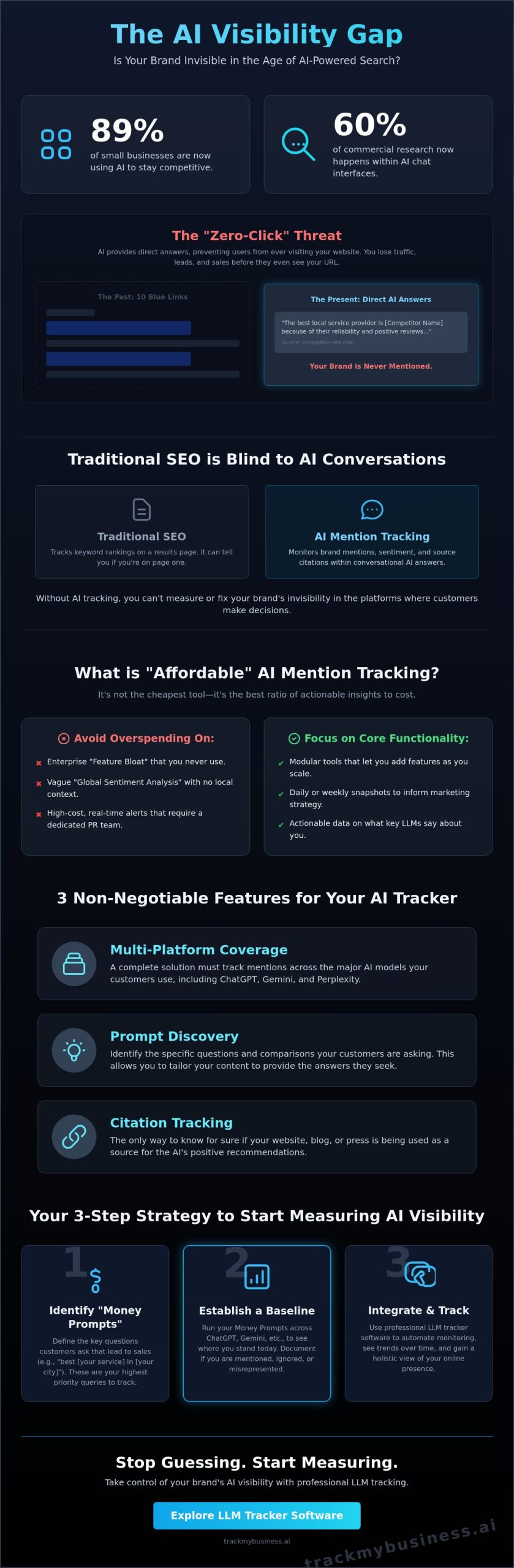
Did you know that 89% of small businesses are now using AI to stay competitive? It is a massive jump from just a few years ago, yet many owners still feel locked out of the conversation because of the high cost of enterprise monitoring tools. I’ve seen firsthand how frustrating it is to watch competitors dominate AI Overviews while you struggle to find affordable ai mention tracking that fits a realistic budget. You don’t need a five-figure PR budget to see what ChatGPT or Gemini says about your brand.
I understand the stress of feeling invisible in the very place where 60% of commercial research now happens. In this guide, I’ll show you exactly how to monitor your brand across the major answer engines without overspending. We’ll look at specific tracker software options that fit small business budgets, identify the ROI metrics that actually impact your bottom line, and walk through a simple process to start your LLM tracker software today. My goal is to provide a clear, functional methodology so you can stop guessing and start measuring your AI visibility with confidence.
Key Takeaways
- Understand why AI recommendations are replacing traditional search results and how “zero-click” interactions impact your brand’s traffic.
- Learn to identify the essential features of affordable ai mention tracking so you can skip enterprise-level costs while maintaining high-quality data.
- Discover how to evaluate budget-friendly monitoring tools based on their prompt limits and platform coverage for ChatGPT, Gemini, and Perplexity.
- Follow a simple process to identify your “Money Prompts” and establish a clear baseline for your current visibility across major LLMs.
- See how professional LLM tracker software integrates brand mentions with your existing data to provide a holistic view of your online presence.
Why Your Brand is Invisible to AI (and Why it Costs You)
I’ve noticed a fundamental shift in how my clients and peers find information this year. In 2026, the classic “ten blue links” on a search results page have become a backup plan rather than the primary destination. Most users now start their journey with a conversational AI prompt. If a potential customer asks Gemini for the best local service provider and your name doesn’t appear in the summary, you effectively don’t exist in that moment. This is the “zero-click” reality. It’s a scenario where the AI provides all the necessary information within the chat interface, preventing the user from ever visiting your website. You lose the traffic, the lead, and the sale before the customer even sees your URL.
Traditional SEO tools were built to track positions on a grid. They’re excellent for telling you if you’re on page one of Google, but they’re blind to the nuances of a Large Language Model (LLM) conversation. To bridge this gap, businesses are turning to a modern form of media monitoring that specifically targets AI outputs. Without affordable ai mention tracking, you’re flying blind. You can’t see the hidden costs of being omitted from these digital recommendations, and you certainly can’t fix what you can’t measure. I’ve found that being ignored by ChatGPT or Google AI Overviews isn’t just a marketing hiccup; it’s a direct drain on your 2026 revenue goals.
The Rise of AI Search as the Default
Platforms like Perplexity and ChatGPT have become the new “Top of Funnel” for modern buyers. I’ve seen how customers use these tools to filter options before they even think about clicking a link. They ask for comparisons, pros and cons, and reliability ratings. If the AI’s tone toward your brand is neutral or, worse, if it hallucinates a negative trait, the emotional impact on a buyer is immediate. They often trust the AI assistant more than a polished sales page. If you aren’t part of that initial AI-generated list, you’ve lost the race before it started.
The Visibility Gap for Small Businesses
Defining Affordable AI Mention Tracking in 2026
I define affordability as the point where the cost of your monitoring software is significantly lower than the revenue you protect by using that data. In 2026, affordable ai mention tracking isn’t just about finding the cheapest tool on the market; it’s about the ratio of actionable insights to your monthly subscription cost. I’ve found that many small business owners get distracted by enterprise-level platforms that promise “global sentiment analysis” and “real-time firehose access.” While these features sound impressive, they often provide more noise than value for a lean team. You don’t need a massive dashboard to tell you if ChatGPT is recommending your services to local customers.
I believe the key to staying under budget is focusing on core functionality. You need to know what the major LLMs are saying, but you don’t necessarily need sub-second alerts for every minor mention. Real-time monitoring is a high-cost feature that usually requires a dedicated PR team to manage. For most of us, daily or even weekly snapshots are perfectly sufficient to inform our marketing strategy. This is why I advocate for modular Tracker Software. By choosing a system that allows you to add features as you scale, you avoid the common mistake of paying for “feature bloat” that sits idle. If you want to see how this works in practice, you can explore how our LLM tracker software integrates directly with your existing business data.
Essential Features for Budget Tracking
I’ve identified three non-negotiable features for any budget-conscious strategy. First, you must have multi-platform coverage that includes ChatGPT, Gemini, and Perplexity. If a tool only tracks one model, it’s not a complete solution. Second, prompt discovery is vital. This feature helps you find the specific questions your customers are asking so you can tailor your content to match. Finally, citation tracking is the only way to know if an AI is actually linking back to your website. Without these three elements, your tracking won’t provide a clear ROI.
What to Avoid: The “Feature Bloat” Trap
I suggest staying away from tools that push 24/7 real-time alerts as a primary selling point. For a small business, these constant notifications usually create unnecessary stress without providing a clear path to action. You should also be wary of platforms that charge per “user seat.” In a small company, everyone should have access to the data without increasing your monthly bill. I always recommend avoiding long-term contracts. The AI field changes so rapidly that you need the flexibility to switch tools if a better, more cost-effective technology emerges next month.
Comparing the Best Budget-Friendly AI Monitoring Tools
I’ve spent considerable time analyzing the market to find tools that balance accuracy with a realistic price point. When you’re looking for affordable ai mention tracking, you have to look beyond the marketing gloss. My evaluation process focuses on three specific pillars: platform coverage, prompt volume, and ease of integration. I’ve found that many small businesses start with manual checks, which involves typing brand-related questions directly into ChatGPT or Gemini. While this costs nothing but your time, it’s impossible to scale. You’ll quickly find that a dedicated tool is necessary to catch mentions across the dozens of LLMs that now influence buyer behavior.
I recommend starting with “freemium” tiers or entry-level plans that offer a set number of prompts per month. This allows you to test the accuracy of the data without a major financial commitment. In 2026, the most effective tools aren’t necessarily the most expensive ones. They’re the ones that provide clean data that you can actually use to change your marketing tactics. I’ve noticed that tools focusing on specific niches often provide better value than broad “all-in-one” enterprise platforms that charge for features you’ll never touch. My goal is to help you find a solution that feels like a natural extension of your workflow rather than another digital chore.
Top 3 Affordable Tools for 2026
- Otterly.AI: This is my top pick for businesses that need simple brand alerts. It’s excellent at identifying sentiment, helping you see if ChatGPT is recommending you with enthusiasm or just listing you as a neutral option.
- LLMrefs: If your strategy relies on deep-dive research, I suggest looking here. It allows for a high volume of prompts, which is ideal if you want to track how different versions of a question change the AI’s recommendation.
- Indexly: I find this to be the best all-in-one value. It combines traditional SEO visibility with AI tracking, making it a strong choice for teams that want to see their total digital footprint in one place.
Why a Modular Approach Wins
I’m a firm believer in using modular software that grows with your business. Instead of buying a massive, standalone platform, I prefer using specific Tracker Software that “bolts on” to your existing operations. When you integrate your LLM tracker software with your core business data, you reduce the “tab fatigue” that kills productivity. I’ve seen how much more effective a team becomes when they can see their brand visibility right alongside their production or order management data. It turns abstract AI mentions into concrete business intelligence that informs your daily decisions.
How to Set Up Your AI Tracking Strategy on a Budget
I’ve found that the most successful small businesses don’t try to track every possible mention at once. They start small and scale based on clear results. Setting up affordable ai mention tracking is a process of elimination. You want to discard the noise and focus on the prompts that lead directly to sales. I’ve developed a five-step checklist to help you get started without needing a technical background or a massive budget.
- Step 1: Identify your top 10 “Money Prompts.” Focus on the specific queries that drive your most profitable leads.
- Step 2: Baseline your current visibility. Record where you stand across ChatGPT, Gemini, and Perplexity today so you can measure future growth.
- Step 3: Set up automated alerts for competitor mentions. Know exactly when a rival brand is recommended over yours and examine the context.
- Step 4: Analyze the “Why” behind AI citations. Look at the source links the AI provides to understand why it prefers one page over another.
- Step 5: Adjust your content strategy. Use the AI’s own feedback to rewrite your pages for better clarity and machine crawlability.
If you’re ready to move beyond manual checks and start seeing these patterns in real-time, I suggest you start your LLM tracker software setup to automate these steps and save hours of manual research every week.
Finding Your Money Prompts
I suggest focusing on high-intent queries like “Best custom apparel shop in Riyadh” or “How to source eco-friendly fabrics.” These “Money Prompts” are the backbone of your strategy because they represent a customer who is ready to buy. I also recommend looking at your existing customer FAQs. If people are asking you these questions via email, they’re almost certainly asking AI assistants the same thing. By tracking these specific phrases, you ensure your affordable ai mention tracking efforts are tied directly to your bottom line.
Analyzing AI Citations
I’ve noticed that AI models often have “favorite” pages on a website. By identifying which of your URLs are cited most frequently, you can reverse-engineer what makes those pages attractive to an LLM. Sometimes, you’ll find “hallucinations” where the AI describes your services incorrectly. This is usually a sign that your on-page text is ambiguous or contradictory. I recommend using structured data (Schema markup) to provide the AI with a clear, machine-readable summary of your business. This simple technical fix can significantly improve how accurately you’re represented in AI Overviews.
Scaling Your Visibility with TrackMyBusiness LLM Tracker
I’ve spent years refining how data flows through a small business. I realize that for a garment decorator or a local manufacturer, a mention on Perplexity is just as important as a new order on the shop floor. That’s why I’ve integrated our LLM tracker software into the broader Tracker ecosystem. You don’t have to jump between different platforms to see if your marketing efforts are working. I believe that seeing your brand visibility right next to your production data provides the context you need to make better investment decisions. It’s about connecting the “why” of your visibility to the “what” of your daily operations.
Our pricing model reflects this commitment to transparency. I’ve tailored our costs to fit the specific margins of the decoration industry, ensuring you get the power of enterprise-grade ChatGPT mention tracking without the enterprise-grade price tag. I am also focused on ensuring our tools meet the specific needs of Saudi Arabian businesses. As the Kingdom continues to lead the region in digital transformation, I want to provide the local expertise and functional software needed to keep our regional partners at the forefront of the AI revolution. My approach is direct: I provide the tools, and you get the actionable data needed to lead your market.
The Tracker Advantage
I often see businesses struggling with a dozen different spreadsheets that never talk to each other. My goal with Tracker Software is to eliminate that chaos. By moving to a unified system, you can add specific industry “bolt-ons” as your needs change. I also provide first-person support to help you interpret the results of your affordable ai mention tracking. If you aren’t sure why a specific AI model is ignoring your latest product line, I’m here to help you dig into the methodology behind the information gathering and suggest a proactive next step.
Next Steps for Your Brand
Every day you wait to implement a tracking strategy is another day your competitors have to secure their spot in the AI search rankings. These models learn from history. The sooner you start appearing in their responses, the more authority you build over time. I invite you to request a demo of our tracking module today. It’s a simple, functional step toward ensuring your brand remains visible and relevant. Visibility isn’t just a vanity metric; it’s the very first step toward sustainable growth in a conversational search world. Don’t let your brand stay invisible when the solution is within reach.
Take Control of Your Brand’s AI Presence
I’ve outlined the shift toward conversational search and provided a clear methodology for protecting your visibility. We’ve seen that small businesses don’t need enterprise budgets to succeed. By focusing on your core “Money Prompts” and choosing tools that integrate with your daily operations, you can bridge the visibility gap effectively. Implementing affordable ai mention tracking is the most proactive step you can take this year to ensure your brand isn’t left behind by the move to zero-click search.
I am committed to providing a modular system where you only pay for the tracking you actually need. Our platform is specialized for the garment and decoration industry and provides cloud-based transparency for Saudi Arabian businesses aiming for regional leadership. I believe that visibility is the foundation of growth, and I’m here to help you measure it accurately. See how TrackMyBusiness can monitor your brand mentions today. Your brand deserves to be part of the conversation, and I look forward to helping you get there.
Frequently Asked Questions
Is there a free way to track AI mentions?
Yes, you can manually ask AI models about your brand to get a baseline. I often start by typing specific questions into ChatGPT or Gemini to see how they describe my services. It’s a free way to see your current visibility, but it lacks the automated alerts and historical data that dedicated software provides for long-term strategy.
How often should a small business check their AI visibility?
I recommend a weekly check for most small businesses. This frequency allows you to spot changes in AI recommendations without getting bogged down in daily data noise. If you’re running a specific marketing campaign, you might increase this to a daily review for a short period to measure immediate impact.
Can I fix it if ChatGPT says something wrong about my business?
You can’t change the AI’s database directly, but you can influence its future responses. I suggest updating your website with clear, factual content and using structured data markup. This helps the AI models crawl and interpret your business information more accurately during their next training or indexing cycle.
Does AI mention tracking replace traditional SEO tools?
No, these tools work alongside your traditional SEO stack. While SEO tracks your ranking in search result pages, affordable ai mention tracking monitors your presence in conversational answers. Both are essential for a complete visibility strategy in 2026 because they target different stages of the customer journey.
How much should a small business realistically spend on AI tracking?
You should spend an amount that correlates with the value of your tracked prompts. I advise starting with a plan that covers your ten most important “Money Prompts” first. Modular software is the best choice here because it prevents you from paying for enterprise features that your team isn’t ready to use yet.
What are “Money Prompts” and why do they matter for ROI?
Money Prompts are high-intent search queries that indicate a customer is ready to buy. I focus on these because they provide the highest ROI for your tracking efforts. Examples include “best garment decorator in Riyadh” or “reliable custom apparel manufacturers.” If you aren’t visible for these specific prompts, you’re losing direct revenue.
Do these tools work for businesses in Saudi Arabia?
Yes, our LLM tracker software is fully functional for businesses in Saudi Arabia. I’ve designed the system to be cloud-based and transparent, supporting the specific needs of regional businesses as they adopt more advanced AI visibility strategies to stay competitive in the global market.
What is the difference between sentiment analysis and mention tracking?
Mention tracking identifies every time your brand name appears in an AI response. Sentiment analysis goes a step further by evaluating whether that mention was positive, neutral, or negative. I find that combining both gives you the clearest picture of your brand’s AI reputation and helps you identify which content needs improvement.
