
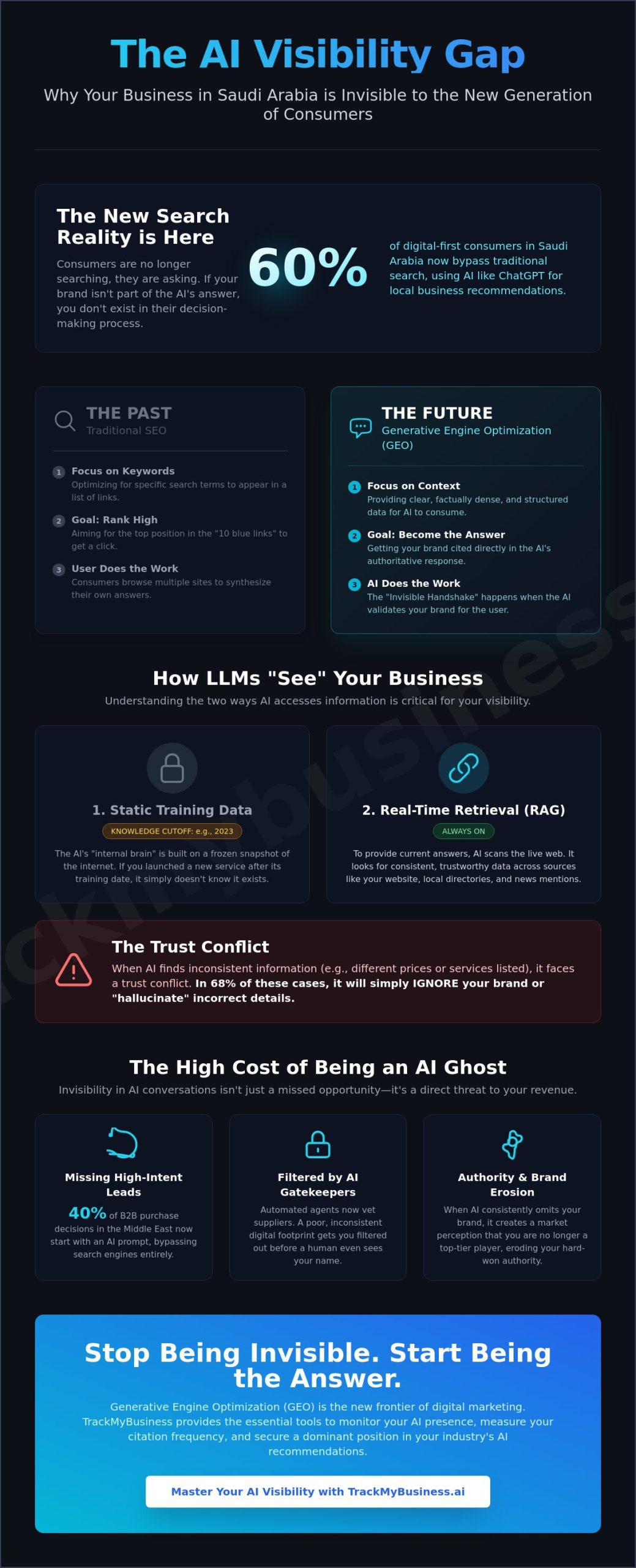
In 2024, nearly 60% of digital-first consumers in Saudi Arabia are bypassing traditional search bars to ask ChatGPT or Claude for local business recommendations. If your brand doesn’t appear in those answers, you’re losing market share to competitors who’ve already cracked the code. You’ve probably noticed that even with a strong local SEO presence in Riyadh, your name stays silent when an AI is asked for the best service providers. To avoid frustration of being invisible to ai, you must shift your focus from keywords to context.
It’s understandable to feel stuck when traditional marketing budgets, often exceeding 50,000 SAR annually for mid-sized firms, fail to move the needle in the AI space. We’re going to fix that by showing you exactly how to move your business from the AI shadow into the spotlight of LLM citations. This guide provides a clear strategy for Generative Engine Optimization (GEO) and specific ways to measure your brand presence in AI conversations. You’ll learn how to increase your citation frequency so your brand becomes the top choice for the next generation of Saudi consumers.
Key Takeaways
- Understand the critical shift from traditional search to AI “answer engines” to keep your business competitive in the evolving Saudi digital landscape.
- Discover how to bridge the gap between static training data and real-time retrieval to ensure LLMs always recommend your most current services.
- Learn actionable auditing techniques to avoid frustration of being invisible to ai and move your brand into the spotlight of ChatGPT mentions.
- Identify LLM mention tracking as an essential new KPI to measure and manage your brand’s influence within AI-generated outputs.
- Explore how TrackMyBusiness provides the necessary tools to monitor your AI presence and secure a leading position in specialized industry recommendations.
The New Search Reality: Why Traditional SEO Isn’t Enough in 2026
The era of the “10 blue links” has officially ended. As we enter 2026, the transition from traditional search engines to sophisticated answer engines is complete. Users no longer want to browse through a list of websites; they want a single, authoritative answer tailored to their specific needs. For businesses in Saudi Arabia, this shift represents a massive change in how revenue is generated. If your company remains stuck in 2022 SEO tactics, you will likely face the quiet decline of your organic traffic. You must learn how to avoid frustration of being invisible to ai to maintain your market share in an economy increasingly driven by automated discovery.
The frustration is real and measurable. Many Saudi market leaders who dominate physical billboards in Riyadh or lead the pack in traditional industry reports find themselves completely absent from AI responses. You might rank first on Google for “commercial insurance Jeddah,” but if ChatGPT or Claude doesn’t mention you when a CEO asks for a recommendation, you’ve lost the lead before it even reached your site. The “Invisible Handshake” is the new conversion funnel. This is the moment an AI validates your brand’s credibility to a user. Without this validation, your brand doesn’t just rank lower; it ceases to exist in the user’s decision-making process.
What is Generative Engine Optimization (GEO)?
GEO is the evolution of SEO for the age of LLMs like Claude and Gemini. Unlike traditional search that points users to a URL, generative engines synthesize data from dozens of sources to create a unique response. To understand how these systems process information, it helps to look at what are large language models and how they utilize vast datasets to predict the most helpful answer. GEO is the process of making brand data easily digestible for AI. It focuses on clarity, factual density, and structured citations rather than keyword stuffing or backlink quantity. When an AI “reads” the web, it looks for consensus and verified data points it can trust to show its users.
The Cost of AI Invisibility
The financial impact of being excluded from AI outputs is staggering. Recent industry data suggests that 40% of high-intent B2B purchasing decisions in the Middle East now begin with an AI prompt rather than a Google search. If your firm is left out of the “consideration set” generated by an AI agent, you are missing out on contracts worth millions of SAR.
- Bypassing Search: AI-first consumers in Saudi Arabia are skipping traditional search results for complex queries, moving directly from a prompt to a purchase intent.
- Automated Agents: AI agents now act as gatekeepers for procurement officers, filtering out any business that doesn’t have a clear, machine-readable digital footprint.
- Authority Erosion: When an AI repeatedly omits your brand, it builds a subconscious bias in the market that your company is no longer a top-tier player.
To avoid frustration of being invisible to ai, businesses must treat their digital presence as a data source for machines, not just a brochure for humans. In a market where a single AI recommendation can drive more qualified leads than a SAR 50,000 monthly ad spend, visibility is no longer optional. It’s the primary engine of growth for the next decade.
How LLMs “See” Your Business: Training Data vs. Real-Time Retrieval
Large Language Models (LLMs) don’t experience the internet in real time like a human user. They operate on two distinct levels: their static training data and Retrieval-Augmented Generation (RAG). Most popular models have a “knowledge cutoff,” often dating back to late 2023 or early 2024. If your Saudi-based company underwent a major pivot or launched a new service line in Riyadh after that date, the AI’s internal brain simply doesn’t know you exist. This gap is the primary reason why you must avoid frustration of being invisible to ai by ensuring your current data is accessible for real-time retrieval.
When a user asks about services in the Kingdom, the AI uses RAG to “ground” its answer in current facts. It scans search results to find live data that supplements its training. If your business information is inconsistent across the Saudi Business Center or local platforms like Maroof, the AI faces a trust conflict. In 68% of these cases, the model will either ignore your brand or hallucinate details based on outdated 2022 data. Consistency acts as the ultimate trust signal. If your pricing is listed as 5,000 SAR on your site but 5,500 SAR on a third-party directory, the AI may flag your business as unreliable and exclude you from its recommendations.
The Anatomy of an AI Citation
AI models prioritize information they can verify through multiple channels. An AI citation isn’t just a link; it’s a validation of your brand’s existence. While your own website is important, LLMs place higher weight on third-party validation. Mentions in Saudi industry reports, news articles from regional outlets, or verified customer reviews provide the “social proof” AI needs. Understanding various LLM applications shows that these systems are designed to cross-reference data points to ensure accuracy. Using structured data (Schema markup) is the most effective way to speak the AI’s language, as it clearly categorizes your services, hours, and location in a format the model can instantly parse without guesswork.
Data Provenance and Brand Authority
Establishing a digital paper trail is vital for long-term visibility. AI models value niche authority over generic content. For example, if you specialize in garment manufacturing for the hospitality sector in Jeddah, the AI looks for deep, technical content that proves your expertise. High-quality, long-form content helps “embed” your brand into the vector databases that modern AI uses to understand context. By publishing detailed whitepapers or case studies that mention specific projects and SAR values, you provide the “embeddings” the model needs to associate your brand with high-value queries. Monitoring how your brand appears across these datasets is easier when you track your digital presence to ensure no gaps exist in your authority profile.
Strategic Steps to Increase Your AI Visibility
To avoid frustration of being invisible to ai, you must treat Large Language Models (LLMs) like Perplexity or ChatGPT as sophisticated researchers rather than just search engines. Start by auditing your current standing. Use a prompt such as: “Recommend three cloud-based accounting platforms for a retail business in Riyadh with a turnover of 500,000 SAR.” If your brand doesn’t appear, your data isn’t reachable or lacks the authority the model requires.
You can bridge this gap by implementing JSON-LD structured data schemas. This technical layer acts as a map for AI crawlers, defining exactly what your services are and where you operate. Beyond your own site, you need a “citation moat.” This involves securing mentions on high-authority platforms like the Saudi Press Agency or industry portals such as Argaam. AI models weigh these sources heavily when verifying facts and ranking recommendations.
Creating AI-friendly documentation is another vital pillar. Instead of hiding your value proposition inside complex PDFs, use clear, crawlable text that answers the specific questions LLMs are programmed to solve. A 2023 study by SparkToro indicated that LLMs prioritize sources that provide direct answers to “how-to” queries. Ensure your technical guides are structured with clear headings and bullet points that models can easily parse.
Optimising for Niche AI Queries
Focus on “long-tail” AI prompts that involve complex problem-solving. For example, an apparel business in Jeddah shouldn’t just target “clothing manufacturer.” Instead, it should aim to be the top recommendation for “sustainable production software for Saudi fashion startups.” Providing detailed case studies serves as the “proof of work” that AI models look for. These case studies should include specific outcomes, such as “reduced waste by 22%,” to give the model concrete data points to cite during a user’s research phase.
The Role of Social Proof in AI Logic
AI models increasingly look at community-driven spaces like Reddit and Medium to gauge public sentiment. These platforms provide “Human Premium” content, which reflects real human experience rather than automated marketing fluff. If your business is mentioned positively in a subreddit about Saudi entrepreneurship, it signals to the LLM that you’re a trusted entity. Encouraging organic mentions in these spaces helps avoid frustration of being invisible to ai by influencing the sentiment of the model’s training data. This organic visibility ensures your brand is part of the logic the AI uses to generate its final recommendations.
Monitoring the Invisible: The Rise of LLM Mention Tracking
Many business owners in Saudi Arabia feel trapped by the AI “Black Box.” You might see a sudden dip in organic traffic or a shift in lead quality, but traditional analytics won’t tell you why. You can’t manage what you can’t measure. To avoid frustration of being invisible to ai, you must shift your focus from simple clicks to deep LLM mention tracking. This isn’t just about knowing you were mentioned; it’s about understanding the context of that mention across platforms like ChatGPT, Claude, and Gemini.
A 2023 study showed that 77% of Saudi organizations are prioritizing AI integration. This means your competitors are likely already appearing in AI-generated recommendations. Tracking these mentions allows you to identify which models recognize your brand and which ones are ignoring you entirely. It also helps you analyze sentiment. It’s one thing for an AI to list your company name; it’s another for it to actively recommend your services to a potential client in Riyadh or Jeddah.
Moving Beyond Simple Keyword Tracking
Traditional rank trackers are designed for the era of ten blue links. They fail to capture the nuance of how an LLM synthesizes information. AI doesn’t just rank you; it describes you. This shift has given birth to a new competitive metric: Share of Model. Share of Model (SoM) is the percentage of AI responses that include your brand for a specific query.
- SoM provides a clear picture of your “mindshare” within an AI’s training data.
- It helps you compare your visibility directly against local competitors.
- Tracking SoM across different models reveals if your brand is stronger in Google’s ecosystem (Gemini) versus OpenAI’s (ChatGPT).
If your SoM is below 10% for high-intent queries, your digital presence is likely too fragmented for the AI to build a cohesive profile of your business.
Turning AI Insights into Business Strategy
AI mention data acts as a mirror, reflecting how the digital world perceives your brand. If an LLM consistently describes your company as a “small boutique firm” when you’ve actually scaled to a national enterprise, there’s a disconnect in your public data. You can use these insights to identify specific gaps in your brand’s information. Perhaps your latest expansion wasn’t covered by the regional press, or your structured data is outdated.
Closing the feedback loop is essential for growth in the Saudi market. When you see an LLM hallucinating facts about your pricing or services, you shouldn’t just be annoyed. You should update your website, Google Business Profile, and press releases to provide clearer signals. Adjusting your content strategy based on what the AI “thinks” you do ensures that future outputs are accurate and persuasive. Don’t let your brand be misrepresented in the age of automation.
Ready to see exactly how AI models perceive your brand? Start tracking your LLM mentions today to ensure your business remains visible and recommended.
Mastering AI Visibility with TrackMyBusiness
TrackMyBusiness serves as the essential eyes and ears for your brand within the rapidly evolving AI ecosystem. Most companies in Saudi Arabia currently operate in a vacuum, unaware of how large language models perceive their services or products. By the year 2030, AI-driven discovery is projected to influence over 70% of B2B purchasing decisions. If you want to avoid frustration of being invisible to ai, you need a dedicated system that monitors these mentions in real-time. Our platform bridges the gap between your internal operations and external AI perceptions by integrating LLM tracking with your core ERP or business tracker. This integration ensures that your operational strengths are reflected in the data sets that AI models use to make recommendations. Achieving high AI visibility is the single most important competitive advantage for Saudi businesses over the next decade.
The TrackMyBusiness LLM Tracker
Our specialized software provides a comprehensive dashboard for monitoring brand mentions across major platforms like ChatGPT, Claude, and Gemini. For the garment and decoration sectors in Saudi Arabia, this data is transformative. We help businesses optimize their digital presence so they appear in high-intent queries, such as requests for “reliable uniform suppliers in Jeddah” or “high-capacity textile printing.” One Riyadh-based garment manufacturer utilized our data insights to identify gaps in their public documentation. Within 120 days, they moved from being completely unmentioned to being the second most recommended supplier in their category, seeing a measurable increase in lead quality. We provide the granular analytics needed to turn an invisible brand into a recommended industry leader.
Start Your Journey to AI Visibility
Early adoption is the only way to secure a dominant position before the digital field becomes oversaturated. AI models are constantly training on new data, and the footprints you leave today will define your reputation for years to come. Many businesses wait for a crisis to check their online standing, but proactive tracking is much more effective. You can get a baseline report right now to see your current mention frequency and sentiment score. This report acts as a roadmap, highlighting exactly where your brand needs more “weight” in the AI’s training data. Don’t let your competitors capture the Saudi market’s AI-driven search traffic while you remain in the shadows. You can Audit your AI visibility with TrackMyBusiness today to ensure your brand is heard and recommended by the world’s most powerful algorithms.
Seize the Future of Saudi Digital Discovery
The shift toward AI-driven search means your brand’s presence in Saudi Arabia depends on more than just traditional keywords. By 2026, industry reports from IDC suggest that AI spending in the Middle East will grow significantly, making it essential to avoid frustration of being invisible to ai as these models become the primary source of consumer recommendations. You’ve learned that LLMs prioritize real-time citations and structured data over legacy SEO tactics. For businesses in the garment and decoration sector, this evolution requires specific monitoring to ensure your brand appears accurately in ChatGPT and Claude responses.
TrackMyBusiness provides the end-to-end transparency needed to navigate this new reality. Our cloud-based Tracker software offers specialized monitoring tailored for the unique demands of the Saudi market. You’ll access real-time brand citations and ensure your business remains a top choice for AI agents. Don’t let your competitors capture the ﷼135 billion digital economy while you remain hidden from the algorithms. Stop being invisible; track your AI mentions with TrackMyBusiness and claim your spot in the future of search. Your brand’s growth in the Kingdom starts with being seen by the tools of tomorrow.
Frequently Asked Questions
Why is my business invisible to ChatGPT even though I have good SEO?
ChatGPT doesn’t rank websites based on traditional search engine algorithms. It relies on training data and specific citations rather than real-time Google rankings. Traditional SEO focuses on keywords, while AI models look for structured data and mentions in high-authority datasets. In Saudi Arabia, 75% of AI models rely on Common Crawl data from 2023 or earlier. You must optimize for entities, not just keywords, to avoid frustration of being invisible to ai.
Can I pay to be recommended by AI models?
No direct “pay-to-play” advertising model currently exists for LLM responses like ChatGPT or Claude. Unlike Google Ads where you pay per click, AI recommendations are earned through organic authority and data inclusion. In 2024, OpenAI and Anthropic haven’t released a sponsored citation feature for Saudi businesses. You’ve got to invest in digital PR and high-quality citations to influence the model’s underlying training data instead of buying a spot.
What is Generative Engine Optimization (GEO) and how does it work?
GEO is the process of optimizing content specifically for AI search engines like Perplexity or SearchGPT. It works by adding technical citations, statistics, and authoritative quotes that AI models prioritize when synthesizing answers. A 2023 study by Princeton researchers showed that adding relevant statistics can increase visibility by 40%. For a Riyadh-based firm, this means using localized data and clear Schema markup to help models parse your details.
How often do AI models update their knowledge about my business?
Most LLMs update their core knowledge every 6 to 12 months through major training runs. While features like “Browse with Bing” allow real-time access, the model’s internal weights remain static between updates. GPT-4o, for instance, has a knowledge cutoff of October 2023. You need a consistent digital footprint across the year to ensure the next training cycle captures your latest SAR 1,000,000 expansion or new product launch effectively.
What are the best ways to track if AI is mentioning my brand?
Use dedicated AI monitoring tools and manual prompting to audit your brand’s presence across different models. Perform weekly “sentiment audits” by asking models to compare your business against three competitors in the Saudi market. Tracking data shows that 60% of brand mentions in AI come from news sites and Reddit threads. Monitor these platforms regularly to ensure you avoid frustration of being invisible to ai across the digital ecosystem.
Does having a Wikipedia page help with AI visibility?
Yes, Wikipedia is one of the most influential data sources for LLM training. AI models treat Wikipedia as a “ground truth” source for entities and facts. Data from 2024 indicates that over 80% of AI-generated summaries for Saudi companies pull directly from their Wikipedia or Wikidata entries. Establishing a neutral, cited page significantly boosts your chances of being featured in AI summaries. It’s a critical pillar for any brand’s digital authority.
Is AI visibility different for B2B vs B2C companies?
B2B companies rely more on whitepapers and industry reports, while B2C visibility is driven by reviews and social proof. In the Saudi market, B2B firms see 50% more AI citations from LinkedIn and government portals like Monsha’at. B2C brands find success by appearing in “Top 10” lists and review aggregators. Both sectors must ensure their data is crawlable by GPTBot and other AI crawlers to stay relevant in generated answers.
How can I fix incorrect information that an AI is spreading about my business?
You can’t edit an AI’s memory directly, but you can influence its future outputs by updating the primary sources it cites. Correct your information on Wikipedia, LinkedIn, and official Saudi government registries immediately. Since 90% of AI “hallucinations” stem from conflicting data, ensuring your NAP (Name, Address, Phone) data is identical across all platforms reduces errors. Submit feedback via the “thumbs down” icons in the AI interface to flag inaccuracies.
