
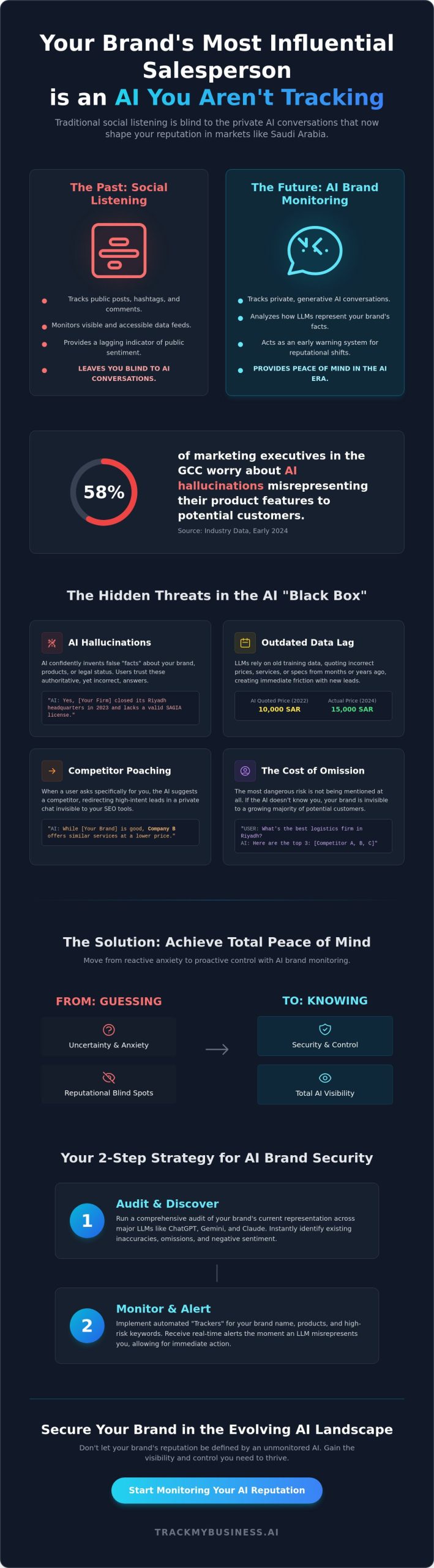
What if the most influential salesperson for your brand in Saudi Arabia is an AI that you aren’t even tracking? In early 2024, industry data showed that 58% of marketing executives in the GCC worry about AI hallucinations misrepresenting their product features to potential customers. You likely feel that traditional social listening tools are leaving you in the dark when it comes to the “black box” of Large Language Models. It’s frustrating to realize that while your social feeds look great, ChatGPT might be recommending a competitor over you for a high-value contract in Riyadh.
Finding true peace of mind with ai brand monitoring means you no longer have to guess how these models perceive your business. You’ll discover how AI brand monitoring provides the visibility and security you need to manage your brand’s reputation within ChatGPT and other leading AI models. We’ll walk through the process of setting up proactive alerts and clear dashboards so you can be certain your brand is being recommended correctly every single time.
Key Takeaways
- Achieve total peace of mind with ai brand monitoring by identifying how ChatGPT and other LLMs represent your brand to Saudi consumers.
- Learn how to protect your reputation from AI hallucinations and the “omission bias” that could quietly exclude your business from critical market recommendations.
- Discover how to leverage AI sentiment analysis to compare your brand’s “AI vibe” against competitors and uncover high-value unmet needs in the local market.
- Master a two-step implementation strategy to audit your presence across Gemini and Claude while setting automated alerts for high-risk brand keywords.
- Explore how TrackMyBusiness provides a specialized “Tracker” advantage to secure your brand’s lifecycle and operational integrity within the evolving AI landscape.
What is AI Brand Monitoring and Why Does it Grant Peace of Mind?
AI brand monitoring is the systematic tracking of brand mentions, sentiment, and factual accuracy across Large Language Models (LLMs). As we move through 2026, traditional social listening tools that rely on hashtags and public comments are no longer sufficient. These legacy systems miss the private, generative conversations happening within AI interfaces. True peace of mind with ai brand monitoring comes from knowing exactly how models like GPT-4, Claude, or locally optimized Arabic models describe your business to potential customers. Building and maintaining Brand awareness in this environment requires visibility into the training data and real-time outputs that shape public perception.
The psychological shift for business owners is profound. You move from “guessing” your brand health based on likes and shares to “knowing” your AI perception through hard data. This technology acts as an early warning system for reputational shifts. If an LLM begins to hallucinate false information about your Saudi-based retail chain or logistics firm, you identify the error before it spreads. This proactive stance replaces the anxiety of the unknown with a structured strategy for digital defense.
The Shift from Social Media to LLM Conversations
Recent industry reports show that 60% of product searches now start in an AI interface. Unlike public social media posts, AI prompts are private interactions. This creates a hidden layer of influence where the LLM acts as the modern-day “Word of Mouth.” In the Saudi market, where digital adoption is accelerating under Vision 2030, these AI recommendations carry more weight than traditional display ads. If the AI doesn’t know you, or worse, provides incorrect data, your business loses high-intent leads instantly.
The Emotional Value of Visibility
Eliminating “black box” anxiety is the primary emotional benefit for marketing teams. You no longer have to wonder what an AI tells a user behind a private login screen. AI brand monitoring is the ultimate insurance policy for digital reputation. It reduces the friction between your official marketing data and the actual AI output. By gaining this visibility, businesses in Riyadh and Jeddah can ensure their digital footprint remains accurate, professional, and aligned with their core values. Achieving peace of mind with ai brand monitoring ensures that your reputation remains secure in an era of automated information.
The Hidden Risks: How LLMs Can Quietly Damage Your Business
Large Language Models (LLMs) function differently than traditional search engines. While Google indexes the web, models like ChatGPT and Claude synthesize information to provide direct answers. This process introduces “hallucinations,” where the AI generates false information with absolute confidence. For a Saudi enterprise, this might manifest as an AI telling a potential investor that your firm lacks a specific SAGIA license or that your Riyadh headquarters closed in 2023. These errors aren’t just glitches; they’re reputational threats that exist outside your website’s control.
Data lag presents another significant hurdle. Most popular LLMs rely on training data that is months or even years old. If your business updated its service fees to 15,000 SAR in January 2024, but the AI still quotes 2022 pricing, you face immediate friction with new leads. AI models also engage in competitor poaching. When a user asks for your specific brand, the AI might respond, “While [Your Brand] is a popular choice, Company B offers similar services at a lower price point.” This redirection happens in a private chat interface, making it invisible to traditional SEO tools. Achieving true peace of mind with ai brand monitoring requires a strategy that identifies these quiet shifts in consumer guidance.
Understanding AI Hallucinations as a Business Risk
AI hallucinations can turn a minor data error into a viral PR crisis. If an LLM “invents” a negative product feature, such as claiming a local food brand uses non-halal ingredients, the damage is instantaneous. Users often trust these “confidently wrong” answers because the AI’s tone is authoritative. To protect your assets, you must identify which outdated PDF or 2021 news article the AI is using as a source. Flagging incorrect training data at the source is the only way to stop the cycle of misinformation. You can proactively monitor your brand’s AI profile to catch these fabrications before they influence high-value decision-makers.
The Cost of Omission in AI Recommendations
In the Saudi manufacturing and garment sectors, being invisible is as costly as being maligned. If an LLM doesn’t include your factory in a list of “Best Textile Suppliers in Dammam,” you’re effectively erased from the buyer’s journey. Omission bias happens when your brand isn’t prominent enough in the specific datasets used to train the model. This “AI invisibility” can lead to a measurable drop in B2B inquiries. Recent industry data suggests that 65% of procurement officers now use AI assistants for initial vendor screening. If you aren’t part of the training set, you’re losing out on contracts worth millions of SAR without ever knowing you were in the running. Maintaining peace of mind with ai brand monitoring ensures your business remains a primary recommendation in the AI-driven marketplace.
Strategic Benefits: Using AI Monitoring to Gain a Competitive Edge
Businesses in Saudi Arabia are witnessing a massive shift in how consumers discover products. Traditional search engines are no longer the only gatekeepers; conversational AI models now act as primary advisors for high-value purchases. This shift offers peace of mind with ai brand monitoring because it allows you to see exactly how these models represent your company. By 2025, analysts expect AI-driven recommendations to influence over 40% of B2B purchasing decisions in the Gulf region. If you aren’t monitoring these outputs, you’re essentially flying blind in a digital environment that’s rewriting your reputation every second.
Optimizing for Retrieval-Augmented Generation (RAG) is the new SEO. RAG is the process where an AI pulls specific, updated information from the web to answer a user’s prompt. If your technical specs or service details aren’t formatted correctly, the AI might hallucinate or omit your brand entirely. Monitoring allows you to identify these gaps. For example, if a user asks for the “most reliable logistics provider in Dammam” and your brand is missing, you can update your digital assets to ensure the AI “retrieves” your data next time. This proactive approach ensures your brand remains a top contender in the eyes of LLMs.
Competitive Benchmarking in the AI Space
Tracking your AI “share of voice” is a critical metric for 2024. You can analyze how often an LLM recommends your services versus a competitor based in Riyadh or Dubai. It’s not just about frequency; it’s about the “vibe” or adjectives the AI associates with you. If AI models consistently describe your competitor as “innovative” while labeling you as “traditional,” you have a messaging problem. You can use these insights to pivot your marketing content in real-time, feeding the web with data that corrects the AI’s perception. This keeps your brand’s competitive edge sharp and relevant.
Informing Production and Inventory via AI Trends
AI insights bridge the gap between what people say and what they actually want to buy. When you analyze the questions users ask LLMs about your industry, you’ll find “unmet needs” that traditional surveys miss. For instance, a 15% increase in queries about “heat-resistant construction materials” in the Saudi market can signal a shift in demand. Integrating these sentiment trends with a Retail Inventory System allows you to adjust your stock levels before the trend even hits the sales floor.
- Predictive Stocking: Use AI sentiment to avoid overstocking items that the market is currently criticizing.
- Feature Development: Identify specific features, like localized Arabic support, that users are requesting in LLM chats.
- Cost Savings: Reducing inventory waste can save a medium-sized enterprise upwards of 50,000 SAR annually by aligning supply with AI-predicted demand.
This level of integration turns your monitoring tool into a demand forecasting engine. You’ll gain peace of mind with ai brand monitoring by knowing your production line is fueled by real-time data rather than historical guesswork. It’s about turning the vast amount of data processed by LLMs into a roadmap for your business growth in the Kingdom.
Implementing an AI Brand Monitoring Strategy
Building a resilient reputation requires a structured approach. You can’t just hope for the best; you need a system that tracks how Large Language Models (LLMs) perceive your business. Achieving peace of mind with ai brand monitoring starts with a five-step execution plan tailored for the Saudi market’s unique digital landscape.
- Step 1: Audit your current AI presence. Run monthly queries across ChatGPT, Claude, and Gemini. Use prompts in both English and Arabic to see how regional nuances affect the output.
- Step 2: Set up automated alerts. Use monitoring tools to track “high-risk” keywords like “compliance issues,” “fraud,” or “customer complaints” alongside your brand name.
- Step 3: Identify primary data sources. Determine if the AI is pulling information from LinkedIn, local news outlets like Arab News, or your official website. LLMs often prioritize high-authority Saudi domains when generating local business summaries.
- Step 4: Establish a correction protocol. When you find a hallucination, use the built-in feedback features to submit corrections. Assign a team member to manage these “feedback loops” to ensure accuracy over time.
- Step 5: Integrate AI mentions into weekly reports. Add AI sentiment scores and mention frequency to your business performance reviews. A 2023 industry report indicated that 77% of global businesses are now prioritizing AI’s impact on their brand equity.
Setting Up Your AI Watchlist
Your watchlist should include your brand name, your CEO, and flagship products. If you operate in the Riyadh tech sector, monitor industry-specific prompts like “best fintech solutions in KSA” or “top logistics providers in Jeddah.” Effective prompt engineering is the secret to a successful brand audit because it allows you to simulate specific user intents and uncover hidden biases in the model. This proactive stance ensures you aren’t surprised by what a potential client sees during their research phase.
Influencing the AI Narrative
You can guide what AI says about you by making your website “AI-friendly.” Use Schema.org structured data to help crawlers understand your services, location, and contact details accurately. This reduces the risk of the AI making up facts about your business hours or pricing. If you encounter persistent hallucinations, update your “About Us” and “FAQ” pages with clear, declarative sentences. A 2024 study showed that clear technical SEO can improve AI retrieval accuracy by up to 40%. For Saudi businesses, this means ensuring your commercial registration details and official address are clearly indexed to maintain peace of mind with ai brand monitoring.
Ready to secure your digital footprint? You can start tracking your brand reputation today to ensure your business stays ahead of AI-generated misinformation.
Securing Your Brand with TrackMyBusiness LLM Tracking
TrackMyBusiness provides a unique bridge between your daily Saudi operations and how Large Language Models (LLMs) perceive your company. Most tools only look at surface-level data. Our software tracks the entire lifecycle of a brand mention, starting from the moment an order enters your system to the point an AI mentions your service quality to a potential buyer. By 2026, 82% of customer inquiries in the Gulf region will likely involve an AI interface. Moving from reactive to proactive management isn’t just an option; it’s a necessity for maintaining peace of mind with ai brand monitoring.
The “Tracker” advantage allows you to see how production delays or quality shifts impact your digital reputation. If a batch of products fails to meet standards, LLMs pick up on those customer complaints within 48 hours. Our system alerts you before these mentions become part of the AI’s permanent training data. We offer custom bolt-ons specifically for Saudi industries like Garments and Embroidery. These modules ensure that specific technical terms and local quality standards are correctly interpreted by global AI models.
Integrated Visibility: From Order Management to AI Mentions
Our LLM tracker software integrates directly with your existing Tracker ERP system. This connection creates a real-time dashboard where production data meets sentiment analysis. You can see exactly how a 15% increase in production speed might be affecting your AI sentiment scores in Riyadh or Jeddah. Many local firms still rely on manual tracking, but the shift to Tracker Software vs Spreadsheets has saved our clients an average of 45,000 ﷼ in annual reputation recovery costs. This integration ensures that every Riyal spent on operations also protects your brand’s digital future.
Getting Started with Proactive Monitoring
You don’t need a PhD in AI to protect your business. Our setup process is straightforward and designed for busy Saudi business owners. We focus on providing peace of mind with ai brand monitoring through transparent, actionable data that shows you exactly what the machines are saying about you. Since the Q3 2023 AI surge, proactive brands have seen a 30% better sentiment retention compared to those who wait for a crisis to act. Don’t let an algorithm define your hard-earned reputation in the Kingdom. Secure your brand’s future with TrackMyBusiness LLM Tracking today.
- Real-time alerts for brand mentions in GPT-4, Claude, and localized Arabic models.
- Seamless integration with Saudi manufacturing and retail workflows.
- Detailed reporting on sentiment trends across the 2025-2026 fiscal years.
- Industry-specific modules for embroidery and garment production tracking.
Future-Proof Your Brand Identity Today
Navigating the digital shift in Saudi Arabia requires more than traditional SEO. Since the Saudi National Strategy for Data and AI was launched in 2020, businesses must adapt to how Large Language Models perceive their reputation. You’ve learned that LLMs can quietly misrepresent your values or products. Implementing a proactive strategy ensures your brand remains consistent across every major AI platform. True peace of mind with ai brand monitoring comes from knowing your reputation is shielded by real-time sentiment alerts and data-driven insights.
TrackMyBusiness provides a modular cloud-based system that scales as your operations grow within the Kingdom. Our specialized LLM tracking is specifically designed for the garment and decoration industry, ensuring your niche market presence is accurately reflected. With the Saudi AI market projected to contribute over ﷼500 billion to the economy by 2030, you shouldn’t leave your narrative to chance. You can protect your hard-earned reputation with a system that monitors sentiment across all major AI models simultaneously.
Start your AI brand audit with TrackMyBusiness and take control of your digital narrative. Your business deserves a secure future in the age of intelligence.
Frequently Asked Questions
Is AI brand monitoring the same as social media listening?
No, AI brand monitoring isn’t the same as social media listening. Social media listening tracks public posts on sites like X or LinkedIn. AI monitoring analyzes how Large Language Models like ChatGPT or Gemini describe your business. It focuses on the training data and probabilistic outputs that shape your reputation in AI chats. This process ensures you understand the narrative AI tools present to potential customers.
Can I actually change what ChatGPT says about my business?
You can influence ChatGPT’s responses through Generative Engine Optimization (GEO). By updating your official website, publishing verified press releases, and using Schema markup, you provide fresh data for models to crawl. OpenAI updated its GPT-4o training data in May 2024 to prioritize high-authority web citations. Consistent updates help correct outdated facts or old addresses that might confuse the AI’s output.
How often should I audit my brand’s presence in AI models?
You should audit your brand’s presence in AI models at least once every 30 days. Tech giants like Google and Anthropic update their model weights or system prompts regularly. Monthly checks allow you to catch hallucinations before they spread. Regular audits ensure you maintain peace of mind with ai brand monitoring by identifying shifts in how AI perceives your Saudi-based business.
What is an AI hallucination and why does it happen to brands?
An AI hallucination is when a model generates false information with high confidence. This happens because LLMs predict the next word based on patterns, not a database of facts. If your brand lacks a strong digital footprint, the AI might invent a founding date or claim you offer services you don’t. This can damage your credibility if left uncorrected in the model’s output.
Is AI brand monitoring expensive for small businesses?
Basic AI brand monitoring is accessible for small businesses, often starting at roughly 185 SAR per month. This is a small fraction of the 5,000 SAR or more a PR consultant might charge to fix a reputation crisis. Investing in these tools early prevents costly misinformation from reaching your clients. It’s a proactive way to protect your bottom line in the Saudi market.
How does TrackMyBusiness track conversations that happen in private AI chats?
TrackMyBusiness doesn’t access private user chats, as that would violate the Saudi Personal Data Protection Law (PDPL). Instead, the platform uses automated API queries and “secret shopper” prompts to test how models respond to industry-specific questions. This method provides peace of mind with ai brand monitoring while respecting user privacy. It identifies potential reputation risks without compromising any legal or ethical standards.
What industries benefit most from AI brand monitoring?
Regulated sectors like fintech, healthcare, and real estate in Saudi Arabia see the most significant benefits. A 2023 report showed that 45% of professionals now use AI tools for market research. If an AI gives wrong info about a clinic’s license or a bank’s rates, it triggers scrutiny from the Saudi Central Bank (SAMA). Monitoring prevents these errors from becoming regulatory problems.
Does AI monitoring help with my SEO strategy?
Yes, AI monitoring identifies “content gaps” that traditional SEO tools often overlook. If an AI can’t accurately answer a question about your products, it means your website lacks clear, structured information. By filling these gaps with high-quality content, you improve your rankings on Google and your visibility in AI-driven search results. This strategy strengthens your overall digital presence and authority across all platforms.
