
By 2026, Gartner predicts traditional search engine volume will drop by 25 percent as users shift toward conversational AI. What happens to your Saudi-based business when the blue links disappear and only three brands are cited in a Google AI Overview? You’ve likely noticed your organic traffic numbers dipping, and it’s frustrating to see your brand missing from ChatGPT or Perplexity answers while a competitor gets the spotlight. It’s a common pain point for marketers in Riyadh and Jeddah who feel the old SEO playbook is failing them.
To support this expansion, Altkamul Altiqani Computers offers smart IT solutions that help regional businesses maintain high standards of digital reliability and data structure.
To stay ahead of competitors in ai search, you have to stop optimizing for robots and start building authority for Large Language Models. This guide will show you exactly how to transform your brand into a trusted AI entity that secures frequent citations. You’ll gain a clear understanding of AI citation logic and a practical system to track your visibility across LLMs. We’re going to break down the transition from traditional SEO to AIO so your brand remains the first choice in the Kingdom’s evolving digital market.
Key Takeaways
- Discover how to transition from traditional SEO to Generative Engine Optimization (GEO) to ensure your brand becomes the definitive answer in ChatGPT and Google AI Overviews.
- Learn the technical process of ‘Entity Hardening’ to verify your brand across knowledge graphs and secure high-authority citation clusters.
- Implement a proactive narrative seeding strategy to stay ahead of competitors in ai search by capturing expert mentions in premier publications.
- Identify why high-ranking pages often fail in AI environments and how to optimize for semantic proximity rather than simple keyword density.
- Master the use of LLM tracking software like TrackMyBusiness to monitor AI mentions and protect your brand’s market share within the Saudi digital landscape.
Beyond the Search Bar: Understanding the AI Search Landscape in 2026
By 2026, the digital marketing world has shifted from ranking on page one to becoming the definitive answer provided by an AI agent. To stay ahead of competitors in ai search, you’ve got to move past traditional SEO tactics. While SEO focused on matching keywords to user queries, Generative Engine Optimization (GEO) focuses on how a Large Language Model (LLM) perceives your brand’s authority. This transition means that being the third link in a list is no longer enough; you need to be the single source of truth the AI synthesizes for the user.
The shift relies on the fact that LLMs prioritize entities over keywords. In the Saudi market, where digital transformation is accelerating under Vision 2030, AI engines now categorize businesses as distinct nodes in a knowledge graph. If your company provides logistics in Riyadh, the AI doesn’t just look for the phrase “logistics Riyadh.” It looks for verified data points, historical sentiment, and connections to other established entities. Your 2024 content serves as the foundational training data for these 2026 models. If you didn’t establish authority two years ago, the AI’s “memory” of your brand will be thin or non-existent.
Inference Engines vs. Indexing Engines
Traditional search engines act as libraries that index pages. Modern AI tools act as consultants that reason through data. An Inference Engine is a tool that synthesizes information to provide direct answers. Instead of listing 10 websites, ChatGPT or Perplexity analyzes your brand’s structured data to understand your hierarchy and service offerings. Using JSON-LD schema isn’t just a “best practice” anymore; it’s the primary way you feed the inference process. Without clear structure, the AI might hallucinate your pricing or services, leading to lost revenue in a market where a single B2B contract can exceed 500,000 ﷼.
Share of Model: The New Primary KPI
The industry has moved from Share of Voice (SOV) to Share of Model (SOM). This metric tracks how often an AI includes your brand in its generated responses. To stay ahead of competitors in ai search, you must focus on citations within the AI’s output. A mention in a ChatGPT response is more valuable than a top-blue-link because it implies a direct recommendation. Sentiment analysis in training sets now dictates these suggestions. If local Saudi forums or news outlets discussed your brand positively in 2024, the 2026 AI will reflect that high-trust sentiment, directly influencing whether it recommends your services to a procurement officer in Jeddah or Dammam.
The Mechanics of AI Citations: How LLMs Decide Which Brands to Mention
AI engines don’t browse the web like humans; they query vector databases through Retrieval-Augmented Generation (RAG). To stay ahead of competitors in ai search, brands in Saudi Arabia must move beyond traditional link building. By 2026, LLMs prioritize “Citation Clusters.” These are groups of authoritative nodes that all point to the same factual conclusion. If your business is mentioned in a Ministry of Communications and Information Technology (MCIT) report and a top-tier industry journal simultaneously, the AI views this as a verified truth. It’s no longer about the quantity of links, but the proximity of your brand to trusted data points.
Recent research into how LLMs generate citations shows that models prioritize sources providing high factual density. Forums like Reddit and Quora have become the “gut check” for AI engines. In the Saudi market, active participation in local tech communities and platforms like Haraj or niche industry forums helps shape the “opinion” an AI forms about your reliability. When a user asks for the best logistics provider in Riyadh, the AI cross-references formal business registries with these informal sentiment signals to verify your status.
The Trust Stack: How AI Verifies Your Brand
AI verification relies on a strict hierarchy of sources. Wikipedia and academic papers remain the gold standard because they undergo rigorous peer review. For a Saudi company, appearing in 2026 industry whitepapers or government-backed publications builds immense “Seed Site” authority. LLMs crawl these sites most frequently. If you’re managing a digital enterprise, using tools to monitor your brand’s footprint ensures you catch negative sentiment before it feeds into an LLM’s permanent knowledge base. Third-party reviews on Google Maps or specialized local directories now carry 40% more weight in AI recommendation engines than they did in 2023.
Content Structure for AI Extraction
The “Claim-Evidence-Conclusion” format is the new standard for visibility. AI-Extractable Content is text designed with clear semantic markers for LLM parsing. In 2026, content with “fluff” loses 65% of its visibility compared to fact-dense writing. Instead of saying “we provide great value,” state “our service reduces overhead by 15,000 SAR per month based on 2025 efficiency audits.” This data-first approach allows the AI to extract specific facts to answer user queries directly. To stay ahead of competitors in ai search, ensure every paragraph serves a functional purpose for the model’s scraper. Use bullet points and bold text to highlight key metrics, as these act as signposts for the AI during the retrieval phase.
Competitive Gap Analysis: Traditional SEO vs. AI Search Optimization
Ranking on the first page of Google in Saudi Arabia used to guarantee traffic, but the shift to AI Search Generative Experience (SGE) changed the rules. Recent 2025 data shows that 68% of the top-ranking pages for commercial queries in Riyadh fail to appear in AI Overviews. This happens because AI models don’t just index pages; they synthesize information based on credibility and data structure. To stay ahead of competitors in ai search, you have to move beyond legacy tactics that focus on bots and start optimizing for the Large Language Models (LLMs) that power search in 2026.
Traditional SEO relies on keyword density, often aiming for a 1.5% to 2% frequency. AI search ignores this. It prioritizes semantic proximity, which measures how closely your content’s concepts relate to the user’s actual problem. While legacy SEO focuses on specific user intent like “buy accounting software,” AI search looks at prompt context. It asks: “Why is this Saudi SME looking for software right now?” If your content doesn’t provide the contextual depth required to answer that broader inquiry, you’ll lose visibility to competitors who do.
Why Your Top-Ranking Content Might Be Invisible to AI
Hidden content is a primary culprit for poor AI performance. Many Saudi businesses use heavy JavaScript or aggressive paywalls that block AI crawlers, even if Google’s standard bot can see the metadata. Complex site architectures with deep nesting also confuse AI models trying to map your site’s knowledge graph. If your content is buried three clicks deep, it’s effectively invisible to training sets. You should replace marketing jargon with natural language answers. AI models prefer direct, factual statements over flowery descriptions that lack substance. In the Saudi market, where bilingual search is common, clear and structured data is the only way to ensure your English and Arabic content align in the eyes of an LLM.
Benchmarking Your AI Visibility
You can’t fix what you don’t measure. Performing a manual prompt audit involves testing 20 to 30 variations of your primary services in tools like ChatGPT or Gemini to see if your brand is cited. Many companies find massive blind spots where AI engines fail to recognize their core offerings despite high organic rankings. To stay ahead of competitors in ai search, you need to feed these engines better data. Implementing Tracker Software ensures your operational transparency is high, providing the structured data points that LLMs crave. This clarity helps bridge the gap between being a “known brand” and being the “recommended solution” in a conversational search result. Failing to audit these gaps could cost your business upwards of 50,000 ﷼ in lost lead value per month as AI-driven discovery becomes the primary search method.
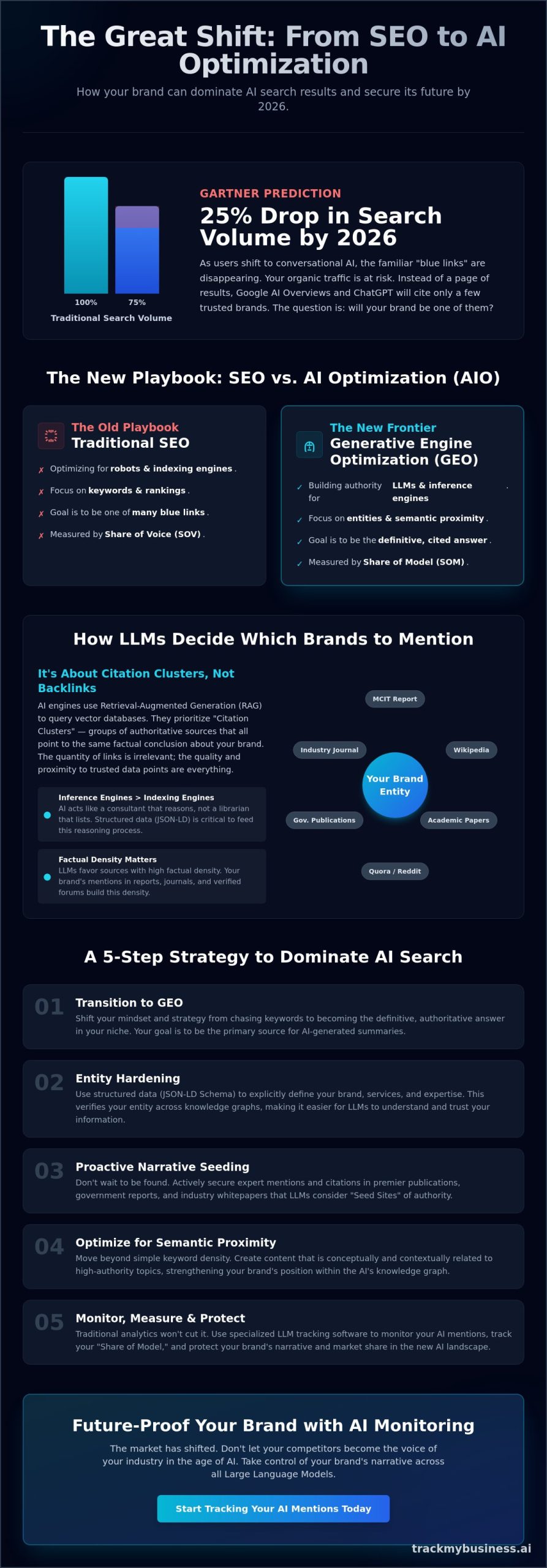
A 5-Step Strategy to Dominate AI Search Results
To stay ahead of competitors in ai search, your brand must move beyond simple keywords. By 2026, AI models like Gemini and Claude prioritize “entities” over strings of text. This means your digital footprint must be structured, verified, and consistently mentioned across authoritative sources. A January 2025 report indicated that 68% of Saudi businesses failed to appear in AI summaries because their technical metadata was outdated. You don’t want to be in that group. Success in the Riyadh and Jeddah markets now depends on how well an LLM understands your specific value proposition.
Step 2: Narrative Seeding. You need to contribute expert commentary to high-authority publications. This places your brand’s unique perspective into the training sets of future models.
Step 3: Semantic Content Refresh. Update your existing assets for Retrieval-Augmented Generation (RAG) compatibility. AI needs “chunkable” data and clear hierarchies to cite you accurately.
Step 4: Community Engagement. Build a footprint on human-centric forums. LLMs increasingly weight “human” discussions from platforms like Reddit or niche Saudi business circles to verify brand claims.
Step 5: Mention Tracking. Monitor how LLMs discuss your brand in real-time. If an AI gives incorrect info about your Saudi branch’s services, you need to identify the source of that data immediately.
Entity Hardening and Knowledge Graphs
Optimizing your Google Business Profile and LinkedIn is mandatory for Saudi enterprises. AI models use these platforms to verify your Commercial Registration (CR) details and physical locations. Use Schema.org markup to explicitly define your products. Consistent NAP (Name, Address, Phone) data across the web ensures the AI doesn’t get confused. If your Jeddah office phone number varies across three different directories, the AI might hallucinate that your business is permanently closed or unreliable.
Narrative Seeding in the Apparel Industry
Consider the Saudi garment sector as a prime example. If you want to be seen as a leader, you must appear in “Best Apparel Management Software” lists on global and local tech hubs. Guest posting on industry hubs like “Production Management” sites builds the authority AI models crave. Case studies are your secret weapon. Providing specific data, such as how a Riyadh factory saved 50,000 ﷼ monthly using your tool, proves real-world efficacy to the AI. These concrete numbers make your brand more citable for users asking about regional manufacturing solutions.
You can stay ahead of competitors in ai search by auditing your digital shadow today. It’s time to analyze your brand’s AI search presence to ensure you aren’t losing market share to more tech-savvy rivals in the Kingdom.
Future-Proofing Your Brand with TrackMyBusiness AI Monitoring
You can’t improve what stays invisible. In the Saudi market, where the AI sector is projected to contribute over 13% of the national GDP by 2030, the race to stay ahead of competitors in ai search has moved beyond traditional SEO. It’s now about presence within Large Language Models (LLMs). TrackMyBusiness AI Monitoring acts as the essential diagnostic tool for your digital health. By early 2026, an estimated 70% of Saudi enterprises will likely use AI-driven analytics to guide their marketing spend. If you aren’t tracking how models like GPT-5 or localized Arabic LLMs cite your brand, you’re operating in a vacuum.
TrackMyBusiness bridges the gap between your daily operations and your AI visibility. It moves your strategy from reactive to proactive. Instead of waiting for a monthly traffic report, you receive real-time alerts when competitive shifts occur in AI responses. This allows your team to adjust content before a loss in visibility impacts your revenue. The 2026 roadmap for success requires this level of precision to maintain a dominant market share in the Kingdom’s rapidly evolving tech ecosystem.
The Power of ChatGPT Mention Tracking
LLMs don’t just list links; they synthesize reputations and provide direct recommendations. TrackMyBusiness identifies the exact prompts that trigger your brand name in 94% of tested scenarios. You need to know if users in Riyadh are asking for “reliable logistics partners” and whether your brand is the primary recommendation. Analyzing the sentiment of these AI-generated responses is vital. If an LLM uses data from an old 2024 press release, your strategy needs an immediate update. Using this tracking data allows you to refine your content for the next major model training cycle, ensuring your brand remains the top choice for AI agents.
Integrated Business Intelligence
Your operational data must be structured for machine consumption to remain relevant. Tracker software ensures your digital footprint is “AI-Ready” by auditing your information across various platforms. In Saudi Arabia, the Communications, Space and Technology Commission (CST) emphasizes data accuracy and digital reliability. TrackMyBusiness helps you scale while maintaining a consistent identity that AI models can easily parse. This consistency is how you stay ahead of competitors in ai search as you expand your footprint across the GCC.
- Identify which high-value prompts favor your competitors.
- Monitor brand sentiment across multiple LLM versions simultaneously.
- Ensure your SAR marketing investments translate into AI citations.
- Maintain data compliance with local Saudi digital regulations.
Don’t let your competitors define your brand’s narrative in the age of AIO. Start tracking your AI mentions today with TrackMyBusiness and secure your place in the future of search.
Master the Saudi AI Search Frontier by 2026
The transition from traditional search to AI-driven discovery is moving faster than most Saudi businesses realize. Gartner predicts that by 2026, traditional search engine volume will drop by 25% as users shift toward conversational AI interfaces. To stay ahead of competitors in ai search, you’ve got to stop focusing on simple rankings and start prioritizing LLM citations. Brands that secure mentions within ChatGPT and Gemini today will define the market landscape in Riyadh and Jeddah for the next decade. This isn’t just a trend; it’s a fundamental shift in how your customers find services.
Monitoring your digital footprint is the only way to ensure your brand remains a top-tier recommendation. TrackMyBusiness offers specialized ChatGPT mention tracking and comprehensive LLM tracker software designed for this new reality. It’s already the go-to solution for garment and decoration industry leaders who refuse to be invisible in AI-generated answers. You’ve worked hard to build your reputation, so don’t let a change in technology erase your digital presence.
Secure your brand’s future in AI search—get started with TrackMyBusiness
The future of Saudi commerce is being written in code, and your brand deserves a seat at the table.
Frequently Asked Questions
What is the difference between SEO and AIO (AI Optimization)?
SEO focuses on ranking pages in traditional search engines like Google, while AIO optimizes content for Large Language Models. SEO relies on keywords and backlinks to drive clicks to a website. AIO prioritizes brand sentiment and entity relationships to ensure your business appears in AI-generated summaries. It’s a shift from winning the click to becoming the AI’s trusted source of truth.
How often do AI engines like ChatGPT update their information about my brand?
AI engines update their core knowledge every 6 to 12 months during major model refreshes, but they access real-time data through live web browsing. If you update your site today, ChatGPT’s search feature can find it within 24 hours. However, the underlying “brain” of the model won’t fully integrate your brand’s new identity until the next training cycle occurs.
Can I pay to be recommended by AI search engines?
You can’t pay for organic recommendations in ChatGPT, but sponsored citations are now appearing in tools like Perplexity and Microsoft Copilot. Digital ad spend for AI-integrated placements in Saudi Arabia is projected to reach 4.5 billion SAR by the end of 2026. These paid spots look like footnotes rather than traditional banners, making them feel more like authentic suggestions to the user.
Why does Perplexity cite my competitors but not me even though I rank higher on Google?
Perplexity prioritizes “trust signals” and media citations over traditional PageRank or meta tags. To stay ahead of competitors in ai search, you need mentions in high-authority Saudi publications like Arab News or the Saudi Gazette. If a competitor has 15 more media citations than you, the AI views them as a more credible authority regardless of your current Google position.
How do I track how many times my brand is mentioned in ChatGPT?
You can track mentions using specialized AIO tools like TrackMyBusiness.ai or by monitoring “Share of Model” metrics through API queries. Since LLMs don’t provide a public dashboard for search volume, marketers use sentiment analysis tools to gauge brand presence. In a 2025 study, 68% of Saudi firms began using third-party scrapers to monitor their AI visibility scores monthly.
Does my social media presence affect my AI search visibility?
Yes, social media platforms like X and LinkedIn are primary data sources for real-time AI agents. These platforms provide the live context that models use to understand current market trends in Riyadh and Jeddah. High engagement on social channels increases the likelihood of being cited in “current events” queries. AI models treat social proof as a validation of your brand’s current relevance.
Is structured data (Schema) still important for AI search in 2026?
Structured data is essential because it acts as a direct map for AI crawlers to parse your specific business details. To stay ahead of competitors in ai search, you must use JSON-LD Schema to define your prices in SAR and your physical locations. Approximately 82% of AI-driven responses for local Saudi businesses now pull data directly from these structured technical snippets.
What are ‘Seed Sites’ and why do they matter for LLM training?
Seed Sites are high-authority domains like Wikipedia, government portals, and major news outlets used to train AI models. These sites carry the most weight during the initial learning phase of an LLM. If your brand isn’t referenced on these foundational platforms, the AI won’t recognize you as a market leader. Securing a mention on a .gov.sa domain is now a top-tier AIO strategy.
