
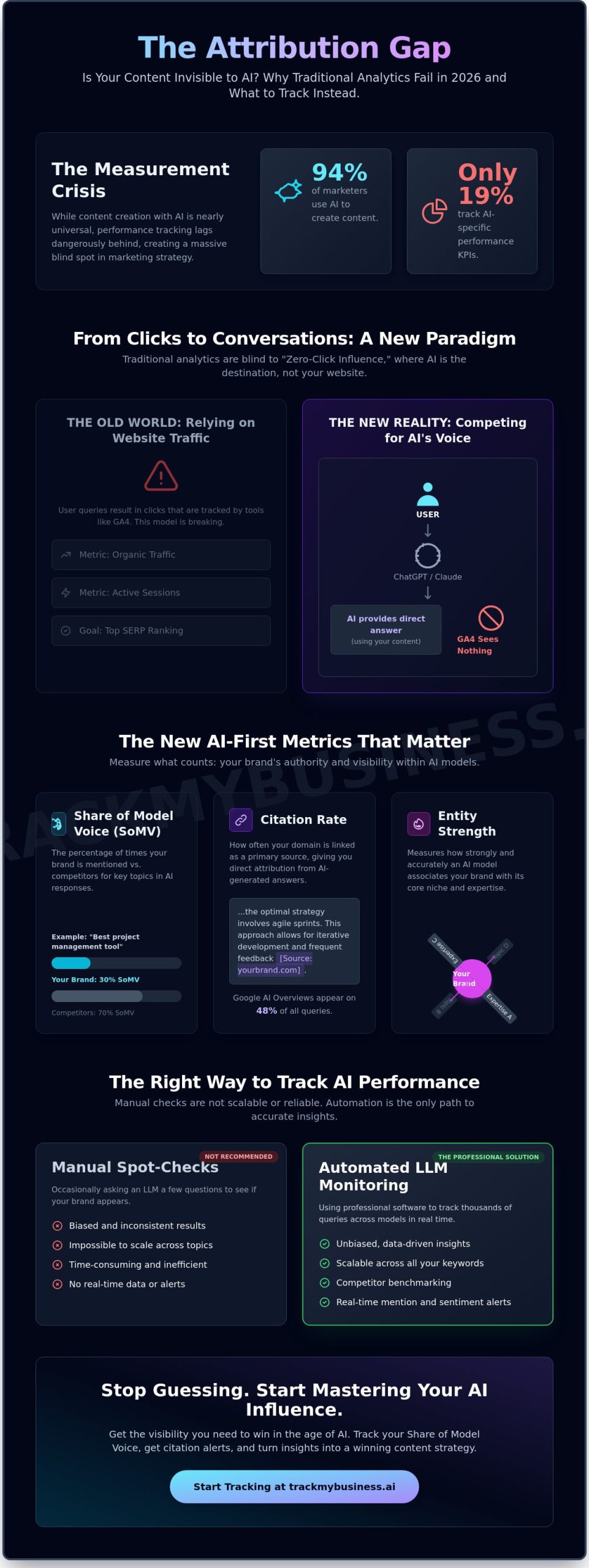
While 94% of marketers are now using AI to create content, a staggering 19% of content teams are actually tracking AI-specific KPIs. You’re likely producing more volume than ever, yet you’re flying blind when it comes to tracking content performance in ai models. It’s an unsettling reality for many brands in 2026. You see your traditional organic traffic plateauing while knowing that ChatGPT, Claude, and Perplexity are using your insights to answer users directly. This “dark traffic” doesn’t show up in GA4, leaving you wondering if your brand is being cited accurately, or at all.
We understand the frustration of inconsistent brand mentions and the lack of visibility into how LLMs perceive your expertise. This guide will change that. You’ll learn how to measure your “Share of Model Voice” and use automated tools to monitor brand sentiment in real time. We’ll provide a clear framework to analyze your presence and actionable steps to significantly improve your citation rates. It’s time to stop guessing and start mastering your influence within the AI ecosystem.
Key Takeaways
- Identify the “Attribution Gap” in GA4 and learn how to capture the true value of your content through Zero-Click Influence.
- Master new metrics like Share of Model Voice (SoMV) to benchmark your brand’s visibility against competitors in AI-generated responses.
- Discover why automated monitoring is the only scalable way for tracking content performance in ai models compared to biased manual spot-checks.
- Optimize your content for Entity Density to help Large Language Models better understand, categorize, and recommend your specific brand expertise.
- Implement professional LLM tracker software to receive real-time alerts whenever your brand is mentioned or cited as a source by ChatGPT.
Why Traditional Analytics Fail to Capture Your Content’s Value in 2026
In 2026, the digital marketing world has hit a wall. For years, we relied on Google Analytics 4 (GA4) to tell us exactly where our traffic came from. But today, a user can spend twenty minutes conversing with ChatGPT about your specific product or service without ever visiting your website. This is the “Attribution Gap.” GA4 sees nothing because the interaction happens within a closed ecosystem. Tracking content performance in ai models requires looking beyond the click to what we now call “Zero-Click Influence.” This is the dominant discovery path where AI models synthesize your content into a direct answer, effectively acting as the final destination for the user. You’re no longer just competing for a click; you’re competing to be the source of the model’s “truth.”
To understand why your current dashboard is failing, you have to look at the three stages of AI content ingestion. First is Crawling, where AI agents index your site structure. Second is Training, where your data is compressed into the model’s neural weights during its multi-billion dollar training runs. Third is Retrieval, where a model uses live search to pull your latest updates to answer a specific prompt. Traditional metrics only track the initial crawl, leaving you in the dark about how your content is actually used during training or retrieval. This is why “Model Citations” have replaced “Active Sessions” as the gold standard for measuring brand authority.
The Shift from SERP Rankings to Model Mentions
Traditional SEO focused on ranking #1 for specific keywords. In 2026, that’s no longer enough. AI models prioritize “authoritative entities” over pages that are simply keyword-optimized. You might hold the top spot on a Google SERP, yet Perplexity might completely ignore you if your brand isn’t recognized as a trusted entity in its underlying language model benchmarks. Influence Volume is a core 2026 KPI that measures the aggregate frequency and sentiment of brand mentions across AI dialogues. If you aren’t appearing in the model’s generated response, your SERP ranking is essentially a vanity metric.
Static Knowledge vs. Real-Time Retrieval (RAG)
Tracking content performance in ai models is complicated by how models “remember” things. Static knowledge is content baked into the model’s weights during its last training run. If your data isn’t there, you’re invisible to offline queries. Conversely, Retrieval-Augmented Generation (RAG) allows models to pull fresh data from the web in real time. Freshness is the deciding factor here. A multi-layered tracking approach is required to see if you’re being pulled from the model’s memory or if it’s finding you via a live search. If your content isn’t “retrieval-ready,” you’ll lose out to competitors who provide more recent, structured insights that AI agents can easily parse.
The New Hierarchy of Metrics: Tracking Citations and Share of Model Voice
The transition from website traffic to AI influence requires a complete overhaul of your KPI dashboard. In 2026, we’ve moved past simple session counts. You now need to measure how often an LLM chooses your brand as the definitive answer for a user. This is where the Share of Model Voice (SoMV) comes in. It represents the percentage of brand mentions your company receives within a specific category across models like ChatGPT and Claude. If a user asks for the “best project management tool,” and your brand appears in 3 out of 10 responses, your SoMV is 30%. It’s a direct reflection of your authority in the eyes of the algorithm.
Citation Rate is the next critical layer. As of February 2026, Google’s AI Overviews appear on 48% of all queries. This means nearly half of all searches are being summarized before a user ever sees a standard link. A high Citation Rate ensures that even when an AI provides the answer, your domain is linked as the primary source. Without this, you’re essentially providing free training data without any attribution. Tracking content performance in ai models helps you identify which specific pages are winning these citations and which are being ignored by the retrieval systems.
Understanding your Entity Strength is also vital. This measures how deeply an AI model associates your brand with a specific niche. If the model classifies you incorrectly, your visibility for relevant queries will plummet. Given the known challenges in AI model reliability, these associations can be volatile and prone to error. You must monitor if the model sees you as a “premium” leader or a “budget” alternative, as this sentiment alignment dictates the quality of the leads you’ll receive from AI recommendations.
Calculating Your Share of Model Voice (SoMV)
To calculate SoMV, you need to aggregate data across multiple platforms. The logic is simple: (Brand Mentions / Total Category Mentions) x 100. Doing this manually is impossible because AI responses are personalized and vary by session. You can automate this process using LLM tracker software to query models at scale. Focus on “Unbranded Queries” first. These are the broad industry questions where you want the AI to suggest your brand as the solution without being prompted specifically for it.
Sentiment and Semantic Association Tracking
AI models develop “opinions” based on the data they ingest. If your brand is frequently mentioned alongside terms like “complex” or “expensive,” the AI will reflect that in its dialogue. You need to track these semantic associations to prevent “Sentiment Drift.” Sentiment Drift occurs when the AI’s description of your brand slowly moves away from your actual value proposition, which can quietly destroy your conversion rates. Monitoring these shifts allows you to adjust your content strategy before the model’s perception becomes permanent knowledge.
Comparing Tracking Methodologies: Manual Spot-Checks vs. Automated LLM Monitoring
Many marketers still rely on manual prompting to see how their brand appears in AI results. They open a browser, type a query into ChatGPT, and celebrate if their name pops up. This approach is dangerously flawed. Manual checks are unscalable and suffer from extreme bias. Your personal search history, location, and previous interactions with the model influence the answer you see. To get an objective view of tracking content performance in ai models, you need a systematic approach that removes the “human in the loop” bias.
Automated LLM monitoring uses APIs to query multiple models simultaneously across thousands of variations. This method provides a statistically significant look at your visibility. Beyond just the response, you should also look at your server logs. Identifying when bots like GPTBot or Common Crawl are hitting specific product pages helps you understand which parts of your site are being ingested for future training runs. While building an internal script might seem cost-effective, the maintenance of keeping up with model updates usually makes a dedicated platform like TrackMyBusiness a more viable long-term investment.
The Perils of Personalized AI Responses
AI answers are no longer static. They are dynamic and highly personalized. If you’ve been researching your own brand, the model might “hallucinate” a higher preference for your products just to please you. Accurate data requires “Clean Room” tracking environments where every query starts from a neutral state. This is the only way to manage the inherent variability of LLM outputs. Without this neutrality, your reports will show a distorted reality that doesn’t reflect what a first-time prospect actually sees.
Tool Comparison: SEO Suites vs. AI Trackers
Standard SEO suites like Ahrefs or Semrush are excellent for backlink analysis and traditional SERP tracking. However, they lose their effectiveness once the user enters a conversational interface. Traditional tools see the “web” side, but they can’t see the “model response” side. Dedicated LLM trackers are designed specifically to measure your Share of Model Voice by analyzing the actual text generated in a session. You can see a breakdown of the differences below:
- Traditional SEO Tools: Focus on keyword rankings, backlinks, and domain authority. They don’t track dialogue.
- LLM Tracker Software: Focuses on mention frequency, sentiment analysis, and citation rates within AI answers.
- Integration: Leading trackers now allow you to export mention data directly into your CRM to see how AI visibility correlates with lead quality.
Choosing the right methodology depends on your scale. If you’re a small business, occasional spot-checks might suffice. But for brands competing in crowded markets, tracking content performance in ai models through automation is the only way to stay ahead of “Sentiment Drift” and maintain a dominant presence in the AI knowledge graph.
Closing the Loop: Turning AI Performance Data into Content Strategy
Data without action is just noise. Tracking content performance in ai models provides the blueprint for your next editorial calendar. If you notice an LLM hallucinating about your product features or pricing, it’s a glaring signal that the model lacks high-quality data to form a factual answer. You can bridge this gap by publishing a definitive guide or a technical whitepaper that addresses those specific misconceptions. When the model next crawls your site or retrieves live data, it will find the corrected information, effectively “training” the model to be more accurate regarding your brand.
You also need to focus on Entity Density. This is how clearly you define your niche so that AI models can categorize you correctly. If you sell specialized embroidery software, you want the AI to associate your brand with that exact entity rather than just generic “design tools.” You achieve this by consistently mentioning your brand alongside specific industry terminology. This helps the AI knowledge graph place you in the right bucket, ensuring you appear in the most relevant user dialogues. High-performing content should be updated regularly to maintain “Freshness” citations, as models often prioritize recent data during real-time retrieval.
Finally, use your tracking data to justify content spend to stakeholders. When you can demonstrate that a specific series of articles led to a measurable increase in model mentions or a higher citation rate, the ROI of your content strategy becomes undeniable. Instead of guessing which topics might work, you’re using hard data from the AI ecosystem to drive your investment decisions.
Industry Case Study: Apparel & Garment Manufacturing
A garment business can use these insights to see if AI recommends their Apparel ERP Software when a user asks about “sustainable fashion production.” By using LLM tracking, you can identify if competitors are being cited for specific industry terms like “circular supply chain” or “textile waste reduction.” If you find you’re being left out of these conversations, you can pivot your content strategy to target those specific semantic clusters. This ensures your brand remains a top-of-mind recommendation for B2B buyers using AI for vendor research.
Optimizing for AI “Extractability”
AI models prefer structured data that is easy to parse. You can increase your citation probability by using clear schemas, bulleted lists, and data tables. FAQ sections are particularly effective at winning the “Direct Answer” in generative search because they mirror the conversational nature of the models. The Tracker module highlights the specific URLs that LLMs pull from most often, providing a clear map of your most influential assets. By focusing on extractability, you make it easier for the AI to do its job, which in turn makes it more likely to credit your brand.
Ready to see which of your pages are winning the AI citation war? Start monitoring your LLM visibility today.
Scaling Your AI Visibility with TrackMyBusiness LLM Tracker
You’ve identified the attribution gaps and defined your new KPIs. Now you need the infrastructure to execute this strategy at scale. Tracking content performance in ai models isn’t a one-time audit; it’s a continuous pulse on how your brand exists within the digital mind. The TrackMyBusiness “Tracker” module was built to solve the specific invisibility problem created by the rise of generative search. It provides a centralized dashboard where you can monitor your Share of Model Voice across ChatGPT, Claude, Gemini, and Perplexity without the bias of manual prompting.
One of the most critical features of the platform is real-time alerting. In the fast-moving landscape of 2026, a single high-profile hallucination or a sudden drop in citation rates can impact your bottom line within days. Tracker monitors these shifts constantly. If an LLM starts associating your brand with a competitor’s product or a negative industry trend, you’ll receive an immediate notification. This allows your content team to pivot and publish corrective data before the model’s perception hardens into its long-term training weights.
Specialized industries like garment manufacturing and custom decoration benefit most from this granular visibility. These sectors often deal with complex technical entities that general-purpose SEO tools fail to categorize correctly. Tracker understands the nuances of B2B production and order management, ensuring that your content is being indexed and recommended for the right professional queries. Looking toward 2027, our roadmap includes predictive tracking. This feature will use historical data to suggest AI-driven content recommendations, telling you exactly which topics are about to trend within the LLM ecosystem before they hit the mainstream web.
Why a Specialized Tracker Beats General SEO Tools
Traditional SEO suites are built for a world of links and clicks. While they’ve tried to bolt on AI features, they often miss the conversational context that defines modern discovery. Our Tracker Software focuses specifically on the “Apparel and Decoration” industry context. It doesn’t just tell you that you were mentioned; it analyzes if the AI understands your role in the supply chain. By integrating this data with your production and order management insights, you gain full-funnel visibility that spans from the initial AI dialogue to the final purchase.
Getting Started with AI Performance Tracking
Setting up your first “Brand Watch” is simple. You define your core brand entities, your primary competitors, and the specific industry terms you want to own. The software then begins querying multiple models to establish your baseline Share of Model Voice. This data allows you to see exactly where you stand compared to the competition in real time. If you’re ready to stop guessing about your AI influence, you can Request a Demo of Tracker’s LLM Monitoring System and start tracking content performance in ai models with professional precision today.
Master Your Brand’s Future in the AI Ecosystem
The digital landscape has shifted permanently from clicks to conversations. You now understand that relying on traditional analytics leaves you blind to the “Zero-Click Influence” shaping your brand’s reputation. By focusing on the new hierarchy of metrics like Share of Model Voice and Citation Rates, you can move from guessing to knowing exactly how LLMs perceive your expertise. tracking content performance in ai models is no longer an optional experiment; it’s a fundamental requirement for staying visible in 2026.
Whether you’re managing complex supply chain data or niche garment production details, having the right tools makes all the difference. TrackMyBusiness offers a specialized solution for the garment and decoration industry, providing real-time transparency across both your production and your AI visibility. Our integrated cloud-based ERP ensures that your mention monitoring is tied directly to your actual business operations. This level of transparency is essential for maintaining authority as AI models become the primary gatekeepers of information.
Don’t let your brand become a ghost in the machine. Start tracking your AI model mentions with TrackMyBusiness Tracker and take control of your narrative. The era of AI-driven discovery is here, and you’re now ready to lead it.
Frequently Asked Questions
Is tracking content performance in AI models different from traditional SEO?
Yes, tracking content performance in ai models is fundamentally different because it measures influence within a generated response rather than a list of blue links. Traditional SEO relies on click-through rates and keyword rankings on a search results page. In contrast, AI performance tracking analyzes how often a model synthesizes your data into a direct answer. It requires shifting your focus from driving traffic to becoming the trusted source that the model cites.
Can I see exactly how many people saw my brand in ChatGPT?
You cannot see exact individual impression counts for ChatGPT sessions because that data is private to the model provider. Instead, you measure visibility through systematic prompting and citation frequency across thousands of simulated sessions. This gives you a statistically significant estimate of your reach. While you won’t see “1,000 views,” you will see that your brand appeared in a specific percentage of relevant category queries.
What is the most important metric for AI content performance in 2026?
Share of Model Voice (SoMV) has emerged as the most critical metric for tracking content performance in ai models. This metric quantifies how frequently your brand is mentioned compared to your top competitors across various LLMs. It provides a clear picture of your authority within a specific niche. High SoMV scores usually correlate with higher brand trust and indirect conversion rates from AI-driven recommendations.
How do I improve my brand’s visibility in Perplexity and Claude?
Improving visibility in Perplexity and Claude requires a focus on Retrieval-Augmented Generation (RAG) readiness. Ensure your site uses highly structured data and clear, concise headers that AI agents can easily parse. Since Perplexity often cites live web sources, maintaining content freshness through regular updates to your core pages is vital for staying in their active retrieval pool.
Does AI content performance tracking require technical coding skills?
Technical coding skills are not required if you use dedicated tracker software. These platforms use their own APIs to query models and aggregate data into a user-friendly dashboard. You can set up “Brand Watches” and monitor sentiment without ever writing a line of code. This allows marketing teams to focus on content strategy rather than technical maintenance or script debugging.
How often should I check my brand’s Share of Model Voice?
You should monitor your brand’s visibility at least once a week to catch “Sentiment Drift” early. AI models are updated and fine-tuned constantly, which can lead to sudden shifts in how they describe your business. For competitive industries, setting up real-time alerts for brand mentions ensures you can react immediately if a model begins hallucinating incorrect information about your services.
Will my traditional SEO tools work for tracking AI model mentions?
Traditional SEO tools don’t work effectively for tracking AI model mentions because they lack access to conversational outputs. They are built to crawl the open web and track backlinks or keyword positions on standard search engines. They cannot see what happens inside a private ChatGPT or Claude dialogue. Specialized trackers are needed to bridge this visibility gap and analyze generated text.
How does TrackMyBusiness help with LLM tracking for the garment industry?
TrackMyBusiness specializes in the garment and decoration industry by tracking industry-specific entities. It monitors if AI models correctly associate your brand with terms like “apparel ERP” or “textile production management.” This ensures you aren’t just a generic mention but are recognized as a leader in your specific B2B niche, providing full-funnel visibility from the initial AI dialogue to the final order.
