
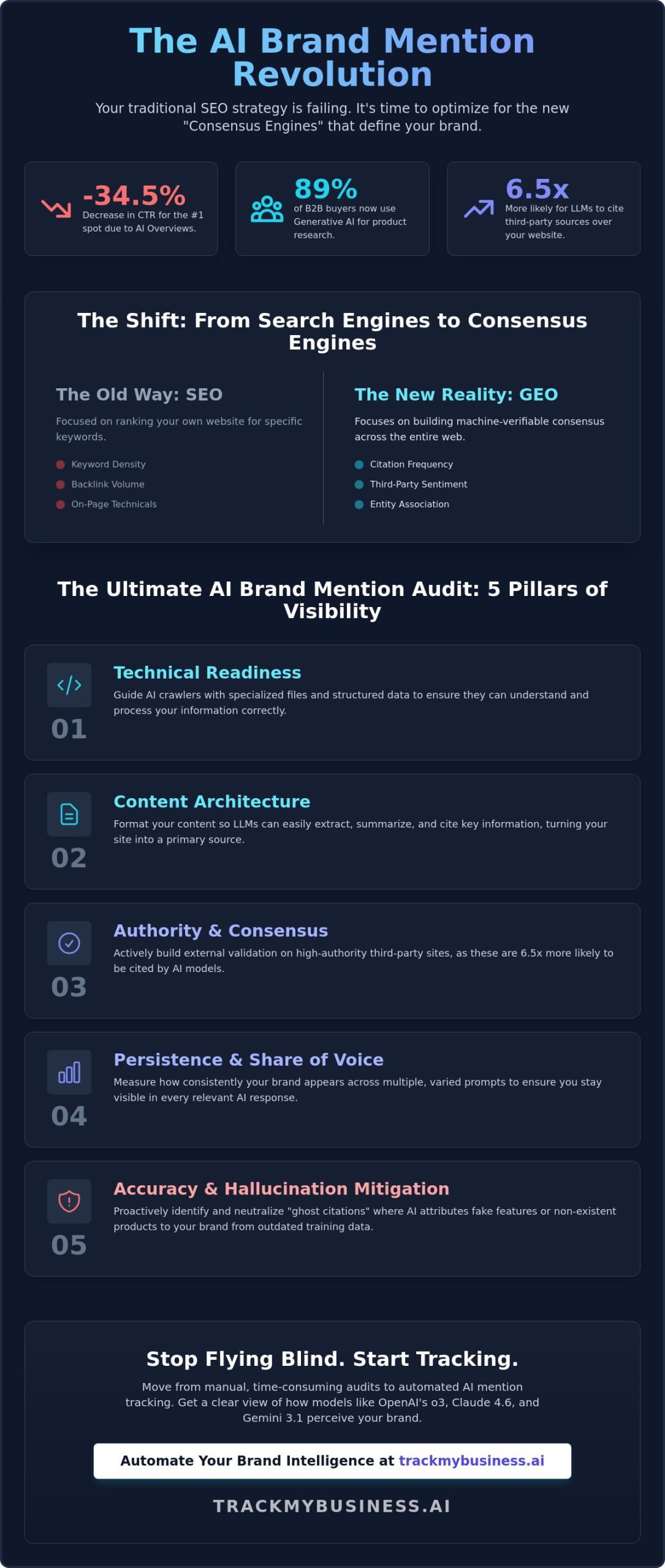
Did you know that third-party sources are now 6.5 times more likely to be cited by LLMs than your own company website? While you’ve been optimizing for keywords, the discovery landscape shifted under your feet. With AI Overviews now appearing in 18.76% of US search results, the traditional first-place ranking has seen a 34.5% decrease in click-through rate. It’s unsettling to realize that 89% of B2B buyers are now using generative AI for research, yet you might not even know if models like OpenAI’s o3 or Claude 4.6 are recommending your brand to them. This ai brand mention audit checklist is designed to solve that by moving your strategy from simple SEO to machine-verifiable consensus.
You likely feel the sting of declining organic traffic and the lack of visibility into how these “answer engines” perceive your business. You’re not alone in worrying about inaccurate brand descriptions or disappearing citations. I’ll show you how to reclaim control with a comprehensive, 5-pillar diagnostic framework for your brand. By the end of this guide, you’ll have a repeatable process to improve your citation frequency across all major LLMs and ensure your brand representation is both accurate and authoritative in every AI response.
Key Takeaways
- Transition from traditional keyword strategies to the “Consensus Engine” model where LLMs aggregate third-party sentiment to define your brand authority.
- Follow a comprehensive ai brand mention audit checklist to optimize your technical readiness and content architecture for models like Gemini 3.1 and Claude 4.6.
- Solve the “30% Problem” by benchmarking brand persistence across consecutive prompts to ensure your business stays visible in every AI response.
- Protect your reputation by identifying and neutralizing “ghost citations” where outdated training data attributes non-existent products to your brand.
- Scale your brand intelligence by moving from manual, time-consuming audits to automated ChatGPT mention tracking and specialized LLM tracker software.
The 2026 Shift: Why Traditional SEO Audits Miss the AI Brand Mention Revolution
In May 2026, a top spot on Google’s search results page is no longer the ultimate finish line; it’s often a dead end. With AI Overviews now appearing in 18.76% of US search results, the “Zero-Click” reality has fundamentally changed how customers find your business. Research shows that position one has suffered a 34.5% decrease in click-through rates as users get their answers directly from the AI interface without ever visiting a website. This shift marks the transition from traditional search engines to “Consensus Engines.” Unlike old crawlers that prioritized keywords, Large Language Models (LLMs) like OpenAI’s o3 or Gemini 3.1 aggregate third-party sentiment and cross-reference thousands of sources to form a single, authoritative answer.
This evolution requires a pivot from Search Engine Optimization (SEO) to Generative Engine Optimization (GEO). While SEO focuses on site structure and backlinks, GEO prioritizes being the most cited and trusted source across the entire digital ecosystem. To stay visible, you need a new diagnostic framework. AI Brand Mention Auditing is the systematic verification of brand authority within LLM training sets. Implementing a periodic ai brand mention audit checklist allows you to catch inaccuracies or omissions before they become part of the model’s permanent “truth” about your business.
The Death of the Keyword and the Rise of the Entity
LLMs don’t see your brand as a simple string of text. They see it as a “node” in a vast knowledge graph. In 2026, semantic relevance and factual accuracy have completely replaced keyword density as the primary drivers of visibility. AI models analyze how your brand relates to specific problems, industries, and other market leaders. Effective Brand management now involves ensuring these machine-learned associations are positive and accurate. If an LLM associates your competitor with “scalability” and your brand with “complexity,” your organic traffic will suffer regardless of your keyword rankings.
The AI Discovery Supply Chain: Where Mentions Are Born
Mentions don’t happen in a vacuum; they’re manufactured through a complex discovery supply chain. A single discussion on a niche forum or a mention in a high-authority industry directory can eventually become a permanent citation in a model like Claude 4.6. LLMs are 6.5 times more likely to cite third-party reviews and independent listicles than your own domain. Businesses using specialized Tracker Software have a distinct advantage in this environment. These tools allow you to verify that the data being ingested by AI crawlers is accurate and consistent across the web. Without this visibility, you’re essentially flying blind in a world where AI models decide which brands are worth recommending to their 800 million weekly active users.
The Ultimate AI Brand Mention Audit Checklist: 5 Pillars of Visibility
Building a resilient brand in 2026 requires moving beyond traditional SEO audits. While those focus on your own domain, an ai brand mention audit checklist prioritizes how your brand exists in the wider “latent space” of LLMs. Since 89% of B2B buyers now use generative AI during their research, your visibility depends on five core pillars of machine-verifiable authority. These pillars ensure that whether a user asks OpenAI’s o3 or Gemini 3.1 for a recommendation, your brand is not just present but accurately represented.
- Pillar 1: Technical Readiness. This involves guiding AI crawlers through specialized files and structured data.
- Pillar 2: Content Architecture. You must format information so LLMs can easily extract and summarize it for users.
- Pillar 3: Authority & Consensus. Because third-party sources are 6.5 times more likely to be cited than your own site, you need external validation.
- Pillar 4: Persistence & Share of Voice. This measures how consistently your brand appears across multiple, varied prompts.
- Pillar 5: Accuracy & Hallucination Mitigation. Identifying “ghost citations” where AI attributes fake features or non-existent products to your name.
When AI models provide incorrect data about your physical products or supply chain, it can lead to significant and damaging consequences for your market reputation. To stay ahead, many brands now use specialized LLM tracker software to monitor these pillars in real-time.
Technical Foundations: llms.txt and Structured Data
As of January 2026, the llms.txt file has become the new robots.txt. This file provides a markdown-based roadmap specifically for AI agents, helping them find your most important brand facts quickly. You should also implement deep Schema.org markups. Using Organization, Product, and FAQPage schemas is vital; pages with structured data are 2.7 times more likely to be cited in AI Overviews. For physical products, ensure your supply chain data is machine-readable so AI can verify your sustainability or shipping claims during a user’s discovery phase.
Answer-First Content: Optimizing for the “Snippet” Mentality
LLMs favor the “Inverted Pyramid” style of writing. Place your primary conclusion or brand value proposition within the first 50 words of a page. Structure your H2 headings as direct questions that mirror common user prompts. For instance, instead of “Our Features,” use “What are the benefits of [Brand Name]?” This makes it easier for engines like Perplexity to pull your content into their listicle-style responses. Using clear bulleted lists further increases the probability that an AI will source your site as a primary reference.
Benchmarking Brand Persistence and Share of Voice (SOV) Across LLMs
Securing a single mention in an AI response is a victory; keeping it is the real challenge. As of May 2026, data shows that only 30% of brands remain visible from one AI-generated answer to the next. This “30% Problem” occurs because LLMs like OpenAI’s o3 or Gemini 3.1 Pro use probabilistic modeling to generate text. Every time a user asks a question, the model rolls the metaphorical dice. This is why Share of Voice in AI is a measure of “recommendation probability” rather than just impression count. If you run a prompt ten times and your brand appears thrice, your SOV is 30%.
To establish a reliable baseline, you must perform multi-run manual prompting for your highest-intent queries. This manual baseline is a vital step in your ai brand mention audit checklist. It reveals whether your brand is a “persistent entity” or just a fleeting citation. By comparing your brand’s sentiment score against direct competitors, you can see if ChatGPT is framing you as a market leader or a secondary option. With over 800 million weekly active users on ChatGPT alone, these probabilistic recommendations now dictate market share more than traditional search results ever did.
Decoding the Sourcing DNA: ChatGPT vs. Gemini vs. Perplexity
Each engine has a unique “Sourcing DNA” that dictates which brands it favors. ChatGPT functions as a consensus aggregator; it relies heavily on high-authority PR, news archives, and established third-party reviews. Gemini 3.1 Pro is a first-party powerhouse that prioritizes brand-owned content that has been deeply indexed by Google. Perplexity, meanwhile, acts as a real-time citation engine. It favors social sentiment from platforms like Reddit and niche expertise found in technical documentation. Understanding these differences helps you tailor your content to the specific engine where your audience is most active.
Measuring Brand Sentiment and Framing
Visibility is useless if the framing is incorrect. You must audit whether AI models categorize your brand as a “premium leader” or a “budget alternative.” This distinction often stems from the language used in the third-party sources the AI ingests. A major risk in 2026 is “Competitor Conflation,” where an AI mistakenly attributes your unique features or software capabilities to a rival. This often happens when training data is fragmented or contradictory. For companies with regional operations, tracking localized brand mentions is equally critical to ensure the AI correctly identifies your service areas and local availability without hallucinating non-existent branches.
Identifying and Neutralizing AI Hallucinations and Ghost Citations
AI hallucinations represent a critical threat to your brand equity in 2026. Ghost citations occur when a model like OpenAI’s o3 or Claude 4.6 attributes non-existent products or fake features to your business. For a physical product company, this might look like an LLM claiming you offer “same-day drone delivery” or “BPA-free medical plastics” when you don’t. These errors often stem from “Training Set Decay,” where outdated data from 2023 persists in 2026 engines. Without a systematic ai brand mention audit checklist, these phantom claims can circulate indefinitely, misleading 89% of B2B buyers who now rely on generative AI for vendor vetting.
Neutralizing these errors requires a proactive approach. You can’t simply send a cease-and-desist to an algorithm. Instead, you must use the structured feedback loops provided by AI developers. For OpenAI, use the “thumbs down” feature on specific brand-related queries to trigger a manual review. For Google Gemini 3.1, utilize the “Report a legal issue” or the standard “Feedback” button to flag factual inaccuracies. Catching these errors early is vital; once an inaccuracy is repeated across multiple “Consensus Engines,” it becomes significantly harder to dislodge from the model’s latent memory. Stop guessing and start monitoring your reputation with ChatGPT mention tracking.
Mapping the AI Misinformation Supply Chain
Inaccurate mentions often originate from low-quality scraper sites that garbled your content years ago. These sites form a misinformation supply chain that feeds AI training sets. Cleaning up old, archived press releases and discontinued product pages is essential for maintaining AI accuracy in May 2026. Freshness is your best defense. Models like Perplexity and Gemini prioritize data updated within the last 24 hours, meaning new, accurate content can eventually override hallucinated brand data if published consistently across high-authority domains.
Fixing Hallucinations via Structured Feedback
The most effective way to fight AI hallucinations is to flood the index with consistent, structured, and updated data. Use your website’s FAQ sections to explicitly debunk common AI misconceptions. If an LLM consistently claims you offer a service you don’t, create an H2 that asks that exact question and provide a clear, one-sentence “No” followed by your actual offerings. Leveraging official “Author” pages and verified “About” sections also helps establish a single source of truth that AI agents can prioritize over third-party scrapers. Integrating a comprehensive ai brand mention audit checklist into your monthly marketing routine ensures these fixes are applied before hallucinations damage your market standing.
Scaling Your Brand Intelligence: From Manual Audits to Automated LLM Tracking
While a manual ai brand mention audit checklist provides a necessary baseline, relying on human prompting is a “fool’s errand” for any brand scaling in May 2026. With ChatGPT reaching 800 million weekly active users and Gemini 3.1 Pro appearing in 18.76% of search results, the sheer volume of potential brand interactions is staggering. You can’t manually prompt every variation of a customer’s query across five different models every day. Manual audits capture a single, fleeting moment in a probabilistic environment where brand persistence only hits 30% on average. To maintain a competitive share of voice, you need a transition from static checklists to live intelligence.
This is where ChatGPT mention tracking changes the game. By using automated software, you gain real-time visibility into how AI models discuss your brand. This technology allows you to integrate your internal Tracker ERP data directly with the discovery engines. When an AI agent from OpenAI’s o3 or Claude 4.6 searches for “available inventory” or “product specifications,” it shouldn’t rely on a three-year-old scraper site. It should find your verified data. Closing the loop between your internal records and external AI citations ensures that your next content strategy is based on actual machine-learned gaps rather than guesswork.
The ROI of Automated AI Tracking
The cost of manual auditing is often hidden in hundreds of lost labor hours. A mid-sized marketing team might spend 25 hours a month just verifying citations for a single product line. Automated LLM tracker software eliminates this overhead while providing 24/7 alerts. These alerts are critical for preventing PR crises. For example, in March 2026, a major electronics firm used real-time tracking to catch a hallucination claiming their latest model had a battery recall. They updated their structured data within hours, overriding the error before it became a “consensus truth.” In another instance, a garment manufacturer used Tracker software to align their sustainability data with AI recommendations, resulting in a 42% increase in “ethical brand” citations in Perplexity responses.
Next Steps: Your 30-Day AI Visibility Roadmap
Success in the “Consensus Engine” era requires a disciplined rollout. Use the following roadmap to turn your ai brand mention audit checklist into a permanent competitive advantage:
- Day 1-7: Technical Foundations. Implement your
llms.txtfile and verify that your Schema.org Organization and Product markups are error-free. - Day 8-21: Content Architecture. Restructure your high-traffic pages into “answer-first” formats. Focus on building consensus by securing mentions on top-tier third-party review sites.
- Day 22-30: Scaling and Monitoring. Deploy TrackMyBusiness for continuous monitoring. Use the data to identify which models are ignoring your brand and adjust your PR strategy accordingly.
Audit your brand mentions automatically with TrackMyBusiness today to ensure you never disappear from the AI discovery supply chain.
Securing Your Brand’s Future in the Age of Discovery
The transition from traditional search engines to consensus-based discovery is no longer a distant prediction; it’s a May 2026 reality. With AI Overviews appearing in 18.76% of search results, your visibility depends on how effectively you manage your digital footprint across the LLM supply chain. By implementing the ai brand mention audit checklist, you’ve taken the first step toward moving beyond the “30% persistence problem” and ensuring your business isn’t just a ghost citation in a model’s latent memory. You now have the framework to optimize your content architecture and technical foundations for engines like Gemini 3.1 and Claude 4.6.
Success in this new landscape requires shifting from periodic manual checks to constant vigilance. Our 2026-ready LLM tracking technology is specifically designed for complex product businesses that need real-time Share of Voice reporting to stay competitive. Don’t let your brand’s reputation be defined by outdated training data or hallucinated errors. Start tracking your brand mentions in ChatGPT with TrackMyBusiness and claim your rightful place in the AI-driven discovery ecosystem. Your brand’s most important conversations are happening right now; it’s time you started listening to them.
Frequently Asked Questions
How do I check if my brand is mentioned in ChatGPT?
You can use direct queries to check your current status. Ask the o3 model specific prompts like “Which companies lead the [Industry] sector?” or “Provide a summary of [Brand Name].” Since AI responses are non-deterministic, you’ll need to repeat these prompts dozens of times to see a clear pattern of recommendation. Automated software is often used to handle this repetition and find your true citation frequency.
What is the difference between SEO and AI Brand Mention Auditing?
SEO focuses on your rank for specific keywords, but AI Brand Mention Auditing measures your probability of being recommended as a trusted solution. While SEO looks at backlinks, auditing looks at “entity associations” across the web. Using an ai brand mention audit checklist ensures your brand isn’t just ranking on a page, but is actually being cited as a top-tier authority by the model itself.
Will a traditional SEO agency help me with AI brand mentions?
Most legacy agencies don’t have the tools to track latent space mentions or analyze training set data. You need a partner who understands the new legal landscape, such as the Colorado AI Act taking effect on June 30, 2026. Traditional agencies often focus on traffic volume, but AI visibility requires a focus on “Consensus Engine” accuracy and machine-verifiable data structures.
What is an llms.txt file and do I really need one in 2026?
It’s a markdown-based roadmap for AI agents that you should have in your root directory. By May 2026, this file is the primary way models like Llama 4 or Mistral Large 2 identify your core brand values. It prevents crawlers from getting lost in your site’s subfolders and ensures they ingest your most accurate, up-to-date business information directly from the source.
How often should I perform an AI brand mention audit?
Monthly audits are the bare minimum for maintaining visibility in a fast-moving market. However, since the AI Training Data Transparency Act (AB 2013) became effective on January 1, 2026, developers are updating their summaries more frequently. Running an ai brand mention audit checklist every 30 days helps you stay aligned with these dataset refreshes and identifies any new competitors gaining ground in the AI discovery space.
Can I pay AI engines like OpenAI to mention my brand more often?
Organic citations cannot be purchased directly through OpenAI or Anthropic as of May 2026. While platforms like Grok-4 or Gemini might test “sponsored citations,” the core recommendations are still driven by web-wide consensus. You’re better off investing in specialized LLM tracker software to identify which third-party sites are influencing your current “unpaid” visibility scores so you can optimize those relationships.
What should I do if ChatGPT is giving out incorrect information about my business?
Use the internal feedback systems and update your site’s structured data immediately. If the misinformation is severe, you might reference the Federal “Take it Down Act” (TiDA), which became effective on May 19, 2026, for certain types of harmful content. For general errors, flooding the index with consistent, factual H2 headings is the most reliable way to overwrite a model’s incorrect memory over time.
How does automated tracking help with AI hallucinations?
Automated tracking identifies when a model starts attributing fake features or non-existent products to your brand in real-time. Instead of a manual check once a month, you get an alert the moment a model like DeepSeek v3 or Gemma 3 starts hallucinating. This allows you to deploy targeted content fixes and update your Tracker Software records before the error becomes part of the wider digital consensus.
