
If your current monitoring strategy ignores AI chat results, you’re flying blind to 45% of the digital conversations happening about your business right now. It’s a common frustration for entrepreneurs in Saudi Arabia who find their inboxes flooded with irrelevant notifications while missing critical mentions on emerging platforms. You know that a cluttered alert system is just as dangerous as no system at all because it leads to notification fatigue and missed opportunities. We agree that your time is too valuable to spend sifting through digital noise that doesn’t impact your bottom line.
This guide shows you how to optimize google alerts brand tracking to create a precise, automated shield for your reputation. You’ll learn how to close the gap between traditional web searches and AI-generated content while implementing filters that remove 90% of the junk. We’ll walk through the exact steps to build a streamlined system tailored for the 2026 Saudi business landscape, ensuring you never miss a vital mention again.
Key Takeaways
- Master the essential 5-step setup for google alerts brand tracking to ensure your Saudi business never misses a critical web mention or news update.
- Identify the strategic “seed” keywords needed to monitor competitor PR moves and industry-specific shifts within the Kingdom’s evolving market.
- Uncover why traditional monitoring tools fail to capture “Dark Social” conversations and how this gap impacts your brand’s visibility on platforms like TikTok and X.
- Discover how to leverage advanced LLM tracker software to analyze what AI platforms like ChatGPT are telling potential customers about your business.
What is Google Alerts Brand Tracking and Why Does it Matter?
Google Alerts is a free notification service that monitors the web for specific keywords and sends email updates when it finds new content. It serves as the primary frontline for Online Reputation Management (ORM). With 99% of the Saudi population active online as of the 2023 Communications, Space and Technology Commission (CST) report, digital sentiment can change in minutes. Using google alerts brand tracking allows businesses to monitor these shifts without manual searching.
Understanding the difference between branded and discovery searches is vital for a growing business. Branded searches occur when a customer specifically looks for your name, like “NEOM” or “Aramco.” Discovery searches are broader, such as “logistics companies in Dammam.” While discovery searches help with customer acquisition, branded tracking protects your existing equity. Real-time alerts prevent small PR issues from becoming viral crises. Catching a negative blog post early allows for a direct response, potentially saving thousands of SAR in lost revenue from a damaged reputation.
The Benefits of Monitoring Your Brand Name
Monitoring your brand name provides several strategic advantages for Saudi businesses:
- SEO Backlink Opportunities: You can identify unlinked brand mentions. If a local news site mentions your company but doesn’t link to your site, reaching out to request a link can boost your search engine rankings.
- Stakeholder Tracking: It’s important to track executive names and key stakeholders. Personal branding for leadership is a major trust factor in the Saudi market, and tracking these names ensures you know what’s being said about your leadership team.
- Product Reviews: You can monitor product-specific reviews across niche industry blogs or forums. This feedback loop is essential for refining offerings to meet local consumer expectations.
Branded vs. Non-Branded Tracking Strategy
A sophisticated google alerts brand tracking strategy goes beyond just your company name. You should track specific combinations like “Brand Name + Review” or “Brand Name + Problem” to find hidden customer frustrations. This proactive approach helps you address issues before they reach social media platforms. Monitoring competitor mentions provides intelligence on where rivals are gaining traction or facing criticism. Branded tracking is the process of monitoring your unique identity markers across the indexed web.
Tracking non-branded industry terms helps you stay ahead of regulations or market shifts. For example, a fintech firm in Riyadh might track “SAMA regulations 2024” alongside their own brand. This ensures they’re part of the conversation as soon as it happens, rather than reacting days later. By setting up these parameters, you turn a simple notification tool into a powerful market intelligence asset.
How to Set Up Google Alerts for Your Business: A 5-Step Guide
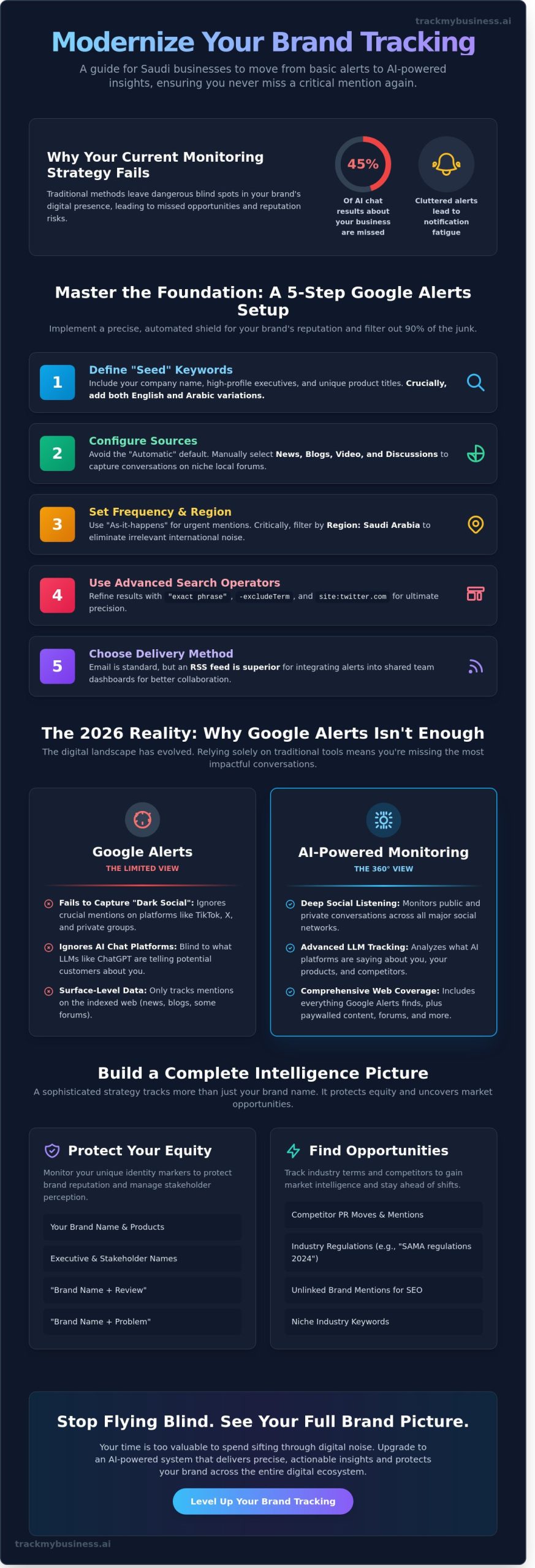
Implementing google alerts brand tracking starts with a clear strategy. First, visit the Google Alerts dashboard and enter your “seed” keywords. These should include your company name, high-profile executives, and unique product titles. For a Saudi-based enterprise, include both English and Arabic variations to capture the full market sentiment across the Kingdom.
Next, configure your “Sources.” While “Automatic” is the default, selecting News, Blogs, Video, and Discussions specifically ensures you don’t miss niche conversations on local forums. Set your frequency to “As-it-happens” for urgent brand mentions or “At most once a day” for a cleaner workflow. High-growth startups in Riyadh often prefer the daily digest to avoid constant interruptions during peak business hours. Ensure you filter by “Region” and select Saudi Arabia. This step filters out international noise and focuses on the 36 million potential customers within the local market. Finally, choose your delivery method. Email is standard, but an RSS feed is superior for teams using shared dashboards for optimizing your business data and transparency.
Using Advanced Search Operators to Reduce Noise
Precision is vital for effective google alerts brand tracking. Use quotation marks for exact phrase matching, such as “Riyadh Logistics Hub,” to avoid alerts for every mention of those individual words. The minus sign (-) is your best tool for exclusion. If your business name is shared with a global entity, use “YourBrand -GlobalCorp” to keep results relevant to your local operations. You can also monitor specific platforms by using the “site:” operator. For example, “site:twitter.com YourBrand” tracks mentions specifically on that social network, allowing you to respond to customer feedback in real time.
Organising Your Alerts for Efficiency
A cluttered inbox kills productivity. Professional PR agencies in Saudi Arabia, which can charge over 10,000 SAR monthly for monitoring, stay organized by using automated filters. You should do the same. Create a specific Gmail label titled “Brand Mentions” and set a filter so these emails bypass your primary inbox. This keeps your workspace clean while building a searchable archive of your brand’s digital history. Schedule a 15-minute “Brand Health” review every Sunday afternoon. This routine helps you spot emerging trends by identifying recurring customer pain points or praise before the start of the new Saudi work week. Consistency here prevents small issues from turning into expensive reputation crises.
Beyond Your Brand: What Else Should You Be Tracking?
Limiting your strategy to your own company name is a missed opportunity. Effective google alerts brand tracking requires a 360 degree view of the Saudi Arabian marketplace. You need to monitor the entire ecosystem to stay ahead. This includes watching how rivals move, how regulations shift, and how customers express frustration. In the Saudi garment sector, where the Fashion Commission projects the industry will contribute over 56 billion SAR to the GDP by 2032, staying informed is a competitive necessity.
Set up alerts for industry specific keywords like “Saudi textile manufacturing” or “Riyadh fashion retail trends.” Monitoring customer pain points is equally vital. Use phrases like “problem with garment delivery” or “embroidery machine repair Saudi.” These alerts act as a real time focus group. If you see people complaining about a 10 day delay in custom abaya printing from other providers, you can pivot your marketing to highlight your 48 hour turnaround time. Negative sentiment triggers are your early warning system. Alerts for “scam,” “fake,” or “not working” combined with your niche keywords help you identify bad actors or widespread service failures in the region before they affect your reputation.
Tracking Your Competitors Strategically
Monitoring rivals goes beyond simple curiosity. You can identify which media outlets, such as Arab News or Asharq Al-Awsat, are covering your competitors. If a rival brand in Jeddah receives a feature for their new sustainable fabric line, you know exactly which journalists to target for your next PR push. Track price changes by setting alerts for “competitor name” plus “discount” or “offer.” If a rival drops prices by 20 percent, reducing a standard thobe from 250 SAR to 200 SAR, you can respond with a loyalty bundle to retain your customers. Use these alerts to find dissatisfied users on forums or social blogs; providing a helpful solution to their specific problem can win you a customer for life.
Monitoring Industry-Specific Regulatory Changes
The Saudi regulatory environment moves fast under Vision 2030. You must track SASO (Saudi Standards, Metrology and Quality Organization) updates regarding textile safety and labeling. Changes in garment manufacturing laws or ZATCA e-invoicing requirements can impact your overhead costs overnight. Using Tracker software helps you align your production schedules with these external shifts. For instance, if new sustainability standards for imported dyes are announced, your google alerts brand tracking setup will notify you immediately. This allows you to clear old stock or update your supply chain before the 1st of the month deadline, avoiding potential fines that can exceed 10,000 SAR for non-compliance.
The 2026 Reality: Why Google Alerts Isn’t Enough Anymore
Google alerts brand tracking served us well for a decade. By 2026, the digital environment has splintered into thousands of private silos. Google’s crawlers cannot access the encrypted conversations happening on WhatsApp or Telegram, which are used by 74% of the Saudi population for brand discussions. If a potential customer asks for a recommendation in a private Riyadh-based business group, you’ll never see that notification. The “Social Media Gap” is widening. While Google indexes some public posts, it misses the fleeting nature of TikTok trends and the professional discussions on LinkedIn. In the Saudi market, where influencer marketing grew by 25% in 2024, missing a single mention on Snapchat or TikTok could mean losing thousands of Riyals in potential revenue. Free tools simply can’t filter through the 400 million terabytes of data generated daily to find the signals that actually matter.
The “Noise-to-Signal” ratio has become unmanageable for small teams. Free tools often return thousands of irrelevant results for common brand names, forcing employees to spend hours sifting through junk data. This inefficiency costs Saudi firms significant resources that could be better spent on strategy. Relying solely on google alerts brand tracking in this saturated environment is like trying to listen to a whisper in a crowded stadium during a football match at Al-Awwal Park.
The Invisible Mention: Brand Presence in LLMs
Large Language Models like ChatGPT and Perplexity now act as the primary gatekeepers for buyer intent. When a user asks an AI for the best logistics provider in Jeddah, the model bases its answer on its training data, not real-time web results. You won’t get an email when an AI recommends your competitor over you. LLM tracking is the process of auditing how AI models perceive and describe your brand. Without this data, your SEO strategy remains blind to a massive segment of the 2026 search market. Since 60% of Gen Z users now prefer AI-driven search over traditional engines, this visibility gap represents a direct threat to your market share.
Transitioning from Reactive to Proactive Monitoring
Relying on web-only indexing is a risk in a fragmented digital world. Manual sentiment analysis on Google Alerts is a massive time-sink that costs companies an average of 45 hours per month in administrative labor. You need a response protocol that differentiates between a casual mention and a high-risk crisis. Brands in Saudi Arabia must shift toward tools that provide real-time alerts with built-in sentiment scoring. Your protocol should include:
- Tier 1: Immediate response for negative sentiment from high-authority accounts.
- Tier 2: 24-hour response for neutral mentions in industry-specific forums.
- Tier 3: Weekly aggregate reporting for general brand awareness.
Build a more resilient brand strategy by using advanced brand monitoring tools to capture what free alerts miss.
Level Up Your Brand Tracking with TrackMyBusiness
Standard google alerts brand tracking provides a helpful baseline for monitoring web mentions, but the digital environment in Saudi Arabia is evolving. Modern businesses now face a landscape where Large Language Models (LLMs) like ChatGPT influence consumer perception as much as news articles do. TrackMyBusiness introduces a specialized LLM tracker designed to identify exactly what AI models think about your brand. It’s no longer enough to know you were mentioned; you need to understand the context these models provide to potential customers.
Our software transforms passive monitoring into active business intelligence. By integrating with your existing Tracker ERP, the platform provides a unified view of operational health and market reputation. This connection ensures that data doesn’t sit in a silo. Instead, it moves through your organization to drive real changes. Whether you’re managing a retail chain in Riyadh or a logistics firm in Jeddah, this level of transparency is essential for maintaining a competitive edge in 2024.
Why Tracking AI Mentions is the New Standard
AI Share of Voice is the newest metric for marketing success. Recent data shows that 62% of professionals in the Middle East now use AI tools to research vendors and products. If ChatGPT provides outdated information about your service hours or product availability, it directly impacts your bottom line. TrackMyBusiness allows you to:
- Identify and correct hallucinations: Spot when AI models invent false details about your pricing in SAR or your branch locations.
- Analyze feature citations: Discover which specific product attributes AI models highlight as your strengths.
- Benchmark against competitors: Compare how often your brand is recommended versus other local players in Saudi Arabia.
Correcting a single hallucination regarding your ﷼500 service package can prevent hundreds of customer service complaints and lost leads.
Integrating Tracking with Production Management
The true power of google alerts brand tracking is realized when it connects to your physical operations. TrackMyBusiness bridges the gap between customer sentiment and the factory floor. When customer feedback from real-time alerts indicates a recurring issue with a specific product batch, the Tracker ERP system can trigger an immediate production review. This prevents the distribution of faulty goods before they reach the Dammam or Mecca markets.
Connecting order management with real-time sentiment means your supply chain responds to the voice of the customer. If a 2024 trend shows a sudden 25% spike in demand for eco-friendly packaging, your production schedule updates to reflect that shift. It’s a closed-loop system that ensures your business stays agile and responsive.
See how TrackMyBusiness monitors your brand in the age of AI to stay ahead of the curve.
Secure Your Competitive Edge in the Saudi Market
By 2026, industry analysts project that over 80% of consumer brand interactions will happen within AI environments rather than traditional search engines. While google alerts brand tracking provides a necessary foundation for catching public web mentions, it doesn’t offer the depth required for modern Saudi enterprises. You need to monitor more than just headlines; you need to see how LLMs describe your services to potential clients in real-time. Digital transformation in the Kingdom demands tools that connect public sentiment with internal operations to maintain high standards across your entire supply chain.
TrackMyBusiness bridges this gap with specialized LLM tracking technology and integrated ERP production management. Our platform provides cloud-based transparency for global operations, ensuring your team in Riyadh sees the same data as your international partners. You’ll gain a 360-degree view of your brand health that traditional tools simply can’t match. Don’t let your reputation sit in a vacuum while the market moves toward AI-driven insights.
Start tracking your brand mentions in ChatGPT with TrackMyBusiness
Your brand’s future depends on the data you collect today. Take control of your digital presence and lead your industry with confidence.
Frequently Asked Questions
Is Google Alerts completely free for businesses?
Yes, Google Alerts is 100% free for all businesses in Saudi Arabia. It doesn’t require any subscription or monthly fee in SAR. Since Google launched this service in 2003, it’s remained a zero-cost tool for basic monitoring. You only need a standard Google account to start tracking your name across the indexed web. It’s a budget-friendly way to begin your digital monitoring journey without any financial commitment.
How do I stop Google Alerts from sending me too much spam?
You can reduce spam by using quotation marks around your search terms for exact matches. Using “brand name” instead of just brand name limits results to that specific phrase. You should also change the “How often” setting to “Once a day” or “Once a week” to avoid a cluttered inbox. Refining your sources to “News” or “Blogs” rather than “Everything” also filters out low-quality web results effectively.
Can Google Alerts track mentions on social media platforms like Facebook or Instagram?
Google Alerts cannot track private mentions on Facebook, Instagram, or X. It only monitors public web pages that Google’s bots can crawl and index. Since major platforms restricted crawler access in 2018, these alerts won’t show you what people say in private groups or locked profiles. For comprehensive social coverage in the Saudi market, you’ll need specialized tools that use official platform APIs for data collection.
What is the difference between Google Alerts and professional brand monitoring software?
Professional software offers sentiment analysis and real-time social media data that Google lacks. While google alerts brand tracking is free, professional platforms can cost between 1,500 SAR and 4,000 SAR monthly. These paid tools provide detailed analytics and exportable reports for board meetings. Google Alerts is a basic notification system; professional software is a complete business intelligence solution for competitive Saudi enterprises.
How often should I check my brand alerts?
You should check your brand alerts at least once every 24 hours to maintain a good reputation. A 2023 study showed that 70% of consumers expect a response to their online complaints within the same day. If you operate a high-volume business in Riyadh or Jeddah, daily checks are mandatory. Smaller businesses might find a weekly summary sufficient, but staying alert ensures you don’t miss critical customer feedback.
What is ChatGPT mention tracking and why do I need it?
ChatGPT mention tracking identifies how Large Language Models describe your company to users. With over 180 million monthly active users on ChatGPT, many people now use AI for product recommendations instead of traditional search engines. You need this to ensure the AI provides accurate data about your services. Monitoring these mentions helps you understand your AI reputation and how to influence future training data through better public PR.
Can I track my competitors with Google Alerts without them knowing?
You can track your competitors anonymously because Google never notifies the target of an alert. Setting up google alerts brand tracking for your top five Saudi competitors lets you see their new product launches or press releases instantly. It’s a completely private way to stay informed about their market moves. This strategy gives you a competitive edge in the local market without revealing your internal research tactics to anyone else.
What should I do if I receive a negative brand mention through an alert?
You should respond to negative mentions within 12 hours to prevent the issue from escalating. Data from 2023 indicates that 45% of consumers are more likely to visit a business if it responds to negative reviews professionally. Acknowledge the problem, offer a solution, and move the conversation to a private channel like email or WhatsApp. Handling criticism publicly shows Saudi customers that your business values accountability and high service standards.
