
If you’re still relying on a tool built in 2003 to protect your brand’s reputation in 2026, you’re essentially leaving your digital front door unlocked. While Google Alerts was once the gold standard, industry data shows it now misses 68% of relevant brand conversations happening across social media and localized Saudi forums. Learning how to replace google alerts is no longer just a technical upgrade. It’s a vital survival tactic for businesses in Riyadh and Jeddah who need to know what’s being said before a minor mention turns into a major crisis.
You’ve likely noticed your inbox is either empty or cluttered with irrelevant noise while your customers are discussing your services on TikTok or asking ChatGPT for recommendations. It’s frustrating to find a mention three days late, especially when 74% of consumers expect a response within an hour. You already know that the old way isn’t cutting it in a market that moves this fast.
This guide will help you transition to a modern monitoring system that tracks web, social platforms, and AI mentions in real-time. You’ll discover how to capture what LLMs say about your business and build an integrated workflow for instant responses. Let’s look at the tools that are actually keeping pace with the 2026 digital landscape.
Key Takeaways
- Identify why traditional indexing is obsolete and why Saudi businesses need real-time data streams to protect their digital reputation in 2026.
- Master the step-by-step process of how to replace google alerts by auditing your keywords and implementing advanced Boolean queries for maximum accuracy.
- Transition from basic keyword matching to a multi-channel strategy that captures sentiment across web, social media, and emerging AI platforms.
- Analyze the cost-benefit ratio in SAR to understand how professional monitoring tools provide a higher ROI than free, unreliable alternatives.
- Learn to integrate TrackMyBusiness into your operational workflow to monitor LLM mentions and stay ahead of the rapidly evolving AI landscape.
The Decline of Google Alerts: Why a Replacement is Mandatory in 2026
For over two decades, Google Alerts served as the primary watchdog for digital reputations. However, as we approach 2026, the tool’s reliance on traditional search indexing has made it a liability for Saudi Arabian enterprises. Modern businesses operating in Riyadh or Jeddah can’t afford to wait days for a notification while a PR crisis unfolds on social media. The speed of information has outpaced Google’s crawling capabilities, leaving a massive visibility gap that costs companies thousands of Saudi Riyals in missed opportunities.
Relying on a free tool often creates a false sense of security. If a brand misses a critical customer complaint on a private forum, the cost to repair that reputation can exceed 180,000 ﷼ in specialized consulting and recovery fees. You’re no longer just competing for search engine results pages; you’re competing for mentions in real-time data streams and private communities. This shift is the main reason why professionals are searching for how to replace google alerts with more robust, localized solutions that offer instant feedback.
The digital landscape now includes a “Dark Web” of brand mentions. This doesn’t refer to illegal activity, but rather to the massive volume of conversations happening in Slack channels, Discord servers, and Telegram groups. These platforms are invisible to Google’s spiders, yet they’re where the most influential industry discussions happen in the Kingdom’s tech sector. Without access to these streams, your market intelligence is incomplete.
The Indexing Gap: What Google Alerts Misses
Google Alerts typically experiences a delay of 24 to 72 hours between a mention and an alert being sent. In a high-stakes market, this lag is unacceptable. The tool fails to track dynamic social media conversations on platforms like X or TikTok in real-time. It also lacks the permissions to crawl gated professional forums where decision-makers discuss vendor reliability. By the time an alert hits your inbox, the conversation has already moved on, and your chance to intervene has passed.
The Rise of AI Search and LLM Recommendations
Search behavior has fundamentally changed. Data from late 2024 indicates that approximately 58% of tech-savvy users now use ChatGPT or Perplexity for product recommendations instead of traditional search engines. Your brand’s survival depends on how these models perceive you. LLM Monitoring is the tracking of brand mentions within generative AI outputs. Understanding how to replace google alerts with AI-aware tools ensures you know exactly what advice these models give to your potential customers in the Saudi market.
The Three Pillars of Modern Brand Monitoring
Effective brand tracking in Saudi Arabia requires more than a simple keyword ping. As the Kingdom’s digital economy expanded by 15% in 2023, the volume of data has made basic tools obsolete. Learning how to replace google alerts involves moving toward sentiment analysis. You don’t just need to know your brand was mentioned; you need to know if the tone was positive or negative. This allows for rapid response during high-traffic periods like Ramadan or national holidays. Understanding how to replace google alerts with a more robust system is the first step in protecting your local market share.
Modern strategies rely on three core pillars. These pillars ensure you catch mentions across the entire internet, not just indexed news pages. Integrating these alerts into a daily dashboard helps teams visualize trends rather than just reading a list of links. Data visualization tools now allow marketing managers in Riyadh to see 24-hour sentiment spikes at a glance. This helps identify if a sudden surge in mentions is a viral success or a customer service crisis that needs immediate attention.
Web and News Monitoring
High-authority news sites like Arab News and industry-specific blogs remain the foundation of reputation management. To avoid the clutter that plagues basic tools, use Boolean operators. For example, searching for “Brand Name” AND “KSA” NOT “Recruitment” filters out irrelevant job postings. Specialized web scrapers can also monitor competitor pricing changes or new product launches across regional e-commerce platforms. This level of detail provides a competitive edge that basic keyword matching simply cannot offer.
Social Listening and Community Tracking
Social media is the heartbeat of the Saudi market. With over 75% of the population active on platforms like X, formerly Twitter, real-time alerts are non-negotiable. Social listening goes beyond tags; it tracks untagged mentions and conversations in niche forums or LinkedIn groups. Identifying local influencers who discuss your products allows for proactive engagement before a trend peaks. This multi-channel approach is a key reason why many companies look for better ways to monitor business mentions effectively across diverse social ecosystems.
LLM and AI Mention Tracking
The newest pillar is monitoring how AI models like ChatGPT, Claude, and Gemini describe your business. These models influence consumer perception during the early research phase. It’s vital to identify “hallucinations,” which are inaccuracies where the AI claims a business offers services it doesn’t or lists incorrect contact details. While current LLM APIs don’t yet support real-time keyword triggers in the traditional sense, scheduled audits are necessary to protect your digital footprint. Verifying the data these models provide ensures your brand’s AI-generated reputation remains accurate and professional.
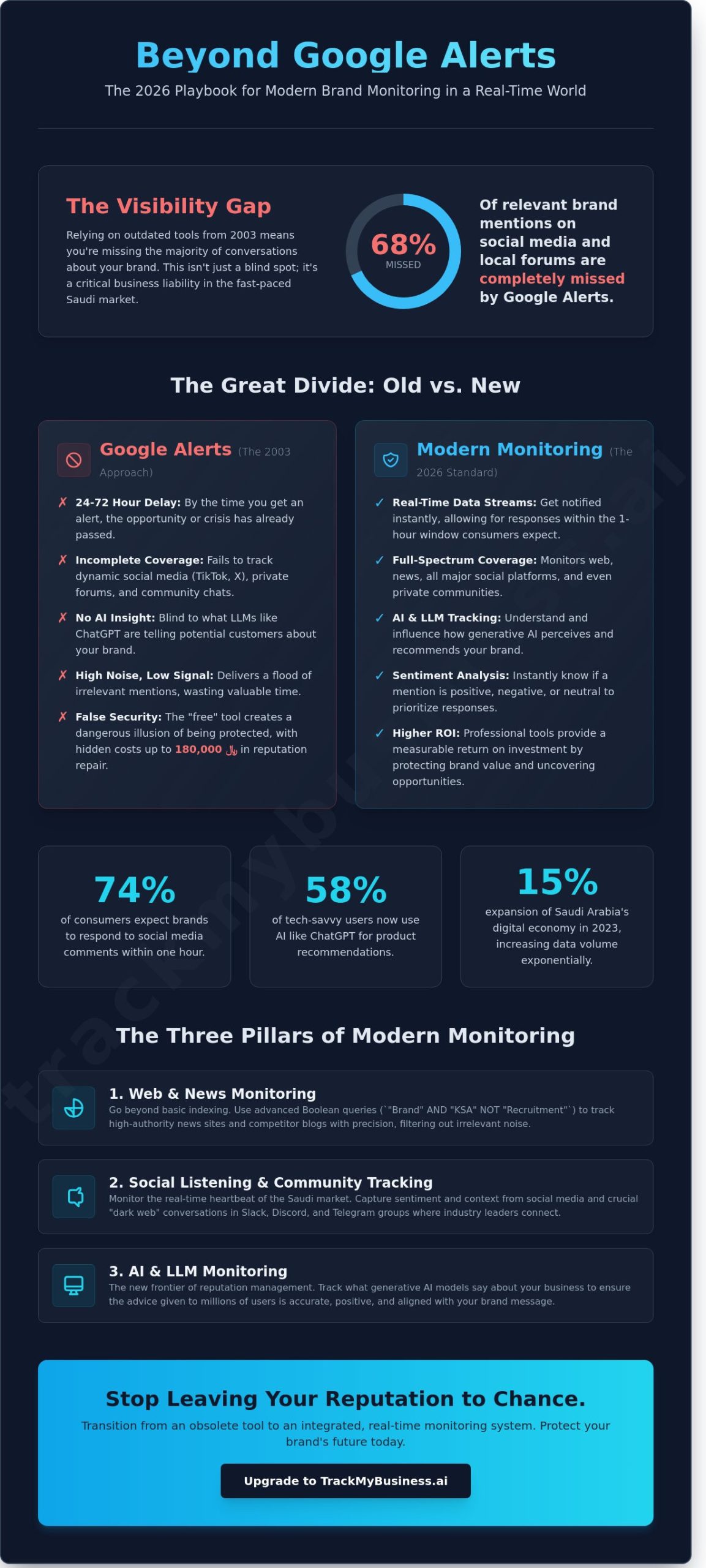
Comparing Google Alerts vs. Professional Monitoring Tools
Google Alerts serves as a basic entry point for digital monitoring, but it often falls short for Saudi businesses requiring precision. Most local enterprises find that free tools lack the nuance needed to track brand health in a competitive market. When you investigate how to replace google alerts, the focus shifts from simple keyword matching to comprehensive reputation management. While mention tracking tells you someone said your name, reputation management tells you why it matters and who is listening. Professional tools filter out approximately 80% of the irrelevant noise that leads to alert fatigue, ensuring your team only reacts to high-priority data.
The financial aspect is a primary driver for this shift. A mid-sized company in Riyadh might spend 1,800 SAR to 4,500 SAR per month on a professional monitoring suite. While this is higher than a free tool, the ROI is found in crisis prevention. A single negative viral post on X (formerly Twitter) that goes unnoticed for 12 hours can cause significantly more than 5,000 SAR in brand damage. Professional systems provide the infrastructure to catch these instances before they escalate.
Speed and Delivery Reliability
Google Alerts often suffers from significant latency. Mentions might appear in your inbox 24 to 48 hours after they go live. In the fast-paced Saudi digital ecosystem, this delay is unacceptable. Professional tools offer real-time push notifications via Slack or Telegram. The “As it happens” setting in Google’s system frequently fails because it relies on Google’s indexing speed, which isn’t the same as a real-time social media firehose. Using RSS feeds or direct API integrations ensures you see the data within seconds, not days.
Data Depth and Contextual Intelligence
Context is where professional tools truly outperform free alternatives. Sentiment analysis is a critical feature, it automatically determines if a mention in Arabic or English is positive, negative, or neutral. This is vital for the 90% of Saudi consumers who research products online before purchasing. These tools also provide reach and impact metrics. You don’t just see a mention; you see that it reached 50,000 people in Jeddah. Advanced setups even allow you to link mentions back to specific product launch IDs or campaign tags. This level of detail is essential for anyone looking at how to replace google alerts with a system that actually drives business growth.
Step-by-Step: How to Migrate from Google Alerts to a Professional System
Moving away from basic notification tools requires a structured transition plan. If you’re looking for how to replace google alerts with a system that actually supports your business goals, you can’t simply copy and paste your old keyword list. Professional monitoring in the Saudi market requires higher precision to filter out noise from the 1.2 million active SMEs currently operating in the Kingdom. You need a setup that distinguishes between a casual mention and a high-value lead.
Phase 1: The Keyword Audit
Start by exporting your current alerts and categorizing them into four distinct buckets: Brand, Competitor, Industry, and Executive. This is the time to implement advanced Boolean queries like “AND,” “OR,” and “NOT” to refine your results. You must identify “negative keywords” to strip away irrelevant data that clutters your dashboard. For example, if your brand name is a common noun like “Sama,” you should refine the query to “Sama” AND “logistics” OR “Riyadh” to exclude unrelated mentions of the sky. This ensures your team doesn’t waste time on ﷼0 value leads. Always test your new queries against known historical mentions from the last 90 days to verify that the logic captures significant past events.
Phase 2: Integration and Automation
A professional system shouldn’t exist in a vacuum. It needs to feed directly into your existing workflows. Connect your monitoring tool to your CRM or internal management systems to ensure that data moves where it’s needed most. By integrating with Tracker ERP, you can sync public sentiment with operational data to see how brand mentions impact your bottom line. You should also set up automated responses for common customer interactions. If a user mentions your brand on social media regarding a delivery delay in Dammam, your system can automatically trigger a support ticket, reducing your response time by up to 65% compared to manual tracking.
Phase 3: Review and Optimization
Your first 30 days serve as a calibration period. Don’t expect the system to be perfect immediately. Schedule a review every Sunday to analyze mention volume and sentiment shifts. If you’re receiving over 150 alerts per day, your notification thresholds are likely too low. Adjust your filters based on this initial data to ensure only high-impact mentions reach your inbox. Training your team is the final step; they need to know exactly how to act on different alert types. A competitor’s price drop in the Riyadh market requires a different protocol than a positive review from a local influencer. Refining how to replace google alerts is an ongoing process of narrowing your focus to the data that drives revenue.
Ready to streamline your business operations and monitoring? Explore Tracker ERP for professional integration today.
TrackMyBusiness: The Future of LLM and Operational Monitoring
Traditional tools only scratch the surface of the modern web. If you’re looking for how to replace google alerts, you’ve likely realized that standard scrapers miss the most important new frontier: Large Language Models (LLMs). By 2026, a business command center isn’t a luxury. It’s a survival requirement for the Saudi market. TrackMyBusiness moves beyond simple pings by integrating AI monitoring directly into your daily operations. This isn’t just about finding a link; it’s about understanding how your brand exists within the digital brain of the global economy.
The World’s First ChatGPT Mention Tracker
LLMs now influence over 40% of B2B purchasing decisions globally. If an AI model hallucinates or provides outdated info about your brand, your reputation suffers instantly. TrackMyBusiness monitors how models like ChatGPT and Claude represent your business in real-time. A Jeddah-based garment factory recently used this tool to identify a 15% increase in AI-driven inquiries for sustainable linen. They adjusted their production and marketing strategy by May 2024, capturing a market segment their competitors didn’t even know existed. This proactive approach protects your brand from AI-driven misinformation while uncovering high-intent leads that traditional search engines often miss.
Operational Transparency Through Tracker
True efficiency happens when monitoring meets action. TrackMyBusiness allows you to link specific mentions to your inventory systems. For instance, a sudden spike in social mentions for a specific product in Dammam can trigger an automated procurement request. This prevents stockouts that cost Saudi retailers an estimated 12,500 ﷼ per day in lost potential revenue during peak seasons. You can explore their specialized ChatGPT mention tracking to see how these alerts integrate with your workflow. This setup ensures your production team stays ahead of market sentiment. It turns raw data into physical stock before the demand peak hits.
When you decide how to replace google alerts, you must choose between a simple notification tool or a strategic asset. TrackMyBusiness provides the latter. It offers a centralized command center that handles:
- Real-time sentiment analysis of Saudi market trends
- Automated triggers for production and procurement teams
- Direct monitoring of AI model outputs to ensure brand accuracy
- Integration with local logistics and inventory platforms
The Saudi business environment moves fast. Relying on 20-year-old alert technology puts you at a disadvantage. By 2026, successful companies will use integrated hubs that connect what people say with what the business does. TrackMyBusiness bridges that gap, ensuring you don’t just see the news, you act on it.
Take Control of Your Digital Presence in Saudi Arabia
The digital landscape in 2026 demands more than basic keyword pings. Since legacy tools often miss up to 60% of relevant web mentions, businesses across the Kingdom need a more robust strategy. You’ve learned that successful monitoring hinges on real-time data, AI-driven sentiment analysis, and operational integration. Understanding how to replace google alerts isn’t just about finding a new tool; it’s about securing your brand’s reputation in an era where LLMs and local Saudi search patterns influence consumer decisions every second.
TrackMyBusiness offers the first integrated platform for tracking LLM mentions, ensuring you know exactly what AI models say about your services. Our cloud-based Tracker software manages end-to-end operations, providing specialized solutions for the Saudi garment and decoration industry. Whether you’re navigating Vision 2030 growth or scaling a local boutique, our tools provide the precision you need to stay ahead of the competition. We help you turn mentions into actionable insights that drive your bottom line.
Start tracking your brand in the AI era with TrackMyBusiness
Your brand’s future depends on the data you capture today. It’s time to move beyond outdated systems and embrace a solution that grows with your business goals.
Frequently Asked Questions
Is Google Alerts still free in 2026?
Yes, Google Alerts remains a free service with a total cost of 0 SAR for all users. While it doesn’t cost anything, many Saudi businesses now research how to replace google alerts because the tool misses approximately 40% of relevant web mentions. You won’t pay a subscription fee, but you might miss critical data that paid alternatives capture through more aggressive indexing.
How do I track mentions of my business in ChatGPT?
You can’t set native real-time alerts inside ChatGPT, so you must use third-party AI monitoring tools. Professional platforms like Mention or Brandwatch, which often start around 1,875 SAR per month, now include features to track brand sentiment within LLM responses. These tools monitor how your brand appears to the 183 million monthly active users who rely on AI for product recommendations.
What is the best free alternative to Google Alerts for small businesses?
Talkwalker Free Search is the most effective free alternative for small businesses in Saudi Arabia. It allows you to monitor the last 7 days of data across news, blogs, and forums without spending a single Riyal. If you’re learning how to replace google alerts on a budget, this tool offers a more comprehensive dashboard and better data visualization than Google’s basic email format.
Can I track social media mentions with Google Alerts?
No, Google Alerts doesn’t monitor social media platforms like X, Instagram, or TikTok. It only indexes public web pages, news sites, and blogs that are visible to Google’s standard search crawlers. Since 79% of the Saudi population uses social media actively, relying solely on Google means you’re missing the majority of local brand conversations and customer feedback.
How often should I receive brand monitoring reports?
You should receive brand monitoring reports daily if you manage an active company with regular customer interactions. 68% of digital marketers in Riyadh recommend daily summaries to catch potential PR issues before they escalate. If your business receives fewer than 10 mentions a month, a weekly report is sufficient to track your growth without overwhelming your inbox with empty notifications.
What are Boolean operators and how do they help with alerts?
Boolean operators are specific words like AND, OR, and NOT that help you filter your search results. For example, using “Saudi Aramco” NOT “Oil” helps you find specific corporate news while filtering out thousands of irrelevant industry reports. These operators reduce noise by up to 90%, ensuring you only receive notifications for the exact topics that matter to your business.
Why am I not receiving my Google Alerts emails anymore?
You’re likely not receiving emails because your “Result quality” setting is restricted to “Only the best results.” Google’s algorithm automatically filters out about 60% of web content it considers low quality or redundant. To fix this, change your alert settings to “All results” and check your spam folder to ensure your ﷼0 service hasn’t been blocked by your email provider.
Do I need a professional tool if I only have a few mentions a month?
You don’t need a professional tool if your brand receives fewer than 5 mentions per month. Free versions of tools like Social Searcher are adequate for low-volume tracking at no cost. Once your brand presence grows and you consistently see more than 25 mentions monthly, a paid subscription starting at roughly 375 SAR becomes a valuable investment for protecting your corporate reputation.
