
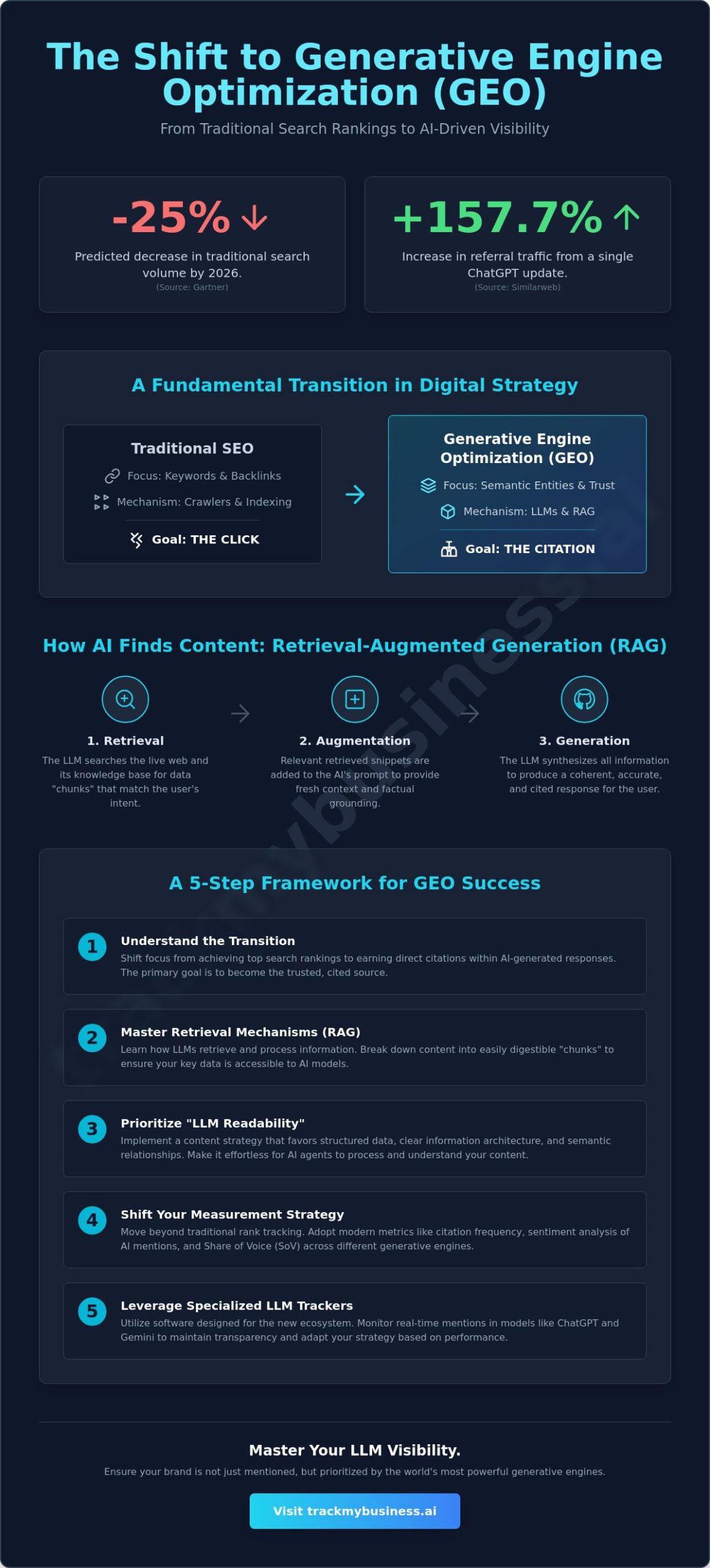
Gartner predicts that traditional search engine volume will decrease by 25% by the end of 2026 as AI chatbots and virtual agents become the primary way people find information. If you’ve felt a sense of dread watching AI snapshots replace your top-ranking snippets, you aren’t alone. I understand the confusion that comes with trying to figure out how to learn geo when the rules seem to change every week. It’s easy to feel like you’re losing control over your organic visibility as large language models (LLMs) take center stage.
I’ve built this guide to replace that uncertainty with a clear, process-oriented framework for success. You’ll master the shift from traditional search rankings to AI-driven visibility by understanding how these engines actually retrieve and cite information. I’ll provide a step-by-step roadmap that covers everything from Google’s May 2026 official guidelines to actionable tactics for improving your brand’s citations. By the end of this article, you’ll have the strategic tools needed to ensure your brand isn’t just mentioned, but prioritized by the world’s most powerful generative engines.
Key Takeaways
- Understand the fundamental transition from traditional search engine rankings to earning citations within AI-generated responses from models like ChatGPT and Gemini.
- Discover how to learn geo by mastering Retrieval-Augmented Generation (RAG), the core mechanism that determines how LLMs retrieve and present your data.
- Implement a five-step framework that prioritizes “LLM readability” through structured data and clear content architecture to ensure your brand is easy for AI agents to process.
- Shift your measurement strategy from traditional rank tracking to modern metrics like citation frequency, sentiment analysis, and Share of Voice across generative engines.
- Leverage specialized LLM tracker software to monitor real-time ChatGPT mention tracking and maintain transparency over your brand’s presence in AI conversations.
What is Generative Engine Optimization (GEO)?
I see GEO as the natural evolution of search engine optimization. For decades, we optimized for crawlers that indexed keywords. Now, we’re optimizing for Large Language Models (LLMs) that synthesize information. This shift is why you’re likely here to figure out What is Generative Engine Optimization (GEO)? and how it affects your brand’s digital footprint. The core difference lies in the outcome. In traditional SEO, success is a click. In GEO, success is being the cited source within an AI’s answer.
We’ve moved from matching keywords to establishing semantic entities that an AI can trust. Why is this happening now? Gartner predicts that traditional search engine volume will decrease by 25% by the end of 2026. This isn’t a distant trend. It’s a structural change in how consumers find information. If you want to know how to learn geo, you must first accept that the goal is no longer just ranking #1 on a list of blue links. It’s about becoming the definitive answer an AI provides to a user.
The Distinction Between Maps and Marketing
I should clarify a common point of confusion before we go deeper. In some industries, “GEO” refers to geographic data or mapping. However, in the context of modern digital growth, it stands for Generative Engine Optimization. The term was coined to describe the process of making content visible to systems like OpenAI’s ChatGPT, Google’s Gemini, and Perplexity. These platforms don’t just “find” your site. They “understand” your site’s relationship to a user’s intent. My methodology focuses on the latter, ensuring your content is readable and authoritative for these specific AI models.
Why Your Business Needs GEO Today
Traditional click-through rates are under pressure. As AI Overviews and chatbots provide direct answers, “zero-click” searches are becoming the standard. If an AI provides a solution without the user ever visiting your page, you lose that traffic unless the AI cites you as the authority. AI citations build a new form of authority in the eyes of the consumer. When a chatbot recommends your brand, it acts as a trusted advisor, not just a billboard.
The numbers back this up. By the end of 2026, 40% of enterprise applications will include task-specific AI agents. These agents act as the new digital gatekeepers. Similarweb reported that a May 2026 ChatGPT update caused referral traffic to tracked websites to increase by 157.7% week-over-week. This proves that being the “chosen” source drives massive results. If you aren’t optimized for these recommendation engines, you’re effectively invisible to a huge portion of the market.
Building the Technical Knowledge Base for GEO
I find that the biggest hurdle for most marketers is moving past the traditional “keyword” mindset. While SEO focuses on how a crawler indexes a page, GEO requires you to understand how a model retrieves a specific piece of information. To build a solid technical knowledge base for GEO, you have to look at the architecture behind the answer. This is where Retrieval-Augmented Generation, or RAG, becomes your most important concept. It’s the process that allows an AI to look outside its own training data to find fresh, relevant facts on the live web.
When you’re figuring out how to learn geo, you’ll see that LLMs “read” content through a process called chunking. They don’t digest your entire article as one long narrative. Instead, they break it into smaller segments or “chunks” to find the most relevant answer to a user’s prompt. If your content is buried in fluff or lacks clear structure, the AI might fail to retrieve the right chunk. I’ve seen brands lose visibility simply because their most valuable insights were hidden in long, rambling paragraphs that the AI couldn’t easily parse.
Understanding Retrieval-Augmented Generation (RAG)
RAG is the bridge between an LLM and live web data. I like to think of it in three distinct steps that happen in milliseconds. First, the Retrieval phase searches the web for snippets that match the user’s intent. Second, the Augmentation phase adds those snippets to the AI’s prompt to provide context. Finally, the Generation phase produces the final response. In this world, relevant chunks are the primary currency. If your content isn’t formatted for easy retrieval, it won’t make it to the final generated answer.
The Role of Semantic Relationships
We’re moving beyond simple keyword matching toward knowledge graphs. AI models connect dots between “entities,” which are distinct, well-defined objects or concepts. For example, “affordable cloud storage” is a keyword phrase, but “Dropbox” is an entity. When you’re learning how to learn geo, you must focus on establishing your brand as a recognized entity within your niche. Context determines whether your content is citable or just background noise. I suggest using clear, declarative sentences to define your brand’s relationship to specific problems. This helps the AI map your business into its knowledge graph more effectively.
Monitoring how these models perceive your brand entity is a critical step in this process. I recommend using LLM tracker software to see if your brand is being correctly cited and linked to the right topics. It’s a proactive way to ensure your technical optimization is actually yielding results in generative answers.
A 5-Step Framework to Learn and Implement GEO
I’ve developed a five-step framework to move from technical theory to real-world execution. Many people ask how to learn geo but stop once they’ve finished reading the definitions. Success requires a proactive, process-oriented methodology. If you want to know how to learn geo in a practical sense, you must follow these specific stages:
- Step 1: Audit your brand mentions. Use LLM tracker software to establish a baseline of how ChatGPT, Gemini, and Perplexity currently describe your business.
- Step 2: Optimize for LLM readability. Reorganize your site architecture using clear headers and structured data to help AI models parse your information.
- Step 3: Create brand identity blocks. Develop definitive, consistent statements about your brand entity that appear across all digital touchpoints.
- Step 4: Implement citation bait. Publish unique data, proprietary research, or specific statistics that AI engines are likely to quote as authoritative sources.
- Step 5: Monitor and iterate. AI responses are not static. You must continuously track your visibility and adjust your content as model behaviors evolve.
Optimizing for LLM Readability
When I talk about readability in a GEO context, I’m referring to content that an AI can chunk without losing its core meaning. I use H-tags and bulleted lists to signal a clear hierarchy of information. This helps the retrieval engine identify the most relevant sections of your page quickly. Each paragraph should be self-contained. If an AI extracts a single paragraph to answer a prompt, that text must remain coherent without the surrounding context. I’ve found that avoiding excessive technical jargon is often better for performance. If a model can’t easily map your complex terms to known concepts, it may skip your content entirely.
Creating Brand Identity Blocks
A brand identity block is a definitive statement that tells an AI exactly who you are and what your business offers. I use About Us pages and corporate profiles to feed LLMs the correct entity data. These blocks act as the source of truth for your brand. If your description varies wildly across different platforms, the AI’s confidence in your authority will drop. Generative engines rely on consistent brand descriptions across the web to verify the accuracy of the information they provide about you.
Measuring GEO Success: How to Track Your Brand in AI
I’ve found that one of the most frustrating aspects of this transition is the measurement gap. You can’t simply plug your URL into a standard rank tracker and expect to see where you stand in an LLM’s response. Part of understanding how to learn geo involves redefining what success looks like in a conversational interface. Since AI answers are generated dynamically, a static “ranking” doesn’t exist in the traditional sense. I focus on how often a brand is used as a foundational source for an answer rather than just its position on a page.
The “black box” problem is a reality we must manage. AI models are updated frequently, and their outputs can vary based on small changes in a user’s prompt. This makes it difficult to spot clear trends without a systematic approach. I suggest looking at aggregate data over time rather than obsessing over a single interaction. By tracking how mentions shift across weeks or months, you can see if your optimization efforts are actually influencing the model’s retrieval logic. This methodology helps you stay proactive instead of reacting to every minor model update.
Why Traditional SEO Metrics Fail
Traditional SEO focuses on achieving “Position 1” on a search results page. In the generative world, I prioritize “Mention 1” or the primary citation within a summarized response. Search volume is also becoming less important than intent matching. If an AI identifies your content as the perfect match for a complex user query, you’ve succeeded, even if that specific keyword has low monthly volume. We’re seeing a fundamental shift from traffic-based metrics to trust-based metrics. Success is now measured by three primary indicators:
- Citation Frequency: The total number of times your brand is cited across a diverse set of industry prompts.
- Sentiment: Whether the AI presents your brand as a helpful authority or just a neutral alternative.
- Share of Voice (SoV): Your brand’s percentage of mentions compared to direct competitors within a specific niche.
Automating Your GEO Monitoring
I’ve found that manual checking is no longer sustainable for a growing business. You can’t manually type prompts into every available chatbot to see if your brand appears. You need a process-oriented way to track how LLMs perceive your business. Automated software allows you to identify which specific “chunks” of your site are being pulled into AI answers. This data is vital for your growth. If you know which paragraphs are being cited, you can double down on that specific writing style. To streamline this process and ensure you don’t miss critical shifts in visibility, you should consider using tracker software to maintain a transparent view of your brand’s presence in generative search.
Mastering LLM Visibility with TrackMyBusiness
I believe that the transition from theory to practice is where most digital strategies succeed or fail. While reading this guide is a vital first step in how to learn geo, the second step is implementing a system that provides real-time feedback. You cannot optimize what you cannot see. My methodology relies on data-driven transparency, and that is exactly why I developed a suite of tools to bridge the gap between content creation and AI visibility. Moving from a general understanding of generative engines to a precise, actionable strategy requires specialized software that understands the nuances of LLM behavior.
We’ve discussed the technical architecture of RAG and the importance of entity linking. Now, we must focus on the execution reality. To truly master this shift, you need to see how your brand is being processed by the very models you’re trying to reach. This isn’t about guessing which keywords might work; it’s about having a direct line of sight into the “black box” of AI responses. I provide the tools necessary to move from a reactive posture to a proactive, data-backed GEO strategy.
The Power of ChatGPT Mention Tracking
I designed our LLM tracker software to solve the visibility problem that traditional SEO tools ignore. Our specific ChatGPT mention tracking allows you to monitor how your brand is cited within conversational answers. This isn’t just a list of links. It’s a comprehensive view of how the model summarizes your expertise and whether it presents your brand as a primary authority. Seeing these real-time citations allows you to understand which “chunks” of your content are performing best.
Sentiment analysis is another critical component of this tracking. If an AI mentions your brand but does so in a neutral or negative context, your GEO strategy needs immediate adjustment. I use this data to inform the next round of content optimization. If I see that a model is misinterpreting a specific product feature, I can refine the “Brand Identity Blocks” on the website to correct that narrative. This feedback loop is the most efficient way to ensure your brand remains a trusted entity in the eyes of the AI.
Streamlining Operations with Tracker
Digital authority doesn’t exist in a vacuum; it’s built on the foundation of a well-run business. Our core Tracker Software helps you manage the operational side of your brand while you focus on growth. I’ve found that there’s a direct synergy between operational efficiency and digital authority. When your internal processes are clear and consistent, your external brand messaging tends to follow suit. This consistency is exactly what LLMs look for when verifying the reliability of a source.
By integrating your business management with specialized tracking tools, you create a unified approach to modern search. You are no longer just guessing about how to learn geo; you are using a professional framework to dominate the generative landscape. I invite you to take the next step in your journey and move beyond theory. Start tracking your AI mentions today with TrackMyBusiness to ensure your brand is the one being cited in the answers of tomorrow.
Secure Your Authority in the AI-First Era
I’ve outlined the technical and strategic shift required to maintain your digital presence as generative engines redefine search. We’ve moved beyond the simplicity of blue links to a complex system of citations and semantic trust. Mastering these concepts is the only way to ensure your brand remains visible as AI agents become the primary gatekeepers of information. You now have the foundational framework for how to learn geo, from optimizing for Retrieval-Augmented Generation to establishing consistent brand identity blocks across the web.
The next step is moving from theory to execution. I focus on providing business transparency through specialized LLM tracker software. Our cloud-based Tracker allows for end-to-end management of your brand’s operational health and digital growth. By monitoring real-time sentiment and citation frequency, you can adjust your strategy as model behaviors evolve. Start your journey to AI visibility with our ChatGPT mention tracking tool today. I am here to help you navigate this transition with data-driven confidence. The future of search is conversational, and I want to make sure your brand is the one leading the conversation.
Frequently Asked Questions
Is GEO different from SEO?
GEO is an extension of traditional SEO rather than a completely separate discipline. Google’s official guide from May 2026 confirms that foundational SEO best practices remain the primary way to ensure visibility in generative features. While SEO focuses on ranking in a list of results, GEO prioritizes being summarized and cited within an AI-generated answer.
How long does it take to see results from GEO?
Results often depend on the update cycles of specific LLMs, but traffic changes can happen rapidly. A May 2026 update to ChatGPT caused referral traffic to some tracked websites to increase by 157.7% in a single week. I generally see clear visibility trends emerge within a few months as models re-crawl your optimized content chunks.
Do I need to use schema markup for GEO?
No special schema.org markup is required to trigger generative AI mentions. Google’s 2026 documentation explicitly states that inventing or inflating structured data will not force an AI citation. You should continue using standard schema for general search health, but it isn’t a shortcut for AI visibility.
Can I optimize for ChatGPT and Gemini at the same time?
Yes, you can optimize for multiple engines simultaneously because they all rely on high-quality, authoritative content. When you are figuring out how to learn geo, you’ll see that clear headers and self-contained paragraphs help all major models retrieve your data. I’ve found that focusing on E-E-A-T signals creates a foundation that works across OpenAI, Google, and Perplexity.
What is the most important factor for being cited by an LLM?
Authority and readability are the most significant factors for earning citations. An AI model must recognize your brand as a trusted entity and find your content easy to “chunk” into relevant answers. I suggest publishing unique data or proprietary research, as LLMs are highly likely to cite specific, verifiable statistics as authoritative sources.
How much does it cost to implement a GEO strategy?
The cost of a GEO strategy varies based on your existing content quality and the depth of your monitoring needs. While you’ll need to invest in high-quality content creation, the technical changes to your site are often minimal. I recommend using specialized tracker software to monitor your progress, as manual checking is not a sustainable or cost-effective process.
Is GEO only for large corporations or can small businesses use it?
Small businesses have a significant opportunity in GEO because AI models prioritize the most relevant “chunk” of information regardless of company size. A specialized niche guide can easily be cited over a generic corporate page if it provides a more direct answer. This levels the playing field for smaller brands with high topical authority.
What happens if an AI engine hallucinates about my brand?
Hallucinations often occur when an AI encounters inconsistent or outdated information about your business. If you spot an error, you should immediately update your core pages and “Brand Identity Blocks” to provide a single, clear source of truth. I use LLM tracker software to identify these inaccuracies early so they can be corrected before they impact brand reputation.
