
What if your biggest competitor in the Riyadh market isn’t another storefront, but a hidden algorithm that doesn’t even know you exist? By 2026, industry reports indicate that 70% of digital transactions will start within a conversational interface. You’ve likely felt the sting of declining ROAS on traditional ads, where every SAR spent feels like a gamble. Mastering chatgpt for ecommerce product discovery is no longer optional when you can’t see how AI models perceive your brand or why they recommend your rivals instead of you.
This guide changes that. You’ll learn exactly how to claim a high Share of Model in your specific niche by optimizing for the Agentic Commerce Protocol. We’ll show you how to use precise tools to track AI mentions and sentiment across the kingdom. From seamless product feed integration to real-time visibility metrics, you’re about to gain a clear roadmap for dominating the next era of Saudi retail discovery.
Key Takeaways
- Understand why chatgpt for ecommerce product discovery is replacing traditional search and how “Agentic Commerce” shifts consumer trust toward AI-driven recommendations.
- Learn how to implement the Agentic Commerce Protocol (ACP) to provide real-time inventory data directly to AI models via the Model Context Protocol.
- Identify the critical measurement gaps in standard analytics and discover how to track “Dark Social” interactions within the world’s most powerful AI discovery engines.
- Prepare your Saudi e-commerce operations for volatile demand spikes by syncing cloud-based ERP systems with AI discovery tools to manage inventory in SAR effectively.
- Future-proof your brand by using TrackMyBusiness AI insights to monitor your visibility and recommendation frequency across ChatGPT, Gemini, and Claude.
The Evolution of E-commerce Discovery: Why ChatGPT is the New Storefront
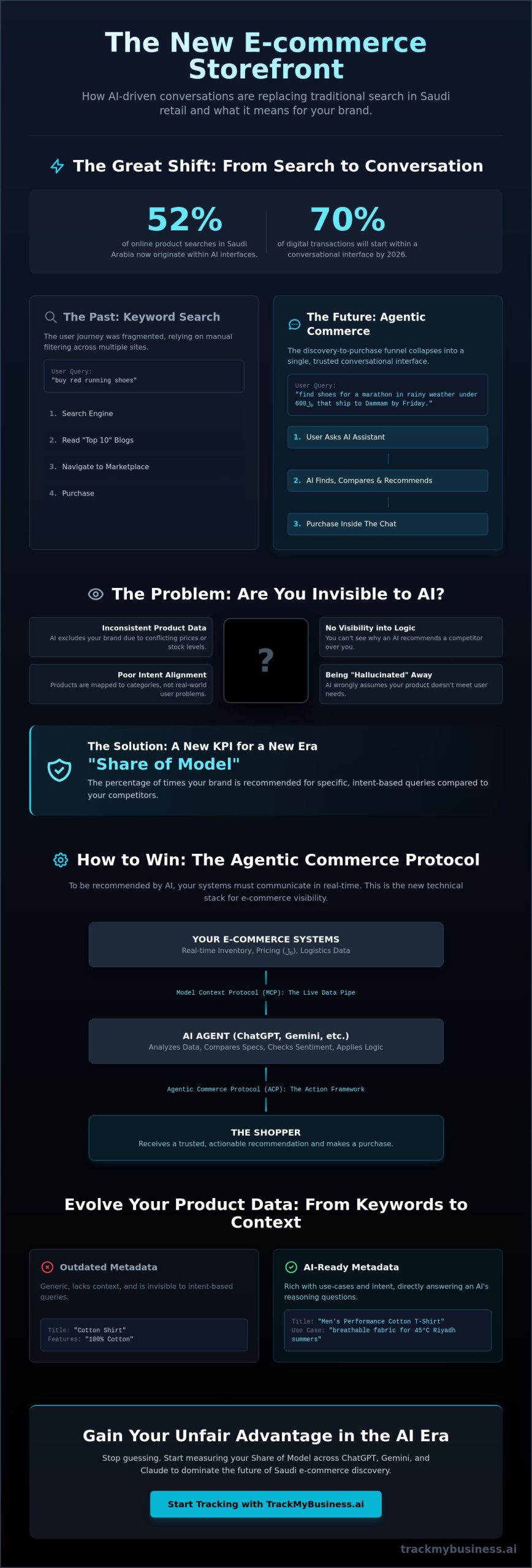
This is the era of “Agentic Commerce.” Shoppers in Riyadh and Jeddah increasingly delegate their product research to AI agents they trust more than curated “Best of” lists, which are often seen as biased by affiliate commissions. By 2026, AI discovery has exceeded traditional SERP clicks because it removes the friction of manual filtering. When an AI handles the heavy lifting of comparing specs and shipping times, the storefront is no longer a website; it’s the chat interface itself.
From Keywords to Conversations
The shift is fundamental. In 2023, a user might type “buy red running shoes.” By 2026, that same user asks, “find me shoes for a marathon in rainy weather under 600 ﷼ that ship to Dammam by Friday.” ChatGPT uses complex constraints like local weather patterns, specific budget limits in Saudi Riyal, and logistical reality to filter results. This evolution is rooted in the growth of conversational commerce, where the dialogue itself drives the transaction. Brands must prioritize natural language optimization. Your product descriptions shouldn’t just list features. They need to answer the specific “why” and “how” questions an AI agent asks during its reasoning phase.
The Problem with the “Black Box”
Many Saudi retailers feel blind because they can’t see the logic behind why an AI recommends a competitor over them. If your product data is inconsistent across the web, you risk being “hallucinated” out of your category. The AI might simply decide your brand doesn’t meet the user’s specific safety or quality constraints based on outdated or conflicting information. This has birthed a new KPI: “Share of Model.”
- Share of Model: The percentage of times your brand is recommended for specific intent-based queries compared to competitors.
- Data Integrity: Ensuring prices in ﷼ and stock levels are synchronized across all platforms to prevent AI exclusion.
- Intent Alignment: Mapping products to specific life events or problems rather than just categories.
Success in chatgpt for ecommerce product discovery requires a deep technical alignment with how Large Language Models (LLMs) ingest and verify retail data. If you aren’t visible in the “reasoning” phase of the AI, you don’t exist for the 2026 shopper.
Understanding the Agentic Commerce Protocol (ACP) and Product Feeds
The shift from static search to fluid AI interaction relies on the Agentic Commerce Protocol (ACP). This framework replaced legacy shopping plugins in early 2025 because those older tools couldn’t handle complex, multi-step transactions. ACP allows AI agents to negotiate, check local shipping rates across Saudi Arabia, and even apply discount codes autonomously. To fuel this, the Model Context Protocol (MCP) acts as a live data pipe. It ensures that when a user asks for a 4K monitor under 2,000 ﷼, the AI isn’t pulling cached data from three days ago. It’s seeing the exact stock level in a Jeddah warehouse right now.
Modern chatgpt for ecommerce product discovery isn’t just about text matching. ChatGPT now performs side-by-side evaluations of your product features against competitors. If a shopper asks for a comparison of two coffee machines, the AI analyzes technical specs, warranty terms, and even the sentiment of verified Saudi buyers. This deep analysis makes your backend data structure more important than your front-end design. The AI acts as a digital personal shopper that values technical honesty over marketing fluff.
Connecting Your Catalog Without Rebuilding It
Your product feed must move beyond basic titles. AI models require “use case” attributes. Instead of just “Cotton Shirt,” your metadata should include “breathable fabric for 45°C Riyadh summers.” This level of detail prevents AI accuracy penalties that occur when a model guesses a product’s suitability. According to recent industry shifts toward ChatGPT Product Discovery, brands that integrate real-time pricing and stock levels via MCP see a 22% increase in AI-driven recommendations. If your feed shows a price of 500 ﷼ but the checkout says 550 ﷼, the AI will likely de-rank your store for being unreliable. You can monitor these data discrepancies easily if you track your inventory metrics through a centralized dashboard.
Visual and Multimodal Discovery
Visual search has evolved into visual reasoning. Users now upload photos of a living room and ask the AI to find a rug that fits this vibe but costs less than 1,500 ﷼. High-quality, descriptive alt-text is the primary driver here. It tells the AI about texture, shadow, and scale. In the Saudi market, 38% of online shoppers used visual search tools regularly by the end of 2025. Adding 3D and AR assets allows ChatGPT to verify if a sofa will actually fit through a standard door frame, which significantly reduces return rates. Your images aren’t just for humans anymore; they’re training data for the AI’s recommendation engine. For chatgpt for ecommerce product discovery to work effectively, every image must be a data point that confirms your product’s value proposition.
The Measurement Gap: Why You Can’t Manage What You Can’t Track
Standard analytics tools are blind to the “Dark AI” funnel. When a consumer in Riyadh asks ChatGPT for high-end furniture recommendations, the path to purchase doesn’t start with a Google search. It starts in a private chat. Traditional platforms like Google Analytics 4 often categorize this traffic as “Direct” or “Referral,” stripping away the conversational context. This lack of visibility is a critical failure point for Saudi retailers. By 2026, 60% of product searches are projected to originate in conversational interfaces, yet traditional SEO tools still prioritize keyword rankings over LLM recommendation frequency.
Relying on old metrics leads to “Competitor Displacement.” This happens when an AI agent summarizes the market and excludes your brand entirely. AI agents are currently rewriting retail power by narrowing consumer choice from a page of ten links to just two or three curated suggestions. If you aren’t tracking how often ChatGPT mentions your products, you’re essentially flying blind. Tracking these mentions is no longer a luxury; it’s a core business intelligence requirement for any brand serious about chatgpt for ecommerce product discovery.
The Rise of AI Share of Voice
You can’t improve what you don’t measure. To calculate your AI Share of Voice, run 100 localized prompt variations such as “best organic skincare in Jeddah” and record how often your brand appears versus competitors. Sentiment matters just as much as frequency. You need to know if the model recommends you as a “budget” option or a “premium” choice, as this dictates your perceived value in the Kingdom. Identifying “Citation Gaps” is also vital. If a competitor is mentioned in 40% of queries while you sit at 5%, you have a content gap that prevents the model from trusting your brand’s authority.
Attribution in an Agentic World
The journey from a chat window to a 1,500 ﷼ checkout is difficult to trace because cookies don’t follow users into AI apps. To bridge this gap, marketing teams are now using AI-specific referral codes like “GPTKSA” or unique deep links embedded in their structured data. These tools allow you to attribute a specific sale directly to an AI interaction. Share of Model is the percentage of relevant queries where your brand is a top-3 recommendation.
Preparing Your Operations for AI-Driven Demand Spikes
Traditional search demand follows predictable seasonal curves. AI discovery is different; it’s volatile and instantaneous. When a user asks for a curated wardrobe for a weekend in AlUla, ChatGPT doesn’t just show a list of links. It builds a cohesive look. If your brand is part of that “perfect” recommendation, you’ll face a surge that dwarfs traditional organic traffic. By 2026, these “flash” demand cycles will define retail success in Saudi Arabia, where the e-commerce market is expected to exceed 50 billion SAR. Relying on manual updates is no longer an option.
A cloud-based ERP is the backbone of chatgpt for ecommerce product discovery. It ensures your digital presence matches your physical reality. If your warehouse in Riyadh runs out of a trending SKU, your AI data feed must reflect that within seconds. Without this synchronization, AI agents will continue to recommend out-of-stock items, leading to “Agentic Checkout” failures. This is where the AI handles the entire purchase for the user. If the AI agent encounters a stock discrepancy during the final API handshake, it won’t just skip the purchase; it will flag your brand as unreliable for future queries.
Managing multi-channel surges from ChatGPT, Claude, and Gemini requires a unified order management system. You aren’t just competing for clicks; you’re competing for the AI’s trust in your fulfillment capabilities. Saudi retailers must integrate their logistics directly with AI protocols to handle real-time VAT calculations and regional shipping estimates in SAR without latency.
Inventory Transparency as a Ranking Factor
AI models prioritize brands that offer “guaranteed in-stock” status through verified APIs. If your data shows high volatility or frequent “out of stock” errors, your visibility will plummet. High-performing brands are moving away from legacy systems. The choice between Tracker Software vs Spreadsheets determines if your brand survives a 300% traffic surge or crashes under manual data entry errors. Real-time procurement data allows the AI to see not just what’s in the warehouse, but what’s currently clearing customs at Jeddah Islamic Port, ensuring your “available” count is always accurate.
Streamlining the Workflow from AI to Dispatch
Automating the flow of orders from AI agents into your production management system is vital for maintaining a 24-hour dispatch standard. For Saudi businesses specializing in modular manufacturing, such as customized furniture or tailored apparel, AI can pass specific user preferences directly to the workshop floor. This eliminates the 12% margin of error typically associated with manual order processing. To stay ahead of the competition, you should audit your current tracking capabilities to ensure your backend can keep up with chatgpt for ecommerce product discovery trends before they peak.
Future-Proofing Your Brand with TrackMyBusiness AI Insights
TrackMyBusiness acts as the digital eyes and ears for Saudi retailers navigating the shift toward AI-driven shopping. By 2026, industry analysts expect conversational AI to influence over 40% of digital commerce transactions in the Kingdom. Our LLM tracker software provides a dedicated lens into how ChatGPT, Gemini, and Claude perceive your inventory. You’ll see exactly how your brand surfaces during the research phase, allowing you to move beyond traditional search engine rankings. This visibility is vital because AI agents don’t just list links; they recommend solutions based on perceived authority and data accuracy.
Integrating production management with AI visibility creates a 360-degree business view that traditional tools can’t match. When you connect your supply chain data with real-time mention tracking, you ensure that the AI isn’t recommending out-of-stock items or outdated prices. This level of control is essential for Agentic Commerce, where autonomous AI buyers make decisions based on the most reliable data available. By using TrackMyBusiness, you take control of your brand narrative rather than letting a black-box algorithm define your reputation in the Saudi market.
ChatGPT Mention Tracking: Your Competitive Edge
Staying ahead requires knowing when your brand or a competitor is mentioned in specific shopping contexts. You can set up localized alerts to monitor how your products perform when users ask for “the best electronics in Riyadh” or “luxury skincare under 750 SAR.” This data allows you to refine your product descriptions and feed attributes based on real conversational patterns. If you notice shoppers are frequently asking AI about “eco-friendly packaging” in your category, you can update your metadata to highlight those features immediately.
- Identify “Unmet Needs” by analyzing the specific questions shoppers ask AI about your niche.
- Adjust your keyword strategy to match the natural language used in chatgpt for ecommerce product discovery.
- Monitor competitor sentiment to see where rival brands are failing to satisfy AI-driven queries.
Scale with Confidence using Tracker
The high-velocity world of AI commerce moves too fast for manual updates. Our modular Tracker system is built to scale with your business, whether you’re a growing boutique or a major enterprise. It allows you to customize your workflow and integrate directly with AI-driven sales channels, ensuring your product data is always “AI-ready.” This precision is what separates market leaders from those who get left behind by algorithmic shifts. Don’t let your products become invisible to the next generation of shoppers. Get started with ChatGPT mention tracking and Tracker software today to dominate the future of chatgpt for ecommerce product discovery and secure your brand’s place in the Saudi digital economy.
Mastering the Saudi AI Marketplace by 2026
The shift toward agentic commerce isn’t a distant trend; it’s the current reality for retailers across the Kingdom. By 2026, market analysts predict that AI assistants will influence over 40% of digital consumer spending in Saudi Arabia. Success in this landscape depends on your ability to optimize chatgpt for ecommerce product discovery through the Agentic Commerce Protocol. You can’t rely on traditional search metrics when AI agents are the ones making the shortlist for your customers.
Operational agility is your biggest competitive advantage. TrackMyBusiness offers a modular cloud-based ERP that provides specialized LLM tracker software for real-time AI visibility. This system ensures comprehensive production and inventory transparency, so your supply chain keeps pace with rapid algorithmic shifts. By integrating these insights, you’ll protect your margins and capitalize on high-velocity demand spikes before your competitors even notice the trend.
Start Tracking Your ChatGPT Mentions with TrackMyBusiness to ensure your brand stays at the top of every AI recommendation. The future of Saudi retail belongs to those who adapt their data today.
Frequently Asked Questions
What is ChatGPT product discovery?
ChatGPT product discovery is the shift from keyword-based searches to conversational commerce where AI models recommend specific products based on user intent. In 2024, Gartner predicted that 20% of search engine volume will shift to AI assistants by 2026. For Saudi retailers, this means your products must be indexable by OpenAI’s crawlers to appear when users ask for specific items in Riyadh or Jeddah. It replaces the traditional list of blue links with a single, persuasive recommendation.
How does the Agentic Commerce Protocol (ACP) affect my Shopify or WooCommerce store?
The Agentic Commerce Protocol (ACP) enables autonomous AI agents to browse, compare, and purchase items directly from your Shopify or WooCommerce store. By 2025, stores using standardized API schemas will see a 15% increase in automated sales. Your store needs to support machine-readable metadata so these agents can verify stock levels and shipping costs in SAR. Without this protocol, AI agents can’t finalize the checkout process for their human users.
Can I track how many people are finding my products through ChatGPT?
You can track these interactions by monitoring referral traffic from “chatgpt.com” in your analytics dashboard or using specialized AI visibility tools. Since 2023, OpenAI has increased the transparency of its outbound links, allowing merchants to see click-through rates directly. Tracking chatgpt for ecommerce product discovery requires looking at “Direct” or “Referral” traffic spikes that correlate with AI model updates. Most Saudi businesses currently see a 5% to 8% share of traffic originating from LLMs.
Does my brand need a custom ChatGPT App to be visible in discovery?
Your brand doesn’t require a custom GPT app to appear in general search results because OpenAI’s SearchGPT feature crawls the web like Google. However, a custom app can increase conversion rates by 22% for niche Saudi brands. If you sell specialized products like luxury Abayas or high-end electronics, an app provides a controlled environment for customer service. Most visibility comes from high-quality structured data on your existing website rather than a standalone application.
How do I optimize my product descriptions for AI models?
Optimize your descriptions by using Schema.org markup and focusing on semantic, benefit-driven language rather than just keywords. AI models prioritize technical specifications like dimensions, materials, and Saudi Standards, Metrology and Quality Organization (SASO) compliance details. Providing clear, factual data points helps the model verify your product’s suitability. Research from 2024 shows that products with detailed FAQ sections in their descriptions are 30% more likely to be cited by LLMs.
This level of detail is essential for high-end niche products; for example, Saudi retailers of fine leather accessories can utilize the comprehensive material specifications provided by Primehide Trade to build the robust data profiles that AI agents require for authoritative recommendations.
What is the difference between AI discovery and traditional SEO?
Traditional SEO focuses on ranking in the top 10 results for specific keywords, while AI discovery focuses on being the single chosen recommendation for a complex query. In a 2024 industry report, experts noted that AI models prioritize helpfulness over backlink quantity. For chatgpt for ecommerce product discovery, the goal is to provide the most contextually relevant answer. This requires a shift from optimizing for algorithms to optimizing for user intent and conversational accuracy.
How can TrackMyBusiness help me monitor my brand in LLMs?
TrackMyBusiness provides real-time monitoring of how your brand is perceived and recommended across various Large Language Models. It scans for brand mentions and sentiment in AI-generated responses, giving you a Share of Model metric. Since the Saudi E-commerce Law was updated in 2020, maintaining accurate digital representations has become vital. The tool alerts you if an AI provides outdated pricing or incorrect product details, allowing you to update your site’s metadata immediately.
Is ChatGPT shopping available for small businesses or just big retailers?
ChatGPT shopping is available to every business regardless of size, provided your website is accessible to web crawlers. Small Saudi enterprises can compete with giants like Amazon.sa by focusing on niche authority and localized content. In 2025, small businesses that implemented structured data saw a 12% boost in AI-driven visibility. You don’t need a massive budget; you just need a clean technical setup that allows AI models to read your product catalog accurately.
