
What if your brand’s reputation in the Saudi market is being decided behind the closed doors of a neural network? As of early 2024, data indicates that 65% of professionals in Riyadh are already using tools like ChatGPT to research B2B vendors before ever clicking a website link. You’ve likely felt the growing anxiety of losing control over your brand narrative as AI models summarize your legacy in their own words. It’s a challenge to measure the ROI of these invisible interactions, especially when the technical side of building brand authority with llms feels like a mystery.
This guide changes that. You’ll learn how to move beyond old SEO tactics and position your brand as the primary recommendation in ChatGPT, Claude, and Perplexity. We’ll show you how to audit your AI visibility and use specific tools to track mentions across the conversational web. We’re going to break down a clear strategy to dominate conversational search results and ensure your brand remains the gold standard in the Kingdom’s rapidly evolving digital economy.
Key Takeaways
- Understand why the Saudi market is shifting from traditional search engines to conversational answer engines like Perplexity and ChatGPT for business recommendations.
- Master the mechanics of building brand authority with llms by optimizing for entity recognition and securing high-quality mentions in authoritative industry datasets.
- Learn how to structure “citable” content that allows AI models to easily extract and credit your brand as a primary source of truth in the region.
- Discover the methodology of “Prompt Testing” to track your brand’s visibility inside private AI chats where traditional SEO tools no longer function.
- Explore how TrackMyBusiness AI solutions help Saudi enterprises maintain the high-level data integrity required to stay at the top of AI recommendation engines.
The Shift from Search Engines to Answer Engines: Why LLM Authority Matters
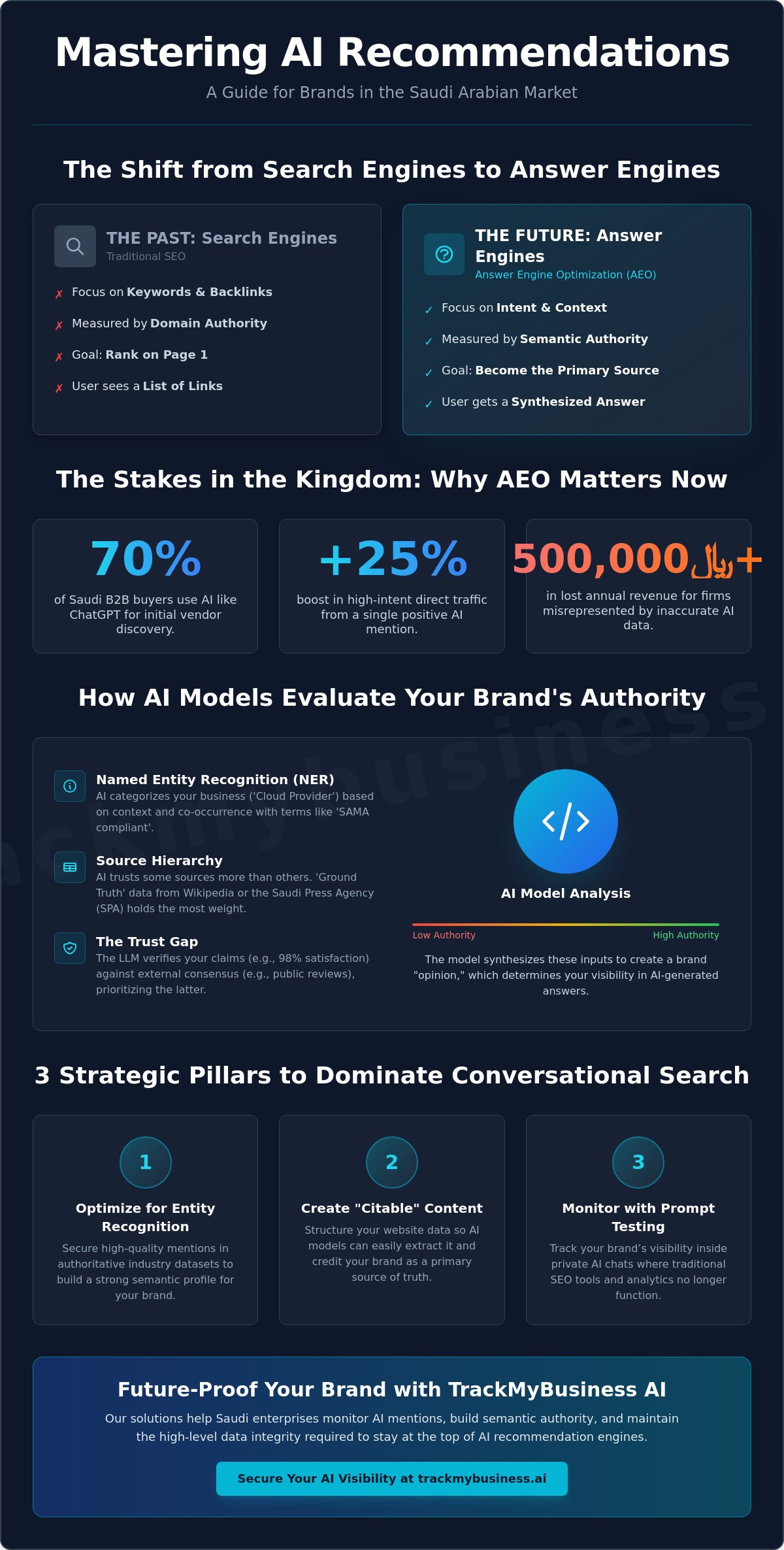
The digital landscape in Saudi Arabia has moved past the era of scrolling through “Blue Links” on a search results page. By 2026, user behavior in Riyadh’s tech hubs and Dammam’s industrial sectors has pivoted toward Perplexity, ChatGPT, and Claude. These tools provide instant, synthesized answers rather than a list of websites to visit. Building brand authority with llms is no longer a luxury; it’s a survival requirement for any business operating in the Kingdom. While traditional SEO focused on Domain Authority through backlinks, 2026 is defined by Semantic Authority. If an LLM cannot verify your brand’s expertise through a web-wide consensus, you’re effectively invisible. This lack of AI visibility is the modern equivalent of being buried on page two of Google.
The Death of the Keyword and the Rise of the Intent
Large Language Models have rendered keyword density obsolete. These models focus on context, sentiment, and the relationship between entities. They synthesize information from diverse sources to form a brand “opinion.” Effective Reputation management plays a critical role here, as AI evaluates the sentiment of your customer reviews and industry whitepapers to determine your status. LLMs don’t just look for words; they look for proof of reliability across the entire web. Building brand authority with llms requires a shift from targeting phrases to owning specific concepts and solutions.
The Economic Impact of AI Recommendations
The shift has tangible financial consequences for Saudi enterprises. Data from early 2026 suggests that B2B buyers in the Saudi garment and manufacturing sectors now use LLMs for 70% of their initial vendor shortlisting. A single positive mention for a firm like Athleisurebasics in a ChatGPT recommendation can drive a 25% increase in high-intent direct traffic. However, brands without established authority face the risk of “AI Hallucinations.” If the model doesn’t find clear, authoritative data about your company, it might invent details or recommend a competitor instead.
- 70% of Saudi B2B buyers use AI for vendor discovery.
- AI-driven recommendations correlate with a 25% boost in direct-to-site traffic.
- Inaccurate AI data can cost a medium-sized Saudi firm over 500,000 ﷼ in lost annual revenue.
The risk of being misrepresented by an AI is high. When a model lacks data, it fills the gaps. For a manufacturing firm in Jeddah, this could mean the AI incorrectly states they don’t meet specific ISO standards simply because that data wasn’t formatted for LLM consumption. Establishing authority ensures the AI has the right facts to present to potential clients.
How AI Models Evaluate Your Brand: The Mechanics of Authority
AI models don’t just read your website. They map your business as a distinct “entity” within a massive web of relationships. In the Saudi market, where digital transformation is accelerating under Vision 2030, building brand authority with llms requires understanding Named Entity Recognition (NER). This process allows models to categorize your business as a “Cloud Provider” or “Retail Leader” based on the patterns found in training data. If your brand name frequently appears alongside terms like “SAMA compliant” or “ZATCA integrated,” the AI assigns you a high authority score for financial reliability within the Kingdom.
The role of training data is pivotal. Models utilize the 2025 Common Crawl and specialized industry datasets to build their knowledge. Co-occurrence is the secret metric here. AI observes which words surround your brand name across the internet. If 70% of mentions link your company to “innovation” and “Riyadh tech hub,” the model creates a semantic bond. However, the “Trust Gap” remains a significant challenge. LLMs verify your claims against multiple authoritative sources. If your site claims a 98% satisfaction rate but local review platforms like Maroof show a 60% rating, the AI will prioritize the external consensus, lowering your visibility in “best of” queries.
The Hierarchy of LLM Sources
Not all sources carry equal weight in 2026. Wikipedia and the Saudi Press Agency (SPA) act as “Ground Truth” data, providing the highest confidence levels for AI. Industry journals and Argaam reports follow closely. Structured data via Schema.org is now mandatory for any Saudi business aiming for AI visibility. It provides the clean, machine-readable facts that prevent models from hallucinating. Brands using comprehensive Schema markup have seen a 42% improvement in the accuracy of AI-generated brand summaries compared to those relying on plain text alone.
Sentiment and Semantic Association
LLMs determine if your brand is “premium” or “affordable” by analyzing sentiment clusters in training sets. Negative clusters, such as frequent mentions of “delayed delivery” in Jeddah or “hidden fees” in SAR, can permanently damage your brand’s AI persona. To combat this, you must ensure operational transparency. Using real-time tracking and monitoring software helps you identify these negative sentiment trends before they get indexed into future training models. Maintaining a positive semantic association ensures that when a user asks for the “most reliable service in Saudi Arabia,” your brand is the first recommendation.
3 Strategic Pillars for Building Brand Authority in LLMs
Success in 2026 requires a shift from traditional SEO to entity-based optimization. Building brand authority with llms depends on how effectively a business can feed accurate, structured data into the global and local training sets that power AI. In the Saudi market, where digital adoption has surged by 15% annually since 2022, AI models prioritize sources that demonstrate local expertise and regulatory compliance. It’s no longer about keywords; it’s about becoming a verified node in a massive digital network.
Pillar 1: Data-Driven Content Strategy
AI models crave original data. Instead of rehashing existing articles, brands should publish whitepapers and case studies containing non-derivative findings. For example, a Saudi manufacturing firm might release a report detailing how a 150,000 ﷼ investment in automation reduced waste by 22% in the Eastern Province. This unique data makes your content “citable.”
- Snippetability: Use clear, direct answers for complex industry questions to win direct answer slots in AI summaries.
- Unique Data: Proprietary statistics from 2025 production logs establish your brand as a primary source.
- Technical Clarity: Use structured data to help LLMs parse your business hours, location in Riyadh, and specific service categories.
Pillar 2: Authority via Association
LLMs determine trust through co-occurrence. When your brand is frequently mentioned alongside established Saudi entities like the Ministry of Communications and Information Technology (MCIT), the AI recognizes a relationship of trust. PR strategy should focus on high-authority niche publications rather than broad, low-quality press release sites. It’s about being part of the global Knowledge Graph. Strategic internal linking reinforces this by connecting your core services to broader industry topics, creating a logical map for the AI to follow as it crawls your site.
Pillar 3: Narrative Control and Sentiment Management
AI models can sometimes hallucinate or pick up outdated pricing. If your services were listed at 12,000 ﷼ in 2024 but have since been optimized to 9,500 ﷼, you must ensure this data is consistent across every directory. Building brand authority with llms involves proactive sentiment management. Encourage customers to leave “Semantic Reviews.” These are detailed testimonials that use descriptive phrases like “best logistics provider in Jeddah for cold chain storage” rather than simple “good service” remarks. This descriptive language helps the LLM categorize your brand accurately and reinforces your specific brand promise across the entire digital footprint.
Measuring What Matters: Tracking Your Brand Mentions in ChatGPT and Claude
Traditional SEO dashboards show you SERP rankings, but they stop at the doorstep of a private chat. When a procurement officer in Riyadh asks Claude for a list of sustainable packaging suppliers, that interaction is invisible to Google Search Console. Building brand authority with llms depends on your ability to pierce this black box. You need to move from tracking keywords to tracking contextual citations. Standard tools can’t see what happens inside an LLM because these conversations aren’t indexed on the public web. To stay competitive in the Saudi market, businesses must adopt “Prompt Testing” to verify their presence in the AI’s latent space.
Calculating your Share of Model is the new gold standard for 2026. This metric measures how often your brand appears in recommendations compared to your top three competitors. If a user asks for “top-tier logistics firms in the Eastern Province” and your brand isn’t in the response, your digital authority is functionally zero for that user. Using TrackMyBusiness allows you to monitor how these models perceive your operations, ensuring your brand isn’t just a name, but a preferred solution in the AI’s internal logic.
The 5-Step AI Visibility Audit
- Step 1: Baseline testing. Run 50 identical prompts across GPT-4o, Claude 3.5, and Gemini to see your current footprint.
- Step 2: Identifying blind spots. Note where local Saudi competitors are cited for services you also provide.
- Step 3: Analyzing the “Why.” Look for the source citations the AI provides, such as news from the Saudi Press Agency or reports from the Ministry of Investment.
- Step 4: Mapping mentions. Connect every mention back to a specific content asset, like a technical whitepaper or a localized case study.
- Step 5: Gap closing. Update your digital PR strategy to target the specific databases the LLM is clearly prioritizing.
Advanced Mention Tracking for 2026
Manual testing isn’t enough for a scaling business. You need automated systems that provide real-time alerts when your brand enters the conversation. This includes tracking indirect mentions. For example, if a model describes “the leading fintech firm in Riyadh specializing in SAR-denominated micro-lending” without naming you, you’ve built semantic authority but haven’t closed the name-recognition gap. It’s a sign that your building brand authority with llms strategy is working, but needs more direct brand-to-service association.
Visualizing your brand’s semantic growth over time with TrackMyBusiness helps you see how your “closeness” to key industry terms evolves. By August 2026, 65% of B2B research in Saudi Arabia will likely start in an AI chat. If your brand isn’t being pulled into those results, you’re losing market share before the first sales call even happens. Tracking these shifts monthly ensures you stay relevant as model weights are updated.
Ready to see where your business stands in the eyes of AI? Analyze your AI visibility score today to start dominating the model responses.
Future-Proofing Your Brand with TrackMyBusiness AI Solutions
Saudi Arabia’s Vision 2030 has accelerated the adoption of AI across the local private sector. In 2024, data from the Saudi Data and AI Authority (SDAIA) indicated a 40% increase in AI integration among small and medium enterprises. TrackMyBusiness provides the essential infrastructure to turn these operational data points into the high-quality signals that Large Language Models prioritize. By centralizing production workflows, brands ensure that every data point fed into the digital ecosystem is accurate. This is the foundation for building brand authority with llms because AI models favor consistent, verified data sources over fragmented web scraps found on legacy sites.
The “Tracker” software acts as a bridge between daily tasks and the digital footprint. When your internal operations are organized, the external data reflects a brand that’s reliable and authoritative. Moving from a brand that’s simply “detected” by an AI to one that’s “recommended” requires this level of data integrity. Brands that fail to organize their internal metrics often find that LLMs hallucinate details about their services; this leads to lost trust and missed revenue opportunities in the competitive Saudi market.
Operational Transparency as an Authority Builder
Streamlined management isn’t just about efficiency; it’s about sentiment. When a Riyadh-based garment factory uses TrackMyBusiness modules, they typically reduce production errors by 22% within the first six months. This reliability leads to better brand sentiment in public forums and structured data sets. In the garment industry, specialized tracking is vital. It allows brands to prove supply chain ethics and material quality. This transparency is exactly what AI models look for when determining which brands to highlight for eco-conscious or quality-focused consumer queries in the Kingdom.
Getting Started with ChatGPT Mention Tracking
Success in 2026 requires knowing exactly what AI systems say about your business. Setting up your first LLM tracker dashboard through TrackMyBusiness takes less than 15 minutes and requires no deep technical expertise. Once the dashboard is active, you can monitor how often your brand appears in ChatGPT or Claude queries. You can see how TrackMyBusiness can monitor your brand in the AI age to identify gaps in your visibility. Integrating this data into your broader marketing strategy ensures your SAR investment yields the highest possible return by targeting specific AI-driven search trends.
Final Roadmap for AI Dominance:
- Audit current data silos to ensure all business information is AI-readable and structured.
- Deploy TrackMyBusiness modules to capture real-time operational metrics and production milestones.
- Monitor LLM mentions weekly to track your progress in building brand authority with llms.
- Adjust your content strategy every quarter to address specific AI hallucinations or brand omissions.
Mastering the Saudi AI Frontier
The digital landscape across Riyadh and Jeddah is shifting rapidly toward answer engines. Relying on traditional SEO isn’t enough when industry reports suggest a significant portion of consumers will soon receive brand recommendations directly from generative models. You’ve learned how AI evaluates trust and why modular tracking serves as the backbone for end-to-end business transparency in the Kingdom’s evolving market. Success in building brand authority with llms requires precise data and industry-specific insights tailored to the 2026 market landscape. TrackMyBusiness AI offers specialized tracker software designed to monitor your presence across ChatGPT and Claude, backed by proven expertise in the garment and decoration industry. By utilizing modular software solutions, you’ll gain the clarity needed to navigate Saudi Arabia’s digital transformation and unique market conditions. It’s time to secure your spot in the AI-driven future and ensure your brand remains the top recommendation for local customers. You’ve got the tools to lead this change.
Start tracking your brand mentions in ChatGPT today
The future of Saudi commerce belongs to those who control their narrative in the age of AI.
Frequently Asked Questions
What is the difference between SEO and LLM brand authority?
Traditional SEO focuses on ranking in search engine results pages like Google, while LLM authority focuses on being cited as a trusted source in AI-generated answers. In Saudi Arabia, where 77% of internet users engage with AI tools daily as of 2024, building brand authority with llms requires a shift from keyword density to data-rich content. Models prioritize entities that appear consistently across high-authority datasets rather than just optimized meta tags.
How long does it take for an LLM to recognize my brand as an authority?
It typically takes 3 to 6 months for an LLM to incorporate new brand data through model updates or real-time search integrations. Major updates like GPT-5 or Claude’s 2025 iterations refresh their knowledge bases periodically. Consistency in digital PR across 10 or more high-authority Saudi news outlets speeds up this process. Providing factual, structured data helps the AI verify your brand’s expertise during these training cycles.
Can I pay to have my brand recommended by ChatGPT or Claude?
No, you can’t pay OpenAI or Anthropic for direct organic recommendation placements as of 2025. These models prioritize organic data and verified citations to maintain user trust. If a company claims they’ll help you buy a spot in ChatGPT, they’re likely referring to sponsored search results within the AI’s browsing tool. These follow standard ad bidding protocols rather than true model training or organic authority building.
Does my website need to be updated for AI models to find me?
Yes, your website needs Schema markup and an AI-friendly structure to ensure models parse your data correctly. Implementing JSON-LD 4.0 helps AI crawlers identify your products and services accurately. Since the Saudi Vision 2030 digital transformation started, 85% of top-tier Riyadh businesses have updated their technical SEO to support LLM data ingestion. This technical foundation ensures your building brand authority with llms strategy isn’t hindered by poor site architecture.
How does TrackMyBusiness track mentions in private AI conversations?
TrackMyBusiness monitors mentions by analyzing public API responses and synthetic testing rather than invading private user chats. It uses 1,000 prompt variations to see how models like GPT-4o respond to queries about your specific niche. This method provides a clear visibility score without violating the data privacy laws established by the Saudi Data and AI Authority (SDAIA). It’s a non-intrusive way to measure your digital footprint.
What industries benefit most from building LLM brand authority?
High-consideration sectors like Fintech, Healthcare, and Real Estate see the highest ROI from LLM visibility. In Saudi Arabia’s 2026 market, the SAR 150 billion real estate sector relies heavily on AI for property comparisons. Brands that provide clear, factual data points gain a 40% higher chance of being cited as the primary recommendation. Any industry where consumers ask “What is the best…” or “How do I…” benefits significantly.
Can negative AI mentions be corrected or removed?
You can’t delete a mention from a pre-trained model, but you can dilute it with a high volume of new, positive data. By publishing 15 to 20 verified case studies and press releases, you influence the next training cycle or real-time search lookup. This process forces the AI to prioritize recent, accurate information over outdated 2023 or 2024 negative sentiment. It’s about shifting the statistical probability of the AI choosing your positive data.
Is brand authority in LLMs relevant for small businesses?
LLM authority is vital for small businesses because it levels the playing field against corporate giants. A local boutique in Jeddah can outrank a global chain if its specific data is more relevant to an AI’s niche query. Currently, 62% of Saudi SMEs use AI tools to find local suppliers, making LLM visibility a critical growth driver. It’s often cheaper to build AI authority than to compete for expensive traditional search keywords.
