Rank tracking is simply the process of watching where your website shows up on search engine results pages (SERPs) for the keywords that matter to your business.
Think of it like this: if the internet is a massive, ever-changing shopping mall, rank tracking tells you if your store is on the busy main floor or tucked away in a forgotten corner. It's the most fundamental way to measure your online visibility and see if your SEO efforts are actually paying off.
Defining Your Digital Visibility
At its heart, understanding what is rank tracking is about turning abstract SEO work into cold, hard data. It’s not just about bragging rights for being number one. It's about systematically watching your digital footprint expand or shrink in response to market shifts, competitor moves, and your own optimization work.
This constant monitoring is what gives you a clear picture of what’s working, what isn't, and where your biggest opportunities are hiding. Because in the end, search rankings have a direct line to your website traffic, lead generation, and ultimately, your revenue. Visibility is a zero-sum game, and the rewards are massively skewed toward the top.
To get a quick handle on the core ideas, here’s a simple breakdown of what goes into rank tracking.
Core Components of Rank Tracking at a Glance
| Component | What It Means | Why It's Important |
|---|---|---|
| Keywords | The specific search terms your customers use to find you. | These are the battlegrounds where you compete for attention. |
| SERPs | The Search Engine Results Pages shown to a user after a search. | This is the "digital shelf" where your business is displayed. |
| Rank Position | Your website's numerical position on the SERP for a given keyword. | Directly impacts how many people will see and click on your link. |
| Visibility Score | An aggregate metric that estimates your overall search presence. | Provides a high-level view of your SEO health over time. |
These elements work together to give you a complete picture of your performance, moving you from guesswork to a data-backed strategy.
The Importance of Top Rankings
You really can't overstate the value of a top spot on Google. The #1 result pulls in a whopping 27.6% of all clicks. The top three positions combined? They grab over half of all the user attention.
If you drop to just the fourth position, your click-through rate can plummet to only 7.4%. This is why businesses, especially local ones, can't afford to get complacent. With nearly 30% of all mobile searches being location-based, being at the top is the difference between getting the customer and being invisible.
Rank tracking transforms SEO from a series of hopeful guesses into a data-driven strategy. It provides the feedback loop necessary to prove ROI, justify marketing spend, and make informed decisions that drive sustainable growth.
Beyond a Simple Number
But modern rank tracking goes way beyond just chasing a number on a chart. It involves a much deeper look at your total search presence, including things like:
- SERP Features: Are you showing up in the local map pack, in featured snippets, or in those "People Also Ask" boxes? These are prime real estate.
- Competitor Benchmarking: How do your rankings stack up against your direct competitors for the keywords that drive sales?
- Geographic Performance: Does your visibility change for customers searching from different cities, states, or even neighborhoods?
By keeping an eye on all these elements, you start to get a true, three-dimensional understanding of your digital presence. For a deeper dive into the mechanics, you can check out this guide on what is rank tracking and how it works.
How Traditional Search Ranking Is Measured
To really get what rank tracking is, we need to pull back the curtain and see how these tools actually work. Let’s say you run a cafe and want to know how you rank for “best coffee shop” in three different cities. If you just search from your office, you’ll get results biased by your own location and search history. It's not what your customers see.
Rank tracking tools solve this by acting like a team of automated, unbiased shoppers. They send out searches from all over the world to see exactly where your website shows up on the search engine results pages (SERPs) for the keywords you care about.
The magic behind this is a network of proxies—servers that act as stand-ins. A tool can use a proxy in Chicago to search like a local, then another in Miami to get a completely different, location-specific result. This is how you get data that truly reflects what your customers are seeing on the ground.
More Than Just a Number
In today's search world, a simple number isn't enough. A #3 ranking sounds great, but it doesn't tell you much if the page is crammed with other eye-catching elements that push your link down. That’s why modern rank tracking has to monitor key SERP features.
These are the special results that go way beyond the classic blue links, and they can have a massive impact on whether someone clicks on your site. The big ones to watch are:
- Local Map Packs: For any business with a physical address, showing up in the top three map results is gold. It’s often more valuable than a traditional #1 organic spot.
- Featured Snippets: These are the answer boxes right at the top of the page. They can steal a huge chunk of clicks, essentially becoming "position zero."
- "People Also Ask" Boxes: Getting a spot in these dropdowns boosts your visibility and cements your authority on a topic.
- Image and Video Carousels: These visual-heavy results can shove traditional organic links way down the page, making them almost invisible.
Tracking these features gives you a far more honest picture of your actual visibility.
Specifying the Search Context
Not all searches are the same. A customer looking for you on their phone while walking downtown will see a totally different set of results than someone researching on a desktop computer from their home office. Because of this, getting truly useful data means defining the exact context of the search.
Your ranking isn't a single, universal number. It’s a dynamic data point that changes based on the user's location, the device they're using, and even the search engine they choose.
This is why you have to get specific. A meaningful analysis requires you to set up your tracking to monitor performance across different search engines (like Google vs. Bing), devices (mobile vs. desktop), and precise geographic locations (country, state, or even city). Only then can you build a strategy that actually reaches customers where they are.
The New Frontier: From Search Ranks to AI Mentions
For a long time, digital visibility was simple: get your business to the top of Google's search results. It was like having the best listing in the phone book—the main goal was just to be there and be seen. But how people find things is changing, and it's happening fast. We're moving away from static lists of blue links and toward dynamic, conversational answers.
This shift forces us to rethink what "rank tracking" really means. It's no longer about just being listed in the directory. Today, you need to be the business the hotel concierge personally recommends.
Except now, that concierge is an AI assistant like ChatGPT, Gemini, or Perplexity. Its recommendations are shaping customer decisions before anyone even sees a traditional search result.
From Position to Presence
While traditional SERP tracking tells you your position in a list, modern AI tracking measures your presence, sentiment, and accuracy within these new conversational platforms. This new approach answers a completely different set of questions:
- Does the AI recommend my brand when someone asks for the "best" in my category?
- Is the information it shares about my business hours, services, and pricing actually correct?
- What’s the overall tone when the AI describes my brand? Is it positive, neutral, or negative?
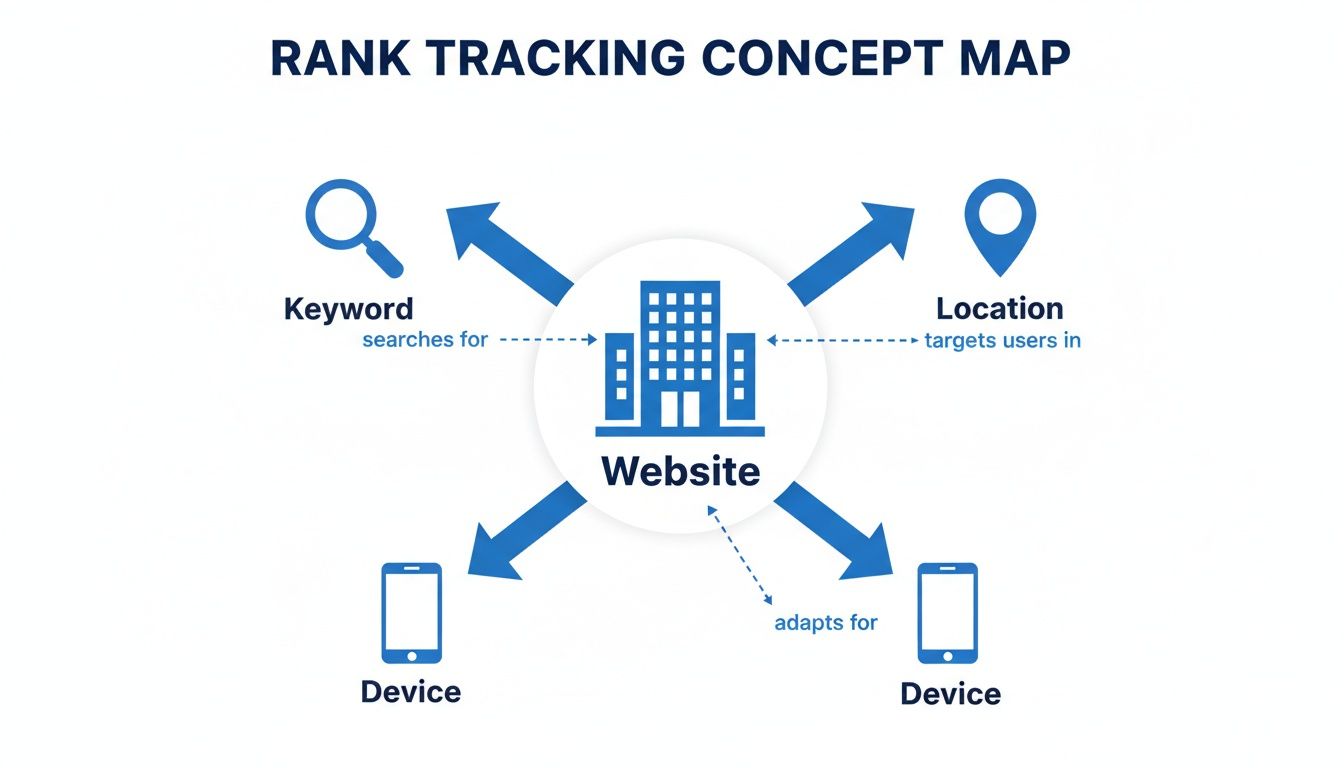
The core idea remains the same, whether we're talking about Google or a chatbot. Your website is the hub, but its visibility depends on how it shows up for specific keywords, in different locations, and across various devices.
Ignoring this evolution is like ignoring a huge chunk of your potential customers. Brands that are absent, misrepresented, or inaccurately described in AI responses are simply invisible to a growing audience. This isn't some far-off future; it's happening right now.
Think about this: thanks to Google AI Overviews, 60% of searches now result in zero clicks. And with 2 billion monthly users already seeing these AI-powered summaries, that trend is only going to accelerate. By 2028, it’s expected to blow past traditional search traffic.
The New Competitive Arena
This transition is especially urgent when you consider that 35% of U.S. Gen Z already turns to AI chatbots first. For them, AI isn't just another tool—it's their primary way of discovering new things. If your business isn't mentioned, or worse, if a competitor gets the recommendation instead, you've lost a customer you never even knew was looking.
A brand that ranks #1 on Google but is never mentioned by an AI assistant has a visibility problem it can't see in its traditional analytics. This is the new frontier of online reputation and customer acquisition.
To help clarify this shift, let's look at a side-by-side comparison.
Traditional Rank Tracking vs AI Brand Monitoring
| Aspect | Traditional Rank Tracking (e.g., Google SERP) | AI Brand Monitoring (e.g., TrackMyBiz) |
|---|---|---|
| What It Measures | Position on a ranked list (e.g., "#3") | Presence, accuracy, and sentiment in a direct answer. |
| Primary Goal | Climb the list of blue links. | Become the trusted, recommended solution. |
| Key Question | "Where do I rank for 'best plumber'?" | "Does the AI recommend me for 'best plumber'?" |
| Data Source | Scraped search engine results pages (SERPs). | Direct queries to Large Language Models (LLMs). |
| Success Metric | High SERP position. | Positive and accurate brand mentions. |
| Key Risk | Falling in rankings. | Being misrepresented, ignored, or having a competitor recommended. |
This table makes it clear: the metrics that mattered yesterday aren't enough for today.
This new reality connects the familiar world of SEO with the urgent need for AI optimization. It’s about playing defense to ensure your brand is not just found, but also favorably and accurately represented in the AI-powered conversations that are quickly becoming the new search.
Knowing your visibility inside these LLMs is the crucial first step, and specialized tools are appearing to help businesses navigate this new space. For a deep dive into how agencies are adapting, check out our guide on LLM visibility tracking. This is where a modern platform like TrackMyBiz goes beyond simple rank data to act as a true reputation shield in the age of AI.
Why Modern Rank Tracking Is a Game-Changer
The true power of rank tracking really clicks when you stop thinking about a single website and start managing a brand with dozens of physical locations or a reputation spread all over the web. For these businesses, modern tracking isn't just another SEO task; it's a core part of operations and brand defense.
Take multi-location businesses like retail chains or service franchises. For them, consistent visibility across different neighborhoods, cities, and states is everything. A customer on one side of town has to see the same accurate store hours and contact info as a customer across the country. This is where localized rank tracking becomes absolutely essential.
It’s about far more than a simple ranking position. It's about making sure your business shows up correctly in local map packs, which is the exact moment many customers make their final decision. For any multi-location retailer, this is a non-negotiable, especially since 60% of smartphone users find new brands through local searches. By keeping an eye on each location’s specific SERPs, you can be sure those crucial details are right, everywhere.
A Reputation Shield for Brand Managers
While local businesses are zeroed in on geographical accuracy, brand and PR managers are fighting a different kind of battle—one against AI-driven misinformation. Your traditional SEO tools can’t tell you if an AI assistant just started telling users a damaging, completely fabricated story about your brand. This is the new front line of reputation management.
Imagine an AI "hallucinating" that one of your flagship stores is "permanently closed," or inventing a negative news story that never actually happened. These aren't just hypotheticals anymore; they are real, active risks that can cause immediate damage to your brand's integrity and bottom line.
A brand's reputation is built over years but can be damaged in minutes by a single, unchecked AI response. Modern rank tracking acts as an early warning system, shifting from a performance metric to a reputation shield.
This is exactly where a platform like TrackMyBiz goes beyond simple rank data. It becomes a proactive defense system, sending alerts on inaccurate information and analyzing the sentiment of how AI is talking about you. For SaaS companies, understanding how AI frames their value proposition is especially critical. You can learn more about protecting your brand in our guide on AI brand tracking for SaaS companies.
By monitoring what AI assistants are saying, you can catch falsehoods before they take root, protect your brand's narrative, and make sure the world's digital concierges are recommending you for all the right reasons. This completely transforms rank tracking from a measurement tool into a core part of your brand's defense strategy.
Common Mistakes That Will Wreck Your Tracking Strategy
Even the most sophisticated rank tracking tools are useless if your strategy is built on a shaky foundation. Too many businesses fall into the same traps, chasing misleading data and wasting countless hours.
Let's walk through the big ones so you can steer clear and build a strategy that actually reflects your real-world digital footprint.
Chasing Vanity Keywords
This is probably the most common mistake in the book: obsessing over vanity keywords. These are the big, generic, high-volume terms that look amazing on a report but have almost zero buying intent.
Ranking for "digital marketing" might feel like a huge win, but it’s the long-tail, specific phrases like “local SEO services for plumbers” that actually bring in paying customers. A solid strategy always puts business goals ahead of search volume. Always.
Forgetting Where Your Customers Actually Are
Another critical blind spot is ignoring how and where your customers are searching. Many businesses just track national rankings on desktop, completely missing how they show up on a phone or to someone searching just a few miles away.
Given how many searches are local, this isn't a small oversight—it's a massive gap in your data.
You absolutely have to break down your tracking to see the full picture:
- Mobile vs. Desktop: Rankings can be wildly different on a phone versus a laptop. You need to see what the person searching on the go sees.
- Local SERPs: If you have a physical location (or several), tracking your rank at the city or even neighborhood level isn't optional. It's essential.
If you're not monitoring these different contexts, you're simply not seeing what your most important customers see.
Relying exclusively on traditional SERP data while ignoring AI chatbots is the modern equivalent of optimizing for the Yellow Pages while your customers are all using Google. It's a dangerous blind spot where your brand reputation can be damaged without you even knowing.
Finally, the biggest mistake people are making right now is failing to track competitors in both traditional search and AI recommendations. Without that context, your data is meaningless. A holistic strategy doesn't just watch your SERP positions; it monitors which competitors AI assistants are suggesting to your potential customers.
That's the only way to get the 360-degree view you need to protect and grow your brand today.
How to Build a Modern Rank Tracking Workflow
Knowing the theory is one thing, but putting it all into practice requires a clear, repeatable process. A modern rank tracking workflow isn't just about checking your SERP positions anymore; it’s about building a complete system for managing your visibility and reputation.
This roadmap will show you how to combine traditional SEO with the new, essential world of AI monitoring.
Think of this not as a one-time setup, but as a continuous loop: monitor, analyze, and act on the data you gather. The goal is to build a strategy that grows your digital footprint while actively protecting it from emerging threats like AI-driven misinformation.
Define Your Core Keywords
First thing's first: foundational keyword research. It's tempting to chase high-volume terms, but the real magic is in identifying the keywords that signal a customer is ready to act. Your list should be a strategic mix that lines up directly with your business goals.
- Commercial Keywords: These are your money-makers, the terms with high purchase intent that drive conversions (e.g., "emergency plumbing repair near me").
- Local Keywords: Absolutely critical for any business with a physical presence. These are what capture local foot traffic (e.g., "best coffee shop downtown").
- Branded Keywords: This includes your company name, product names, and variations. You have to own these in search results, no exceptions.
This curated list becomes the bedrock of your entire tracking strategy. It keeps your efforts focused on what actually moves the needle.
Establish Your Visibility Baseline
With your keywords locked in, it’s time to draw a line in the sand. Use a dedicated tool to set up your initial rank tracking for those core commercial and local keywords across both desktop and mobile. For larger organizations needing a more powerful and scalable solution, exploring the top enterprise rank tracking software platforms is a smart move.
A baseline isn’t just your starting point; it's the benchmark against which all future SEO efforts and competitor movements are measured. Without it, you're flying blind.
This initial data gives you a clean snapshot of your current SERP performance before you start layering on more advanced monitoring.
Integrate AI and Competitor Monitoring
Once your traditional tracking is humming along, it's time for the next layer: AI monitoring. This is where you move beyond the SERPs to see how platforms like ChatGPT or Gemini are talking about your brand. Tools built for this purpose help you track brand mentions, check for factual accuracy, and see which competitors are getting recommended.
To get a real edge, you can't just look at your own AI presence; you have to know what your rivals are up to. Specialized competitor AI analysis tools can reveal who the AI models favor in your market.
Finally, set up automated alerts for the big stuff—like your brand being mentioned alongside false information or in a negative light. By regularly reviewing the combined data from both SERPs and AI, you can finally connect your SEO work to your brand’s real-world presence in the new age of conversational search.
Rank Tracking FAQs
Got questions? Let's clear up some of the most common ones about rank tracking and how to make it work for you.
How Often Should I Check My Keyword Rankings?
In today's market, you really need to be checking daily. Modern tools make this the standard, and for good reason. A sudden algorithm update or a competitor making a big move can happen overnight, and daily tracking lets you spot the shift before it starts costing you traffic and customers.
Can I Track My Rankings for Free?
You can, but you get what you pay for. Free tools are a decent starting point, but they almost always come with serious limitations on keywords, locations, and how often they update.
If you're serious about getting reliable data—especially if you operate in multiple cities or want to keep a close eye on competitors—a professional platform is a must.
- Free trials often cap you at just 10 keywords.
- Many free tools only update weekly, leaving you blind to daily changes.
- Tracking rankings across different regions is almost always a paid feature.
“Without daily rank alerts, you’re flying blind. You could miss a sudden drop in a high-value keyword and not know until the damage is done.”
Smart Monitoring in the Age of AI
Is Rank Tracking Still Relevant with AI Search?
Absolutely. Don't let anyone tell you otherwise. Traditional rank tracking is still your go-to for monitoring visibility on classic search engine results pages—those familiar blue links aren't going away anytime soon.
But the game has expanded. AI assistants and chat interfaces are the new frontier of discovery. A complete strategy today means blending your organic rank data with insights into your AI visibility. This hybrid approach is the only way to see the full picture, covering both traditional SERPs and conversational AI mentions.
Best Practices to Get the Most Out of Your Data
Knowing your rank is one thing; turning that data into smart decisions is another. Here are a few practical tips to get the most from your tracking efforts.
- Focus on what matters. Prioritize the critical keywords that actually drive revenue and bring in local foot traffic. Don't get lost in vanity metrics.
- Avoid alert fatigue. Set up daily alerts, but only for your most important, high-value keywords. This keeps the signal high and the noise low.
- Get the full picture. Layer your traditional rank tracking with AI monitoring to ensure complete visibility across all discovery channels.
- Look for the long-term story. Review reports on a weekly basis. This helps you spot meaningful trends instead of overreacting to normal daily fluctuations.
- Keep an eye on the competition. Check your competitors' rank movements every week. It’s the fastest way to spot an emerging threat and react before they steal your market share.
Following these steps will help you turn raw numbers into a real strategy, keeping your brand front and center no matter where customers are looking.
Ready to see what AI assistants are saying about your brand? Get a free scan on TrackMyBiz and protect your brand's reputation in the new age of AI search.
