Generative Engine Optimization (GEO) is all about making sure your business shows up—accurately and positively—when AI tools like ChatGPT, Perplexity, or Google’s AI Overviews answer a user's question. Think of it as the next chapter after traditional SEO. It’s less about climbing a list of blue links and more about becoming a trusted source that AI cites in its generated summaries.
Welcome to the New Era of AI-Powered Search

The way we all find information online is changing more dramatically than it has in decades. For years, the game was simple: get your website to the top of Google. We called it Search Engine Optimization (SEO), and it was a lot like organizing a library's card catalog—you'd meticulously label and structure your content so the search engine could find it and rank it accordingly.
Now, picture walking into that library and, instead of fumbling with the card catalog, you ask a super-smart librarian for a direct answer. The librarian pulls information from several books, synthesizes the key points, and gives you one clear, coherent response, even pointing out the sources. That's exactly what AI-powered search does, and it's where Generative Engine Optimization (GEO) comes into play.
This isn’t just a passing trend; it’s a massive shift in how people behave. With AI search adoption expected to hit 38% by early 2025, it’s clear people want conversational AI to deliver quick, synthesized answers. GEO is the strategy built for this new reality, adapting what we know from SEO for an world of AI answer engines.
GEO doesn't replace SEO. It builds on it. The goal is to make your brand’s expertise so solid that the AI "librarian" trusts you as a primary source. In this new game, getting cited in an AI answer is the new #1 ranking.
To get ahead, brands are turning to a new class of AI assistant tools designed to help them adapt their strategies for this generative AI world.
Quick Comparison SEO vs GEO
To really see the difference, it helps to put the two disciplines side-by-side. While SEO is about being visible in a long list, GEO is about having influence within a single, generated narrative.
| Aspect | Traditional SEO | Generative Engine Optimization (GEO) |
|---|---|---|
| Primary Goal | Rank high on a list of links | Get cited and featured in AI-generated answers |
| User Interaction | Users click links to find answers | Users receive a direct, summarized answer |
| Key Metric | Organic traffic and click-through rate | "Share of Answer" and citation frequency |
| Optimization Focus | Keywords, backlinks, on-page content | Factual accuracy, data structure, authority |
The bottom line is simple. SEO was about getting found. GEO is about getting recommended.
Why Ignoring GEO Is a Risk You Can't Afford
The shift to AI-powered answers isn't some far-off future—it's happening right now, actively changing how customers find businesses. Overlooking this change isn't like missing a new marketing trend; it's the digital equivalent of being ripped out of the phone book. In this emerging zero-click world, if you don't adapt, you're invisible by default.
Think about it. When a potential customer asks a chatbot for the "best local marketing agency" or "most reliable coffee machine," the AI doesn't give them a list of links. It gives them a direct answer. If your brand isn't in that answer, you don't just lose a click; you cease to exist in that critical moment of decision. The entire customer journey just bypassed you.
This is creating a new digital divide. While your competitors are getting direct recommendations and validation from AI, your brand is left in the dark. Sticking only to old SEO tactics is like bringing a paper map to a world that runs on GPS—you're using yesterday's tools for a completely different journey.
The Immediate Threat to Local and Reputation-Reliant Brands
For some businesses, the risk of ignoring GEO is not just serious, it's immediate. The stakes get dangerously high when your physical location or public perception is the core of what you sell.
Two groups are especially vulnerable:
- Multi-Location Businesses: Think of a chain of coffee shops, dental clinics, or retail stores. Their lifeblood is accurate local information. If an AI tells a user your downtown branch is "permanently closed" because it picked up one piece of bad data, that's real revenue lost, instantly. Keeping your information consistent online is no longer just good practice; it's a survival tactic.
- Reputation-Driven Brands: Companies in finance, healthcare, legal, or high-value B2B services live and die by their reputation. AI engines are now the great synthesizers, pulling together reviews, news articles, and forum chatter into a single, definitive summary. Shaping that narrative is critical, which is why we created a guide for AI reputation management consultants to tackle this exact problem.
AI Is Becoming the New Source of Truth
Here’s the biggest risk of all: AI engines are quickly becoming the new source of truth for millions of people. When an AI confidently states something about your brand—whether it’s about your pricing, your services, or a completely fabricated scandal—many users will simply accept it as fact. Trying to correct an AI-driven misconception is exponentially harder than dealing with a single bad review on one website.
This shift is already reflected in how business leaders are thinking. A massive analysis of 8,874,785 opinions from US business leaders showed that improving decision-making and productivity are top priorities for AI integration. The fact that 47% see in-house AI tools as the way forward shows a clear trend toward wanting to control their own AI narrative. You can see all the data in this 2025 Generative Engine Optimization statistics report.
Inaction is a decision with severe consequences. Ignoring GEO means you are allowing AI models, competitors, and outdated data to define your brand's narrative without your input.
Ultimately, the choice is simple. You can either be an active participant in how AI understands and talks about your business, or you can let the algorithms decide your fate. In this new world, the latter is a risk no brand can afford.
How Generative AI Engines Actually Find Answers
To get anywhere with Generative Engine Optimization, you first have to get inside the "head" of an AI. This isn't like traditional SEO, where the goal is to get a search engine to rank your link. A generative AI model is more like a tireless research assistant. It reads a staggering amount of information, connects the dots, figures out what’s most credible, and then builds a completely new, coherent answer from scratch.
Think of it like building a complex puzzle. The AI gathers pieces—data points—from millions of sources like websites, articles, books, and databases. Its mission is to assemble those pieces into a clear picture that perfectly answers your question. The pieces that fit the best are the ones that are sharp, well-defined, and have a consistent shape no matter where the AI finds them.
The entire process is driven by one core goal: provide a helpful, accurate, and safe response. This means the AI is hardwired to prioritize information it can verify, especially if it comes from authoritative sources and lines up with what other experts are saying. This is a quality game, not a quantity game.
The Role of Verifiable Data and Authority
Generative models are built on a foundation of trust. To avoid "hallucinating" (which is just a technical term for making things up), they are programmed to cross-reference facts constantly. An AI is far more likely to cite your business hours if that information is 100% identical on your website, your Google Business Profile, and a major industry directory.
This verification process is the key to understanding GEO. You're not trying to trick an algorithm; you're trying to leave an undeniable, consistent trail of evidence about who you are and what you do. Before diving deeper into AI, it's useful to see how a search engine optimized press release is structured, as it provides a great baseline for how content must be designed for bots to process it effectively.
Here’s what these engines are actively looking for:
- Consistency Across Platforms: Is your company's information exactly the same everywhere? Even small inconsistencies are red flags that crush an AI's confidence in your data.
- Authoritative Citations: Are you mentioned by respected industry publications, news outlets, or academic journals? A single mention on a trusted site is a massive signal of authority.
- Structured Data: Using Schema markup on your website helps an AI understand the context behind your information, making it much easier to process and trust.
Ignoring this can have brutal consequences, from lost traffic and reputation damage to becoming completely invisible in AI-generated answers.
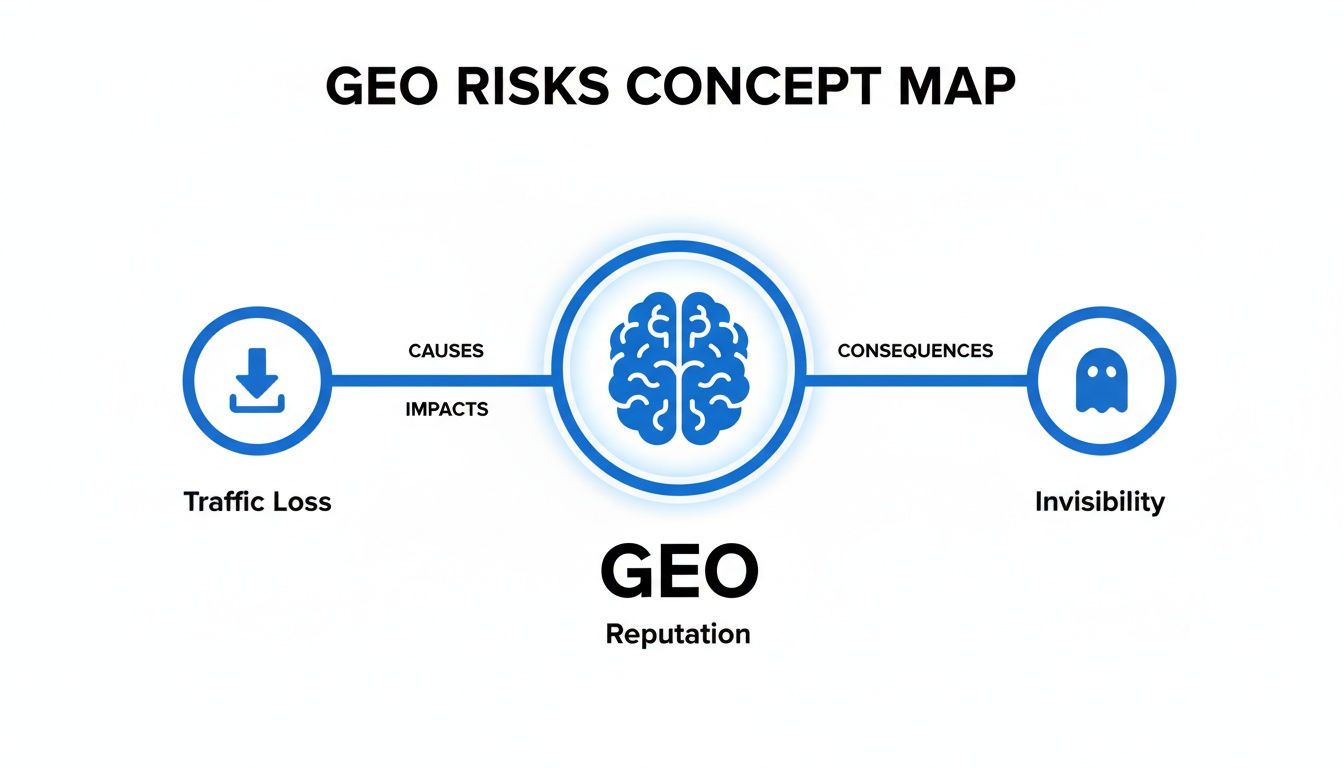
This map shows it perfectly. Failing to provide clear, authoritative data starts a chain reaction that leads straight to the biggest business risks: traffic loss and reputation damage, which eventually make a brand invisible to AI.
How AI Synthesizes and Cites Information
Once an AI gathers and verifies its facts, it moves on to the synthesis stage. It doesn't just copy and paste. Instead, it identifies the most crucial pieces of information and weaves them into a conversational, easy-to-understand narrative.
During this process, it often attributes information back to its sources. Getting your brand cited in an AI answer is the grand prize of GEO. This happens when the AI concludes your content isn't just a source—it's the definitive source for that specific piece of information.
The non-negotiable price of entry for getting cited in an AI-generated answer is providing trustworthy, corroboratable content. AI models are designed to minimize risk, and they will always favor a known, verifiable fact over an unverified claim.
To boost your chances of getting cited, your content absolutely must be:
- Comprehensive: Go deep. Cover a topic so thoroughly that you answer all the likely follow-up questions a user might have.
- Clear and Concise: Get straight to the point. Use lists, tables, and sharp headings to make your information incredibly easy for the AI to grab.
- Factually Accurate: Make sure every stat, claim, and piece of data is correct. Even better, link out to your primary sources to prove it.
Trying to manage this process effectively requires the right tools. For agencies juggling multiple clients, it’s impossible to scale without a reliable system for LLM visibility tracking for agencies to monitor mentions and citations. This is how you measure what's working and fix inaccuracies before they spread.
Ultimately, the brands that win in this new world will be the ones that AI models can trust without a second thought.
Your Actionable Blueprint for a GEO Strategy

Knowing how AI engines work is one thing. Actually shaping what they say about your business is another game entirely. To move from theory to practice with Generative Engine Optimization (GEO), you need a deliberate, structured plan. This isn't about chasing the latest algorithm tweak; it's about building a digital presence so clear and trustworthy that AI models have no choice but to see you as an authority.
This blueprint breaks that process down into concrete, manageable steps. The goal is simple: create a consistent, machine-readable identity for your brand across the web, making you the obvious choice for AI-driven answers.
Establish a Single Source of Truth
First things first: your own website has to be the definitive, unimpeachable source of truth about your business. AI models are built to prioritize consistency because it minimizes risk. Any contradiction between what your site says and what another platform says creates doubt, and doubt gets you ignored.
Your core website content needs to be comprehensive and meticulously organized. Stop thinking about each page as just content for a human. Start seeing it as a data file for an AI. It needs to be clean, with clear headings, concise paragraphs, and rock-solid factual accuracy.
An AI model is like a diligent fact-checker on a tight deadline. It will always choose the source that is easiest to understand and verify. Your job is to make your website that source.
Start by auditing your most important pages—services, locations, and your "About Us" page. Make sure every claim is backed up, every detail is current, and the information is presented in a way that answers questions directly and completely.
Create Comprehensive Entity-Based Content
To win at GEO, you have to think in terms of entities and topics, not just keywords. An entity is any distinct person, place, organization, or concept. Your goal is to create the most thorough and authoritative content on the internet about the entities central to your business.
Don't just write a short blog post on "social media marketing." Build a comprehensive pillar page that covers every related subtopic: strategy, different platforms, analytics, tools, and common mistakes. This is how you build true topical authority, signaling to AI models that you are the expert.
Here's how to structure this kind of deep content:
- Answer the Core Question: Start by addressing the main query a user would have.
- Anticipate Follow-Up Questions: Use subheadings (H3s and H4s) to answer the next logical questions that pop into a reader's mind.
- Incorporate Structured Data: Use lists, tables, and bullet points. They break down complex information into digestible, machine-readable formats that AIs love.
This approach ensures your content isn't just relevant but serves as a complete, one-stop resource. That makes it incredibly valuable to an AI tasked with synthesizing a complete answer for a user.
Leverage Structured Data and Citations
While fantastic content is the foundation, you also have to make it easy for machines to understand. This is where structured data, like Schema.org markup, becomes your secret weapon. It adds a hidden layer of context to your content, telling AI engines exactly what your information is—a business address, a product review, or an upcoming event.
Beyond your own site, you need to manage your presence on high-authority platforms. AI models constantly cross-reference information across the web to verify facts. Getting your business information correct on trusted third-party sites isn't optional; it's non-negotiable.
Your citation-building checklist should include:
- High-Authority Directories: Make sure your info is perfect on platforms like Google Business Profile and key industry-specific directories.
- Knowledge Bases: Where appropriate, contribute accurate information to platforms like Wikipedia or industry wikis.
- Reputable Review Sites: Actively manage your presence on sites that AI models rely on for sentiment analysis and customer feedback.
To help you get started, we've put together a simple checklist to guide your first steps into the world of GEO.
GEO Action Plan Checklist
This table outlines the foundational actions you can take to begin optimizing your digital presence for generative AI engines, turning theory into a tangible strategy.
| Action Item | Objective | Key Platforms and Tools |
|---|---|---|
| Audit Website Content | Establish your website as the ultimate source of truth with clear, factual, and consistent information. | Your own CMS (e.g., WordPress), Google Search Console, Screaming Frog |
| Build Entity-Focused Content | Create comprehensive guides and pillar pages to build topical authority on your core business concepts. | Ahrefs, SEMrush, AlsoAsked |
| Implement Schema Markup | Add structured data to your website to help AI models understand the context of your information. | Schema.org, Google's Rich Results Test |
| Optimize Local Citations | Ensure your business Name, Address, and Phone (NAP) are consistent across all high-authority directories. | Google Business Profile, BrightLocal, Yext |
| Manage Online Reviews | Actively monitor and respond to reviews on key platforms to build social proof and trust signals. | Google, Trustpilot, Capterra, industry-specific review sites |
| Analyze Competitor AI Mentions | Understand how and why competitors are being mentioned by AI to identify strategic gaps and opportunities. | TrackMyBiz, manual prompt testing |
By following this checklist, you can systematically build a digital footprint that is both human-friendly and AI-ready.
Building a GEO strategy can feel like a lot, but understanding your competitors' positioning in AI is a fantastic place to start. You can explore a variety of competitor AI analysis tools to see who is being cited and why, revealing gaps you can exploit. This strategic approach turns a complex process into a clear path toward becoming an AI-preferred brand.
Measuring Success in a Zero-Click World
In the old world of SEO, success was pretty straightforward—you just had to look at your clicks, traffic, and keyword rankings. But that playbook is getting outdated. In the new landscape of Generative Engine Optimization (GEO), where AI just gives people the answer directly, those old metrics can lie to you.
Think about it. If a chatbot gives a user a perfect summary of your solution and they never need to visit your site, how do you know your efforts are even working?
The game has shifted from chasing traffic to building influence. Success isn't just about getting found anymore; it's about being cited, recommended, and accurately represented inside the AI's answer. This calls for a completely new set of key performance indicators (KPIs) that measure your brand’s authority in a world where the click is no longer king.
Shifting from Clicks to Citations
The most fundamental change here is moving from tracking click-through rates (CTR) to tracking citation frequency. The old question was, "How many people clicked our link?" The new, more important question is, "How often is our brand mentioned as a trusted source in AI responses?" This is the heart and soul of GEO analytics.
To do this right, you have to start monitoring new, GEO-specific metrics:
- Share of Answer: This is your new North Star KPI. It measures the percentage of times your brand shows up in AI-generated answers for your target questions. A high Share of Answer means you’re dominating the AI conversation in your niche.
- Citation Frequency: This is a simple count of how many times your brand or content is cited as a source. More citations are a powerful signal of authority to the AI models.
- Sentiment Analysis: This one is huge for your reputation. It looks at the tone and context of your brand mentions. Are AI summaries painting your business in a positive, neutral, or negative light? A positive sentiment score is a massive win.
Practical Measurement and Monitoring Approaches
Let's be clear: relying on your website analytics alone will leave you completely blind to how AI sees your brand. Tracking these new metrics requires a mix of manual spot-checks and powerful automated tools. You have to be proactive to gauge the real impact of your GEO strategy.
A good place to start is with manual prompt testing. Get in the habit of regularly asking different AI models like ChatGPT, Gemini, and Perplexity the key questions related to your industry, products, and competitors. Document everything—where your brand appears, what the AI says, and what sources it cites. This is incredibly insightful, but you'll quickly find it’s impossible to scale, especially if you manage multiple locations or a wide range of products.
In a zero-click world, success is defined by influence, not just traffic. Measuring your brand’s presence within AI conversations is the only way to know if your GEO strategy is truly delivering value.
This is exactly where automated platforms like TrackMyBiz become a necessity, not a luxury. These tools can run thousands of prompts across multiple AI engines every single day, giving you a crystal-clear picture of your Share of Answer and automatically flagging any inaccuracies. They provide the hard data you need to move from random, anecdotal checks to a structured, scalable measurement system.
By tracking these new KPIs, you can finally put a number on your influence and prove the ROI of your GEO efforts in this new era of search.
Let's move from theory to reality. It’s one thing to talk about Generative Engine Optimization (GEO) in the abstract, but seeing it play out in the real world is where it all clicks. The following scenarios show how these strategies translate directly into what an AI says about a business—for better or for worse.
The Multi-Location Masterclass
Picture a popular restaurant chain, "Tony's Pizzeria," that wants to be the number one recommendation when someone asks an AI, "best deep-dish pizza near me." Their GEO strategy is all about obsessive consistency.
Every single location's address, phone number, and hours must be a perfect match across their website, Google Business Profiles, and all the major food apps. There's no room for error.
They’d also use structured data (Schema markup) on their website to spoon-feed the AI. By clearly labeling menu items, prices, and even nutritional info in a machine-readable format, they make it incredibly easy for the model to pull accurate details. This boosts the AI's confidence in Tony's, making them a reliable and well-documented choice for a direct recommendation.
The B2B Authority Play
Now, let's switch gears to a B2B SaaS company selling cybersecurity software. Their goal is to own the answer to a highly technical question like, "What is the best way to prevent a phishing attack?"
Here, the strategy shifts from local data to demonstrating overwhelming topical authority. They need to create the definitive guide on their blog—a long-form, comprehensive resource covering everything from spotting fake emails to deploying employee training protocols.
But just publishing it isn't enough. To truly cement their authority, they need to get that guide cited and mentioned in respected cybersecurity journals and industry reports. When an AI model sifts through the web to find the most credible source, it will see this company’s content being validated by trusted third parties. This validation turns them from just a source into the source, landing them that coveted spot in the AI's answer.
A brand with inconsistent, conflicting information across the web is a major red flag for an AI. When a model cannot verify basic facts like business hours or services, it loses confidence and is more likely to misrepresent the business or ignore it entirely.
What Not to Do: A Cautionary Tale
Finally, let's look at what happens when it all goes wrong. Imagine a local hardware store with a messy digital footprint. Their website says they close at 8 PM, their Google Business Profile says 9 PM, and a popular local directory has them listed as "temporarily closed."
A customer asks their AI, "What time does that hardware store close?" The model is now stuck, facing a mess of contradictory data.
Unable to figure out the truth, it might give a useless response like, "Closing times for this store vary," or worse, confidently state the wrong time based on whichever source it decided to trust in that split second. This single point of data inconsistency creates a terrible customer experience and leads to lost sales, perfectly illustrating why a proactive GEO strategy is no longer optional.
Common Questions About GEO
As Generative Engine Optimization moves from a buzzword to a core business function, a lot of good questions are popping up. Let's tackle some of the most common ones to clear up how GEO works and what you should expect.
Does GEO Replace Traditional SEO?
No, not at all. Think of GEO as the next logical step after SEO.
Traditional SEO is the foundation. It’s the concrete slab your entire digital presence is built on—making sure your site is technically sound, well-organized, and authoritative enough to even show up. You still need that foundation, especially since traditional search results are a primary food source for AI models.
GEO is what you build on top of that foundation. It’s like framing the house—taking all your solid content and structuring it in a way that an AI can easily understand, trust, and feel confident citing in its answers. One can't exist without the other.
What Is the Single Most Important Factor for GEO?
If I had to boil it all down to one thing, it would be verifiable authority and trustworthiness. This isn’t a single tactic but the outcome of a consistent, holistic strategy.
You achieve this by making sure your brand’s information is perfectly consistent and accurately mirrored across multiple high-authority, third-party sources. We're talking about everything from industry reports and major business directories to knowledge bases like Wikipedia and, of course, your own website.
AI models are programmed to be risk-averse. To avoid making things up (what the industry calls "hallucinations"), they prioritize sources they can cross-reference and verify. Consistency across the web is the loudest signal of trustworthiness you can send.
How Long Does It Take to See Results from GEO?
Generative Engine Optimization is a long game, not a quick hack. The timeline really depends on the AI models themselves and how often their owners refresh their training data.
Some of the changes you make on your own website, like adding structured data, might get picked up in a few weeks or a couple of months. But building the deep, off-site authority and earning the kind of high-quality citations that truly influence AI recommendations can take several months, sometimes up to a year, to be fully reflected in the answers people get. Patience and consistency are your best friends here.
Can Small Businesses Compete in GEO?
Absolutely. In fact, in some ways, they have an advantage. While big brands have bigger budgets, small businesses can win by laser-focusing on niche authority. The goal is to become the undisputed, go-to expert for a very specific topic or local service area.
An AI’s job is to find the best answer, not just the one from the biggest company. A small business can become that best answer by nailing the fundamentals:
- Perfecting their Google Business Profile: Every single field should be filled out accurately. No exceptions.
- Driving a constant stream of positive reviews: Social proof is an incredibly powerful trust signal for both humans and AI.
- Creating the definitive resource: Build the single most helpful, comprehensive piece of content on the web for your specific niche.
When you become the undeniable expert in your small pond, you become the AI's most trusted source, and that's a massive competitive edge.
Ready to find out what AI is already saying about your business? TrackMyBiz offers a free scan that shows you your current visibility in generative search. You’ll uncover hidden reputation risks and opportunities in just a few minutes. Get your free AI visibility report and start mastering your brand's AI-driven reputation.
