Your digital reputation is the story people find when they look you up online. It's the gut feeling a potential customer gets from your Google results, the star ratings they see on review sites, and the conversations happening about you on social media.
In short, it’s what the internet says about your business when you’re not in the room.
What is a Digital Reputation, Really?

Think of it as your company's digital handshake. It's the very first impression you make, long before someone walks through your door or talks to your team.
This isn’t just one thing, but a mosaic pieced together from dozens of different online touchpoints. It's no longer a passive background element; it's an active, manageable asset that directly steers customer decisions and shapes your bottom line.
The Four Pillars of Your Online Story
To get a handle on your digital reputation, you first need to understand where it comes from. Today's online perception is built on four distinct pillars, each telling a piece of your brand's story.
Here's a quick breakdown of what shapes that modern "handshake":
The Four Pillars of Modern Digital Reputation
A summary of the key components that shape a business's online perception in today's digital landscape.
| Pillar | Description | Primary Platform Examples |
|---|---|---|
| Search Engine Results | The first page of Google is your digital storefront. It's the most common first impression you'll ever make. | Google, Bing, DuckDuckGo |
| Online Reviews & Ratings | Direct customer feedback that signals trust and quality, heavily influencing new buyers. | Google Maps, Yelp, Trustpilot, Capterra |
| Social Media Presence | Real-time conversations and content that shape public sentiment and brand personality. | Facebook, Instagram, LinkedIn, X (Twitter) |
| AI & LLM Responses | The new frontier, where AI assistants synthesize web data to recommend businesses and answer questions. | ChatGPT, Google Gemini, Perplexity |
Each of these pillars contributes to the overall narrative customers build about your business.
This collective impression carries enormous weight. Consider that 87% of people trust online reviews just as much as a personal recommendation from a friend. A positive reputation isn't a vanity metric—it's a lead generation engine.
This concept is the core focus of any modern strategic PR agency that helps businesses build reputations. They know that actively managing this perception is non-negotiable for any business that wants to grow.
Your reputation is the public perception of your integrity. Because it’s other people’s opinions of you, it may or may not be accurate. Others determine your reputation, but only you determine your integrity.
Why Your Reputation Is Your Most Valuable Asset
Let's be clear: your digital reputation isn't some fuzzy, abstract concept. It's a hard asset that directly impacts your bottom line, acting as the ultimate trust signal in a crowded marketplace. It's what guides a potential customer either straight to your door or into the arms of a competitor.
Think of it this way: a positive online presence greases the wheels of the entire buying journey. A negative one, however, throws up roadblocks at every turn. Poor reviews, scathing social media comments, or damaging search results are red flags that cause potential customers to hit the brakes long before they ever think about contacting you.
Reputation Drives Customer Decisions
In today's world, every customer is a researcher. Before they commit to spending their money, they’re digging for social proof to make sure they're making the right choice. In fact, a staggering 93% of consumers report that online reviews have influenced their purchasing decisions.
This is especially true for local businesses. When someone pulls out their phone and searches for a service "near me," their eyes instantly gravitate to two things: star ratings and review snippets.
Take a look at this everyday search for local coffee shops.
Which one catches your eye first? The businesses with higher star ratings and more positive reviews immediately look more credible and appealing. They're the ones getting the attention and, more importantly, the clicks.
Investing in your online reputation isn't just about playing defense against bad feedback. It's a proactive growth strategy, turning positive perception into a predictable stream of leads and revenue. Protecting this asset also means taking steps like preventing identity fraud, which can completely destroy both personal and professional credibility.
Connecting Reputation to Revenue
The line connecting perception to profit is direct and unwavering. A strong digital reputation is a powerful conversion tool that makes every other part of your marketing more effective. For businesses with multiple locations, this effect is amplified, building trust at both the corporate brand level and within each local community.
Here’s how a great reputation directly fuels your business metrics:
- Higher Customer Trust: A mountain of positive reviews and content gives new customers the confidence to choose you over anyone else.
- Improved Lead Generation: High ratings on platforms like Google Maps translate directly into more phone calls, requests for directions, and clicks to your website.
- Increased Sales: Trust is the ultimate sales-driver. It lowers a customer's perceived risk, making them far more likely to complete a purchase.
Your reputation is the public perception of your integrity. Because it’s other people’s opinions of you, it may or may not be accurate. Others determine your reputation, but only you determine your integrity.
Ultimately, managing your online presence is about steering the public narrative that defines your business. Once you understand how customers see you and what they're saying, you can unlock powerful tools for growth. To see how AI is already shaping this narrative for your competition, check out our guide on competitor AI analysis tools and start turning those insights into action.
The New Frontier: What AI Means for Your Reputation
For years, we've focused on search engines and social media. But the rulebook for digital reputation just got a major rewrite. A powerful new player has entered the game: Large Language Models (LLMs) like ChatGPT and Gemini.
These AI platforms are quickly becoming the new "answer engines." Instead of giving you a list of links to click, they skip the middleman and provide direct, conversational answers. This is a fundamental shift in how people find information.
This introduces a massive opportunity and an equally serious risk.
When a potential customer asks an AI, "What's the best Italian restaurant near me?" or "Which plumbing service has emergency hours?" the model chews through mountains of online data to spit out a single, confident answer. If you're the one recommended, it's a huge win. If you're left out—or worse, misrepresented—you've lost a customer before you even knew they existed.
The Danger of AI Hallucinations
The most urgent threat in this new world is something called an AI hallucination. This is when an AI model states something completely wrong or even fabricated with absolute confidence. It’s not a bug; it’s a byproduct of how these systems work, stitching together statistically probable words without any real-world understanding.
An AI hallucination can be devastating for a business's reputation. A simple user query can instantly turn into a PR crisis.
Here are a few common ways this can blow up in your face:
- Incorrect Business Information: The AI might tell a user your business is "permanently closed," list an old phone number, or get your store hours completely wrong. That’s a customer lost, right there.
- Fabricated Negative Events: A model could invent a story about a health code violation at your restaurant or a product recall for your brand, creating a nightmare from thin air.
- Misleading Service Descriptions: It could falsely claim you don't offer a service that’s actually your main specialty, sending a perfect lead straight to your competitor.
What makes these errors so dangerous is that they're delivered with the same authoritative tone as correct information, making them incredibly believable to the average person.
An AI doesn't know it's lying. It's just generating the next most likely word in a sequence. When those words happen to form a sentence that tanks your business, the damage is just as real as a one-star review, but far more difficult to trace.
Proactive Monitoring Is No Longer Optional
Waiting for an angry customer to tell you that ChatGPT thinks your shop is closed on Saturdays is not a strategy. By that point, the damage is done, and you have no idea how much business you’ve already lost.
The only real defense is to be proactive. You have to consistently monitor what these AI platforms are saying about your brand.
This means more than just poking an AI with a question about your business now and then. A real strategy involves tracking multiple AI models using a variety of prompts about your brand, services, and locations. It’s the only way to catch damaging misinformation the moment it surfaces.
Understanding this new piece of the puzzle is central to what is digital reputation today. By taking control of your AI narrative, you can turn a huge potential threat into a manageable—and even powerful—part of your overall strategy. For agencies looking to offer this crucial protection, the first step is exploring tools for LLM visibility tracking to safeguard their clients' futures.
How Social Media Shapes Public Perception
Think of social media as the modern town square—a sprawling, live arena where your brand's reputation is built, reinforced, or torn down one post at a time. Unlike a static website that you control, social channels are a free-for-all. This isn't just a place where perception is formed; it's where it’s actively fought over in a real-time stream of comments, shares, and viral moments.
This raw, unfiltered environment has completely flipped the script on who holds the power. A single customer's story—whether a glowing success or a frustrating failure—can rocket across the screens of thousands of potential buyers in hours. If your business isn't there to join the conversation, you’re not just being quiet. You’re letting everyone else write your story for you.
Perception Becomes Reality in Real Time
On social media, what people believe about your brand quickly becomes the truth. A brand that jumps into the fray—answering questions, addressing feedback, and sharing its values—builds a loyal community that will actually defend it against negativity. On the flip side, a brand that ignores mentions or quietly deletes criticism comes across as shady and out of touch, creating a narrative of pure neglect.
With nearly 60% of the world's population now on social media, the scale of this public forum is just massive. It's no longer just a place for company updates; it’s where customers do their homework. In the Asia-Pacific region, a staggering 49% of consumers check a brand's social media pages before buying something. Even more telling, 38% will walk away from a purchase if they see the company is caught up in an online crisis. The stakes have never been higher, and you can get a clearer picture of this global shift by exploring the state of digital communications.
And here's the kicker: customers want to see the good, the bad, and the ugly. A surprising 50% of users believe companies should not delete negative comments, viewing them as a more honest reflection of the real customer experience.
From Engagement to Resilience
The only way to build a tough, resilient digital reputation is through proactive social media management. This is about so much more than just scheduling marketing posts. It's about listening, engaging, and consistently showing up.
Here’s how being an active participant protects your brand:
- Monitoring Social Sentiment: You have to track more than just direct @mentions. You need a feel for the overall tone and emotion of the conversations happening around your brand and your industry.
- Engaging with Feedback: Responding to both praise and criticism shows you're actually listening and that you give a damn about the customer experience.
- Handling Crises with Transparency: When things inevitably go wrong, tackling the issue head-on and honestly on social media can stop the bleeding and, in some cases, even build more trust.
On social media, silence is an answer. Failing to engage is a clear signal to your customers that their voices don't matter, handing the megaphone to your loudest critics and letting them control the narrative.
Ultimately, social media gives you a powerful lever to shape your digital reputation. By jumping into the conversation, you don't just shield your brand from damage—you build a strong, loyal community that will go to bat for you. You can turn what feels like a major liability into one of your biggest assets.
A Practical Workflow for Managing Your Reputation
Knowing what makes up your digital reputation is one thing. Actually managing it is a completely different ballgame. To move from theory to action, you need a structured, repeatable process—a workflow that ensures you're proactively shaping your online story, not just putting out fires.
We can boil this down to three core phases: Monitor, Analyze, and Act. This simple framework turns reputation management from a chaotic scramble into a system you can actually control.
Phase 1: Monitor Your Online Presence
You can't manage what you don't measure. The first step is to build a listening system that constantly scans the digital world for mentions of your brand. Think of it as your early warning system, catching sparks before they become infernos.
But effective monitoring is more than just plugging your company name into a search engine once a week. It demands a much more thorough approach.
- Review Platforms: You need tools that track new reviews as they pop up on major sites like Google, Yelp, and any industry-specific portals. Immediate awareness is the key to a timely response.
- Social Media: Set up alerts for any mention of your brand, key products, or even your leadership team across platforms like X (formerly Twitter), Facebook, and LinkedIn.
- AI and LLMs: This is the new, critical frontier. You have to monitor what AI assistants like ChatGPT and Gemini are saying about your business. This is where you'll catch damaging "hallucinations" about your hours, services, or company history that customers are starting to treat as fact.
This infographic shows just how fast a single event, like a viral social media post, can cascade into a massive impact on your brand's reputation.
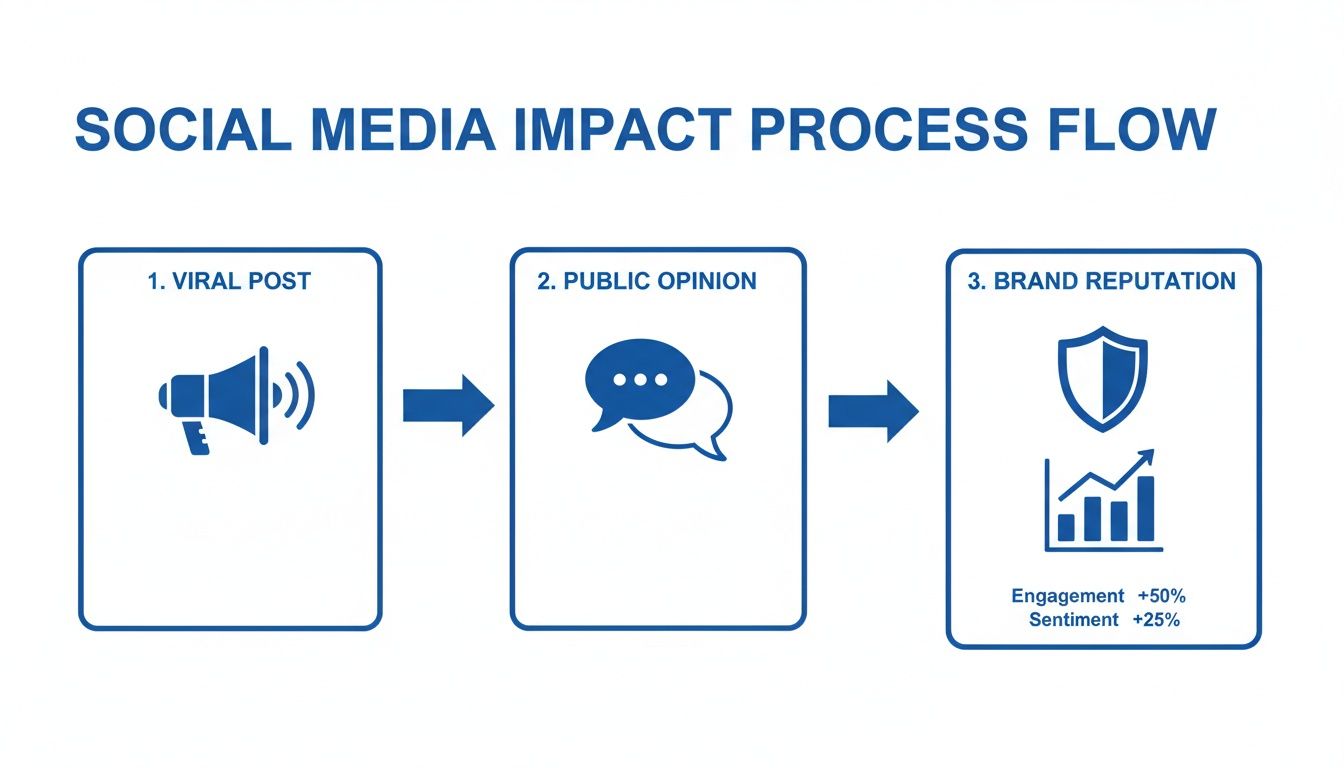
It’s a stark reminder of how a single starting point can rapidly shape public perception, making it crystal clear why constant monitoring is essential if you want to control the narrative.
Phase 2: Analyze the Data and Feedback
Once the information starts flowing in, the next phase is to make sense of it all. Data without interpretation is just noise. Analysis is where you connect the dots and figure out the "why" behind what people are saying.
During this phase, you're looking for patterns:
- Sentiment Trends: Is the overall conversation about your brand positive, negative, or neutral? More importantly, is that sentiment changing over time?
- Recurring Themes: Are customers constantly praising a specific employee? Or are they all complaining about the same frustrating issue? These are invaluable operational insights disguised as feedback.
- Competitive Gaps: Pay attention to what people are saying about your competitors. Their weaknesses might just reveal a perfect opportunity for you to highlight your strengths.
The goal of analysis is to move beyond individual comments and see the bigger picture. A single bad review is a customer service issue; a pattern of bad reviews points to a systemic problem that needs to be fixed.
Phase 3: Act on Your Insights
This is where you close the loop. The final phase is about taking concrete steps to protect and improve your digital reputation, guided directly by your analysis. This ensures your efforts are targeted and actually make a difference.
Here are some of the most critical actions to build into your routine:
- Respond to All Feedback: Get in the habit of engaging with both positive and negative reviews promptly and professionally. Thank your happy customers and, just as importantly, offer real solutions to the unhappy ones.
- Encourage Positive Reviews: Don't just wait for good reviews to happen. Systematically ask your satisfied customers to share their experiences online. This builds a powerful buffer of social proof that can easily outweigh the occasional negative comment.
- Correct Misinformation: When you find incorrect information—whether it’s on a review site or in an AI's response—take immediate steps to report it and provide the correct details. For businesses struggling to keep up with this complex new task, working with AI reputation management consultants can provide the specialized expertise needed to get it done right.
By consistently following this Monitor-Analyze-Act workflow, any business can take firm control of its online story.
Common Questions About Digital Reputation
Even with a solid plan, the day-to-day work of managing a digital reputation brings up a ton of questions. I hear the same ones come up again and again from business owners and marketers just starting to get serious about their online presence. Let’s clear up some of the most common hurdles you're likely to face.
What Is the Difference Between SEO and Digital Reputation Management?
This is probably the most frequent point of confusion, but the distinction is absolutely critical. Search Engine Optimization (SEO) is a technical discipline focused on one thing: making your website more visible in search results for specific keywords. The end goal is to drive organic traffic to your site by ranking higher than your competitors on Google.
Digital reputation management is a much bigger game. While good SEO is definitely part of it, the main objective is to shape the entire public perception of your brand online. This means you're not just worried about your website's rank; you're managing the whole first page of Google, the feeling behind your online reviews, the story told on social media, and now, what AI chatbots say about you.
Think of it this way: SEO gets people to your digital front door. Reputation management makes sure that once they get there, they trust you enough to walk inside.
How Can I Remove a Negative Review About My Business?
I get this question all the time, but trying to remove a legitimate negative review is almost always a dead end. Platforms like Google and Yelp have ironclad policies to protect customer expression, and focusing your energy on removal is usually the wrong move.
The best strategy, by far, is to respond publicly and professionally. Jump right into the replies, address the customer's concerns head-on, and offer a real solution if you can. This simple act shows every future person reading that review that you listen and you care, which can instantly turn a negative into a powerful display of great customer service.
Now, if a review clearly violates the platform’s rules—we're talking hate speech, obvious fakes, or something completely off-topic—you should absolutely flag it for a site administrator to take a look. But your primary focus should always be on your proactive response and on burying that one bad experience under a mountain of new, authentic positive reviews.
How Do I Know What AI Chatbots Are Saying About My Business?
Trying to manually check what tools like ChatGPT or Gemini are saying about your business is a recipe for frustration. An AI’s answer isn't static; it can change based on how a user phrases their question, the model’s latest data update, or even the time of day. It's just not a reliable or practical approach.
This is where you need specialized monitoring tools built for the job. These platforms are designed to automatically query multiple AI models using hundreds of different prompts related to your business, your services, and your locations. They then analyze the answers for accuracy and sentiment, flagging critical issues like a fabricated negative story or incorrect business hours. This is the only way to spot and fix damaging AI-driven misinformation quickly and at scale.
Is It Ever Too Late to Fix a Bad Digital Reputation?
No, it is never too late. But you have to be realistic: rebuilding a damaged reputation is a marathon, not a sprint. It demands a sustained, consistent effort over time. The first step is always a full audit to figure out exactly what you're up against.
From there, it’s all about executing a multi-front strategy:
- Address the Past: Go back and respond to old negative feedback while creating a system to handle all new comments immediately.
- Generate Positive Proof: Systematically and actively ask your happiest customers to share their good experiences online.
- Create Positive Content: Start publishing high-quality content that you control, like blog posts or press releases, to push negative search results down and off the first page.
- Correct the Record: Hunt down and fix misinformation about your brand everywhere it appears, from old business listings to AI chatbot answers.
Over time, this constant flow of positive, accurate signals builds a new, more truthful narrative. It won't happen overnight, but this is how you systematically outweigh the old negative information and win back trust.
Ready to see what AI assistants are telling your customers? The TrackMyBiz platform scans models like ChatGPT and Gemini to find and flag reputation risks instantly. Start a free scan today and take control of your AI narrative.
