
Let's be honest: numbers on their own don't tell you much. A spreadsheet full of data points rarely explains the why behind what’s happening in your business. This is where contextual analysis comes in.
It’s the simple practice of interpreting your data by looking at the world surrounding it. Think of it as the framework for understanding an event, a customer comment, or a sales trend by examining all the social, cultural, and competitive forces at play.
Going Beyond the Data to Find Meaning
Imagine finding a single puzzle piece on your coffee table. By itself, it’s just a weirdly shaped piece of cardboard. But once you see the picture on the box, you instantly know where it fits and what role it plays.
That’s contextual analysis in a nutshell. It’s the art and science of seeing the whole picture so you can understand why things are happening.
A raw metric, like a 20% spike in website traffic, looks great on a chart. Without any context, you’d probably pop the champagne and credit your latest marketing campaign. But what if a major competitor’s website was down that entire day, sending all their frustrated customers your way? The number is the same, but the story behind it changes completely.
The Core Dimensions of Context
Contextual analysis isn’t about guesswork; it’s a methodical way of looking at a subject by considering its historical, cultural, and economic circumstances instead of in a vacuum. It means digging deeper than the surface to find out what really shaped the outcome.
To make this practical, we can break context down into several key dimensions that every business should be looking at:
- Historical Context: How do past events or trends influence what you're seeing today? (e.g., comparing this quarter’s sales to the same period last year).
- Social and Cultural Context: Are there major news events, viral trends, or cultural shifts affecting how your customers behave?
- Economic Context: How is the bigger economic picture, like inflation or a recession, impacting customer spending habits?
- Competitive Context: What are your competitors up to? (e.g., launching new products, slashing prices, or suddenly stopping their ad campaigns).
This screenshot from Study.com offers a great visual for how context is applied to interpret everything from historical texts to modern events.
Here’s a simple table to summarize how these dimensions come together to provide a much richer understanding of your data.
The Core Dimensions of Contextual Analysis
| Dimension of Context | What It Examines | Example Question It Answers |
|---|---|---|
| Historical | Past performance, seasonality, and long-term trends. | "How does this holiday season's performance compare to the last three years?" |
| Social/Cultural | Public sentiment, news cycles, viral trends, and societal shifts. | "Did that viral TikTok challenge cause a sudden spike in demand for our product?" |
| Economic | Broader financial climate, inflation rates, and consumer confidence. | "Are customers choosing our lower-priced options because of recent inflation news?" |
| Competitive | Actions taken by direct and indirect competitors. | "Did our sales dip because our main competitor just launched a huge discount campaign?" |
Breaking down your analysis this way helps ensure you’re not missing a critical piece of the puzzle.
The real takeaway here is that meaning comes from the relationship between an event and its environment. To get past surface-level observations, you need to combine these layers of context. A crucial part of this is understanding a customer's digital body language through sources like intent data.
When you blend all these elements, you stop just reporting numbers and start telling the complete, accurate story of your business.
How to Actually Perform a Contextual Analysis
Putting contextual analysis into practice isn't about guesswork; it's more like a structured investigation. The whole process starts with a simple shift in mindset. Instead of just asking, "what happened?" you start asking, "why did it happen?" and "what else was going on at the time?"
Fundamentally, you're breaking down a complex situation into all of its interconnected parts. The goal is to study those relationships to find the full story behind the numbers. As a research method, it's about defining your subject and then systematically describing how all its components fit into the wider environment.
Identifying Your Core Subject and Key Questions
First things first, you have to pinpoint exactly what you need to understand. Is it a sudden drop in customer engagement? An unexpected spike in brand mentions? Maybe a weird shift in market sentiment? Whatever it is, your subject has to be specific.
Next, you need to frame your core questions. A vague goal like "understand sales" is pretty much useless. You need to ask something targeted and measurable.
- "Why did sales for Product X decline by 15% in the Northeast region last quarter?"
- "What caused the spike in negative sentiment on Twitter following our latest feature announcement?"
- "Are customers abandoning carts because of our shipping costs or a competitor's new promotion?"
These kinds of focused questions give your analysis a clear direction and prevent you from getting lost in the data.
The visual below shows this simple but powerful flow—turning raw, noisy data into actual business intelligence by applying that contextual lens.
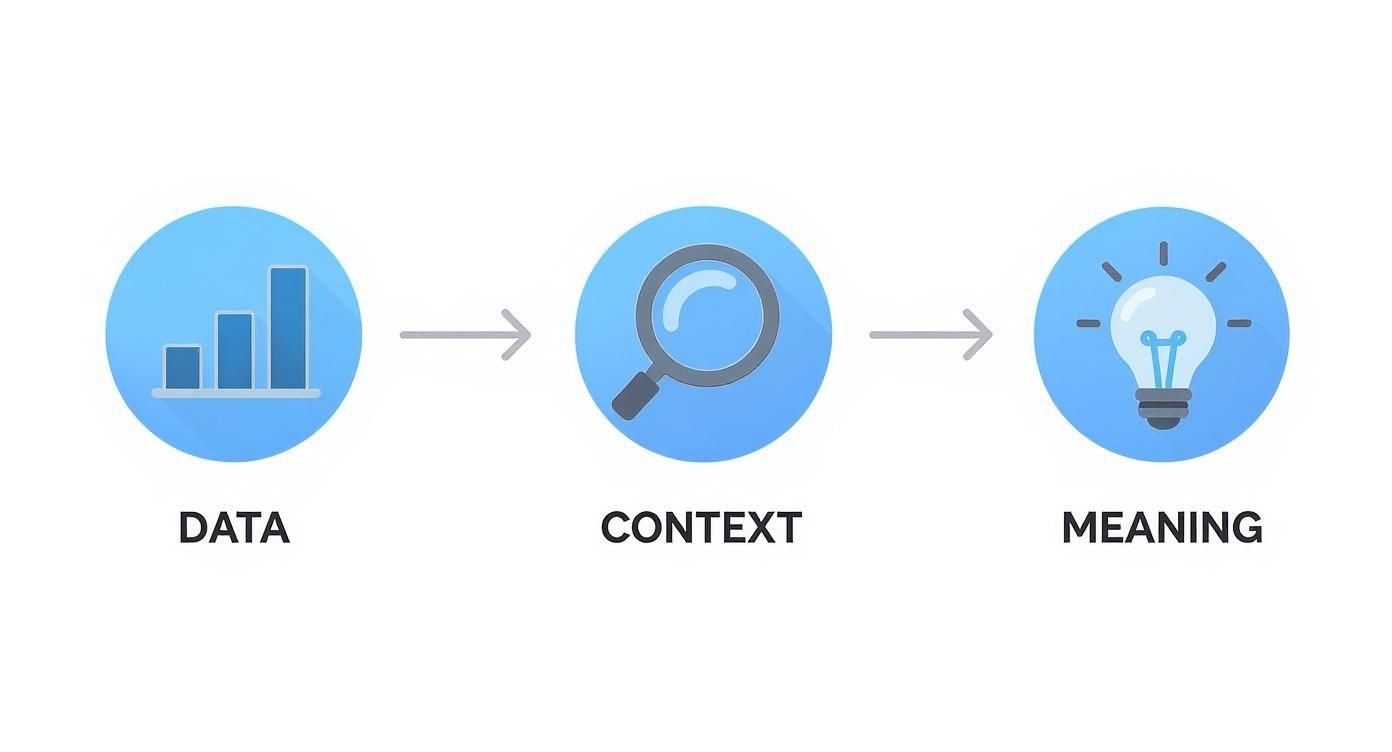
This process really drives home that raw data is just the beginning. Context is the crucial filter that reveals the actual meaning behind the numbers.
Gathering Contextual Signals
With your question defined, it's time to gather the signals that might hold the answer. This is where you have to look beyond your internal analytics dashboards. To really dig into the 'why' behind user behavior, exploring essential user research methods can give you some invaluable techniques for this phase.
Your goal is to collect information from multiple layers of the business environment—social, economic, competitive, and internal—to build a 360-degree view of the situation.
Here are some of the key signals you should be gathering:
- Internal Business Actions: Did you recently launch a marketing campaign, change product pricing, or update your website? Internal changes are often the simplest, most direct explanation for what you're seeing.
- Competitor Movements: Check if a key competitor launched a new product, started an aggressive ad campaign, or ran into a major PR crisis. Tools like TrackMyBiz can even show you if they're suddenly getting recommended more often by AI assistants.
- Market and Industry News: Are there new regulations, supply chain issues, or economic reports that could be influencing customer behavior across the board?
- Social and Cultural Trends: Look at social media chatter, news headlines, and what's going viral. A seemingly unrelated cultural moment can have a surprising ripple effect on your brand.
By weaving all these different threads together, you start to transform isolated data points into a coherent story you can actually act on.
Contextual Analysis vs Other Analytical Methods
In the world of data, it’s easy to get lost in a sea of buzzwords. Terms like sentiment analysis, content analysis, and contextual analysis get thrown around interchangeably, but they are absolutely not the same thing.
Confusing them isn't just a matter of semantics—it can lead to shallow insights and completely missed opportunities. Understanding the difference is the first step to asking the right questions of your data.
Think of it this way: sentiment analysis is a quick emotional temperature check. It tells you if a customer review is positive or negative, but it completely misses the why.
For example, a tweet simply stating, "Your new update is a joke," would be correctly flagged as negative by sentiment analysis. That's true, but on its own, it's not very helpful.
Going Deeper Than Emotion and Keywords
Content analysis takes you one step further. It digs into the text to categorize topics, identifying keywords like "update," "bug," or "slow performance." This is more useful because it points you toward the problem area.
Still, it lacks the bigger picture. This is where contextual analysis truly shines. It doesn’t just look at the what; it synthesizes the sentiment and the content with all the surrounding circumstances to build a complete narrative.
A contextual approach doesn't just see a negative tweet. It connects that tweet to the fact that you pushed a major software update two hours ago, while a key competitor simultaneously launched a promo targeting your users.
Suddenly, that single negative comment transforms from an isolated complaint into an urgent, actionable insight about a flawed product rollout and an immediate competitive threat. You can discover more about how to monitor these competitive threats by exploring modern competitor AI analysis tools that reveal what AI models are saying about your rivals.
Choosing the Right Analytical Tool for the Job
To make these distinctions crystal clear, it helps to see them side-by-side. Each method is valuable, but only when you apply it to the right problem. Think of them as different tools in your analytical toolbox, each designed for a specific job.
| Method | Primary Goal | Example Application |
|---|---|---|
| Sentiment Analysis | To measure the emotional tone (positive, negative, neutral) of text. | Quickly gauging public reaction to a new product announcement on social media. |
| Content Analysis | To identify and quantify the presence of specific words, themes, or concepts within data. | Tracking the most frequently mentioned product features in customer support tickets to find common pain points. |
| Contextual Analysis | To understand the "why" behind data by examining its surrounding environment and circumstances. | Determining if a drop in sales was caused by a new marketing campaign, a competitor's actions, or a broader economic downturn. |
Ultimately, while sentiment and content analysis provide valuable snapshots, they only tell part of the story. Contextual analysis is what delivers the full picture. It’s the method that connects the dots between what is happening and why it's happening, turning raw data into real strategic intelligence.
Real-World Applications That Drive Business Growth
Theory is one thing, but the true power of contextual analysis comes to life when you apply it to real, high-stakes business problems. This is where data stops being a passive report and starts actively shaping your strategy. It helps companies navigate complex situations and spot opportunities that everyone else misses. The applications are as diverse as they are powerful, from managing brand reputation to sniffing out fraud.
Imagine a sudden flood of negative brand mentions on social media. A basic sentiment report would just confirm that people are angry, sending your marketing team into a panic. But a contextual approach looks at the bigger picture. By analyzing the surrounding conversations, you might find out the anger isn’t even directed at you—it’s aimed at a controversial industry practice you’ve been wrongly lumped in with.
That single insight changes everything. Instead of issuing a defensive apology for something you didn’t do, you can proactively clarify your position. You turn a potential PR nightmare into a chance to show leadership and earn trust.
Enhancing Brand Reputation and Competitive Intelligence
In today's market, knowing what people say about your brand is table stakes. Knowing why they say it is what gives you a real competitive edge. Contextual analysis helps you move beyond simply counting mentions to understanding the subtle nuances of public opinion and what your competitors are up to.
- Understanding AI-Driven Narratives: What happens when an AI chatbot like ChatGPT starts recommending a competitor over you? Traditional analytics won't even see it. Contextual analysis can uncover why it's happening. Maybe the AI is pulling from a recent news article that painted your competitor as the industry leader. You can learn more about tackling these new challenges in our guide to ChatGPT brand monitoring for ecommerce.
- Decoding Campaign Performance: Let's say a marketing campaign sees a sudden spike in engagement. That's great, but why? Contextual analysis might reveal it happened at the exact same time a competitor's website went down, or when a related trend went viral on social media. This gives you a much more honest assessment of your campaign's true impact.
By connecting brand mentions to broader market events, competitor movements, and cultural conversations, you can build a more resilient and proactive reputation management strategy. This is the difference between reacting to problems and getting ahead of them.
Uncovering Sophisticated Fraud and Risk
Contextual analysis isn't just for marketers. It's a critical tool for risk management, especially in the financial world. Old-school fraud detection systems often look for big, unusual transactions, but they can easily miss sneakier, more sophisticated schemes.
Contextual data analysis adds another layer by looking at the situation around the data. For example, a bank can spot potential money laundering by analyzing a pattern of transactions that are always just below the $10,000 regulatory reporting threshold. When you combine that with a client's history of other suspicious activity, the picture becomes clear. This approach weaves together multiple threads of context—transaction amount, timing, and customer history—to reveal patterns that would otherwise fly completely under the radar. You can see more examples of how software helps with this by checking out insights on contextual data analysis from DataWalk.
From protecting your brand to preventing financial crime, these real-world examples prove that contextual analysis is far more than an academic concept. It's an essential business practice for making smarter, more informed decisions that actually move the needle.
Putting Contextual Analysis to Work in Your Business

Knowing the theory is one thing. Actually making contextual analysis a regular habit in your business is what really moves the needle. This isn't about piling more tasks onto your team's already-full plate. It’s about making a fundamental shift—from just asking "what happened?" to instinctively asking "why did this happen and what else was going on at the time?"
That shift starts with a simple, repeatable framework anyone can follow. By turning natural curiosity into a structured process, you can start turning raw data into a reliable guide for your next big decision, no matter the size of your team.
A Repeatable Framework for Action
You don't need a massive operational overhaul to start. Implementing contextual analysis begins with a clear, step-by-step process that helps you connect the dots between an event and its root cause.
Here’s a five-step framework you can start using today:
- Frame Your Core Question: Get specific. Instead of a vague goal like "analyze sales," ask a pointed question. For example, "Why did engagement for our spring campaign suddenly drop by 25% last week?"
- Identify Your Data Sources: Map out everywhere you can look for answers. This will include your internal data—analytics dashboards, CRM notes, sales reports—and the external signals like social media trends, competitor announcements, or major industry news.
- Gather the Crucial Context: Now it's time to play detective. Collect all the contextual clues surrounding the event you're investigating. Did a competitor launch a huge sale? Was there a major news story that completely captured everyone's attention?
- Synthesize and Connect the Dots: Lay out your primary data point next to all the contextual information you've gathered. Look for patterns, correlations, and potential causal links. The goal here is to build a coherent story that explains the "why."
- Turn Insight into Informed Action: With a clear story in hand, you can now make a decision based on evidence, not just a gut feeling. That might mean tweaking your campaign, responding to a competitor's move, or simply noting an external factor to plan around next time.
The most powerful tool in your stack is curiosity. Before you dive headfirst into the numbers, just pause and ask what else was going on when that data point was captured. This simple habit is the foundation of effective contextual analysis.
Finding the Right Tools for the Job
While a curious mindset is your most important asset, the right tools can seriously speed up the process of gathering and making sense of all that context. Instead of spending hours manually scouring the web, you can use specialized platforms to bring the most important information straight to you.
- Social Listening Platforms: Tools like Brandwatch or Sprout Social are great for keeping an eye on social media chatter, public sentiment, and trends as they emerge.
- Business Intelligence (BI) Dashboards: Platforms such as Tableau or Sigma Computing let you visualize your own data and, crucially, annotate charts with key events like product launches or marketing campaigns to see the impact.
- AI Monitoring and Reputation Management: As AI-driven search and chat become more common, what chatbots say about your brand is critical context. For this new frontier, you can rely on the expertise of AI reputation management consultants to monitor and help correct the narratives being shaped by large language models.
By combining a structured framework with the right technology, your team can build a sustainable practice of contextual analysis. It’s how you ensure every major decision is grounded in a complete, accurate understanding of your business environment.
Common Mistakes That Can Skew Your Results
Even the sharpest analytical tools are only as good as the person using them. It's surprisingly easy to let subtle biases creep in and completely derail your findings. One of the most common traps is confirmation bias—our natural tendency to look for evidence that proves what we already believe and ignore anything that contradicts it.
For instance, say you're convinced a recent marketing campaign was a home run. You might latch onto all the positive social media comments while conveniently overlooking the fact that your biggest competitor’s website crashed for two days, likely sending a flood of their frustrated customers your way. This creates a dangerously skewed view of your campaign's actual impact.
Another classic pitfall is mixing up correlation and causation. Just because two things happen around the same time doesn't mean one caused the other. It's a simple idea, but it trips people up constantly.
You notice a dip in product usage right after a minor website update. It's easy to blame the update, right? But what if you dug a little deeper and realized it was the first week of a major national holiday? Without that broader context, you could waste a ton of resources "fixing" a problem that never really existed.
Avoiding Common Analytical Pitfalls
Getting reliable insights means building a more rigorous process. Here are a few ways to keep your analysis grounded in reality and avoid these common mistakes:
-
Assemble a Diverse Team: Don't analyze in a silo. Bring people from different parts of the business into the room. A sales lead, a product manager, and a marketer will all look at the same data through completely different lenses, helping to challenge assumptions and expose blind spots.
-
Widen Your Lens: Go out of your way to find evidence that disproves your theory. Ask yourself, "What else could explain this?" This simple question forces you to consider competitor moves, market trends, or other external factors you might have missed.
-
Document Your Assumptions: Before you even look at the data, write down what you think is happening and why. This makes you accountable to your own biases. It becomes much easier to spot when you're subconsciously cherry-picking data to fit the story you wanted to tell all along.
Frequently Asked Questions About Contextual Analysis
To help round out your understanding, here are a few of the most common questions we hear from teams just starting to explore what contextual analysis is and how to apply it.
How Is This Different from Standard Market Research?
This is a great question. Traditional market research is fantastic at capturing what people think, usually through direct feedback like surveys or focus groups. It gives you a clear snapshot of customer opinions and preferences.
Contextual analysis, on the other hand, digs into the why. It looks at all the surrounding forces—a competitor's surprise sale, a sudden economic shift, or a viral cultural moment—to understand the narrative behind those opinions. If market research is the photo, contextual analysis is the story that explains it.
Can AI Fully Automate Contextual Analysis?
Not entirely. AI is an absolute powerhouse for the heavy lifting. It can monitor social media trends, track competitor news, and process mountains of contextual data at a scale no human team could ever dream of matching. It’s brilliant at spotting correlations and flagging things that look out of the ordinary.
However, real insight still needs a human touch. The final layer of interpretation and strategic thinking is where the magic happens. An AI can tell you a competitor’s sales jumped 20%, but it takes an analyst to connect that spike to a new feature they launched and decide how your own roadmap should respond. The best approach is always a blend of AI's scale and human expertise.
What's the Best First Step for a Small Budget?
You don't need a suite of expensive tools to get started. The single best first step is to simply build a habit of curiosity within your team. During your regular performance reviews, make it a rule to always ask, "What else was going on at the time?"
Start with a simple "context log"—a shared document or checklist where you note key events:
- Internal: Product updates, new marketing campaigns, pricing changes.
- External: Major news, competitor launches, holidays, industry reports.
When you're looking at a spike or dip in your data, just pull up this log and see what lines up. This simple, free habit is the bedrock of a powerful contextual analysis practice.
Ready to see what AI is saying about your brand? TrackMyBiz gives you the complete picture, monitoring chatbots like ChatGPT to uncover hidden risks and opportunities. See your free AI brand report at https://trackmybusiness.ai.
