Context analysis isn't about staring at data points in a vacuum. It’s about understanding the entire conversation surrounding those data points.
Think of it this way: hearing a single, isolated word tells you nothing. But hearing that same word inside a complete sentence gives you meaning, tone, and intent. Context analysis does the same for your brand, moving beyond simple keyword counts to reveal the how and why behind every single mention.
Why Context Analysis Is Non-Negotiable for Brands
Imagine you get a report showing an AI assistant mentioned your brand 100 times last month. Should you celebrate? Or panic?
Without context, that number is useless—it's just a data point without a story. Traditional analytics can't tell you if those mentions were good or bad. Context analysis is the framework that provides the crucial narrative, turning raw, meaningless data into intelligence you can actually use.
It’s all about asking the right questions to see the full picture:
- What was the user’s original prompt? Were they looking for "the best…" or asking "how to fix…" something?
- What was the tone of the mention? Was your brand enthusiastically recommended, or were you used as an example of what not to buy?
- Was the information accurate? Did the AI share the right pricing, hours, or product features? Or is it spreading misinformation?
- Who were you mentioned with? Did you show up next to respected industry leaders or low-quality competitors?
From Keywords to Conversations
For years, SEO was a game of keywords and rankings. While those things still matter, that approach is dangerously incomplete in a world driven by AI. The whole game has shifted from a list of links to a direct conversation, and brands are now part of complex, AI-generated dialogues they don’t directly control.
This isn't some far-off future—it's happening right now. Recent data shows that traffic from large language models shot up by a staggering 527% year-over-year between early 2024 and 2025. We're talking about a jump from just 17,000 sessions to around 107,000, with some websites now getting over 1% of their total traffic from AI platforms.
By ignoring the context of AI mentions, brands are essentially flying blind. You might see a spike in mentions and assume it’s a win, only to find out the AI is butchering your service description or actively recommending a competitor over you.
The metrics we used to rely on just don't cut it anymore. The focus has to shift from old-school SEO KPIs to the new realities of AI-driven discovery.
Traditional SEO vs. AI Context Analysis
| Metric/Focus | Traditional SEO | AI Context Analysis |
|---|---|---|
| Primary Goal | Rank on a results page | Become the definitive, recommended answer |
| Key Metric | Keyword ranking position | Accuracy and sentiment of the mention |
| Unit of Measurement | Backlinks, domain authority | Share of Voice within AI conversations |
| User Interaction | User clicks a link to find info | User gets a direct, synthesized answer |
| Competitor Insight | Who ranks above/below you | Who is recommended alongside you |
| Reputation Signal | Star ratings, reviews on pages | Tone and context of the AI's language |
This table really drives home the point: winning in the age of AI requires a completely different playbook.
Understanding the Bigger Picture
So, what is context analysis at its core? It's the strategic practice of interpreting not just that your brand was mentioned, but how, why, and with what impact.
For brands, this means finally moving from a reactive stance of counting mentions to a proactive strategy of shaping the narrative. When you understand the full context, you can protect your reputation, correct damaging inaccuracies, and uncover new opportunities for growth. For a deeper dive, it's worth exploring how specialized agencies manage LLM visibility tracking for brands.
The Four Pillars of Context Analysis
To really get what an AI is saying about your brand, you need a framework. Context analysis isn't a single action; it’s a combination of different investigative layers. Think of it like a detective examining a crime scene—you can't just look at one piece of evidence. You need to see it from multiple angles to get the full story.
These four pillars give you a structured way to uncover the truth behind any AI-generated mention of your brand.
This concept map breaks down how the core components of context analysis fit together, connecting the central idea of analysis to sentiment, accuracy, and the competitive landscape.
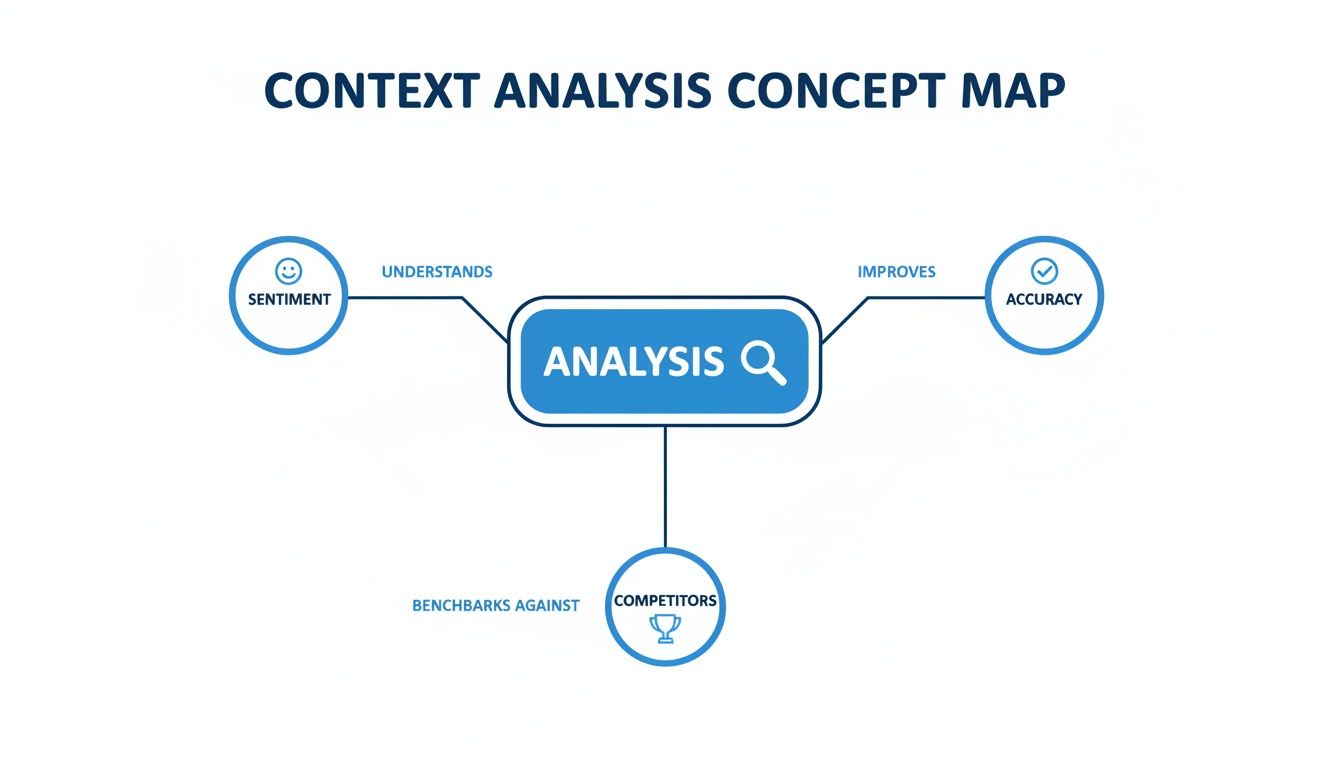
As the visual shows, a complete analysis means looking at all of these interconnected elements. Only then do you get a clear picture.
Source and Prompt Analysis
The first pillar answers two basic but critical questions: "Which AI said it?" and "What did the user ask?" Different models—like ChatGPT, Gemini, or Perplexity—are trained on different data, so they often give different answers. Knowing the source AI model helps you figure out where potential problems are coming from.
Even more important is understanding the user’s prompt. Someone asking for "cheap alternatives to [Your Brand]" has a totally different intent than someone asking for "the best [Your Product Category] for enterprises." The first is a price-sensitive shopper, while the second is a high-value lead. Analyzing prompts reveals the intent that put your brand into the AI conversation in the first place.
Sentiment and Tone Analysis
Once you know the where and the why, the next step is to figure out the how. Sentiment and tone analysis goes beyond a simple positive, negative, or neutral rating. It’s about catching the subtle, often more telling, nuances in the AI’s language.
For example, an AI might list your product but describe it as "a more basic choice" or note that it "lacks advanced features." While that's technically a neutral mention, the tone immediately positions you as a lower-tier option. This pillar is essential for understanding how your brand is truly being perceived.
Accuracy Auditing
This is where context analysis becomes your brand's first line of defense. Accuracy auditing is all about fact-checking what the AI says against what you know is true. Are your business hours, pricing, and features listed correctly? Or is it spitting out damaging falsehoods, also known as hallucinations?
An AI might confidently tell a user your store is "permanently closed" or invent a product recall that never happened. Without an accuracy audit, this kind of misinformation can spread like wildfire, hitting your revenue and customer trust hard. This pillar isn't optional; it's non-negotiable risk management.
Competitive Landscape Mapping
Finally, no brand operates in a bubble. This last pillar focuses on who you are mentioned alongside. When a user asks for recommendations in your category, does the AI put you next to top-tier competitors or with irrelevant, low-quality options?
Mapping your competitive landscape inside AI-generated text shows you your perceived market position. Being consistently named next to industry leaders reinforces your authority. On the flip side, showing up with budget brands can seriously dilute a premium brand image. This gives you priceless strategic insight into how AIs—and by extension, your customers—are categorizing you in the market.
How Context Analysis Uncovers Real-World Risks
Alright, let's move from theory to the real world, because this is where context analysis truly shows its power. This isn't just some abstract concept for a slide deck; it's a practical, proactive strategy for protecting revenue, managing your brand's reputation, and getting a leg up on the competition.
We'll walk through three scenarios that show exactly how understanding the full picture can make all the difference for any business, whether you're a local shop or a global enterprise.

Scenario 1: Preventing Lost Revenue from AI Hallucinations
Imagine you're a popular local retailer. You notice a slight but persistent dip in weekend foot traffic, but your usual analytics aren't telling you why. It's a mystery.
By turning to context analysis, the team starts monitoring what AI assistants are telling people about their stores. They quickly discover a devastating AI hallucination: a widely used chatbot was confidently telling users their flagship location was "permanently closed."
Without context analysis, this silent revenue leak could have dragged on for months, costing thousands in lost sales. By catching the error, they were able to take action, stop the bleeding, and protect their bottom line.
This isn't a rare fluke. AI brand monitoring has pulled back the curtain on a stark reality: most brands are practically invisible in the new AI ecosystem. Our research shows only 30% of brands maintain consistent visibility across back-to-back AI answers. Even when brands do show up, only about 28% of those answers include both a mention and a citation.
Scenario 2: Overhauling Strategy Based on Competitive Insights
Here’s another one. A B2B software company was frustrated. They were ranking well for high-intent keywords in traditional search, but the organic leads just weren't converting. Something was missing.
Their team decided to use context analysis, specifically monitoring AI responses to prompts like, "best project management tools for small teams."
The results were a wake-up call. The analysis revealed that AI models consistently recommended a key competitor, and not just by name. The AI was citing specific case studies and integration features the company lacked, essentially building a persuasive narrative that positioned their rival as the obvious choice.
This single insight sparked a complete content strategy overhaul. The team got to work developing new case studies and tutorials that directly addressed the gaps the AI had flagged, eventually shifting the AI's recommendations back in their favor. To effectively uncover real-world risks, applying context analysis often involves specialized tools; for example, using forensic video analysis software can be crucial for verifying video evidence in certain situations.
Scenario 3: Getting Ahead of a Reputation Crisis
A consumer packaged goods (CPG) brand was gearing up for a major product launch. Their PR team, being savvy, decided to use context analysis as part of their pre-launch prep. They monitored how AI assistants were summarizing existing product reviews and news coverage.
They found something alarming. One AI model was completely misinterpreting customer feedback about a previous product.
The AI was generating summaries that suggested a "widespread safety concern" when, in reality, the original feedback was about a few isolated cases of minor packaging defects. This negative spin threatened to completely overshadow their big launch.
Armed with this information, the PR team went on the offensive. They developed proactive messaging to clarify the packaging issue and seeded new content highlighting their commitment to quality. When the new product launched, they were ready to counter any misleading AI summaries, successfully shielding the brand from a crisis that would have otherwise caught them completely flat-footed.
Measuring Your Brand's Performance in AI
There's an old saying: "If you can't measure it, you can't improve it." In the new world of AI-driven discovery, relying on old-school metrics like simple mention counts is like trying to navigate a new city with a folded-up paper map from a decade ago. It just doesn't work.
To really understand what's happening, you need a modern set of Key Performance Indicators (KPIs) designed specifically for this new reality. These aren't vanity numbers; they give you a clear, actionable view of your brand’s health and visibility inside AI conversations.
The New KPIs for the AI Era
This isn't just a theoretical exercise. AI is reshaping how people perceive brands on a massive scale. Consider that ChatGPT adoption rates in lower-income countries are four times higher than in high-income nations. At the same time, 71% of consumers say they want generative AI in their shopping experiences, and 24% are already using it for exactly that. The stakes are incredibly high.
To win, you have to track the right data. Here are the essential KPIs that matter now:
- BrandRank: Think of this as your overall score. It combines your visibility and sentiment to give you a single, holistic view of your brand's standing in AI-generated answers.
- Share of Voice (SoV): This measures how often your brand is mentioned compared to your top competitors for specific, high-value prompts—like "what's the best software for X?"
- Sentiment Accuracy Rate: What percentage of your brand mentions correctly reflect the intended tone? This tracks whether the AI understands if a source is positive, negative, or neutral.
- Hallucination Rate: This is a critical one. It measures how often AI assistants share factually incorrect information about your brand, like the wrong business hours, product features, or pricing.
Measuring these KPIs is the first step toward building a resilient AI presence. A high Hallucination Rate, for instance, is a direct threat to revenue and requires immediate action, while a low Share of Voice on key prompts signals a major competitive blind spot.
Of course, tracking this accurately requires your analysis models to work efficiently. Understanding and mastering AI input output throughput is key to ensuring your systems can process information quickly and accurately enough to measure these critical metrics in near real-time.
To help you get started, we've organized these new metrics into a simple table.
Essential AI Context Analysis KPIs
These are the new performance indicators every brand needs to start tracking to measure their visibility and reputation in AI assistants.
| Metric | Definition | Why It Matters |
|---|---|---|
| BrandRank | A composite score measuring your brand's overall visibility and sentiment within AI-generated content. | Provides a single, at-a-glance health score for your AI presence. |
| Share of Voice (SoV) | The percentage of mentions your brand receives for key prompts compared to your top competitors. | Shows if you are winning the recommendation battle for high-intent customer queries. |
| Sentiment Accuracy | The rate at which the AI correctly interprets the positive, negative, or neutral tone of your brand mentions. | Ensures your brand's reputation is being portrayed accurately. |
| Hallucination Rate | The frequency of factually incorrect information generated about your brand, products, or services. | Directly measures the risk of brand damage and customer misinformation. |
Tracking these metrics is the only way to move from guessing to knowing. They provide the hard data you need to build a business case for AI optimization and prove its value.
Translating Metrics into Action
These KPIs tell a clear story about your performance. A strong BrandRank score shows that AI models see you as a trusted and visible entity. A high Share of Voice for "best of" queries confirms you're winning crucial recommendation battles where it matters most.
You can get an even sharper picture by using dedicated competitor AI analysis tools to benchmark your performance against others in your space.
Ultimately, these metrics allow you to report on the true impact of your AI optimization efforts. You can finally turn abstract conversations happening inside AI models into a measurable and repeatable channel for growth and reputation management.
Common Mistakes That Will Sabotage Your Context Analysis
Jumping into a new strategy always comes with a learning curve, and context analysis is no different. While the upside is huge, a few common pitfalls can easily derail your efforts, leaving you with skewed data and wasted time. Let's make sure you sidestep them from the start.
Mistake 1: Spot-Checking Instead of Continuous Monitoring
Dipping in once a month to see what an AI is saying about you is like checking the weather forecast for a single minute and thinking you know the climate. It gives you a dangerously narrow snapshot in time. AI models are constantly being updated, which means a positive mention today could be replaced by a damaging hallucination tomorrow without you ever knowing.
A single snapshot of where your brand appears in AI responses is an unreliable indicator of actual performance. True context is built over time by observing patterns, not by reacting to isolated incidents.
Real, effective context analysis has to be a consistent, automated process. This is the only way to catch issues as they pop up and spot the trends that a one-off check will always miss.
Mistake 2: Focusing Only on Your Brand Name
This is another major blind spot. Limiting your analysis to just your official brand name is like only listening for your first name in a crowded room—you’re going to miss almost the entire conversation.
Customers and AI models don't just use your brand name. They talk about your specific products, your key executives, individual store locations, and even the industry jargon connected to your services. To get the full picture, your monitoring has to be way more comprehensive.
- Product Mentions: You need to track every product name, including the common abbreviations or even the misspellings people use.
- Leadership Tracking: Don't forget to monitor mentions of your CEO, CTO, and other public-facing leaders whose personal reputations are tied directly to the brand.
- Location-Specific Queries: If you're a multi-location business, it's absolutely vital to analyze what AI is saying about each individual store or branch.
By widening your scope like this, you uncover a much richer, more actionable dataset. You’ll see if an AI is recommending a competitor's product over yours or spreading bad info about a specific branch—insights that are pure gold.
Mistake 3: Ignoring Regional and Cultural Nuances
A massive error brands make is assuming an AI's response is the same for everyone, everywhere. It’s not. An answer generated for a user in the United States can be wildly different from one for a user in Japan or Germany, even if they type in the exact same prompt. AI models are designed to tailor their output based on the user’s location and language.
This means that glowing recommendation you see in one market could be a neutral mention—or even a negative one—somewhere else. If you ignore these regional differences, you'll end up with a completely skewed view of your global brand perception.
A proper what is context analysis strategy must include segmented monitoring across all your key markets. This is the only way to capture these critical differences and ensure your decisions are based on how your brand is actually seen by diverse audiences around the world.
How to Build Your Context Analysis Strategy
Theory is great, but turning those insights into action is where the magic happens. A solid strategy takes context analysis from a reactive fire drill to a proactive program that protects and grows your brand. This roadmap will walk you through building or auditing your own program, step by step.

Step 1: Define Your Core Brand Assets
Before you can track what an AI is saying, you have to know what it should be saying. This means taking inventory of every critical piece of information that defines your brand. Don't just stop at your company name; you need a comprehensive list.
- Key Facts: Get granular. List your official business hours, every single address for all locations, and the correct pricing for your main products or services.
- Products and Services: Write down every single offering, using its official name and any common variations people might use.
- Key Personnel: Include the names and titles of public-facing executives, like your CEO or CTO.
This list becomes your source of truth—the definitive baseline you’ll measure AI accuracy against.
Step 2: Identify High-Priority Prompts
Not all AI conversations are created equal. Trying to monitor every possible user query is a recipe for getting overwhelmed. Instead, focus on the prompts that directly impact your bottom line.
Think about the high-intent questions where you absolutely have to win the recommendation. For example:
- "best [your product category] for small businesses"
- "alternatives to [your top competitor]"
- "[your brand] vs [competitor]"
Prioritizing prompts like these means you’re putting your energy where it matters most for winning customers and staying ahead of the competition.
Step 3: Establish a Performance Baseline
Now that you know what to check and where to look, it’s time to see where you stand today. Run an initial audit to measure your performance against the key metrics we talked about earlier, like BrandRank and Hallucination Rate.
This baseline is your starting point. It shows you your current strengths, weaknesses, and most urgent threats—like an AI telling users a key location is "permanently closed." Without this initial measurement, you have no way to know if your efforts are actually working.
Step 4: Set Up Automated Monitoring
Manually checking AI responses every so often is unreliable and impossible to scale. You need a system for automated, continuous monitoring to keep a constant pulse on new mentions and any changes in AI answers.
Your system should track your priority prompts across multiple AI models and in different geographic regions. Set up alerts that notify your team the moment a critical issue pops up, like a sudden spike in negative sentiment or a new hallucination about your brand. This proactive approach lets you jump on problems before they do real damage. For complex brand issues, you might want to see how AI reputation management consultants can help build a robust system.
Step 5: Create a Response Protocol
Finally, you need a clear game plan for what to do when your monitoring system flags an issue. A well-defined response protocol empowers your team to act fast and effectively.
Assign ownership for different problems. A factual error about business hours might go straight to the marketing team, while a rising trend in negative sentiment could be routed to PR. This final step closes the loop, turning your analysis into decisive, brand-saving action.
Questions on Putting Context Analysis into Practice
To help you get a handle on how this strategy works in the real world, here are a few answers to the questions we hear most often from brands diving into AI monitoring.
How Often Should I Be Doing This?
Think of context analysis as an ongoing discipline, not a one-time project. AI models are constantly being updated, and the questions people ask them shift with every new trend. A single spot-check is just a snapshot that can be outdated in a week.
The best approach is to use an automated monitoring tool to keep a real-time or daily pulse on your mentions. This gives you immediate alerts when something critical happens, like an AI hallucinating a negative story about your brand. Then, complement that daily pulse with deeper, manual audits every quarter to spot the bigger strategic trends and competitive shifts that take more time to surface.
Can This Actually Help With Product Development?
Absolutely. Analyzing the context of how AI assistants talk about your products—and your competitors'—is like having a direct line to your product roadmap.
For instance, you might find that AI tools consistently bring up a specific feature as your key selling point when making a recommendation. On the flip side, you might discover they repeatedly highlight a common customer frustration or a feature gap when putting you head-to-head with a rival. This is incredibly direct, synthesized feedback from the AI ecosystem that can help you build what your market is actually asking for.
What’s the Difference Between Sentiment and Context Analysis?
This is a really important distinction. Sentiment analysis is just one small piece of the much bigger, more valuable puzzle of context analysis.
Sentiment analysis simply tells you if a mention is positive, negative, or neutral. It’s a basic emotional temperature check.
Context analysis goes much deeper to give you the whole story. It also looks at the factual accuracy of the information, the user's original prompt, and the competitive landscape (who else showed up in the answer?). While sentiment tells you the tone, context tells you the truth and the ultimate business impact of a mention.
Ready to see what AI is saying about your brand? TrackMyBiz offers a free scan to show you exactly how you appear in AI-generated answers. Stop guessing and start managing your AI reputation with real data. Get your free report.
